
A patient writes their address on a clipboard.
A front desk staffer types it into the EHR.
A nurse retypes it into a chart note.
A billing coordinator keys it in again for insurance.
Four people, one piece of data, four different times.
Manual rework isn’t obvious at first. It hides inside routine tasks, disguised as “just part of the job.”
But behind the scenes, it’s draining hours from every shift, introducing mistakes, and driving staff toward burnout.
In a world where surgeries can be assisted by robots and AI can read scans in seconds, the fact that healthcare teams are still re-entering the same patient information again and again isn’t just inefficient.
It’s absurd.
What Is Manual Rework in Healthcare Admin and Why Is It Everywhere?
Manual rework is the silent time thief in healthcare admin.
It shows up in the background of nearly every workflow: retyping data between systems, duplicating forms, and double-checking records that should have been right the first time.
It’s invisible until you measure it, and then the cost is staggering.
A Silent Time Thief
At the front desk, in billing, and in clinical documentation, rework shows up as repeated entry of the same data.
It’s not just extra clicks. It’s wasted hours that could have been spent supporting patients.
A recent Health Affairs report highlighted how administrative duplication is one of the most expensive hidden costs in healthcare, consuming billions in labor every year.
For individual clinics, it often means staff leaving late and patients waiting longer.
The Hidden Cost of Redundancy
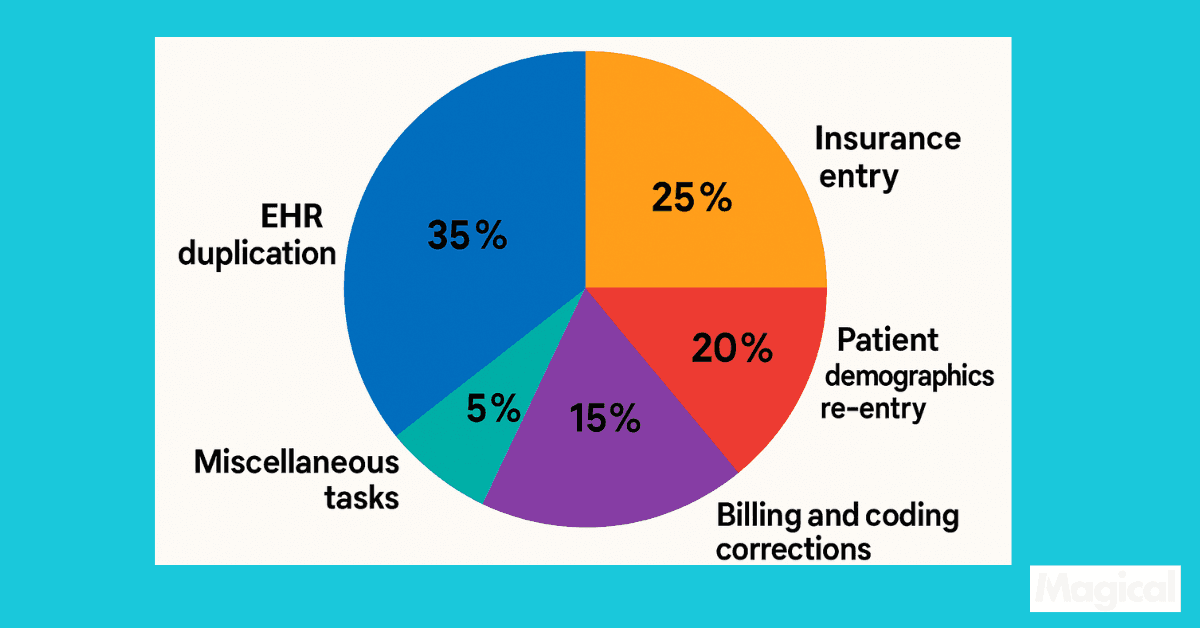
Rework doesn’t just burn time. It multiplies errors.
Every extra keystroke is another chance for a typo, a missed digit, or an outdated record to be carried forward. That’s why redundant data entry is a leading cause of claim denials and compliance issues.
A 2024 NIH study found that redundant documentation directly increases error rates in clinical records. When accuracy is compromised, revenue cycle performance suffers, and patient safety can too.
Rework Isn’t a People Problem. It’s a Workflow Problem
Healthcare staff don’t create rework by choice. It’s a byproduct of the tools they’re given and the way those tools fit (or don’t fit) together.
Most duplication isn’t about human error. It’s about workflows designed without true interoperability in mind.
Copying and Pasting ≠ Documentation
Copy-paste was supposed to be a shortcut. In reality, it’s become a trap. Teams spend hours lifting the same information from one field to another, hoping it will save time.
Instead, it creates cluttered records, higher error rates, and more review cycles.
That was the challenge at ZoomCare. Staff were retyping the same patient details into multiple systems every day.
The process worked, but only by consuming 20+ hours a week in avoidable rework.
Rework as a Symptom of Tool Mismatch
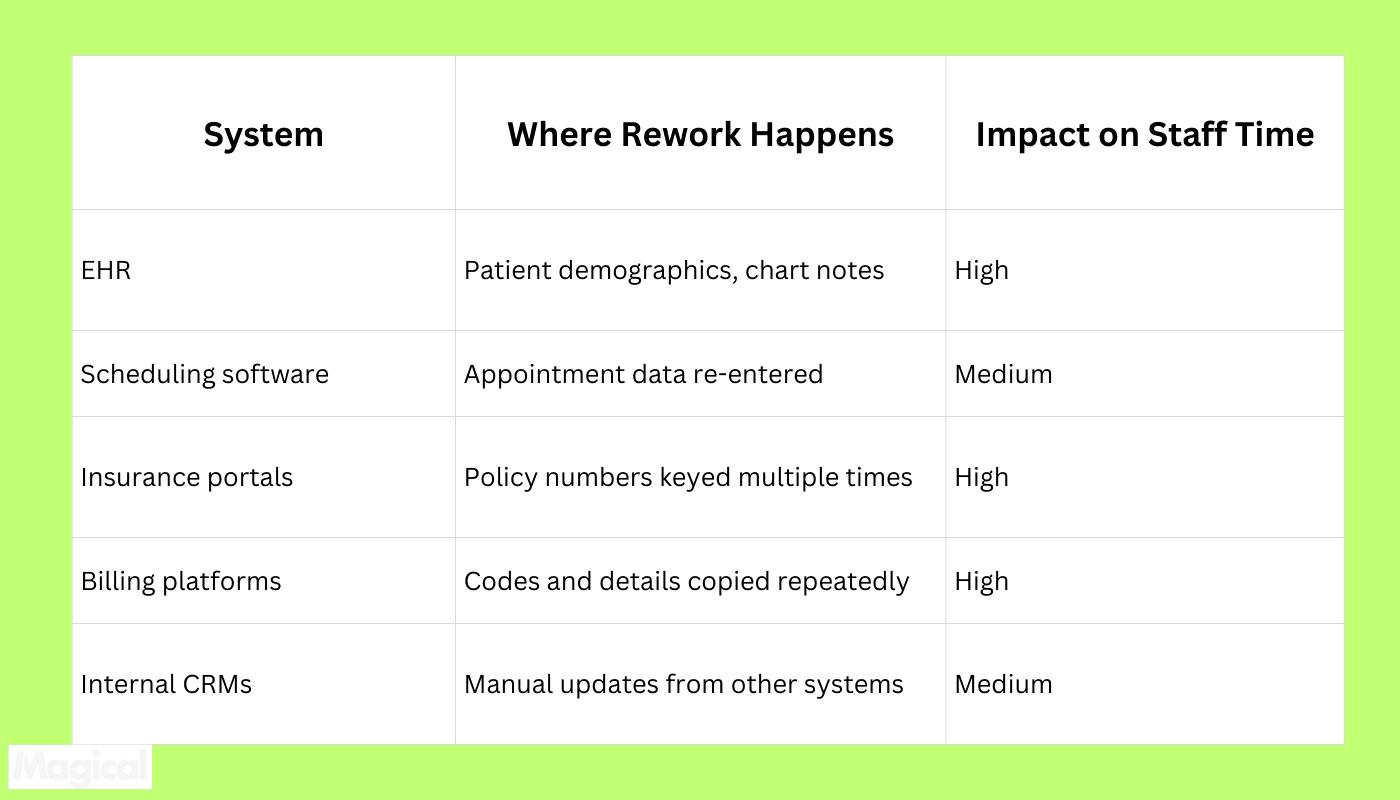
EHRs, scheduling software, billing platforms, and insurance portals rarely “talk” to each other. Staff are left to bridge the gap manually. This tool mismatch forces human hands to do what systems should handle automatically.
The result: every handoff creates another layer of duplication. Rework isn’t a staffing issue. It’s a system design issue.
What Happens When You Eliminate Rework with Automation
When rework disappears, the ripple effect is immediate. Hours once lost to typing and retyping are suddenly available for higher-value work.
Errors shrink, claim approvals speed up, and patients experience smoother care from the first interaction.
Reclaiming Hours Without Rewriting Anything
Automation doesn’t ask teams to change their entire tech stack. It simply removes the friction of duplicate entry.
Patient details flow once, then populate wherever they’re needed.
That’s what happened at WebPT. By automating form entry and reducing redundancies across thousands of clinics, they saved more than 500 hours of staff time.
Teams didn’t need to rebuild processes.
They just needed the rework to stop.
Less Human Error, More Human Time
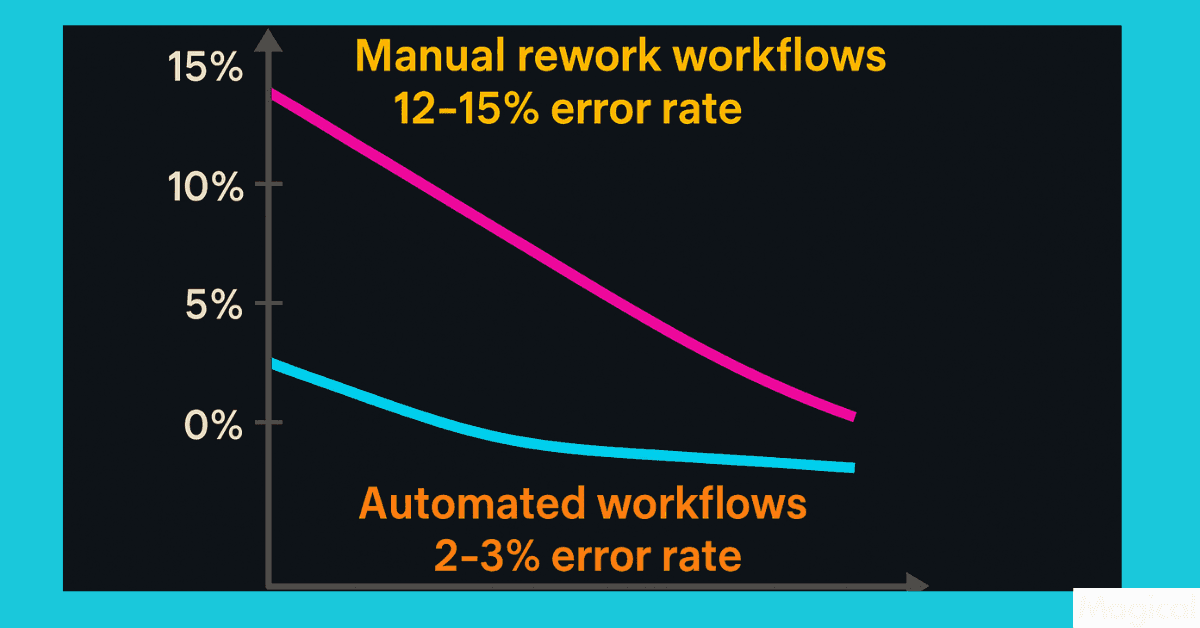
Every extra touchpoint increases the risk of mistakes. When automation reduces those touches, records stay cleaner, claims process faster, and compliance risks drop.
A HealthIT.gov report confirmed that reducing manual input directly improves documentation accuracy and staff efficiency. For healthcare teams, that means fewer corrections and more energy to focus on patients.
Building a Rework-Free Admin Workflow
Eliminating rework doesn’t mean overhauling every system at once. The fastest wins come from targeting repetitive, high-volume tasks and automating them first.
With the right approach, teams can chip away at duplication until the workflow feels lighter, faster, and more reliable.
Start with the Repetitive Tasks
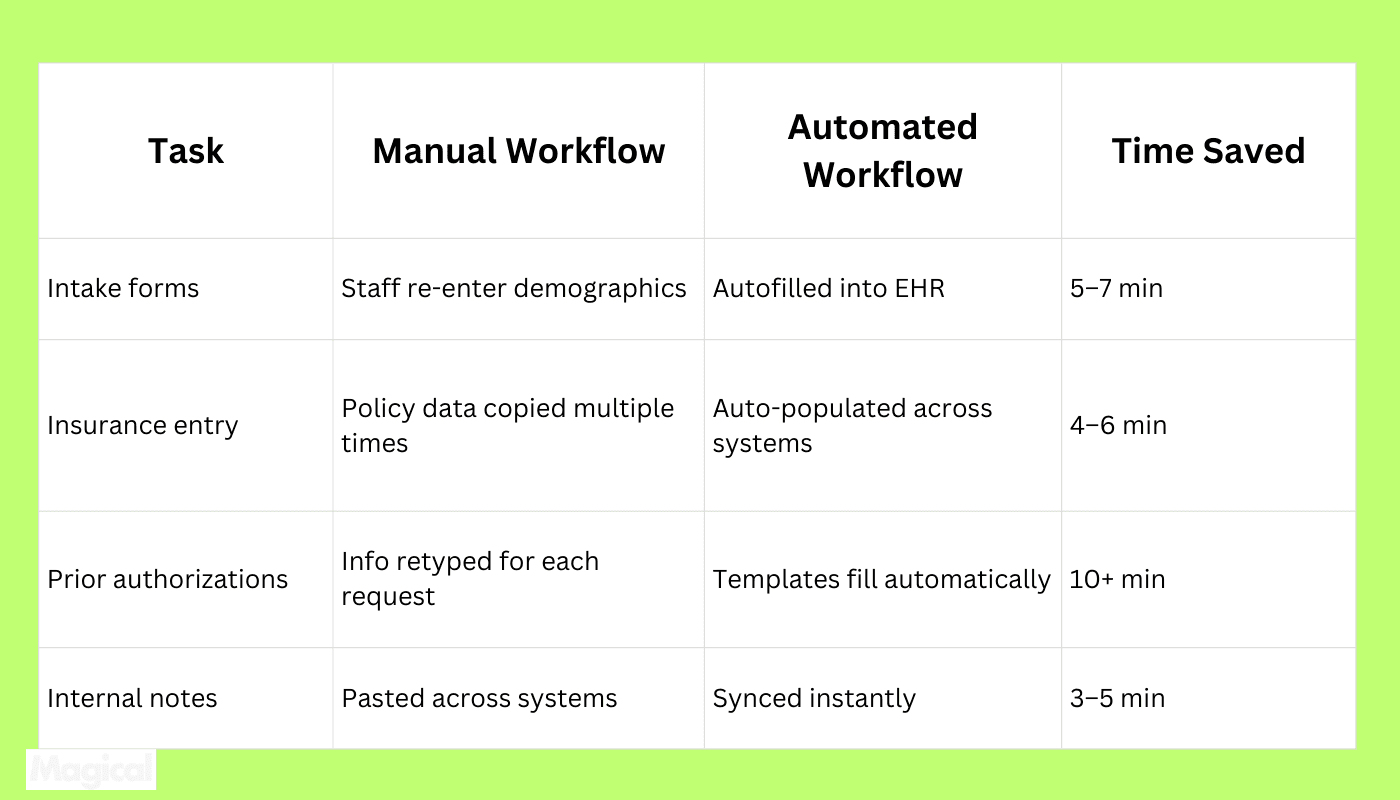
Some tasks are obvious candidates for automation:
Intake forms that get re-entered into the EHR
Insurance details that appear in multiple portals
Prior authorization requests that require duplicate information
Internal notes that need to be copied across systems
Automating these areas can save hours each week while also reducing downstream errors.
Layer Automation Over Existing Tools
The beauty of modern automation is that it doesn’t require a rip-and-replace approach. Tools like Magical sit on top of existing systems and handle the duplication automatically.
That means no IT tickets, no custom integrations, and no downtime.
The TCPA case study proves this in practice. They layered automation into their scheduling and communication workflows without disrupting operations.
The result: smoother patient interactions and less administrative drag.
Automation That Actually Understands Healthcare Workflows
Not every automation tool is built for the realities of healthcare.
Front desk staff, billing coordinators, and administrators need solutions that respect compliance rules, work across complex systems, and feel simple enough to use right away.
The right tool doesn’t just cut rework. It fits seamlessly into the way teams already operate.
HIPAA-Compliant, Human-Centric
Healthcare automation must protect patient data while making daily tasks easier. Look for tools that are HIPAA-compliant, require minimal setup, and can be used without coding knowledge.
If a solution introduces friction or security concerns, it won’t reduce rework. It will create new ones.
From Rework to Real Work
The end goal isn’t just fewer clicks. It’s more time for meaningful work: helping patients, resolving complex cases, and running smoother operations.
Automation should fade into the background, removing the repetition while amplifying human judgment and care.
Real-World Proof That Automation Ends Rework
The fastest way to see the impact of automation is to look at the teams already using it. Healthcare organizations across the country are cutting hours of manual work every week by removing rework from their workflows.
TCPA: Eliminated Manual Processes from Patient Communications
TCPA’s team spent hours managing repetitive communication tasks that slowed down scheduling and created more opportunities for error.
By layering automation into their workflows, they streamlined patient outreach, reduced redundancy, and freed staff to focus on meaningful interactions. The work moved faster, and the team felt lighter.
WebPT: Automating Across 7,000 Clinics
For WebPT, manual rework wasn’t just a time drain. It was a scaling challenge.
With thousands of clinics and millions of patient records, even small inefficiencies ballooned into major costs. Automation eliminated redundant entry and copy/paste in documentation, reclaiming over 500 hours of staff time.
The result: fewer errors, faster turnaround, and more capacity for patient care.
Check out the WebPT case study.
Final Thoughts: It’s Time to Stop Doing the Same Task Twice
Rework doesn’t have to be part of healthcare admin anymore. The tools exist to make one entry enough, to let data flow where it needs to go, and to give staff back the hours they lose to duplication.
Imagine a workflow where intake forms don’t need retyping, where insurance data doesn’t need copying, and where notes don’t need pasting.
That’s not the future. It’s already happening in clinics that have eliminated rework with automation.
Download the free Magical Chrome extension or book a demo for your team today! Magical is used at 100,000+ companies and by nearly 1,000,000 users to save 7 hours a week on average.