
Copy-paste isn’t a time-saver.
It’s a slow bleed.
It’s that quiet, invisible routine—Ctrl+C, Alt+Tab, Ctrl+V—repeated hundreds of times a day by healthcare admin teams just trying to stay afloat.
It feels fast, feels harmless. But every copy-paste is a fork in the road:
Did the data go to the right place?
Did it land in the right field?
Did it expose PHI to the wrong system or the wrong person?
When you’re copying patient IDs, insurance info, CPT codes, denial reasons, and prior auth notes across five platforms under pressure, you’re not speeding up. You’re setting traps.
Traps that lead to:
Duplicate records
Billing errors
Rework and burnout
HIPAA violations with five-figure fines
Lost trust from the people you serve
And here’s the real kicker: None of this is your fault.
This isn’t a training issue.
It’s not “human error.”
It’s a workflow problem.
A system problem.
A technology problem.
The real question isn’t “how do we reduce copy-paste errors?”
It’s: Why are we still copying and pasting at all?
This post is your answer.
The Hidden Cost of Copy-Paste Culture
On the surface, copying and pasting looks like hustle. But underneath, it’s chaos disguised as productivity.
What’s really happening?
People are manually stitching together workflows that should be connected. Because the systems aren’t.
And that’s not just clunky. It’s dangerous.
It Feels Fast, But It’s Expensive
When you’re processing hundreds of records a day, copy-paste becomes muscle memory. But the second something goes wrong (a missed character, a dropped digit, a pasted field in the wrong chart), you don’t just lose time.
You lose money.
Every error leads to:
Claims kicked back
Denials requiring rework
Delayed care
Staff hours wasted retracing steps
Multiply that across days, across people, across departments, and the cost stacks up fast.
It’s Not Just Inefficient. It’s a Liability
Copy-paste isn't just risky for operations. It’s risky for compliance.
According to a HIPAA Journal report, nearly 25% of healthcare data breaches are caused by human error. Often stemming from manual actions like copying and pasting PHI into the wrong system or message.
And a JAMA study found that over 46% of clinical documentation included copied text, increasing the risk of data redundancy and medical errors.
What does all this mean?
That one quick paste could cost your org tens of thousands in HIPAA fines, and that’s before you factor in damage to your reputation.
It Hurts Everyone Involved
Patients suffer when errors delay claims or referrals
Admin teams get stuck redoing work they already did
Finance feels it in collections
Compliance holds the bag when things go sideways
And let’s not forget burnout. Nothing drains morale like spending your day copy-pasting data you know should move automatically.
Copy-paste isn’t the shortcut. It’s the slowdown.
It’s the red flag that your workflows were never designed for the volume and complexity you’re managing now.
It’s time to fix that. Not with more oversight, but with better systems.
Why Copy-Paste Is So Widespread in Admin Teams
No one wants to copy-paste all day.
But when every system speaks a different language, and you're the only translator in sight, what choice do you really have?
Copy-paste isn’t a bad habit. It’s a survival strategy.
Here’s 4 reasons why it’s so entrenched in healthcare admin workflows:
1. Disconnected Systems
Your tech stack wasn’t designed to work together.
The EHR doesn’t talk to the billing system
The CRM doesn’t pull clean data from the patient intake portal
The payer’s denial portal lives in its own silo
Your internal communication lives on Slack, email, and Post-Its
So what happens?
You become the bridge.
Tab, copy, paste. Tab, copy, paste.
It’s fast, until it’s not.
2. High Volume, Low Support
Healthcare admin teams are processing:
Hundreds of patient records
Dozens of denials
Constant intake forms
Ongoing referral and prior auth requests
And yet?
You don’t have access to dev resources
You can’t wait for IT to “approve” every workflow
Your tools don’t scale with your workload
So you move faster the only way you can….manually.
3. Broken or Outdated Processes
A lot of “processes” in healthcare aren’t really workflows. They’re workarounds.
They were built under pressure and never revisited. They rely on:
Individual memory
Copying from macros
Data entry into rigid EHR templates
Alerts that no one reads
Instead of fixing the process, people fill in the gaps. And the fastest filler is Ctrl+C, Ctrl+V.
4. Automation Isn’t Accessible
Sure, your org “has automation.” But is it automation you can actually use?
You need to submit an IT ticket
Wait three weeks for a response
Sit through a technical review
Hope nothing breaks during rollout
So what do you do in the meantime? You open a new tab, and… paste.
The Result?
A workforce that knows better, but isn’t set up to do better.
Until now.
The 4 Risks You Can’t Afford to Ignore
Copy-paste seems harmless until it isn’t.
Until the patient data ends up in the wrong portal.
Until someone bills the wrong payer.
Until your compliance officer calls you into a meeting you never want to have.
What feels like a shortcut is one of the riskiest behaviors in modern healthcare operations. And when it finally breaks, it breaks big.
1. Wrong Patient, Wrong Data
All it takes is:
One ID pasted into the wrong field
One letter dropped from a name
One referral sent with the wrong attachments
And suddenly:
Protected health info (PHI) is exposed
Care is delayed or misrouted
Trust is broken
Even if the mistake is caught, the cleanup costs hours.
If it’s not caught? You’re looking at downstream harm, clinical and reputational.
2. Duplicate or Conflicting Records
Copy-paste is a huge driver of data pollution:
Mismatched fields
Misspelled names
Redundant or outdated insurance info
EHRs and CRMs don’t know what’s “copied”; they just log what they’re fed.
That leads to fragmented records, billing errors, and internal confusion that can take weeks to fix.
3. Burnout and Rework
Even if your team’s accuracy is heroic, manual workflows always crack under pressure.
Claims get kicked back
Referral packets are incomplete
Appeal documentation is inconsistent
Time is lost checking and rechecking what was already “done”
The admin team ends up doing work twice. Or three times.
It’s inefficient, and it wears people down.
4. Compliance Failures and HIPAA Risk
Copy-paste mistakes are one of the most common triggers for HIPAA violations.
PHI pasted into the wrong portal or message
Sensitive data left in a browser clipboard
Access logs that don’t show who touched what
These risks aren’t hypothetical. The consequences are real.
Civil fines up to $50,000 per violation
Investigation and reporting requirements
Public breach disclosure
And all of it… because someone copied the wrong row.
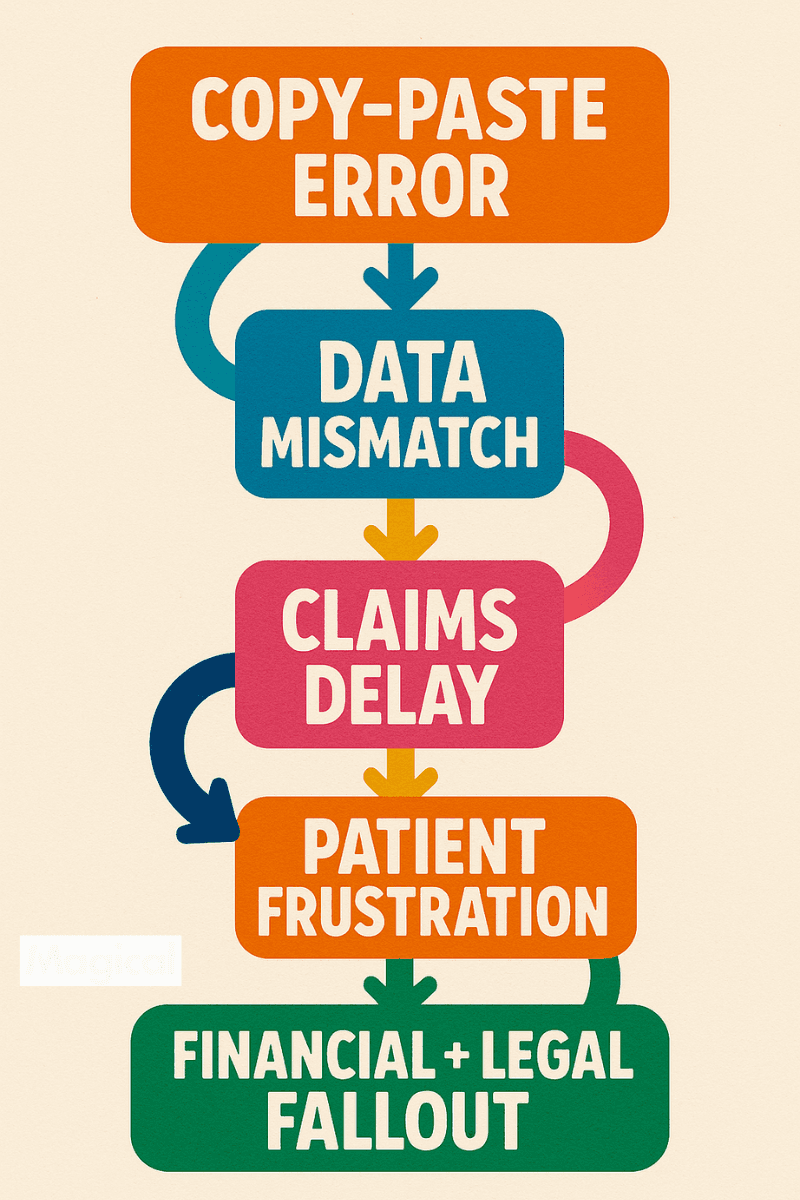
Copy-paste isn’t just a “bad habit.” It’s a structural weakness in your workflow.
One that’s costing your team time, money, and peace of mind every single day.
How AI-Powered Agents Eliminate Copy-Paste at the Root
You don’t solve the copy-paste problem by training people harder.
You solve it by removing the need to copy anything in the first place.
That’s exactly what AI-powered agents do.
Instead of:
Bouncing between tabs
Hunting down fields
Hoping you pasted the right value into the right system...
Your agent handles it. End to end.
What AI Agents Do Differently
These aren’t your grandpa’s macros or rule-based bots.
Agentic AI, like what powers Magical, operates with intelligence, flexibility, and real-time context.
Here’s how it works:
Reads from the source: The agent can access structured data directly from your browser (via secure, HIPAA-compliant processes). No more retyping.
Understands what belongs where: It doesn’t just push data—it knows which values go into which fields, in which systems.
Acts across multiple platforms: From your EHR to your billing tool, to your CRM, to your payer portal—the agent works across them all, automatically.
Logs every step: Every action is traceable, auditable, and secure. You’re never in the dark.
Never forgets: Once an agent is trained on a workflow, it doesn’t make typos. It doesn’t get distracted. And it doesn’t copy the wrong chart.
And the best part? No Code.
You don’t need to submit an IT ticket or write Python. You can create, launch, and refine agents using plain language.
Tell Magical what you want the agent to do, like:
“When a denial code appears in the billing system, extract the patient ID, check eligibility, and draft an appeal response.”
Magical builds the workflow. You approve it. Done.
Compliance? Built-In.
Magical is:
Fully HIPAA-compliant
Encrypted at every level
Audit-logged for every action
Ready for a signed BAA from day one
You eliminate the most common source of HIPAA risk (human error) by taking the human out of repetitive, high-stakes workflows.
Copy-paste is reactive.
Agents are proactive.
And once you switch, you never go back.
3 Workflows Where Magical Removes Copy-Paste Completely
Copy-paste isn't just annoying. It’s built into the DNA of most healthcare workflows.
But with Magical, it doesn’t have to be.
These are three high-volume processes where AI agents replace every Ctrl+C and Ctrl+V with precision, security, and speed.
1. Claims Denial Appeals
The Old Way (Manual):
Get a denial notification in your EHR or payer portal
Copy the denial reason code
Open the patient chart, copy the relevant notes
Paste into a doc, then paste that into the payer’s form
Double-check all codes, dates, and contact info
Risks: Missed codes, mismatched fields, wasted time, delayed reimbursements
The Magical Way (Agentic):
Agent detects the denial code
Automatically pulls required patient data from the EHR
References payer rules to determine next steps
Builds the appeal packet
Routes to the right person or submits directly
Outcome: No manual copying. No missed fields. No claims left behind.
2. Referral Submissions
The Old Way (Manual):
Copy patient data from the EHR
Paste into a third-party form or email
Upload scanned documents from another system
Manually format everything before sending
Risks: Inconsistent info, attachments missed, faxes sent to the wrong provider
The Magical Way (Agentic):
Agent detects when a referral is ready
Pulls all relevant patient details and documentation
Populates the referral form or pre-formatted message
Verifies completeness and sends with a click
Outcome: Accurate, complete referrals on the first try.
3. Intake-to-CRM Updates
The Old Way (Manual):
Patient submits intake form
Admin opens it, copies name, date of birth, insurance
Pasts it into Salesforce or CRM
Flags any missing info in a separate task
Risks: Field mismatches, duplicate records, lost follow-ups
The Magical Way (Agentic):
Agent detects new intake submission
Pulls validated data
Cross-checks for duplicates
Populates the CRM with correct, clean fields
Notifies team only if data is missing or ambiguous
Outcome: No re-entry. No errors. No follow-up falling through the cracks.
These aren't rare exceptions. They're common workflows admin teams handle thousands of times every month.
And with Magical, every single one of them becomes faster, safer, and error-free.
What to Look for in a Copy-Paste-Killing Platform
If your goal is to eliminate copy-paste from your admin workflows, you need more than macros and good intentions.
You need a platform that:
Understands healthcare
Respects compliance
Works across systems
Adapts in real time
And can be used without calling in IT
Here’s the checklist.
HIPAA Compliance by Design
Don’t settle for “secure-ish.” Your automation platform should:
Offer a signed BAA
Encrypt PHI in transit and at rest
Maintain full audit trails of every agent action
Follow strict access controls and role-based permissions
Magical? All of the above, plus SOC 2 compliance.
True No-Code Setup
Automation shouldn’t require engineers. Your ops team should be able to:
Spin up new workflows
Update existing ones
Handle exceptions
And launch, all without dev tickets
Magical lets your team build agents using natural language. No code, no technical friction.
Intelligent, Cross-System Execution
Copy-paste happens because systems don’t talk to each other.
Your platform must:
Work across EHRs, CRMs, portals, and internal tools
Understand data formats and field mappings
Handle multi-step, multi-system processes in real time
Magical agents operate across tools, from browser-based portals to back-end systems, securely and seamlessly.
Workflow Transparency & Control
Admins need visibility, especially when patient data is involved.
Look for:
Live status tracking
Real-time notifications
Granular logs
Easy rollback or overrides if something changes
Magical provides full agent visibility, right from your dashboard.
Proven Use Cases in Healthcare
If your automation tool was built for sales teams and repackaged for healthcare, run.
You want:
Real-world results in healthcare admin
Workflow examples you can adapt
Compliance baked in from the start
Magical is used in hundreds of real-world healthcare workflows from claims and intake to denials and referrals.
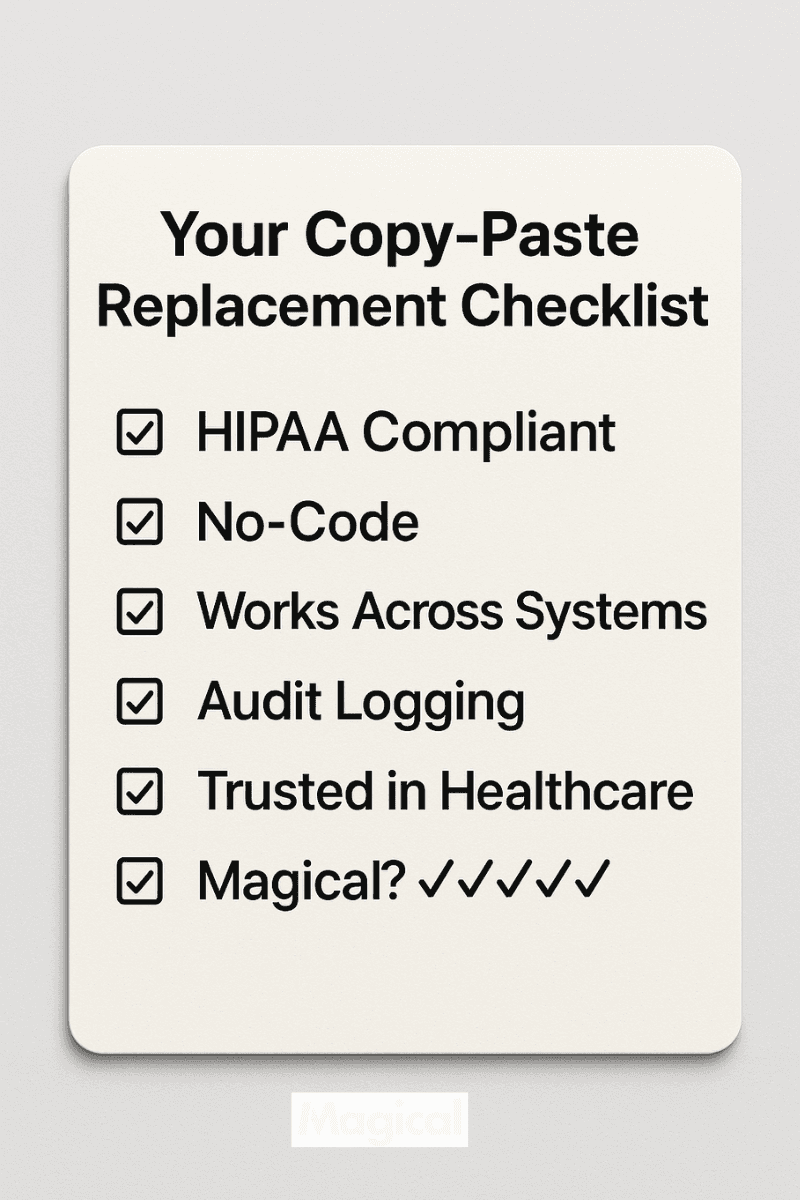
If your automation platform can’t remove the need for copy-paste at the root, it’s not solving the real problem.
Magical does. At scale. Every day.
Final Thoughts: Say Goodbye to Copy-Paste. Say Hello to Smart Workflows
Your team was never supposed to spend their day copying data from one screen to another.
That’s not “ops.”
That’s manual labor disguised as digital work.
You don’t need more training.
You don’t need stricter SOPs.
You don’t need another spreadsheet to track the spreadsheets.
You need workflows that run themselves, with accuracy, transparency, and zero risk of human error.
That’s what Magical delivers.
AI agents that eliminate repetitive tasks
Cross-system workflows with no more copy-paste
HIPAA-compliant automation, ready to scale
Used by nearly 1 million users across 100,000+ companies
Saving teams 7 hours a week per person, on average
This isn’t the future.
This is right now.
Try Magical Free or Book a Demo
Install the free Magical Chrome extension and start saving time today
Book a personalized demo to see how agentic workflows can replace your riskiest manual processes
Copy-paste isn't a necessary evil.
It’s a solvable problem.
Replace it. Reclaim your time. Restore your team’s sanity.