
The numbers don’t always speak for themselves.
Sometimes, they whisper, buried under piles of paperwork, lost in another denied claim, or silently aging inside an unpaid invoice.
If you work in healthcare administration, you’ve heard that whisper before.
Maybe it sounded like a patient’s coverage didn’t match the code.
Or maybe it was a mistyped digit in a 12-hour day of toggling between EHRs, spreadsheets, and billing systems.
Medical billing errors aren’t loud. They’re quiet losses.
They don’t show up on the schedule, but they cost time, money, and trust every single day.
You don’t need another spreadsheet.
You need a system that protects your work from the weight of human error.
That gives your team back hours.
That makes billing boring again.
This is where AI-powered automation steps in, not with fanfare, but with precision.
Let’s pull back the curtain on what’s really draining your revenue. And then, let’s fix it.
What Are Medical Billing Errors?
They’re not always obvious.
They don’t always look like mistakes.
But they add up fast.
Medical billing errors are discrepancies between what was done and what was billed. That simple.
A single incorrect digit in a CPT code, a duplicate charge for a test that was only run once, a patient birthdate copied incorrectly during intake. Each one sends a clean claim into a denial spiral.
And the truth? This isn’t rare. It’s the norm.
According to the Medical Billing Advocates of America, up to 80% of medical bills contain errors. That means the majority of claims your team submits have at least one small slip that could delay reimbursement, or cancel it entirely.
Here’s what that looks like in the real world:
Common Types of Billing Errors:
Incorrect patient information: Name spellings, insurance ID numbers, dates of birth. Small errors that trigger rejections.
Coding mistakes: Wrong CPT or ICD-10 codes, mismatched diagnoses and procedures, or outdated codes.
Duplicate billing: The same procedure gets entered twice by accident, and flagged as potential fraud.
Upcoding or downcoding: Whether intentional or not, coding at a higher or lower level than the service actually performed can lead to major compliance risk.
Missing documentation: If the chart doesn’t support the claim, it won’t get paid. Simple as that.
Each of these errors isn’t just a clerical issue. They’re revenue leaks, workflow breakdowns, and stress triggers for staff who are already juggling a thousand details.
And they don’t happen because your team isn’t good at their jobs. They happen because they’re doing too much, in too many systems, with too little time.
That’s the real problem we’re here to solve.
The Real Cost of Billing Errors in Healthcare
Every error has a price tag. Some just take longer to show up.
When a claim is denied because of an avoidable mistake (a wrong code, a typo, a missing modifier), it doesn’t just cost the immediate reimbursement. It kicks off a chain reaction: follow-up, correction, resubmission, delay.
And all of it burns time, labor, and morale.
The Financial Fallout
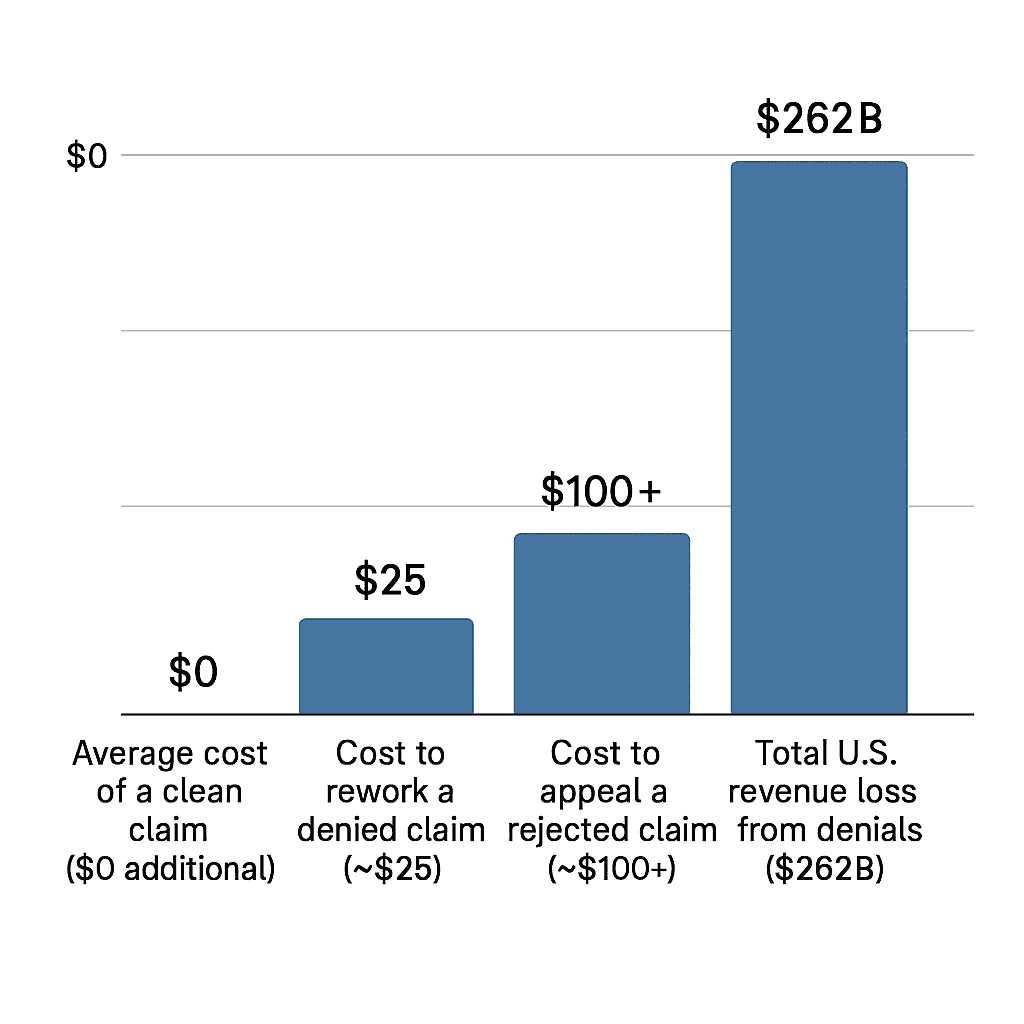
According to a study by the Medical Group Management Association (MGMA), it costs an average of $25 to rework a single claim. If the claim requires appeal, that cost can climb to over $100 per instance.
Now multiply that by dozens or hundreds of claims per month.
And here’s the kicker: across the U.S., hospitals lose a staggering $262 billion annually due to claim denials.
That’s not theoretical. That’s money not hitting the books because of simple, preventable errors.
Time Is Money. And Stress.
It takes about 16 minutes to manually rework a single claim. That’s 16 minutes an admin could’ve spent scheduling patients, updating records, or reconciling charges that haven’t even been flagged yet.
Every moment spent untangling mistakes is time taken away from patient care and operational flow.
Compliance Risks You Can’t Afford to Ignore
Errors aren’t just financial. They’re legal liabilities.
Upcoding or mismatched documentation can raise red flags with payers and regulators.
Repeated billing issues can trigger audits, fines, and loss of payer trust.
Even minor inconsistencies can violate HIPAA standards when data is mismanaged across systems.
When these errors scale, they don’t just cost your team money. They put your entire revenue cycle and your organization’s credibility at risk.
Medical Billing in a Manual World: Why It’s Not Working Anymore
You don’t have to overhaul your billing system to know it’s broken. You just have to watch it work.
Ask any front-desk admin or billing coordinator what their day looks like, and you’ll hear a familiar story:
Toggling between tabs. Copy-pasting patient data. Re-entering the same insurance info into multiple platforms. Fixing someone else’s typo. Hunting for a chart note. Calling a payer. Repeating the process.
That’s not a workflow. That’s a minefield.
Too Many Systems, Not Enough Sync
Modern healthcare runs on software. But when those tools don’t talk to each other, your staff becomes the integration layer.
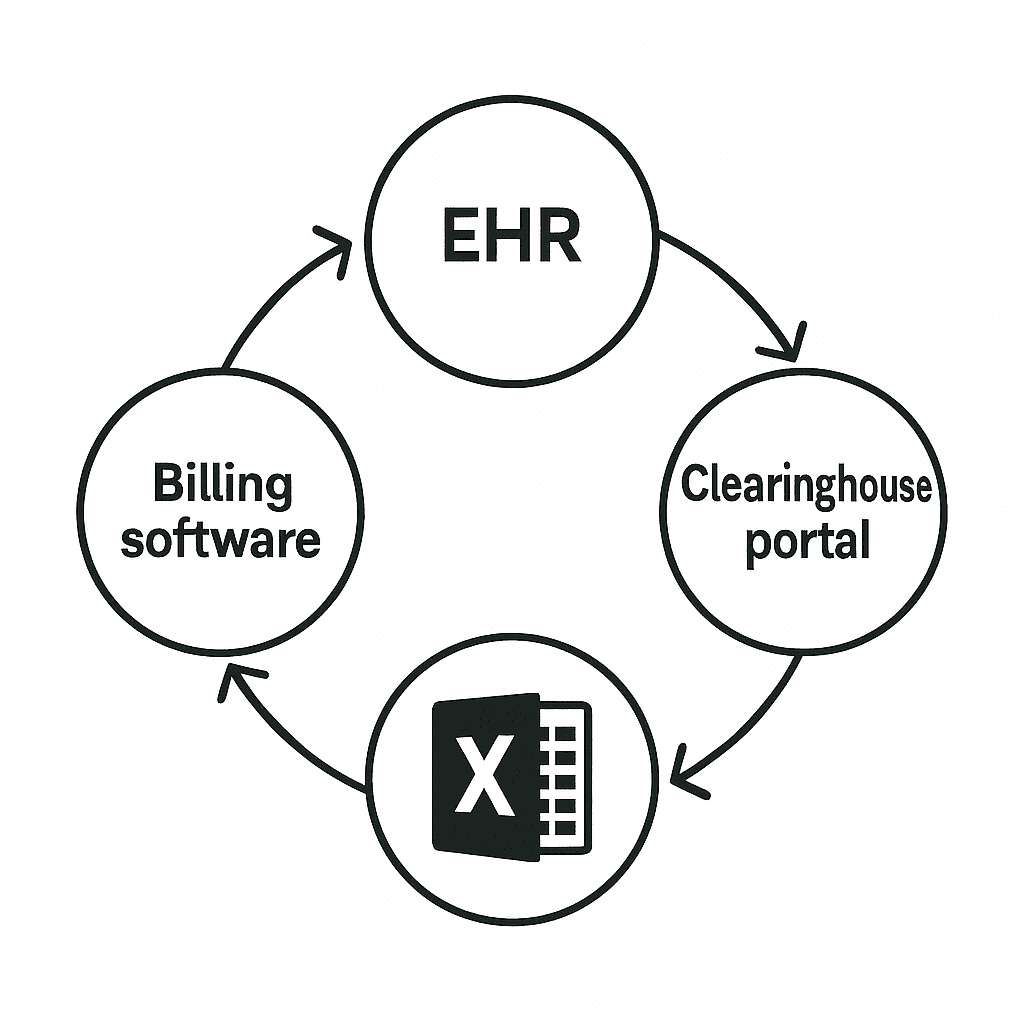
Every manual step is a chance to drop a charge, miscode a procedure, or duplicate a submission.
Even with training and SOPs in place, this is what creates bottlenecks—and burnout.
Admin Burnout Is a Systemic Risk
Manual billing isn’t just inefficient. It’s unsustainable.
In a survey by the American Medical Association, nearly half of healthcare administrative staff report feeling overwhelmed by the burden of paperwork and repetitive digital tasks.
They didn’t go into healthcare to be human photocopiers. But when billing depends on keystrokes, memory, and endless tab-switching, even the best teams start making mistakes.
Real-world proof: In ZoomCare’s case study (see below), front-desk teams were spending hours re-entering patient data across platforms—manually copying and pasting the same fields multiple times a day. The cost wasn’t just time. It was morale, accuracy, and consistency.
How Automation Helps Prevent Medical Billing Errors
You can’t outwork a broken workflow. But you can outsmart it.
That’s the promise of automation. Not to replace your team, but to remove the repetitive, error-prone tasks that are quietly breaking them.
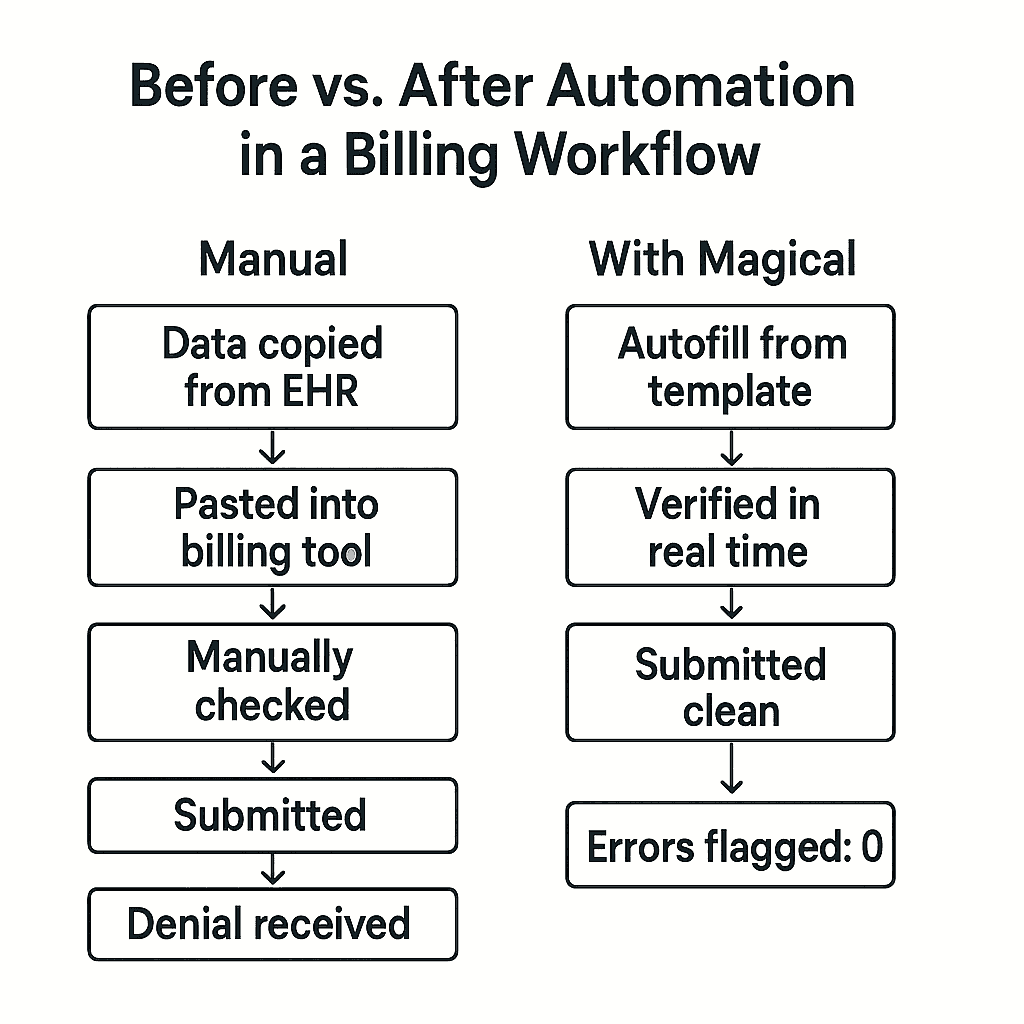
Instead of chasing billing errors after the fact, automation tools like Magical eliminate those mistakes before they happen.
Let’s break it down.
Autofill That’s Actually Intelligent
Magical isn’t just a text expander. It’s an AI-powered autofill assistant that works across your EHR, billing software, spreadsheets, and web-based portals anywhere you work in Chrome.
When you’re entering patient data or codes into a claim form, Magical instantly fills in the right fields with the right information, pulling from saved templates or previously entered data.
No toggling. No typos. No “I thought I already filled that out.”
Smart Templates = Fewer Missed Charges
You can build custom templates in Magical for your most common workflows, like insurance verification, visit documentation, and CPT code combos.
Your team doesn’t have to remember which modifiers go with which procedures or which codes require supporting documentation. Magical prompts them automatically, so nothing gets missed.
Built-In Error Prevention
Magical doesn’t just move data faster. It makes sure the data is right.
You can embed logic into your workflows that flags:
Mismatched patient info across forms
Missing fields before submission
Incorrect or outdated CPT/ICD-10 codes
Duplicate entries
Instead of discovering an error days later in a denial report, your team catches and corrects it in real time.
Real Outcomes from Magical Users
This isn’t theory. It’s what happens when automation gets real in healthcare admin teams.
WebPT: 5–10 Hours Saved Per Week, Per Team Member
WebPT’s team was drowning in repetitive data entry across multiple systems. Manual processes created bottlenecks in billing, slowed down claims, and wore down staff.
With Magical, they built custom workflows that pulled patient and billing data directly into the right fields. No toggling, no retyping.
Result:
5–10 hours saved weekly
Cleaner claims, faster submissions, and more time to focus on patients (not paperwork)
“We didn’t need to overhaul our tech stack. We just needed Magical to connect the dots.” – WebPT Operations Lead
TCPA: Faster Patient Data Transfer, Fewer Denials
The Tennessee Center for Patient Advocacy (TCPA) was losing time and claims due to inconsistent intake data and billing mismatches. Their admin team handled sensitive data across disconnected platforms—ripe territory for errors.
By using Magical to autofill validated patient and payer info, they eliminated common mistakes at the source.
Result:
Fewer denials due to missing or incorrect fields
Streamlined billing processes from the front desk to back office
ZoomCare: Front-Desk Teams Reclaimed Their Day
ZoomCare’s front-line staff were stuck in a cut/paste loop—transferring patient data across EHR, billing forms, and communication tools all day long. The process was tedious and highly prone to errors.
Magical gave them a simple, no-code solution to autofill and standardize every workflow.
Result:
Admins reduced repetitive tasks by up to 80%
Increased accuracy and staff morale across multiple clinics
These aren’t edge cases. They’re proof that when you automate the small stuff, the big things get better, cleaner claims, less burnout, and more revenue that actually shows up.
5 Key Benefits of Automating Medical Billing Workflows
Automation isn’t just a timesaver. It’s a revenue protection strategy.
When you remove repetitive, error-prone steps from billing, you don’t just speed things up. You tighten your revenue cycle, reduce costly delays, and give your team space to do the work that actually needs a human.
Here’s what your billing process looks like when automation takes the wheel:
1. Fewer Errors, Cleaner Claims
Autofill and prompt-based workflows mean fewer mistakes get through. Codes match. Documentation supports charges. Payer rules are followed.
Result: More claims paid on first submission.
2. Faster Reimbursements
With fewer denials and reworks, claims don’t get stuck in limbo. They get submitted and paid faster.
Result: No more two-week delays because someone missed a modifier.
3. Less Time Spent on Manual Tasks
Your admin team gets back the hours they were spending on re-entry, double-checking, and chasing down fixes.
That’s time they can spend reconciling higher-value charges, supporting providers, or just breathing easier.
4. Improved Team Morale
Nothing drags down a good employee like bad workflows. When teams aren’t buried under busywork, they perform better and stay longer.
5. Better Audit and Compliance Readiness
Automation helps create consistent, accurate records across platforms. When everything matches up, audits become a formality, not a fire drill.
What to Look for in an Automation Tool for Healthcare Billing
Not all automation is created equal.
Some tools promise to “optimize your workflow” and then require a 9-month implementation, 4 IT resources, and a tolerance for pain. Others offer bells and whistles, but don’t actually solve the biggest problem: your team is still manually typing the same data into multiple places.
Here’s what to look for if you’re serious about reducing billing errors and reclaiming lost hours:
HIPAA-Conscious Data Handling
You’re working with PHI. Any tool you use must follow HIPAA best practices, full stop.
Look for: browser-native workflows that don’t store data in the cloud unless explicitly configured to do so.
Chrome-Native and Platform-Agnostic
Your team works in the browser. Your automation tool should too. Magical runs natively in Chrome, meaning it works across EHRs, billing platforms, spreadsheets, and payer portals without needing deep integrations or IT setup.
Fast Setup, No IT Required
You shouldn’t need engineers to automate a field entry. The right tool is self-serve, intuitive, and up and running in under an hour.
Customizable Templates and Prompts
Every billing workflow is a little different. Your automation tool should let you:
Autofill recurring fields (like insurance ID, CPT codes)
Prompt staff to complete missing data
Create department-specific templates
Works Across Teams and Roles
From front-desk to back-office billing, everyone should benefit. The tool should scale across roles without forcing people to learn a new system.
Backed by Real Results
You want proof. Case studies. Time saved. Denials avoided. Revenue reclaimed. Tools like Magical don’t just talk about impact, they show it.
Try Magical. Built for Healthcare Admin Teams
You don’t need a six-figure implementation or a new billing platform.
You just need a way to stop making the same edits, catching the same errors, and fixing the same problems over and over again.
Magical is an AI-powered automation tool that’s already helping healthcare admin teams:
Eliminate repetitive copy-paste tasks
Autofill billing and patient data across systems
Reduce claim denials
Reclaim hours every week
It works inside Chrome. No engineering, no rip-and-replace, no friction. If your team knows how to fill out a form, they can use Magical. Today.
Here’s what you can do right now:
Try Magical for free — Install the Chrome extension in under 60 seconds
Book a demo — See how your actual workflows can be automated, from intake to billing
Whether you’re running a clinic, managing a front desk, or leading a billing team across multiple locations, Magical is your shortcut to error-free, stress-free billing.
Because billing should be boring. And Magical makes it that way.
Final Thoughts
Billing errors don’t usually show up in headlines. They show up in subtle ways: delayed payments, denied claims, frustrated staff, and slow, silent revenue leaks that compound over time.
But it doesn’t have to be that way.
Your team isn’t failing. Your system is. And automation is how you fix it—without burning out your people or blowing up your stack.
Magical gives healthcare teams a faster, smarter way to handle the billing work that used to take hours. It eliminates errors before they cost you, fills in data where mistakes happen, and makes admin feel less like survival and more like control.
Ready to stop letting billing errors eat away at your time and revenue?
Start automating today.
Try the free Magical Chrome extension
Or book a demo for your team and see what flawless billing workflows really feel like