
You don’t need another post reminding you that healthcare fraud is a problem.
You see it every day, buried in duplicate charges, mis-coded procedures, “ghost” patients, and claims that just don’t add up.
And you already know what it costs: hours lost, revenue stalled, red flags from payers, and the stress of wondering what you missed.
What you might not know is this: AI is already catching fraud, waste, and abuse (FWA) faster than human teams ever could.
And no, this isn’t about replacing your staff.
It’s about taking the repetitive, mind-numbing detective work off their plates so they can focus on what matters.
Because right now, fraud detection is stuck in a cycle of slow audits, reactive fixes, and incomplete data.
Meanwhile, bad actors get smarter.
Claims get dirtier.
And your team falls further behind.
Let’s change that.
What Is Fraud, Waste, and Abuse in Healthcare Claims?
Fraud. Waste. Abuse.
Three words that show up in compliance training slides, and then quietly cost the healthcare system over $100 billion every year.
They don’t just drain revenue from payers. They bury admin teams in preventable denials, post-payment audits, and hours of make-up work no one has time for.
Let’s call it what it is: broken processes being exploited by bad actors (or sometimes, just sloppy billing). But the cost hits the same.
Fraud
This is intentional deception.
Billing for services that were never provided. Using someone else’s insurance info. Performing unnecessary procedures just to get reimbursed.
It’s deliberate and illegal.
Waste
This isn’t always intentional, but it’s still costly. Think: ordering redundant tests, scheduling excessive follow-ups, or using more expensive treatments when cheaper alternatives work just as well.
Waste bloats spending and opens the door for scrutiny.
Abuse
Abuse sits in the gray area. It includes practices that bend rules to maximize reimbursement, like upcoding a routine visit as a more complex one, or unbundling procedures to get paid for each one individually.
Not always criminal, but still a violation of billing standards.
And here’s where things get worse: Most admin teams don’t have the capacity to catch this before the claim is submitted. Or even after.
In a 2022 survey by the National Health Care Anti-Fraud Association (NHCAA), experts estimated that as much as 10% of total U.S. healthcare spending is lost to fraud alone.
This puts the annual impact in the $300 billion range when you factor in all forms of improper billing.
That’s not a blip. That’s an emergency.
Why Traditional FWA Detection Doesn’t Work Anymore
If you’re still relying on audits to catch fraud, waste, and abuse, you’re already too late.
Most traditional fraud detection is built around a reactive model:
Wait for the claim to get processed.
Hope a denial or audit catches something suspicious.
Manually investigate.
Manually rework.
Repeat.
The problem? Fraud doesn’t wait. Neither do revenue losses.
Manual processes can’t keep up.
An average health system processes thousands of claims every day, each with dozens of fields that can be mistyped, misused, or intentionally manipulated.
And the people reviewing them?
Human. Stretched. Under pressure.
Even with skilled billing staff and compliance protocols in place, human review isn't scalable.
You might catch a few red flags, but what about patterns?
What about outliers across departments or providers?
What about subtle indicators that only show up when you compare large datasets over time?
That’s not human work. That’s machine work.
Data is fragmented across too many systems.
In most healthcare organizations, billing data is scattered across EHRs, payer portals, spreadsheets, and third-party systems that don’t talk to each other.
This fragmentation means your team is copy-pasting between platforms, toggling between screens, and often re-entering the same information multiple times, introducing even more room for error.
Teams copy-paste between platforms, toggle screens, and re-enter information, increasing errors.
And when errors get submitted in a claim? It’s a compliance risk.
Whether it’s fraud, abuse, or just a mistake, you’re still on the hook.
Audits are backward-looking. Fraud is forward-moving.
By the time you catch an issue in a post-payment audit, the damage is already done.
The claim is processed. The reimbursement is paid (or denied). The patient may already have been affected.
Even worse? Audit fatigue is real.
Teams spend so much time chasing documentation, appeal letters, and justifying charges that they lose sight of proactive improvements.
The system isn’t designed to stop fraud before it happens. AI is.
How AI Is Transforming FWA Detection
AI isn’t a buzzword anymore. It’s already changing how the smartest healthcare organizations prevent fraud, waste, and abuse, not react to it.
Instead of depending on human intuition and random audits, AI works like an always-on, ultra-fast claims analyst. One that never misses a pattern, never gets tired, and never overlooks a red flag hidden in plain sight.
Let’s break down how.
Pattern Recognition at Scale
One suspicious claim won’t tell you much. But 500 from the same provider with unusual billing behavior? That’s a pattern.
AI thrives at spotting these trends. Using machine learning algorithms, AI systems analyze massive volumes of claim data across providers, procedures, and time periods, looking for statistical outliers that might suggest fraud or abuse.
This could include:
A provider billing far more high-complexity visits than peers
Repeated use of rarely necessary procedures
Diagnoses that don’t match billed services
Clusters of identical claims submitted across multiple patients
And it’s not just theory. AI-powered tools use this exact model to surface coding inaccuracies and identify suspicious billing behavior in real time.
Humans can't keep up with this kind of scale. AI was built for it.
Real-Time Alerts for Suspicious Activity
Traditional fraud detection = detect, then react.
AI-powered fraud detection = detect while it’s happening.
Instead of waiting for a denial or an audit to reveal that something went wrong, modern AI tools can flag a claim the moment it’s entered. And stop it from moving forward.
For example:
If a procedure code doesn’t match the diagnosis, the AI flags it.
If a provider’s volume spikes in a way that doesn’t make sense, the AI alerts compliance.
If there’s missing documentation tied to a high-risk billing code, the AI stops the claim cold.
Solutions like Clearwater Compliance and others are already integrating real-time anomaly detection into claims workflows, making fraud prevention proactive, not punitive.
Natural Language Processing (NLP) in Medical Coding
AI isn’t just scanning numbers. It’s reading, interpreting, and understanding documentation.
Natural Language Processing (NLP) allows AI to analyze free-text fields (like provider notes or encounter summaries) and compare them to codes submitted for reimbursement.
This means your AI assistant can:
Spot when a claim is upcoded compared to the documented complexity
Catch when bundled services are unbundled improperly
Flag mismatches between treatment notes and billing codes
It’s how you catch abuse before it becomes a compliance issue. And how you protect your team from unintentional errors that could look a lot like fraud.
When AI handles detection, your team doesn’t need to be detectives. They just need to follow the signals.
Use Cases: How Healthcare Admin Teams Are Using AI to Catch FWA
The best part about AI-driven fraud detection? It’s not theoretical.
Healthcare admin teams are already using it to cut down on repetitive claim errors, reduce the risk of audits, and move faster without compromising compliance.
Here’s how they’re doing it.
Pre-Submission Claim Scrubbing
Before a claim ever hits the payer’s system, AI can scan it for red flags.
This means:
Ensuring CPT codes match diagnoses
Checking for missing documentation
Validating provider info and patient data
Flagging services that appear duplicated or medically unnecessary
Instead of scrambling to fix denials after the fact, AI assistants do the cleanup beforehand. This dramatically reduces the number of claims that bounce back.
Result: Fewer denials. Fewer delays. Better first-pass resolution rates.
Some RCM teams have reported up to a 30% reduction in denials using AI-driven scrubbing tools (source).
Post-Submission Auditing at Scale
Even with solid pre-submission checks, auditing doesn’t go away. It just gets smarter.
AI can scan thousands of processed claims to identify patterns that suggest systemic issues, like:
A recurring mismatch between procedure codes and documentation
A specific provider overusing high-reimbursement codes
Regional or specialty-specific anomalies in billing behavior
Instead of pulling random samples, AI helps you prioritize high-risk claims for manual review, saving your compliance team time while increasing the chances of catching real problems.
AI-Powered Pattern Detection Across Providers
One of AI’s superpowers is cross-comparison.
If one physical therapist in your network consistently bills double the average for a certain code, or if one location’s claims consistently result in higher denial rates, the AI will notice. And it’ll keep noticing as the data changes over time.
This is especially useful for:
Multi-site healthcare organizations
Provider groups with varying specialties
Admin teams trying to uncover inefficiencies across billing departments
It’s the kind of insight that helps leadership make data-backed decisions about training, documentation, and resource allocation.
Case Study Snapshot: How WebPT Reduced Claims Errors Using Magical
WebPT’s billing team was no stranger to high-volume admin work. With thousands of claims moving through their system each week, the team was constantly bouncing between their EHR, billing tools, and payer portals.
This made for a perfect storm for small mistakes to become expensive problems.
Copy-paste errors.
Manual data entry.
Inconsistent formatting.
The usual suspects.
So they brought in Magical.
Instead of adding new software to their tech stack, WebPT used Magical’s AI-powered Chrome extension to automate repetitive billing workflows inside the tools they already used.
Claims data was autofilled accurately. Copy-paste tasks were eliminated. And error rates dropped fast.
Here’s what changed:
Time-to-submit improved across billing tasks that used to be manual
Claim accuracy increased, reducing downstream rework
Admin workload dropped, giving the team more bandwidth for higher-value work
With Magical, WebPT didn’t just speed up their billing process. They cleaned it up.
The result? Fewer preventable denials, stronger audit readiness, and a team that finally had breathing room.
Proof that a simple shift in workflow can solve a costly FWA problem.
Benefits of AI for Healthcare Admin Teams
AI isn’t just about speed. It’s about building smarter workflows that reduce risk, reclaim time, and give healthcare admin teams the tools they need to operate at their best, without burning out.
Here’s what happens when you let AI take the heavy lifting off your plate.
Increased Accuracy and Compliance
Even the best teams make mistakes when they’re forced to work fast and manually juggle multiple systems. AI removes the manual entry points that cause those mistakes in the first place.
Data is autofilled consistently
Codes are double-checked against documentation
Claims are validated before submission
That means fewer denials, fewer payer rejections, and better compliance, especially as CMS and commercial payers ramp up scrutiny on billing accuracy.
You also reduce the risk of triggering costly audits. That’s not just peace of mind. That’s real savings.
Time Savings and Productivity
AI doesn’t just do things faster. It does them instantly.
Tools like Magical allow admin teams to automate high-volume, low-value tasks like copying patient details, entering CPT codes, or checking claim statuses.
All without leaving their existing tools.
On average, Magical users save 7 hours per week, per person.
Now imagine what your team could do with that time back.
Cost Savings
Every denied claim costs money. Every error that has to be corrected burns staff time. And every inefficient workflow means more overhead to achieve the same result.
AI reduces all three.
According to the Council for Affordable Quality Healthcare (CAQH), automating administrative healthcare transactions could save the industry over $25 billion annually.
Even at the individual organization level, that translates to real dollars saved, especially when automation prevents problems before they require costly rework.
How to Start Using AI to Detect FWA in Your Organization
You don’t need a giant budget, a massive IT team, or six months of implementation time to bring AI into your fraud detection workflows.
In fact, some of the most effective tools (like Magical) are already working inside the browser tools your team uses every day.
Here’s how to get started.
Step 1: Audit Your Current Workflow
Start by identifying where fraud, waste, or abuse can slip through the cracks.
Look for:
High volumes of manual claim entry
Frequent resubmissions or appeals
Inconsistencies between what’s documented and what’s billed
Copy-paste work between systems that slows your team down
Ask your admin staff:
Where do errors happen most often?
Which workflows feel the most repetitive or risky?
What takes the most time and delivers the least value?
That’s your starting point.
Step 2: Identify AI Tools That Fit
Not every AI tool is built for healthcare. And not every healthcare AI solution is designed to support real admin work.
Look for solutions that:
Are HIPAA-conscious and browser-native (no EHR overhaul required)
Can automate copy-paste, form-filling, and data movement between systems
Work with your current stack (billing portals, payer systems, EHRs, etc.)
Give human teams full control over what gets triggered and when
Magical is a strong fit here: it works directly in Chrome, adapts to your workflows, and never stores PHI.
It’s not a rip-and-replace system. It’s a lightweight way to get started fast.
Step 3: Train Your Team and Monitor Outcomes
AI doesn’t replace people. It supports them.
Start with one high-volume workflow, like claims prep or portal data entry, and show your team how to automate it.
Track results:
How much time are they saving?
Are claim errors going down?
Are you submitting faster? Getting paid quicker?
Use that data to expand into other workflows.
Fraud detection doesn’t need to be complex. But it does need to be consistent.
AI gives you that consistency and the speed to act on it.
Ethical Considerations in AI-Powered Fraud Detection
Just because AI can detect fraud doesn’t mean every system does it the right way. And when it comes to healthcare (where decisions affect patients, finances, and compliance, how you use AI matters just as much as whether you use it at all.
Here’s what your admin team (and leadership) should be thinking about as AI becomes a bigger part of fraud prevention.
Bias and False Positives
AI is only as good as the data it’s trained on. If that data carries bias (or if it’s incomplete), the AI can misfire.
That could mean flagging legitimate claims as suspicious or unfairly targeting certain providers based on flawed patterns.
A 2021 study published in Health Affairs found that predictive algorithms in healthcare can show bias against marginalized populations if not properly calibrated.
The risk? Overcorrecting. Flagging too many claims.
Or worse, denying care by accident.
Your AI solution should be transparent about how its models are trained and offer a human override. If it’s a black box, walk away.
Accountability When AI Makes a Mistake
What happens when the AI gets it wrong?
You still own the outcome. Your organization is still liable. That’s why AI should support decisions, not make final calls without review.
Ethical AI systems are built with a “human-in-the-loop” design, where humans stay in control and have the final say, especially for high-impact decisions like claim rejection or potential fraud escalation.
Automation should never be a scapegoat.
Transparency and Trust with Your Team
If your billing or compliance team doesn’t understand how the AI is flagging claims, they won’t trust the results. And if they don’t trust it, they’ll go back to manual work, and your ROI disappears.
Look for tools that:
Offer clear audit trails for every decision
Let users see why a flag was raised
Can be easily explained to both staff and auditors
Your team should feel empowered by AI, not confused or threatened by it.
Data Privacy and Security
AI systems used in healthcare workflows must be HIPAA-aware, even if they don’t store data.
That means:
All data stays on the user’s device or in secure environments
No PHI is stored, shared, or used for model training without compliance
Audit logs are maintained, especially when integrated with billing or claim systems
Magical is designed with this in mind. It never stores sensitive data, works inside secure environments like Chrome, and puts control in your team's hands.
If you’re not 100% confident in an AI tool’s privacy approach, don’t use it. Compliance violations cost way more than inefficiencies.
Traditional vs. AI-Powered FWA Detection
Let’s make this simple. Here’s how traditional fraud detection stacks up against AI-powered workflows used by modern healthcare admin teams.
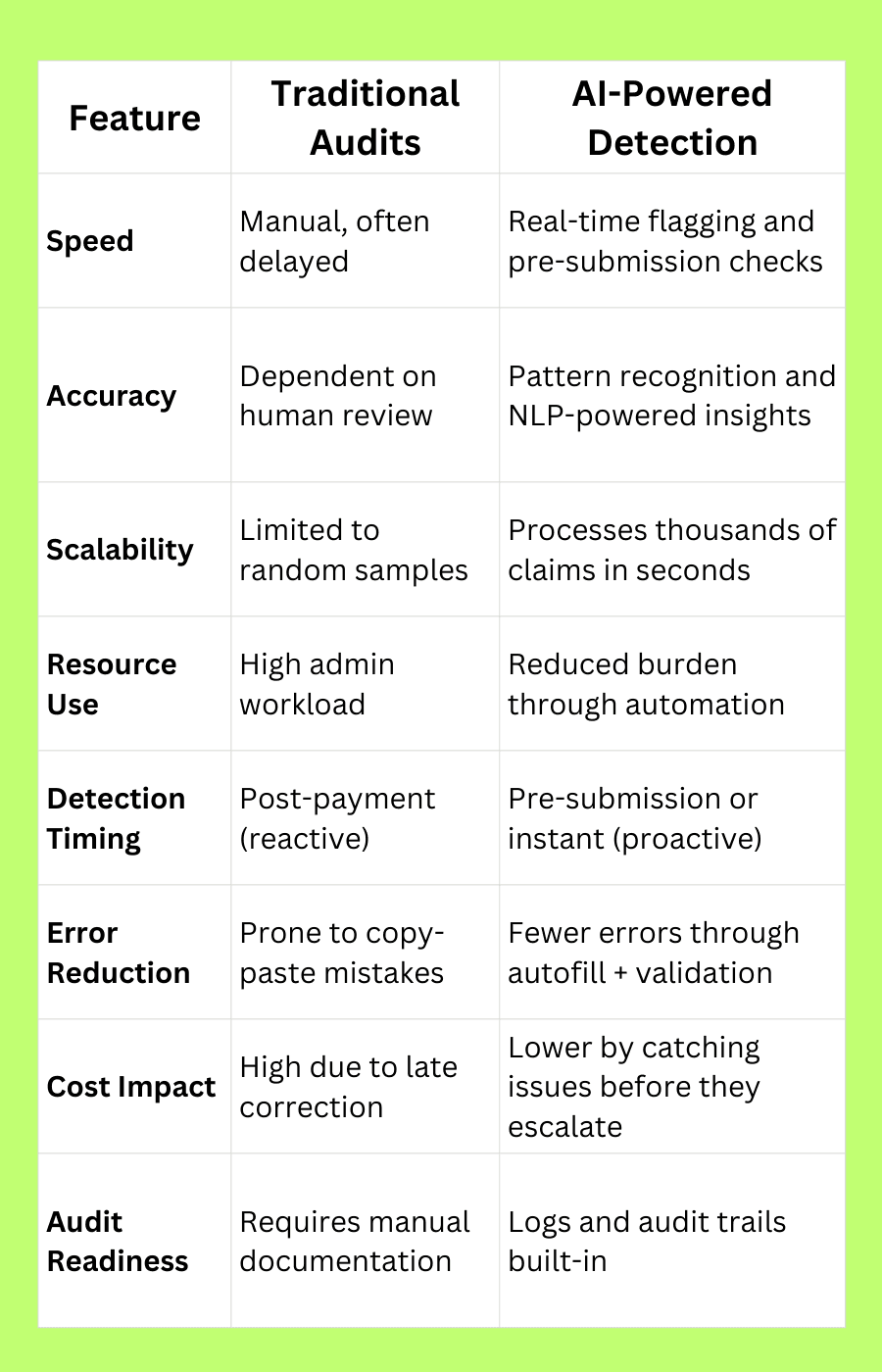
AI doesn’t just make FWA detection possible. It makes it sustainable, scalable, and human-friendly.
Final Thoughts: The Future of FWA Prevention Is AI-Assisted
Healthcare fraud isn’t slowing down.
Neither are billing complexities, payer rules, or audit demands.
But your admin team doesn’t have to keep patching holes with manual work and overreliance on after-the-fact audits.
AI is already changing how leading healthcare teams operate. Not by replacing people, but by making their work more accurate, less repetitive, and way more strategic.
It doesn’t take a complete system overhaul.
It doesn’t require heavy IT resources.
And it doesn’t mean putting sensitive data at risk.
It just means using the right tools to fix the right problems.
Because when your claims are cleaner, your processes are faster, and your staff isn’t stuck triple-checking the same data everyone wins.
The teams that get ahead of fraud now won’t just save time.
They’ll protect their bottom line, reduce burnout, and build workflows that are finally built for this century.
Ready to Save Time and Reduce Risk?
Download the free Magical Chrome extension or book a demo for your team today!
Magical is used at 100,000+ companies and by nearly 1,000,000 people to save 7 hours a week on average, without ripping and replacing your existing systems.
Less fraud. Less waste. Less admin pain. More time back to do what matters.