
The claim was filed.
The codes were correct.
The documentation was complete…or so the admin team thought.
Seventeen days later, the payer flagged the submission for missing a modifier.
A different modifier. The same modifier that had been valid six months ago…until the policy changed with zero notice.
So the clock reset.
Rework.
Resubmission.
More waiting.
Meanwhile, the patient called again to ask why their bill was so high. The billing department shrugged.
The provider rolled their eyes.
Multiply that by a few hundred claims a month and you get the invisible crisis dragging healthcare operations under the surface: noncompliance with payer requirements.
It’s expensive.
It’s messy.
And it’s not getting better with spreadsheets, staff burnout, or “compliance checklists.”
The truth? Most teams aren’t noncompliant because they’re careless.
They’re noncompliant because they’re trapped in outdated workflows that weren’t designed to keep up with shifting payer policies, inconsistent portals, or the demands of today’s reimbursement environment.
The good news? Automation tools (real ones, built for outcomes, not outputs) are finally catching up.
Let’s break down what compliance automation actually looks like in 2025, where it’s already working, and what healthcare admin teams need to know before they fall another step behind.
What Is Payer Compliance (and Why It’s So Hard to Get Right)
Payer compliance refers to how well a healthcare organization follows the rules, documentation standards, and submission protocols required by insurance companies and government payers.
These requirements can touch almost every operational process, from intake to billing to reimbursement, and they’re constantly changing.
Compliance isn’t just about checking boxes. It’s about submitting claims that meet specific formatting rules, timelines, and medical necessity standards. It’s about ensuring documentation aligns with each payer’s unique expectations, and that nothing gets flagged when an audit rolls around.
Here’s where things fall apart.
Payer compliance touches everything. And it touches everything differently.
There’s no single, unified payer policy that every healthcare organization can follow. Instead, compliance means playing by dozens or even hundreds of payer-specific rules.
One insurer may require a prior authorization for a procedure, while another doesn’t. Some reject claims for using outdated ICD-10 codes. Others deny submissions simply because a field was formatted incorrectly.
This inconsistency leads to constant friction.
And the cost is massive. The U.S. healthcare system loses an estimated $16 billion annually due to administrative waste related to payer-provider interactions.
That includes denials, appeals, delays, and errors, most of which stem from breakdowns in compliance workflows.
The regulatory burden is only growing.
Compliance isn’t just dictated by payers. It’s also enforced by regulators.
HIPAA, the Centers for Medicare & Medicaid Services (CMS), and other governing bodies introduce requirements that touch everything from how data is stored to how documentation is submitted.
CMS, for example, continues to push for greater interoperability, more transparency, and stricter prior authorization rules. In 2025, new CMS guidelines will require some payers to support automated prior authorization and provide real-time decisioning tools.
That means healthcare orgs are being held to higher standards, while still using manual tools to meet them.
Siloed systems and manual workflows make it worse.
Most compliance failures happen not because teams don’t know the rules, but because they’re forced to manage workflows across disconnected platforms:
Clinical documentation lives in the EHR
Insurance rules live in PDFs or payer portals
Submission happens through clearinghouses
Audits pull from Excel sheets and email threads
All of these touchpoints create opportunities for human error. And with staffing shortages and burnout already impacting admin teams, those errors are becoming more common.
In one study, manual rework and claim resubmission accounted for up to 40% of revenue cycle team workloads.
Even the most detail-oriented teams are set up to fail when compliance is handled by hand.
Why Manual Compliance Is a Losing Game for Healthcare Admin Teams
There’s a reason why teams are burned out. Manual compliance isn’t just tedious. It’s risky, error-prone, and incredibly expensive.
Every data field is an opportunity to get it wrong.
Manual entry means relying on staff to key in payer-specific details over and over again. Even experienced team members miss something eventually, especially when payer rules shift with little to no warning.
That’s not a reflection of poor performance. It’s what happens when overworked people are expected to remember thousands of tiny, shifting requirements across different insurers, regions, and formats.
A typo in a CPT code.
A missing prior auth number.
A date out of range. These small mistakes create big problems.
In fact, coding and documentation errors are among the top causes of claim denials, accounting for nearly 40% of all rejections in some systems.
Delays ripple through the entire revenue cycle.
Manual compliance doesn’t just cause errors. It slows everything down.
Claims take longer to prepare. Resubmissions require additional time and resources. And in many cases, denied claims simply fall through the cracks.
According to the American Hospital Association, administrative complexity causes over $39 billion in excess healthcare spending annually, and most of it stems from slow or error-filled communication between providers and payers.
These delays directly affect cash flow, team morale, and patient experience.
The audit clock is always ticking.
Healthcare organizations also face another layer of pressure: external audits.
Manual compliance makes it hard to trace decisions, track documentation changes, or prove due diligence. Without an audit trail, even compliant teams look noncompliant when the documentation isn’t centralized and timestamped.
That lack of defensibility becomes a liability, especially in high-volume environments like outpatient rehab or specialty care, where claims are frequent and complex.
Real-world impact: How WebPT scaled smarter with automation
WebPT, a leading rehab therapy platform, was no stranger to payer complexity. Its teams were managing documentation for millions of patient visits annually, across hundreds of different payer relationships.
Before using Magical, their admin teams were stuck in repetitive, manual compliance tasks, like entering the same details into multiple systems or chasing down small formatting inconsistencies.
With Magical, WebPT deployed an AI-powered automation solution that reduced manual entry, improved consistency, and helped the team scale operations without scaling burnout.
Read the full story here: WebPT + Magical Case Study
What Automation in Payer Compliance Actually Looks Like
When most people hear “automation,” they picture macros, rigid templates, or robotic process automation (RPA) that breaks the moment a field changes. But that’s not what modern payer compliance automation looks like in 2025.
Today’s best tools don’t just repeat tasks. They adapt to context, learn payer rules, and support human teams by doing the heavy lifting, accurately and consistently.
Here’s what that actually looks like inside a healthcare admin workflow.
Payer-compliant documentation generated automatically
Instead of relying on staff to copy and paste clinical notes or reformat documents for each insurance portal, AI tools can generate payer-specific documentation instantly. These systems learn the requirements for each payer (down to formatting, required fields, and acceptable ranges) and fill in the gaps before a claim goes out.
That means fewer rejections due to incomplete or inconsistent forms.
Real-time policy validation
Modern automation tools can reference up-to-date payer policies as claims or prior auth requests are being prepared. No more cross-referencing PDFs, payer portals, or internal spreadsheets to confirm if something is covered. The system already knows.
Some platforms even alert teams when a particular claim is likely to get flagged, based on real-time policy data and historical denial trends.
Smart field population and cross-platform syncing
One of the most time-consuming tasks in payer workflows is re-entering the same patient or case information across multiple systems (EHRs, billing platforms, payer portals, and spreadsheets).
With the right automation, those data points are captured once and then populated instantly wherever they’re needed. This reduces not just time, but also the likelihood of data entry errors that lead to compliance issues.
Proactive risk detection
Advanced AI tools can spot patterns in rejections and flag them before they become systemic issues. For example, if a payer starts denying claims with a specific diagnosis code unless a certain modifier is included, a good system can surface that pattern and apply the fix automatically.
This turns compliance from reactive to proactive and protects revenue in the process.
ZoomCare Case Study: 20+ Hours Saved Each Week
ZoomCare, a rapidly growing on-demand healthcare provider, faced mounting pressure from administrative overhead. Their team was losing valuable time to repetitive payer compliance tasks, especially around form population and policy adherence.
By deploying Magical, they enabled their staff to automatically fill in repetitive fields across multiple compliance forms and portals. The result? Over 20 hours of manual work saved per week, fewer mistakes, and a smoother path from service to reimbursement.
See how they did it: ZoomCare + Magical Case Study
Critical Features to Look for in Payer Compliance Automation Tools
Not all automation tools are built the same.
Some are retrofitted RPA systems.
Others are glorified form fillers.
And many don’t understand the nuances of payer compliance at all.
If your goal is to reduce denials, prevent rework, and stay audit-ready, your automation platform should offer more than shortcuts. It should offer outcomes.
Here’s a breakdown of the non-negotiable features you should look for in any compliance automation tool and what each one looks like in action.
Payer Compliance Automation Feature Comparison Table
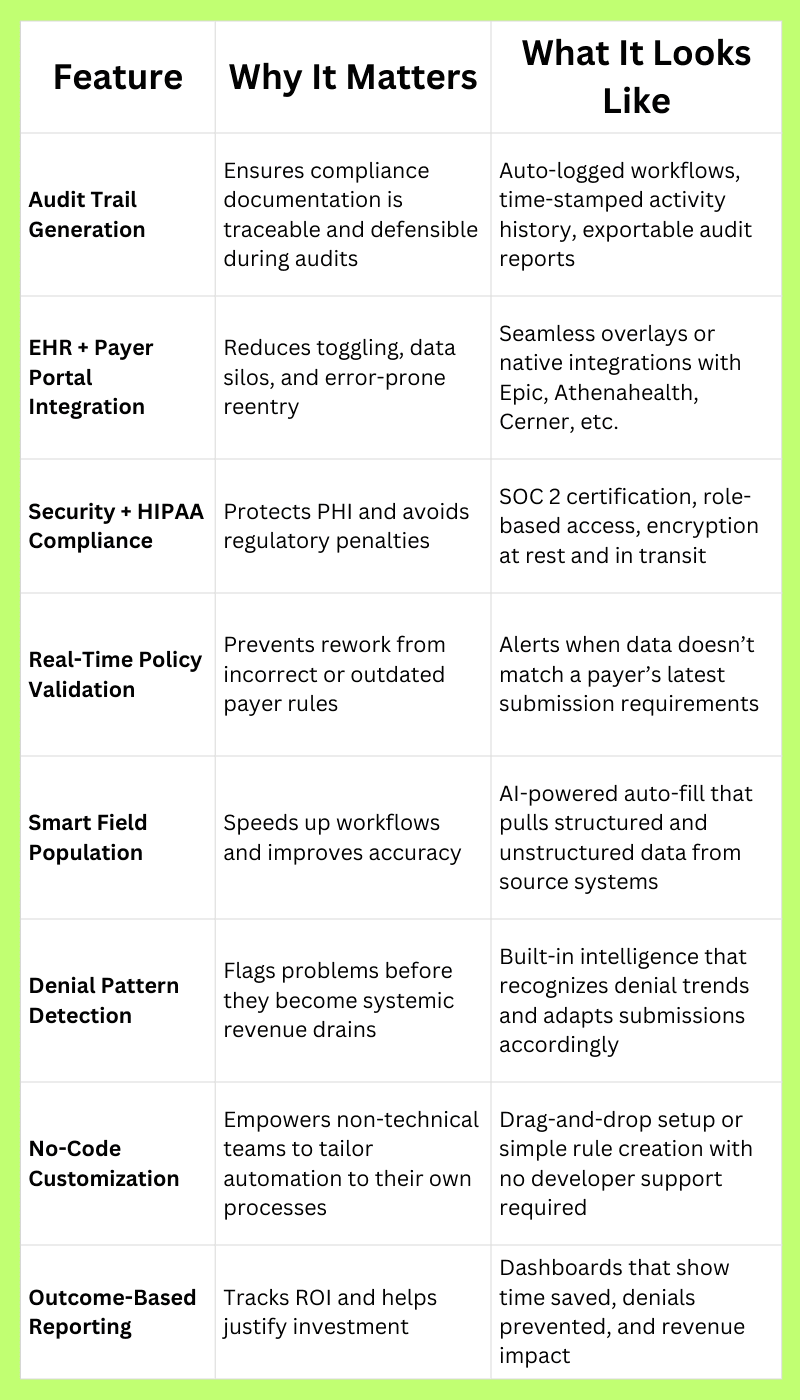
Why These Features Matter Right Now
Healthcare admin teams don’t need more complexity, they need clarity. When compliance tools deliver the features above, they:
Catch errors before claims are denied
Shorten the time from service to reimbursement
Improve audit readiness
Reduce burnout and repetitive data entry
Help organizations scale without needing to hire more admin staff
In short, they create a system that works for the team, not one that creates more work for the team.
How Magical Powers Compliance Without Adding Complexity
Most automation platforms promise efficiency. Few deliver it without a long implementation cycle, IT lift, or steep learning curve. That’s where Magical stands apart.
Magical gives healthcare admin teams an AI workforce that plugs directly into their workflows. No code, no new interfaces to learn, and no complicated onboarding.
The focus isn’t on replacing staff. It’s on giving staff the tools to move faster, make fewer errors, and stay compliant without thinking about it.
Here’s how Magical maps to the core needs of payer compliance automation.
Built for the Actual Workflow, Not Just the Output
Magical doesn’t force teams to rebuild their workflows around a new platform. Instead, it integrates directly into the tools admins already use, like EHRs, billing systems, and payer portals.
With smart field recognition and autofill, it captures key data once, then populates it across every system where it’s needed. That eliminates redundant entry, formatting mismatches, and submission inconsistencies.
Need to verify coverage, generate documentation, and log the entire workflow? Magical does it in the background while your team stays focused on moving work forward.
Secure by Default, Compliant by Design
Every action Magical takes is logged in real-time and visible to admins for review. It supports SOC 2, HIPAA, and enterprise-grade encryption standards, so PHI stays protected at every step.
More importantly, Magical creates an auditable trail, something most admin teams don’t have time to build manually. If a claim is flagged, the team can pull up a time-stamped, auto-generated record of every input and action taken.
No-Code Automation That Learns Fast
Magical trains in minutes, not weeks. Admins can teach it a workflow (like populating a specific payer form or generating pre-auth documentation) without writing a single line of code.
Once taught, Magical adapts. It learns the nuances of different payers and continues to optimize the process, identifying what works best for each workflow and preventing repeat mistakes.
Outcome-Driven, Not Just Activity-Driven
Magical isn’t about task completion. It’s about task impact.
Admin teams can track how many hours they’ve saved, how many denials have been prevented, and how much faster documentation is completed.
That level of transparency helps teams prove the ROI of automation in real numbers, not vague time estimates.
TCPA Case Study: From Overload to Accuracy
The Telephone Consumer Protection Act (TCPA) Compliance Center faced a common challenge: payer-specific documentation requirements that bogged down their staff and introduced costly errors.
Before Magical, compliance tasks were inconsistent and time-intensive. Each submission required manual formatting and validation, with no guarantee that it would meet the payer’s latest rules.
After deploying Magical, TCPA automated the bulk of their payer documentation process. The result?
70% reduction in time spent on compliance tasks
Increased documentation accuracy across the board
More time freed for high-impact work, like patient outreach and service coordination
Read the full story here: TCPA + Magical Case Study
From Reactive to Proactive: The Future of Payer Compliance Is Intelligent
For years, payer compliance has been reactive. A claim gets denied. A task gets reworked. An audit reveals a gap. Teams fix it, retrain, and move on, until it happens again.
That loop is exhausting. It’s also unnecessary.
With the rise of AI-powered, context-aware automation, healthcare teams are shifting to a new model.
One where the system flags problems before they happen, adapts to policy changes in real time, and helps teams avoid denials altogether.
Payer rules are changing too fast for manual tracking. AI keeps up.
Payers adjust their rules constantly. Requirements for prior auths, formatting, supporting documentation, even specific language in notes, it’s all in flux.
Traditional compliance strategies can’t keep up with these changes. But AI systems trained on real-time data can.
Magical, for example, monitors and adapts to shifts in payer expectations. If a payer begins rejecting a particular procedure code unless paired with a modifier, the system identifies that trend, alerts the team, and automatically adjusts the workflow going forward.
That’s not just faster. It’s smarter.
Proactive systems reduce denials before submission.
Denials are costly. But the cost isn't just in rework. It's in the delay.
AI-powered compliance tools use historical data and denial patterns to flag risk before the claim goes out the door. They evaluate each submission for:
Missing or incorrectly formatted fields
Mismatched documentation
Noncompliant language or unsupported codes
Outdated policy references
By doing this pre-submission, AI eliminates the guesswork and gives teams confidence that claims will pass the first time.
The future is not rule-based. It’s learning-based.
Legacy automation relies on fixed rules: “If X, then Y.” But the future of compliance uses machine learning and large language models (LLMs) that understand nuance, learn from prior outcomes, and evolve over time.
That’s what separates basic task automation from true AI-powered workforce automation.
Here’s what that future looks like:
An AI assistant that writes payer-specific documentation based on clinical context
A system that self-updates workflows as payer rules evolve
A tool that learns from past denials to prevent repeat mistakes
A teammate, not just a tool, that augments human judgment and reduces admin pressure
It’s already happening. The only question is whether you’re ready.
Compliance is no longer just about submitting the right form. It’s about creating a system that anticipates what payers will accept and helps your team meet that standard every time.
AI isn’t coming for healthcare admin jobs. It’s coming for the inefficiencies that make those jobs harder than they need to be.
Getting Started: Choosing the Right Tool for Your Compliance Headaches
The idea of overhauling compliance workflows can feel daunting. Most healthcare admin teams are already underwater.
Adding a new tool often sounds like adding more complexity, not less.
But with the right framework, implementation doesn’t need to be disruptive. In fact, it should feel like the first real relief in years.
Here’s how to get started.
Step 1: Run a Quick Compliance Audit
Before looking at solutions, identify your biggest points of friction. Focus on outcomes, not just tasks.
Ask your team:
Where are we seeing the most claim denials?
How many hours per week are spent reworking documentation?
Are our audit logs manual or automated?
How many different payer systems or portals do we use?
Do we know the top 3 reasons our claims get rejected?
If these questions don’t have clear answers, you’re already losing time, money, and defensibility.
Step 2: Define What "Success" Looks Like
What does winning look like for your team?
For some orgs, it’s reducing denial rates. For others, it’s regaining time. For many, it's both.
Here are examples of measurable outcomes that define success:
30% reduction in payer rejections within 90 days
50+ hours per month reclaimed from manual form entry
Audit trail generation that meets regulatory requirements
3x faster turnaround from documentation to claim submission
Choosing automation is easier when you know what you're measuring against.
Step 3: Evaluate Tools with a Simple, Outcome-Focused Framework
Use this framework to assess whether a tool is worth adopting:
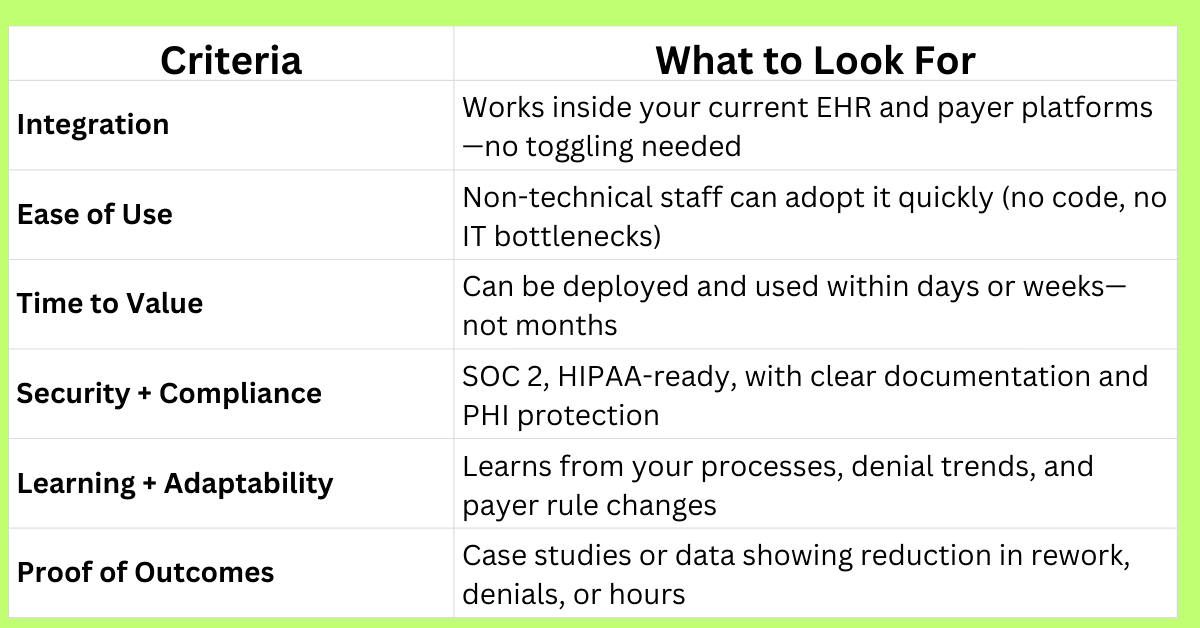
Step 4: Ask the Right Questions Before You Commit
Before selecting a vendor, ask these five questions:
Does this tool integrate with our current systems and portals?
How long does it take to train and deploy for a small team?
What payer processes does it automate out of the box?
Can it adapt to changes in payer rules over time?
How is data secured and audit-logged?
If a vendor can’t answer these confidently, they’re not built for the complexity of healthcare compliance.
Step 5: Start Small, Scale Smart
Roll out automation in phases. Start with a single process, like prior auth generation or claims formatting. Then expand once the team sees results.
This builds momentum, earns buy-in, and minimizes disruption.
Final Thoughts: Compliance Doesn’t Need to Be the Bottleneck
Payer compliance is complex but it doesn’t need to be chaotic.
Healthcare admin teams aren’t failing because they’re underperforming. They’re struggling because they’re forced to manage ever-changing payer rules with outdated, manual tools.
Automation changes that.
Modern compliance tools, especially those powered by AI, aren’t just about moving faster. They’re about moving smarter.
They reduce denials.
They generate documentation accurately the first time.
They help teams shift from reacting to problems to preventing them.
Tools like Magical are already helping organizations like ZoomCare, TCPA, and WebPT reclaim time, reduce risk, and simplify workflows across multiple payer systems.
Download the free Magical Chrome extension or book a demo for your team.
Magical is used at 100,000+ companies and by nearly 1,000,000 users to save 7 hours a week on average.