
They don’t get sick.
They don’t take PTO.
They don’t complain about payer portals, and they never miss a deadline.
And no, they’re not superhuman. They’re not even human.
They’re AI agents, and they’re quietly becoming the most reliable “employees” in healthcare operations.
While your staff is stuck clicking through 12 different screens to process a single denial, AI agents are already:
Pulling patient data from the EHR
Drafting the appeal based on payer rules
Submitting it through the portal
Logging every step for HIPAA compliance
All before your coffee gets cold.
The future of healthcare operations isn’t more bodies in chairs.
It’s smarter, faster, always-on teammates who handle the grind so your human team can focus on the work that needs a human.
And the best part? You don’t have to wait for this future.
It’s here.
Right now.
Let’s meet the AI agents already running the show in healthcare admin.
What Are AI Agents in Healthcare Operations?
An AI agent is a software entity that can understand context, make decisions, and take action across different systems to achieve a specific goal, without constant human direction.
Think of them as digital colleagues who know the rules, can adapt to unexpected changes, and are relentless in getting work done.
How AI Agents Differ From Other Tools
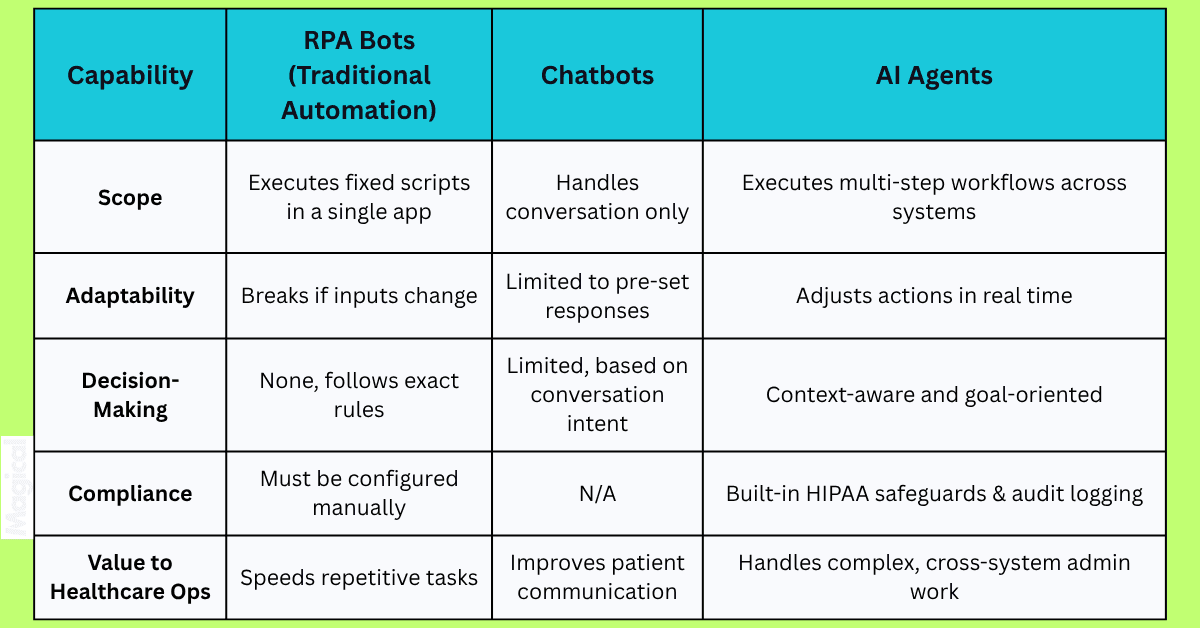
Key Capabilities That Make AI Agents Healthcare-Ready
Context Awareness – Understands payer rules, denial codes, and patient data formats.
Goal-Oriented Execution – Focuses on completing the task outcome, not just following a script.
Cross-System Functionality – Works across EHRs, billing systems, payer portals, and CRMs.
Compliance by Design – HIPAA-aligned workflows, encryption, role-based access, and full audit trails.
Scalability – Runs 24/7 and can handle thousands of cases simultaneously.
Why AI Agents Are Emerging Now in Healthcare
Admin load is unsustainable: Administrative costs make up nearly 30% of U.S. healthcare spending.
Staff shortages are intensifying: 88% of healthcare leaders cite workforce shortages as a top challenge over the next three years (AHA 2024 Workforce Report).
Technology has matured: Browser-based, no-code agents mean deployment can happen in hours (not months) without deep integrations.
AI agents aren’t here to replace healthcare admin teams. They’re here to remove the work that never should have been manual in the first place.
Why Healthcare Needs AI Agents Now
Healthcare admin work is stuck in a dangerous loop: More patients → more claims → more admin tasks → more burnout → fewer staff → even more admin work.
Breaking that cycle requires more than adding headcount or tweaking processes. It requires a scalable, always-on workforce that can handle the volume without sacrificing accuracy or compliance.
Workforce Shortages Are Here to Stay
The American Hospital Association’s 2024 Workforce Report found:
88% of healthcare leaders cite staffing shortages as a top three concern, as stated above
Turnover among non-clinical staff can exceed 25% annually, driven largely by repetitive, low-value work
Even if you could hire fast enough, the talent pool for experienced revenue cycle and admin professionals is shrinking.
Administrative Burden Is Crushing Margins
A Health Affairs analysis estimates administrative costs account for nearly 30% of U.S. healthcare spending.
That’s hundreds of billions annually. Much of this comes from:
Claim rework and appeals
Manual data entry into multiple systems
Redundant verification and documentation steps
Every hour spent on those tasks is an hour not spent improving patient access or experience.
Denials Are Rising and Getting Harder to Rework
According to the Medical Group Management Association (MGMA):
69% of medical groups reported an increase in denials in 2023
Each denial costs an average of $118 to rework (AMA)
Many denials never get appealed due to backlog or missing documentation
Without AI agents, denial queues grow while cash flow slows.
The Tech Gap Is Widening
Many “automation” tools in healthcare:
Only work inside one application
Break when payer forms or portals change
Require heavy IT involvement to maintain
AI agents can work across systems, adapt to changes, and deploy without IT bottlenecks, making them the only realistic solution to keep up with operational demands.
Healthcare operations need a way to do more with the same (or fewer) people while improving accuracy, compliance, and turnaround times. AI agents are built for exactly that.
The Top AI Agents for Healthcare Operations (with Real Use Cases)
The beauty of AI agents is that they don’t just handle one narrow task. They can take ownership of entire workflows.
Here are the top-performing AI agents healthcare teams are using right now, along with the results they’re delivering.
Denial Management Agent: TCPA Case Study
The challenge: TCPA’s billing team was buried under a growing pile of denials. Each one required locating denial codes, pulling documentation from the EHR, logging into payer portals, filling forms, and tracking appeals—a process that could take up to 20 minutes per denial.
The AI agent solution:
Detects denials as soon as they appear in the billing system
Matches each denial code to payer-specific appeal requirements
Pulls supporting documents from the EHR automatically
Drafts and submits the appeal in the correct portal format
Logs every action for HIPAA compliance
The impact:
50% faster denial rework time
More recovered claims before deadlines
Reduced staff burnout from repetitive rework
Referral Management Agent: WebPT Case Study
The challenge: WebPT’s team had to navigate multiple systems for patient referrals—EHRs, payer portals, and document uploads—creating delays and risking missed patient appointments.
The AI agent solution:
Identifies new referrals needing action
Gathers all necessary patient and provider data from the EHR
Populates payer forms accurately
Uploads supporting documentation and submits for approval
Tracks referral status automatically
The impact:
Faster referral turnaround times
Fewer lost or delayed referrals
Improved provider and patient satisfaction
Read the full WebPT case study
Intake-to-CRM/EHR Update Agent: ZoomCare Case Study
The challenge: ZoomCare’s admin team spent hours every day transferring intake form data into the CRM/EHR, prone to typos, missed fields, and duplicate records.
The AI agent solution:
Reads patient intake forms directly from the intake system
Formats and inputs data into CRM/EHR fields automatically
Creates or updates patient records with zero manual re-entry
Flags exceptions for human review when data is incomplete
The impact:
100% clean, accurate patient records
Zero duplicate record creation
Staff time redirected to patient engagement
Read the full ZoomCare case study
Prior Authorization Agent
The challenge: Prior authorizations delay care when they’re incomplete or submitted late.
The AI agent solution:
Monitors for cases requiring prior auth
Compiles necessary documentation from the EHR
Submits requests through payer portals
Tracks approval status and escalates if delayed
The impact:
Reduced patient treatment delays
Higher approval rates on first submission
Eligibility Verification Agent
The challenge: Verifying insurance eligibility is tedious and often left until the last minute.
The AI agent solution:
Runs eligibility checks automatically ahead of appointments
Updates patient records with coverage details
Flags discrepancies for follow-up
The impact:
Fewer last-minute cancellations
Improved billing accuracy and cash flow
5 Benefits of Deploying AI Agents in Healthcare Admin
When AI agents take over the repetitive, rules-based, cross-system work that clogs up your day, the benefits go far beyond “saving time.”
1. Dramatic Time Savings at Scale
AI agents work 24/7, never wait for logins, and never get distracted.
A single agent can process hundreds of cases in the time it would take a human to handle a fraction of that volume.
Stat: Healthcare organizations using automation save an average of 7 hours per employee per week (Magical internal data, 2025).
2. Higher Accuracy, Fewer Errors
Agents pull data directly from source systems, removing the risk of typos and copy-paste mistakes.
Every action is logged automatically, so you can trace exactly what happened in an audit.
Stat: Administrative errors cost the U.S. healthcare system $21 billion annually (CAQH Index, 2023)—much of which is preventable.
3. Compliance by Design
HIPAA safeguards are built into the workflow, no bolted-on solutions or risky workarounds.
Role-based access ensures only the right people (or agents) see sensitive data.
Audit logs keep you ready for inspections or investigations at all times.
4. Reduced Staff Burnout
Removing the most mind-numbing, repetitive tasks means staff can focus on work that requires human judgment and patient interaction.
Stat: 40% of healthcare admin staff report burnout, often from repetitive tasks (MGMA, 2024).
5. Faster Patient Access to Care
With agents handling prior auth, eligibility checks, and referral submissions, bottlenecks that delay patient care disappear.
Faster admin cycles mean earlier treatment starts and better patient satisfaction scores.
AI agents aren’t just a cost-saver; they’re a capacity multiplier.
They help you do more, do it better, and do it without hiring in an already competitive labor market.
How to Choose the Right AI Agents for Your Organization
Not all AI agents are created equal.
Choosing the right ones for your healthcare operations means matching the biggest operational pain points with the workflows agents can own from start to finish.
Start With Your Bottlenecks
Ask: Where is my team losing the most time or money?
High-volume denial rework
Referral delays
Manual data entry between systems
Prior auth backlogs
Eligibility checks
Magical Tip: If it’s repetitive, rules-based, and spans multiple systems, an AI agent can likely take it over.
Prioritize Measurable Outcomes
Look for workflows where you can track:
Time saved per case
Increase in completed cases per week
Reduction in error rate
Revenue recovered or accelerated
Case in point:
TCPA → Cut denial rework time by 50%
WebPT → Reduced referral delays and improved patient scheduling
ZoomCare → Achieved 100% clean patient records without re-entry
Choose No-Code Deployment
Traditional automation tools require IT bandwidth you probably don’t have. With Magical:
Agents run directly in your browser
No deep integrations needed
Deployment happens in hours, not months
Demand Compliance by Default
In healthcare, compliance can’t be an afterthought. Look for:
HIPAA-aligned workflows
Role-based access controls
Automatic audit trails for every action
Partner With a Proven Vendor
Ask potential vendors:
Do you have healthcare-specific case studies?
Will you sign a Business Associate Agreement (BAA)?
How quickly can you launch my first agent?
What’s your track record with multi-system workflows?
Getting Started with AI Agents (Without Replacing Your EHR)
The fastest way to stall an innovation project in healthcare? Make it sound like a six-month IT overhaul.
The truth is, you can deploy your first AI agent without touching your EHR or replacing a single system you already use.
Step 1: Pick One Workflow
Choose something:
High volume
Clearly defined
Easy to measure before-and-after results
Examples from real Magical customers:
TCPA → Denial management
WebPT → Referral processing
ZoomCare → Intake-to-EHR updates
Step 2: Define the Outcome, Not the Steps
Traditional automation maps every click. AI agents start with the goal and adapt their path.
Instead of:
“Log into the portal, paste this info, click submit”
Think:
“Submit this denial appeal with all required documentation.”
Step 3: Deploy in Hours, Not Months
With Magical:
Agents run in your browser, no API integrations needed
Setup can be done by your ops team, not just IT
HIPAA compliance is built in from day one
Step 4: Test and Prove Value
Run the agent alongside your existing workflow for a short trial
Track time saved, errors reduced, and outcomes achieved
Use those metrics to make the case for scaling
Step 5: Scale to Other Workflows
Once you’ve proven the impact in one area, expand to:
Prior auth
Eligibility verification
Patient scheduling
Claims follow-up
The Future of Healthcare Operations is Agentic
The first wave of automation in healthcare was about replacing clicks.
The next wave (powered by agentic AI) is about replacing entire workflows.
From Task Automation to Workflow Ownership
Agentic AI doesn’t just execute instructions.
It understands the desired outcome, chooses the right steps, and adapts in real time when systems, rules, or formats change.
Think of them as autonomous teammates:
Always available
Always compliant
Always working toward the finish line
Multi-Workflow Orchestration
Soon, AI agents won’t just handle one process at a time. They’ll coordinate across workflows:
Denial management feeding into cash flow forecasting
Eligibility checks triggering appointment scheduling
Referral processing linked directly to prior auth workflows
This isn’t a “maybe someday” concept. It’s already starting to happen.
Why Magical Is Ahead of the Curve
Agents run in the browser, so they work with any system you already have
HIPAA compliance and audit trails are built in from day one
No-code deployment means your team controls its own automation roadmap
Proven results with real healthcare teams like TCPA, WebPT, and ZoomCare
The organizations that adopt agentic AI now won’t just survive the next wave of healthcare admin challenges. They’ll thrive with a leaner, faster, more resilient operation.
Final Thoughts: Your New Best Hire Isn’t Human
The healthcare admin grind isn’t going away.
But it doesn’t have to keep eating your team’s time, energy, and focus.
AI agents can take full ownership of the workflows that bog you down, from denial rework to referral processing, while your human team focuses on work that truly needs human judgment.
That’s not theory.
It’s what TCPA, WebPT, and ZoomCare are already doing with Magical today.
Try Magical Free or Book a Demo
Install the free Magical Chrome extension to start saving hours this week
Book a personalized demo to see how AI agents fit your existing workflows, without replacing your systems
Over 100,000 companies. Nearly 1 million users.
7 hours saved per person, per week.
Your team doesn’t need more meetings, more headcount, or another “automation” tool that breaks when things change.
They need a partner that gets the work done.
With Magical, they’ve got one.