
There’s no such thing as a “quick fix” in healthcare operations.
The intake queue is backed up.
Claims are aging in the AR bucket.
A new insurance policy update just broke your team's six-step billing workflow.
And the only thing more constant than administrative chaos… is the copy-paste fatigue that fuels it.
Most teams aren’t short on talent. They’re short on time.
Time lost to swivel-chair tasks, disconnected systems, and automation that’s only as smart as the script someone wrote three months ago.
The uncomfortable truth is that traditional automation doesn’t scale in healthcare.
Not when every workflow is a moving target.
But AI agents do. And not in theory, in practice.
Today.
What follows isn’t a hype piece.
It’s a breakdown of how healthcare ops teams are reshaping their processes one workflow at a time. By deploying AI agents that don’t just move data, but understand it.
What Is an AI Agent? (And Why It’s Not Just a Smarter Bot)
To be clear, an AI agent isn’t just a bot with a better résumé.
It doesn’t wait for exact instructions.
It doesn’t crumble when a field changes on a web form.
And it doesn’t just automate steps. It achieves outcomes.
So What Is an AI Agent?
In simple terms, an AI agent is an autonomous digital worker that can:
Understand a goal
Analyze the surrounding context
Plan the necessary actions
Execute steps in real systems
Adjust behavior if the situation changes
The technical community defines this as agentic behavior: the ability of an AI to act independently and purposefully toward a specific goal.
According to Stanford’s Center for Research on Foundation Models, agentic AI represents a new paradigm of AI that combines planning, reasoning, and acting within dynamic environments.
In other words, it thinks before it clicks.
Why Healthcare Needs This Shift Now
In healthcare administration, processes aren’t just repetitive. They’re variable, complex, and constantly evolving. A 2023 McKinsey report found that up to 25% of administrative tasks in healthcare are automatable, but only if the automation is smart enough to handle variation and exceptions.
That’s where traditional bots break down. They rely on:
Predefined scripts
Rigid task sequences
Human babysitting when something goes off-script
They work fine for simple, high-volume, low-variation tasks. But for workflows like prior authorization, denial appeals, or multi-system data entry, static automation simply can’t keep up.
AI Agents, on the Other Hand...
Can read and interpret structured and unstructured data (e.g., denial reason codes, policy language, patient records)
Are trained to reason and choose the next best step without being told exactly what to do
Can operate within constraints like HIPAA policies, system logins, and approval loops
Can improve over time by learning from interactions (within safe, auditable boundaries)
And unlike legacy RPA platforms, agents like those powered by Magical are no-code, HIPAA-compliant, and designed to be deployed directly by operations leaders, not just engineers.
Real Example: Bot vs. Agent
Scenario: A claims denial is received due to missing medical necessity documentation.
Traditional Automation: Flags the denial and sends it to a human. Stops there.
AI Agent: Reads the denial reason, checks the patient record, finds the missing document, attaches it to a corrected claim, and resubmits or routes to a supervisor if a manual decision is needed.
That’s not just automation. That’s intelligent collaboration between humans and machines.
Think of It This Way:
A bot follows rules.
An AI agent follows intent.
The Five Healthcare Workflows Being Reimagined by AI Agents
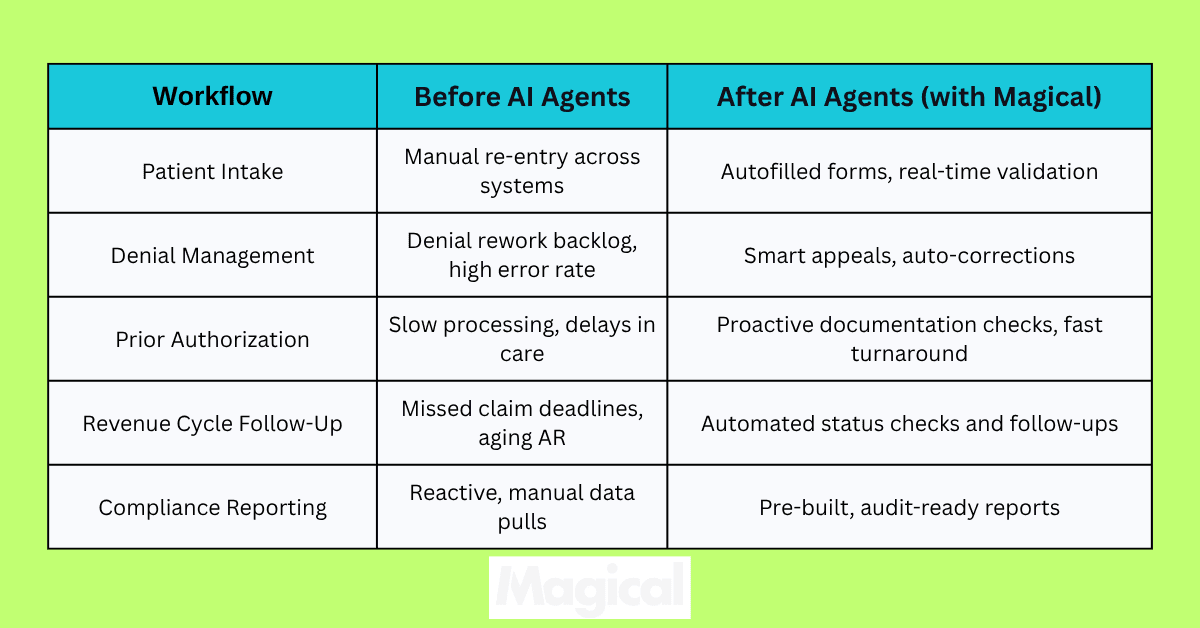
AI agents aren’t theoretical anymore. They’re already taking the weight off admin teams by stepping into the workflows that once demanded late nights, highlighter markers, and two monitors.
Below are five high-friction workflows where agentic AI is quietly doing its best work. One click, one claim, one workflow at a time.
1. Patient Intake & Registration
The Problem: Intake teams juggle disconnected forms, portals, and EHR systems. Patient info is entered and re-entered across systems, creating delay, fatigue, and mistakes.
75% of providers still rely on manual data entry at some point in the patient intake process.
What AI Agents Do Differently:
Pull patient data from submitted forms or existing systems
Autofill downstream forms (EHR, CRM, payer portals) with context-aware field matching
Identify incomplete or conflicting data before it causes bottlenecks
Impact:
Speeds up registration without sacrificing compliance
Frees up staff to handle edge cases or escalations
Reduces form errors, duplicate entries, and intake delays
2. Claims Denial Management
The Problem: Denials clog up revenue. Teams spend hours chasing down codes, resubmitting with corrections, or escalating to billing managers.
Over $262 billion in claims are denied annually, with 86% of denials being potentially avoidable.
What AI Agents Do Differently:
Detect denial reason from EOBs or payer portals
Cross-reference with patient documentation and payer rules
Suggest or automatically execute resubmission steps
Track appeal status and learn from outcomes
Case in Point: WebPT reduced their denial backlog using Magical’s AI workforce, saving hours each week and increasing revenue recovery.
3. Authorization & Referrals
The Problem: Manual prior authorizations cost time, delay care, and frustrate patients.
On average, providers spend 13 hours per week on prior authorization tasks.
What AI Agents Do Differently:
Validate documentation against payer requirements
Auto-populate and submit prior auth forms
Flag missing information before submission
Route exceptions to clinical or billing leads
Impact:
Reduces the number of denied or delayed authorizations
Speeds up patient access to care
Lessens operational drag on nursing and admin teams
4. Revenue Cycle Follow-Up
The Problem: Once claims are submitted, follow-up often falls apart. Aging AR, lost time, and missed reprocessing windows = money left on the table.
67% of provider organizations say their RCM performance has declined in the past year due to operational inefficiencies.
What AI Agents Do Differently:
Monitor payer portal status updates
Trigger actions based on claim aging thresholds
Automatically log and escalate issues to billing managers
Consolidate multi-payer updates into one view
Impact:
Keeps AR moving without adding headcount
Recovers payments faster
Flags patterns for strategic insight
5. Regulatory Reporting & Compliance Audits
The Problem: Compliance tasks are often rushed, retroactive, and riddled with human error.
Healthcare compliance-related admin costs are estimated at $39 billion per year.
What AI Agents Do Differently:
Aggregate data from multiple systems (EHR, claims, internal logs)
Build pre-formatted reports with audit-ready documentation
Highlight anomalies, missing fields, or risk flags
Maintain real-time audit trails with logic mapping
Impact:
Saves time during audits and reduces panic-prep cycles
Ensures consistent reporting standards
Supports internal quality review and external audits
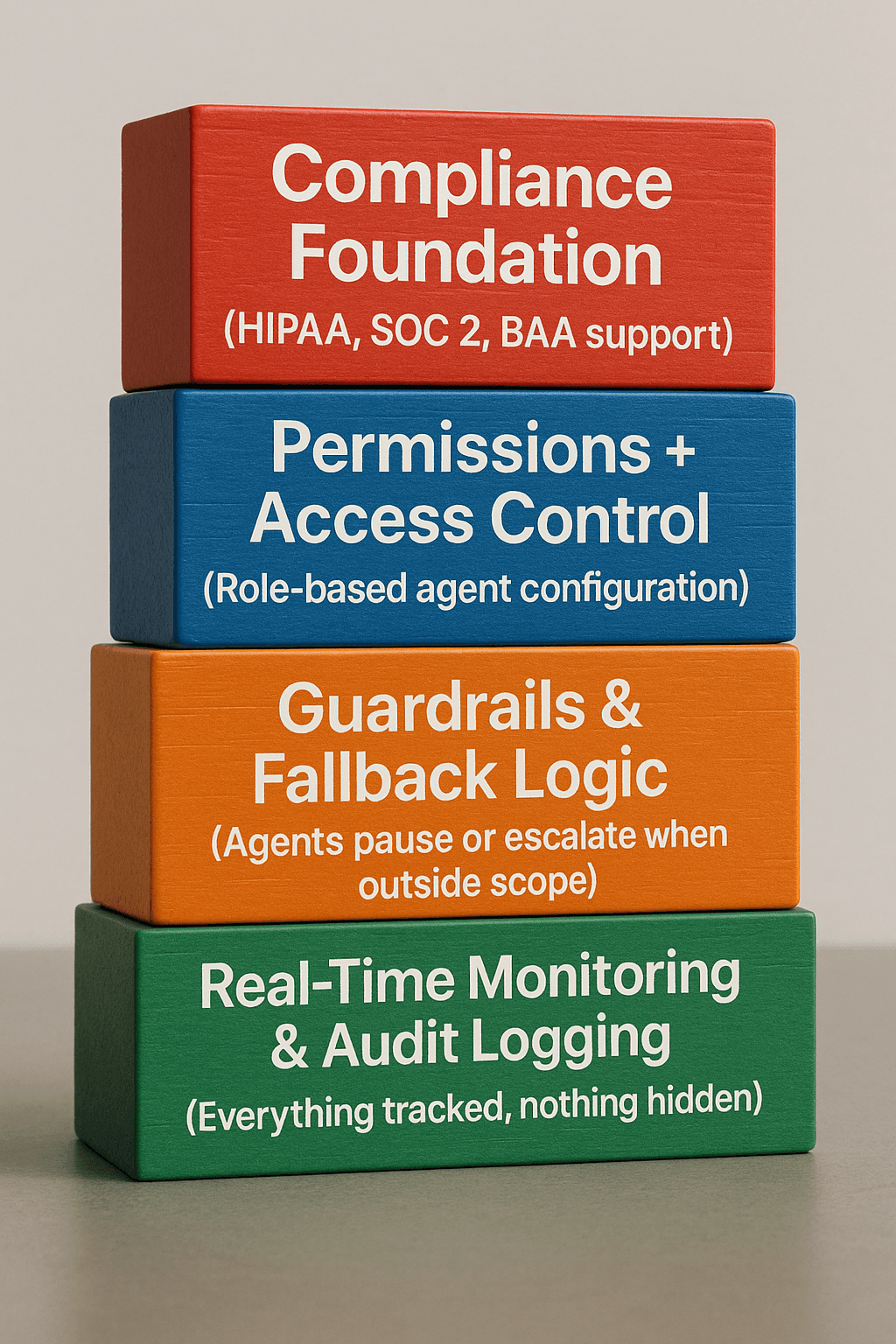
What Makes AI Agents Safe for Healthcare?
Autonomy sounds risky, especially in healthcare. But here’s the thing:
AI agents don’t mean less control. They mean smarter control.
With the right guardrails, agentic AI doesn’t threaten compliance. It enhances it. The key is choosing technology designed for healthcare-grade standards from day one.
Built for Compliance, Not Retro-Fitted for It
Many automation tools were built for general business use, then “adapted” for healthcare. That’s not good enough.
Magical’s AI agents are engineered with privacy, security, and auditability baked in, not bolted on. That means:
End-to-end HIPAA compliance
SOC 2 Type II certification
User-specific access controls and permissions
Data encryption in transit and at rest
More than checkboxes, these are structural guarantees. (See Magical’s Security Commitment for the full breakdown.)
Agents Operate Inside Guardrails
Autonomy doesn’t mean chaos. In fact, AI agents work within clearly defined parameters:
What systems they can access
What data they can touch
What actions they’re allowed to take
Who gets notified when human input is needed
If they encounter a situation they can’t resolve confidently, they pause and escalate, rather than taking a risky guess.
This is what makes AI agents viable in healthcare: they’re not guessing; they’re reasoning within your rules.
Full Audit Trails, Always
One of the biggest compliance pain points? Documentation. Especially during audits or payer disputes.
Magical’s AI agents automatically generate comprehensive logs of:
Every action taken
Why it was taken
When and where it happened
What system it occurred in
That means full traceability, whether you're dealing with an internal QA check or a CMS compliance audit.
Real Example: ZoomCare’s Guardrails in Action
ZoomCare uses Magical’s AI agents to automate appointment workflows and patient data updates. Every agent action is logged, monitored, and governed by strict access policies.
Result: More efficient operations, without compromising privacy or compliance.
Real-World Results: What Happens When AI Agents Go Live
You don’t need a vision board or a 12-month IT roadmap to start using AI agents.
You need one painful workflow, and a platform built for healthcare-grade automation.
That’s what leading organizations like WebPT, ZoomCare, and TCPA have already discovered by putting Magical’s AI agents to work in their real-world ops.
Here’s what happened next.
WebPT: Crushing Denial Rework With Smart Workflow Automation
The challenge: Denial rework was creating costly bottlenecks across billing teams, with claims stalling due to manual corrections, incomplete data, or misrouted follow-ups.
The agent-powered solution:
Magical agents now read denial codes, match them to payer policy logic, and assist with resubmission workflows in real time, without IT intervention.
The result: WebPT significantly reduced their denial backlog, saved hours per agent each week, and accelerated reimbursement timelines.
See the full case study → WebPT + Magical
ZoomCare: Empowering Admin Teams to Automate, Without Code
The challenge: ZoomCare needed a way to automate repetitive admin tasks across appointment scheduling and patient record management, without waiting on engineering support.
The agent-powered solution:
Ops leaders built and deployed AI agents themselves—using Magical’s no-code platform.
Agents now move data between scheduling platforms, ensure record consistency, and eliminate duplicative entries.
The result: Improved operational accuracy, faster scheduling updates, and reduced tech debt across departments.
See the full case study → ZoomCare + Magical
TCPA: Securing Scale With Compliance at the Core
The challenge: TCPA’s growing patient volume demanded automation, but HIPAA compliance, security, and data integrity were non-negotiable.
The agent-powered solution:
Magical’s HIPAA-compliant, audit-ready agents helped TCPA automate patient info updates and workflow logging without exposing PHI to risk.
The result: Greater throughput in admin operations—and full confidence that automation wouldn’t compromise trust or compliance.
See the full case study → TCPA + Magical
The Pattern Is Clear
Across each of these orgs, success didn’t start with a massive overhaul.
It started with one broken workflow, one ops leader who said: “We’re not copy-pasting our way through another quarter,” and one AI agent trained to fix it.
Why “One Workflow at a Time” Is the Secret to Success
Here’s what no one tells you about AI transformation:
You don’t need a full-stack implementation plan. You don’t need buy-in from six committees. You don’t even need to know how to define “agentic AI.”
You need one messy, manual workflow and the green light to stop doing it the old way.
Big ROI Doesn’t Require Big Rollouts
Every AI success story you’ve seen (ZoomCare, WebPT, TCPA) started with one pilot. One broken process. One ops lead who saw the copy-paste hamster wheel and said, “No more.”
That’s not just convenient. It’s strategic.
Because when you improve one workflow:
You validate the tech
You prove value to leadership
You build trust across teams
You uncover repeatable patterns
And then? You scale. With momentum instead of resistance.
How to Identify an Agent-Ready Workflow
Not all admin tasks are ready for agents. But many are. Start by looking for workflows that check these boxes:
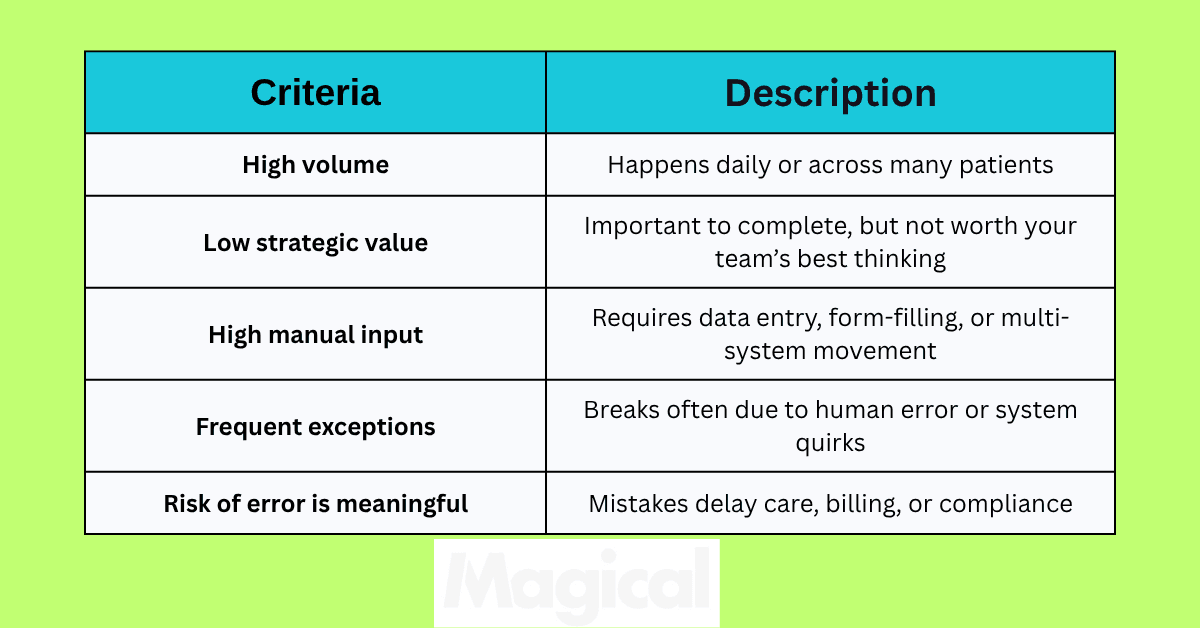
If a task meets three or more, it’s a strong candidate for agentic automation.
A clean, printable-style checklist of the five criteria above, branded with Magical's style—perfect for embedding or linking as a resource.
Start Small. Scale Smart. Move Fast.
Magical’s platform is built for this kind of rollout:
Deploy agents without engineering help
Stay HIPAA-compliant from day one
Track outcomes in real-time dashboards
Add more workflows as trust grows
This isn’t a rip-and-replace moment. It’s an upgrade, one workflow at a time.
Final Thoughts: Getting Started with Magical’s AI Workforce
You don’t need a room full of engineers. You don’t need an overhaul. And you definitely don’t need another quarter of burnout, backlog, and broken workflows.
What you need is a smarter way forward, one workflow at a time.
That’s exactly what Magical delivers: AI agents that are autonomous, compliant, and built for real-world healthcare admin teams.
With Magical, you can:
Deploy AI agents that actually understand your workflows
Stay HIPAA-compliant from day one
Automate without code, IT tickets, or risk
Track performance, learn, and scale on your terms
Trusted by the Teams That Keep Healthcare Running
Magical is already used by nearly 1,000,000 professionals at 100,000+ companies, including forward-thinking healthcare orgs like ZoomCare, TCPA, and WebPT. Teams using Magical save an average of 7 hours per week, per user, without sacrificing compliance or control.
You can get started today free.
Try Magical Free or Book a Demo
Install the free Magical Chrome extension to start saving time instantly
Book a personalized demo to see how AI agents can reshape your team’s workflows
One agent. One workflow. One game-changing shift in how healthcare admin work gets done.