
Healthcare admin has been “getting automated” for over a decade.
And yet… your team is still drowning in denials, chasing missing documentation, and copy-pasting patient data across more tabs than you can count.
The tools promised to fix this.
Instead, they gave you:
More logins
More “process change” meetings
More half-finished automations that work great until the payer portal updates a field
Somewhere along the way, “automation” stopped meaning less work and started meaning different work, most of it still manual.
The truth?
It’s not your people.
It’s not your workflows.
It’s the kind of automation you’ve been sold.
Traditional automation follows a script. When the real world changes, it breaks.
Intelligent automation understands the job, adapts on the fly, and finishes the work, without forcing you to babysit it.
This isn’t about replacing your team.
It’s about finally giving them a partner that can handle the admin grind without adding another system-shaped headache.
What “Intelligent Automation” Really Means in Healthcare
“Automation” has become the duct tape of healthcare admin. It’s used to patch together broken workflows, speed up repetitive clicks, and make leadership feel like they’re “innovating.”
The truth is, not all automation is intelligent. And in healthcare, the difference matters more than anywhere else.
Defining Intelligent Automation (IA)
At its core, intelligent automation combines:
Automation – the ability to execute tasks without manual intervention.
Artificial Intelligence – the ability to understand context, make decisions, and adapt to changes.
Human Oversight When Needed – the safety net for edge cases, exceptions, and compliance-critical workflows.
Instead of just following a rigid script (“If X, then Y”), intelligent automation can:
Interpret data in context
Adapt when formats, systems, or rules change
Decide the best next action to achieve the desired outcome
Execute across multiple systems, not just one
This is crucial in healthcare, where payer rules, regulations, and patient data requirements shift constantly.
How IA Differs From Traditional Automation in Healthcare
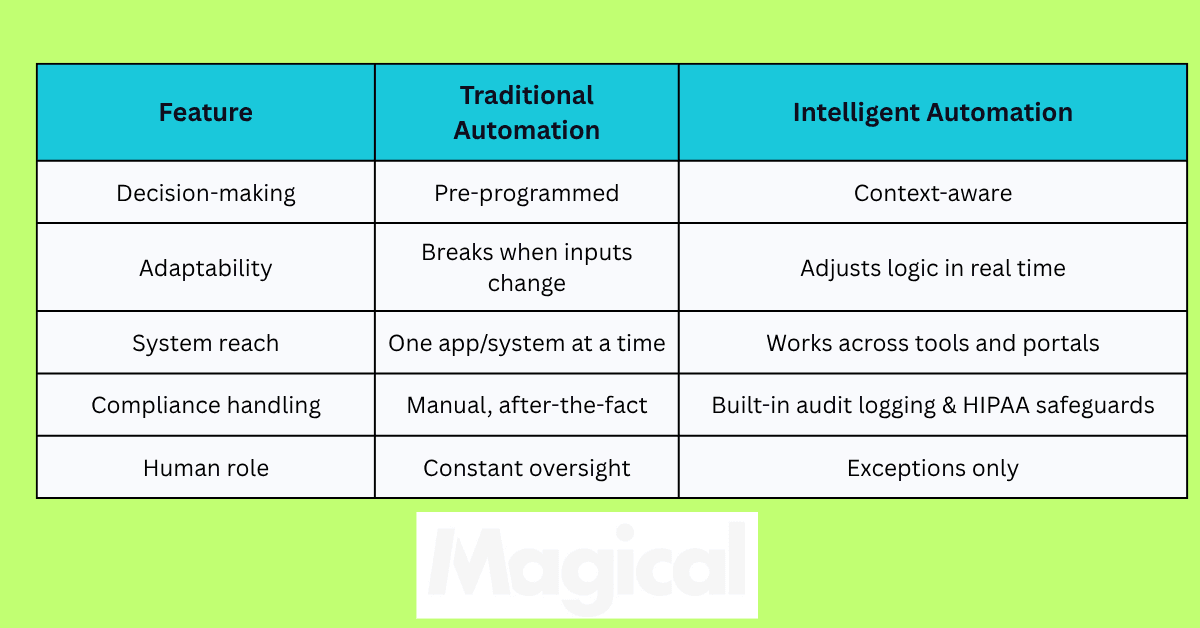
Why It Matters Now
Healthcare admin workloads are heavier than ever:
A 2023 MGMA study found 69% of medical groups reported increased claim denials year-over-year.
The American Medical Association estimates each claim denial costs an average of $118 to rework, and many are never recovered.
Admin staff burnout rates are at historic highs, with 1 in 3 healthcare workers considering leaving their job.
Traditional automation can speed up parts of these processes. But it can’t adapt when something unexpected happens.
Intelligent automation doesn’t just move faster. It moves smarter, making it possible to scale high-quality admin work without adding headcount.
Why Traditional Automation Falls Short in Healthcare
Healthcare workflows aren’t simple, linear processes. They’re living, breathing ecosystems full of exceptions, dependencies, and regulations.
And that’s exactly where traditional automation breaks.
It Can’t Handle Workflow Variability
Most healthcare admin processes change depending on:
Payer-specific requirements
Patient eligibility status
Provider specialty
State regulations
Missing or incomplete documentation
A rules-based bot doesn’t think, it just follows instructions.
When something doesn’t match the script, like a denial code the system hasn’t seen before, it stops. Or worse, it completes the task incorrectly without flagging it.
It Lives in Silos
Traditional automation often works inside one application. That’s fine for invoice processing in accounting.
But in healthcare, critical workflows jump between:
EHRs
Billing software
Payer portals
CRMs
Secure messaging systems
If the automation can’t cross those silos, the human still has to bridge the gap by clicking, copying, pasting, and reformatting.
Result: The process isn’t truly automated; it’s just broken into smaller manual chunks.
It Adds IT Overhead
Traditional automation projects require:
Weeks (or months) of mapping every possible workflow path
Custom coding or scripting
Ongoing maintenance when systems or forms change
Instead of freeing up staff, it often locks up IT resources and leaves frontline teams waiting for fixes.
It Doesn’t Think About Compliance Until It’s Too Late
In healthcare, automation can’t be an afterthought when it comes to HIPAA:
Every data touchpoint needs encryption
Every action needs an audit trail
Every user and bot needs controlled access
Many legacy tools weren’t built with these requirements at their core, making them a compliance liability.
Stat Spotlight:
Nearly 50% of healthcare leaders say their current automation tools don’t integrate well with other systems.
The average U.S. hospital uses 16 disparate EHR or health IT systems (AHIMA). That’s a nightmare for siloed automation.
Traditional automation can move faster, but it can’t think smarter.
And in healthcare, “smart” isn’t optional. It’s the only way to keep up with shifting rules, high volumes, and zero-error expectations.
How Intelligent Automation Works
If traditional automation is a train on fixed tracks, intelligent automation is a self-driving vehicle. It knows the destination, can adjust its route, and navigates obstacles along the way.
Intelligent automation combines AI-powered decision-making with hands-on execution across your systems, all while keeping compliance in check.
Here’s what that looks like in action.
Core Components of Intelligent Automation in Healthcare
Context Awareness
Reads and understands the data it’s working with
Knows payer rules, denial codes, and documentation requirements
Adjusts behavior if inputs don’t match the expected pattern
Cross-System Execution
Operates in multiple platforms without stopping at system boundaries
Moves from EHR to billing software to payer portal without human intervention
Built-In Compliance
HIPAA alignment from day one
Full audit trails for every action taken
Role-based access to protect PHI
Human Oversight Only When Needed
Escalates edge cases, incomplete records, or compliance exceptions
Leaves routine, high-volume work to the agent
Example: Denial Rework With Intelligent Automation (TCPA Case Study)
Before Magical:
TCPA’s billing team manually identified denials, pulled records, drafted appeals, and submitted them via payer portals.
Each denial could take 15–20 minutes to process.
Backlogs were common during high-volume periods.
With Magical:
An intelligent automation agent detects new denials in the billing system.
Cross-checks payer rules and documentation requirements.
Gathers supporting documents from the EHR.
Drafts and submits the appeal in the correct format.
Logs every action for compliance.
Result: 50% faster denial rework time, fewer missed deadlines, and recovered revenue that would otherwise have been lost.
What Intelligent Automation Looks Like
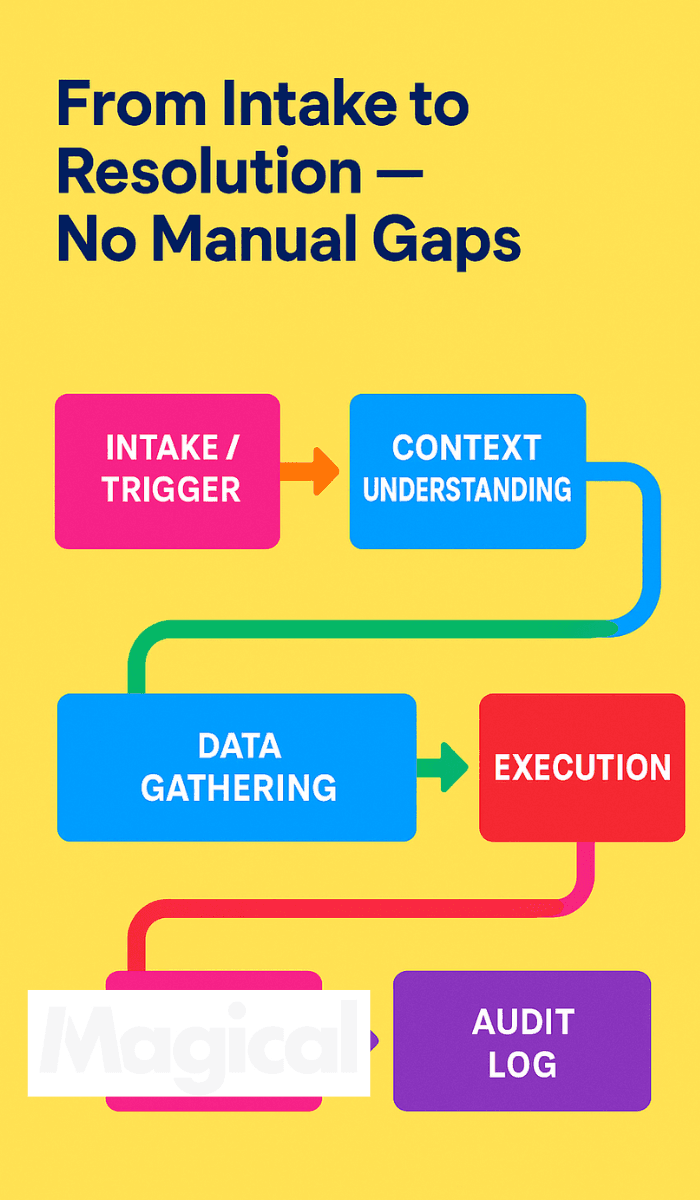
Intelligent automation isn’t just “automation plus AI.” It’s a different way of working.
Instead of speeding up parts of the process, it takes full ownership of the outcome.
Real-World Applications of Intelligent Automation in Healthcare Admin
The easiest way to understand intelligent automation is to see it at work.
Across billing, intake, and referral management, it’s already removing bottlenecks, eliminating copy-paste errors, and recovering revenue for real healthcare teams.
Here are three proven examples from healthcare organizations using Magical today.
1. Denial Management: TCPA
The challenge: TCPA faced a growing backlog of insurance denials. Each case required:
Locating denial reasons in the billing system
Gathering supporting documentation from the EHR
Submitting appeals through payer portals
Tracking each case to resolution
Manual processing could take 15–20 minutes per denial, and even longer for complex cases.
The intelligent automation solution:
Agent detects denials the moment they appear
Matches denial codes with payer-specific appeal rules
Pulls required documents from the EHR
Drafts and submits appeals in the correct format
Logs every step for HIPAA compliance
The impact:
50% faster denial rework time
More claims recovered before deadlines
Reduced burnout from repetitive, low-value work
2. Referral Management: WebPT
The challenge: WebPT’s team handled a high volume of patient referrals, many of which required:
Pulling data from the EHR
Logging into payer systems
Filling forms with the correct fields
Uploading documentation
These steps were scattered across different platforms, creating delays and the risk of missed referrals.
The intelligent automation solution:
Agent detects new referrals needing action
Gathers all required data from the EHR automatically
Populates payer portal fields accurately
Uploads attachments and submits for approval
Alerts team only for missing or incomplete data
The impact:
Faster referral turnaround times
Fewer lost or delayed patient appointments
Improved provider and patient satisfaction
Read the full WebPT case study
3. Intake-to-CRM Updates: ZoomCare
The challenge: ZoomCare’s admin staff spent hours daily transferring patient intake form responses into the CRM/EHR. This process was prone to:
Typos
Missing fields
Duplicate records
The intelligent automation solution:
Agent reads form responses directly from the intake system
Matches and formats data for the CRM/EHR fields
Creates or updates patient records automatically
Flags exceptions for manual review
The impact:
100% clean, accurate patient records without re-entry
Reduced duplicate record creation
Staff able to focus on patient engagement instead of data entry
Read the full ZoomCare case study
Benefits Beyond Speed
Healthcare leaders often adopt automation for one reason: to go faster.
But the organizations seeing the biggest ROI from intelligent automation are finding something surprising: speed is just the beginning.
Reduced Errors and Compliance Risk
Manual data entry and rework are major sources of:
Typos that lead to claim rejections
Missing documentation that delays care
Incomplete audit trails that risk HIPAA violations
With intelligent automation:
Every action is logged automatically
Data is pulled directly from source systems, eliminating re-keying errors
HIPAA compliance is built in, not bolted on
Stat: Administrative errors cost the U.S. healthcare system $21 billion annually (CAQH Index, 2023).
Happier, More Engaged Staff
Burnout isn’t just a clinical problem. It’s rampant in admin teams.
One survey found 40% of healthcare administrative staff report feeling burned out, largely due to repetitive, low-value work.
When you take away:
Endless copy-paste tasks
Portal-hopping
Manual record reconciliation
You give your team:
More time for patient interaction
Work that uses their skills and judgment
A reason to stay with your organization
Faster Patient Access to Care
Delays in admin processes delay patient care:
Late referrals mean delayed appointments
Denial backlogs postpone treatment approvals
Intake bottlenecks push back scheduling
Intelligent automation:
Shortens turnaround times on critical workflows
Ensures complete, accurate submissions the first time
Reduces patient wait time for authorizations and follow-ups
Scalability Without Adding Headcount
Healthcare demand is growing faster than staffing capacity. Intelligent automation:
Handles increasing workload without hiring additional staff
Works 24/7 with no fatigue or downtime
Lets you expand services without expanding payroll
Stat: 88% of healthcare leaders say workforce shortages will be a top challenge over the next three years (AHA 2024 Workforce Report).
Speed matters, but what intelligent automation really delivers is:
Quality (fewer errors)
Compliance (less risk)
Capacity (more work done without more people)
Experience (better for both staff and patients)
How to Get Started With Intelligent Automation (Without Ripping Out Your EHR)
Most healthcare teams don’t need another massive IT project.
They need results fast, and without disrupting the systems they’ve already invested millions in.
The good news? Intelligent automation doesn’t require replacing your EHR, billing system, or payer portals. It works with what you already have.
Step 1: Pick One High-Impact Workflow
Look for:
High volume (happens every day, multiple times a day)
High admin load (manual clicks, data entry, or portal logins)
Clear outcome (referral sent, claim appealed, record updated)
Examples from Magical users:
TCPA: Denial rework backlog
WebPT: Referral processing delays
ZoomCare: Intake-to-CRM record creation
Step 2: Define the Outcome, Not the Steps
Traditional automation maps every click.
Intelligent automation starts with the goal and lets the agent determine the best path.
Instead of:
“Click here, copy this, paste there”
Think:
“When a denial is received, resolve it and document the action.”
Step 3: Deploy Without Code
With Magical:
Agents run directly in your browser
No API integrations required
No IT bottlenecks or custom dev work
Setup in hours, not months
Step 4: Test and Scale
Start with one workflow and run it in parallel with your existing process
Track time saved, errors reduced, and revenue recovered
Expand to additional workflows once results are proven
Step 5: Build Your “Always-On” Admin Team
As you add more agents:
Routine admin work disappears from your team’s plate
Staff spend time on higher-value work
Your organization gains capacity without adding headcount
Final Thoughts: From Busywork to Breakthroughs
Healthcare teams have been told for years that automation would free them from the grind.
But the reality? Most “automation” still needs handholding, still breaks under pressure, and still leaves too much work on your plate.
Intelligent automation changes that. And when you combine it with agentic AI, you’re not just moving faster, you’re working smarter.
You’re achieving outcomes without micromanaging every step.
You’re scaling capacity without adding headcount.
You’re protecting compliance without slowing down.
That’s not theory.
It’s what healthcare teams like TCPA, WebPT, and ZoomCare are already doing with Magical today.
Try Magical Free or Book a Demo
Install the free Magical Chrome extension to start saving hours this week
Book a personalized demo to see how agentic AI fits your existing workflows—no system replacements, no disruption
Over 100,000 companies. Nearly 1 million users.
7 hours saved per person, per week.
Your team doesn’t need another tool.
They need a partner that can actually finish the work.
With Magical, they’ve got one.