
If traditional automation is a factory conveyor belt, agentic AI is a smart logistics manager.
One mindlessly moves widgets down the line.
The other understands why, when, and how to move them, sometimes even rethinking the entire process.
In healthcare administration, that difference matters.
It could mean fewer billing errors, reduced denial rework, and a radically leaner operational load on already overstretched teams.
This isn’t a post about trends.
It’s a blueprint for what comes after automation and why your team needs to be thinking in agents, not just scripts.
What Is Traditional Automation in Healthcare Admin?
Traditional automation typically refers to rule-based systems like Robotic Process Automation (RPA), macros, and pre-programmed bots. These tools are designed to perform repetitive tasks within rigid parameters: click here, copy that, paste this.
They're useful, but limited.
The Core Features of Traditional Automation:
Predefined rules: You tell the system exactly what to do.
Fragile execution: If one field changes, the whole script breaks.
No contextual understanding: The bot doesn’t know why it’s doing the task. It just follows instructions.
Common Use Cases in Healthcare:
Copying patient info between EHRs and CRMs
Generating insurance forms
Standard appointment reminders
The Problem?
The healthcare admin world is dynamic. Insurance rules change. Fields update. And human oversight is still needed to manage exceptions, of which there are plenty.
That’s where Agentic AI comes in.
Traditional Automation Is Breaking in Healthcare. Here’s Why
The promises of traditional automation sounded great on paper.
Fewer manual tasks. Faster workflows. Reduced overhead.
But for healthcare admin teams? The reality hasn’t delivered.
Because most automation tools weren’t built for healthcare.
They were built for static, repetitive tasks in clean, structured environments. Think logistics or accounting.
Healthcare workflows? They’re dynamic, high-volume, high-stakes, and scattered across siloed systems.
That’s a completely different battlefield.
Here’s where traditional automation cracks under pressure:
Healthcare Workflows Are Complex and Nonlinear
Every patient interaction kicks off a cascade of admin tasks:
Intake
Insurance verification
Prior auths
Clinical documentation
Billing
Denials
Appeals
Referrals
Follow-ups
And every step has dependencies, exceptions, and timing windows.
Traditional RPA bots? They can’t handle that kind of variability.
They follow rigid rules, and when one piece of data is missing or a portal layout changes, they break.
Admin Teams Are Already Overextended
Automation should feel like relief. But traditional systems often feel like extra work.
Why?
They require constant IT support to configure or maintain
They force admins into new workflows they didn’t design
They cover only part of the process, leaving gaps that still require manual copy-paste or rekeying
So instead of solving the problem, they shift the burden.
And that leads to burnout, delays, and rework.
Systems Don’t Talk to Each Other and Automation Doesn’t Bridge the Gap
Your EHR doesn’t talk to your billing system. Your billing system doesn’t talk to the payer portal. Your CRM lives on an island.
Automation tools that only work in one app or system can’t fix that.
And they definitely can’t handle workflows that jump across tools, tabs, and formats.
So what happens?
Your team becomes the integration.
Click → copy → paste → double-check → hope you didn’t miss anything.
Healthcare Compliance Adds Friction, Not Flexibility
In other industries, automation can afford to be “move fast and break things.”
In healthcare? Break things, and you violate HIPAA.
That means:
You can’t just plug in a third-party bot without security reviews
Every action needs an audit trail
Every data transfer has to be encrypted and compliant
Every tool must sign a BAA
Most traditional automation tools simply aren’t built for that level of trust.
Where Automation Fails in Healthcare
Traditional automation breaks because healthcare is uniquely complex. And legacy tools simply weren’t built for dynamic, regulated, cross-system workflows.
Agentic AI is.
Agentic AI: A Smarter, More Adaptive Partner in Admin Work
Agentic AI is not just automation. It’s autonomy.
The ability to reason, adapt, and execute with purpose.
What Makes AI Agentic?
According to researchers at Stanford, agentic AI refers to systems that are:
Goal-oriented (understands outcomes, not just tasks)
Context-aware (adapts to data, not just rules)
Able to self-correct and problem-solve
In practical terms for healthcare, this means:
An AI that can read a denial reason and initiate the correct next steps
A system that doesn’t just flag errors, but suggests how to fix them
A workflow that can adjust to changes in insurance forms or HIPAA protocols without rewriting scripts
What Makes Agentic AI Different From RPA, Bots, and Traditional Automation
It’s tempting to lump everything under the “automation” banner.
But agentic AI isn’t just a new automation tool. It’s an entirely different class of intelligence.
Where RPA bots follow scripts, agents make decisions.
Where macros run instructions, agents adapt to outcomes.
Where traditional tools wait for inputs, agents drive the process.
Let’s break it down.
Agentic AI vs Traditional Automation: A Side-by-Side Breakdown
Feature/Capability | Traditional Automation (RPA, Bots, Macros) | Agentic AI (Magical) |
Workflow Type | Pre-scripted, rule-based | Dynamic, outcome-driven |
Decision Making | Follows logic trees | Adapts with real-time context |
Data Handling | Static inputs and outputs | Reads, interprets, and applies information |
Exception Management | Breaks or halts | Self-corrects or escalates |
System Integration | Limited to structured APIs or app-specific | Works across any browser-based or web-native system |
Human Oversight Needed | Constant, especially for exceptions | Minimal, alerts only for edge cases |
Build & Deployment | Requires IT or developers | Built and managed by ops teams, no code |
Compliance & Audit | Often bolted on manually | Built-in HIPAA compliance + full audit trail |
Learning & Improvement | Static unless reprogrammed | Continuously learns patterns and improves performance |
Agents Don’t Just Follow Instructions. They Achieve Goals
Traditional automation asks:
“If X happens, do Y.”
Agentic AI asks:
“Given this denial, what needs to happen next to resolve it?”
That’s a massive shift from doing what it’s told to getting the job done.
This is exactly how Magical’s agents operate in live healthcare workflows:
Detect a problem (like a payer denial)
Determine what’s needed (appeal? resend? escalate?)
Pull data across systems
Take action
Document the whole thing
All in real time.
All without code.
All within your existing tools.
How Agentic AI Transforms Healthcare Admin Workflows
Here are 4 ways agentic AI transforms healthcare admin workflows:
1. Reduces Manual Entry, Without Risking Compliance
Magical’s agentic AI can log into secure systems (with proper permissions), extract the right information, and input it elsewhere. All while staying within HIPAA and SOC 2 compliance. That’s not something every RPA vendor can claim.
2. Eliminates Denial Rework Bottlenecks
Denials aren’t just frustrating. They’re expensive. Agentic AI can automatically:
Identify the denial reason
Match it with payer policy
Suggest or initiate the correct correction workflow
For example, WebPT saw a significant reduction in rework backlog by using Magical to automate parts of their claims workflow.
3. Improves Data Quality
Unlike copy/paste macros, agentic AI can detect and correct field mismatches, missing context, or improper formatting. This cuts down on downstream errors, like duplicate records or incorrect billing codes.
4. Scales with Your Team
Traditional RPA requires IT help to update. Agentic AI platforms like Magical can be trained by ops managers or team leads with no code.
That’s scalability without the dev backlog.
Real-World Use Cases of Agentic AI in Healthcare Administration
You don’t need to imagine how agentic AI might work in healthcare workflows.
Magical agents are already doing it in the wild, across teams handling thousands of patients, claims, and cases every month.
Here are three admin-heavy processes where agentic AI has taken over and crushed manual, error-prone work in the process:
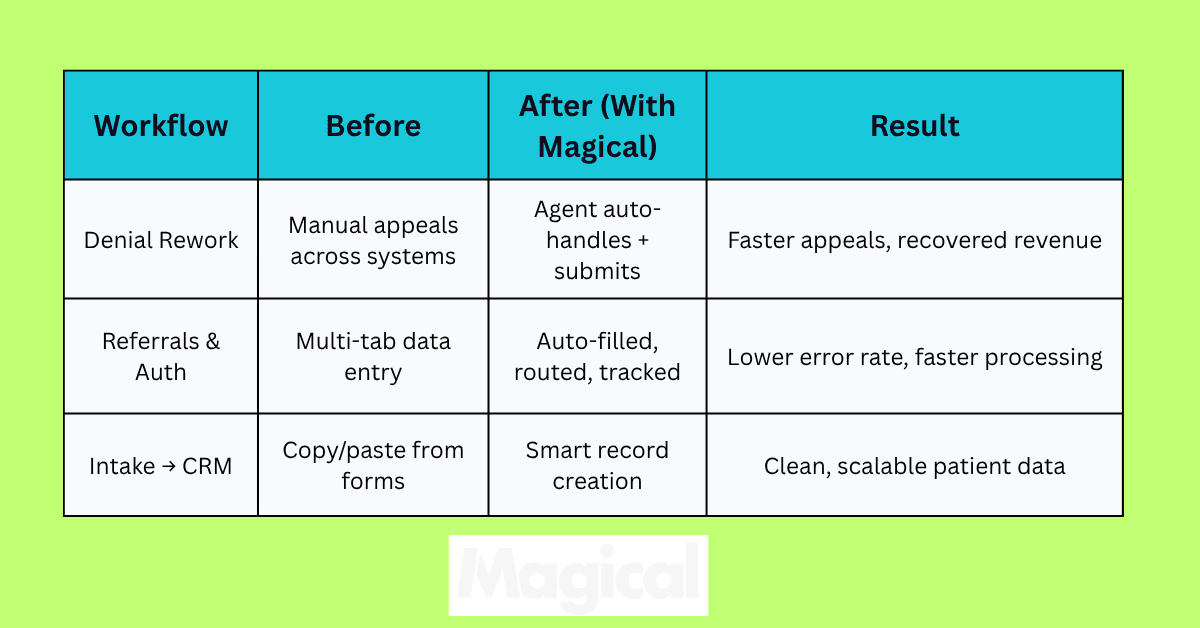
1. Denial Rework Automation
The old way:
Billing teams manually pull denial reasons
Copy patient data from EHR
Paste into payer appeal forms or PDF templates
Submit via fax or portal
Hope they didn’t miss the appeal window
With Magical:
Agent detects new denials as they appear
Cross-references payer rules
Auto-pulls required patient data from EHR
Drafts and submits the appeal (or routes it for review)
Logs every step for compliance
Impact: Teams reduce rework time by up to 90% while increasing first-pass recovery rates; currently, denial rework is responsible for more and more time spent by healthcare admin teams.
2. Referral Management and Prior Authorizations
The old way:
Admins log into multiple systems
Re-enter patient data manually
Upload documents
Track referral status in spreadsheets or emails
Constantly follow up with providers
With Magical:
Agent detects when a referral is initiated
Gathers required info from patient record
Populates payer portal or referral system
Submits with all attachments
Flags exceptions or missing fields for human review
Impact: Reduced processing time, fewer lost referrals, higher provider satisfaction
3. Intake-to-CRM Updates
The old way:
Staff copy-paste intake form responses into Salesforce, Epic, or another CRM
Missed fields, typos, or duplicates are common
Staff waste hours on redundant data entry
With Magical:
Agent reads form inputs directly
Maps and formats fields correctly for the target system
Automatically creates or updates records
Notifies team only if data is incomplete
Impact: 100% clean data transfers, zero re-entry, no duplicate records
Why This Matters
These aren’t science projects.
They’re working workflows running on Magical’s agentic AI today, with no code, no devs, and no need to overhaul your EHR.
So, Should You Replace Traditional Automation?
Not necessarily.
There’s still a place for macros and bots, especially for high-volume, low-variance tasks. But for the work that’s manual, repetitive, and filled with edge cases?
That’s where agentic AI shines.
Think of traditional automation as your hammer. Agentic AI is the whole toolbox with diagnostics, blueprints, and a helper that can adjust mid-project.
How Agentic AI Handles HIPAA, Security, and Compliance by Default
If an AI tool can’t protect patient data, it has no place in healthcare, period.
That’s why Magical doesn’t treat HIPAA compliance as an afterthought or “add-on.” It’s baked into the foundation of every agent, every workflow, every action.
Here’s how Magical’s agentic AI is designed to meet (and exceed) healthcare’s toughest security requirements:
Signed BAA with Every Healthcare Customer
Magical provides a fully executed Business Associate Agreement (BAA)—no exceptions.
This gives you legal assurance that:
All PHI is protected under HIPAA standards
Magical acts as a business associate under compliance scope
Data handling and access follow strict guidelines
No BAA = No go. Magical checks that box out of the gate.
End-to-End Data Encryption
All data handled by Magical agents is:
Encrypted in transit using HTTPS/TLS 1.2+
Encrypted at rest using AES-256
No unencrypted exposure.
No risky clipboard storage.
No “it’s only temporary” excuses.
Role-Based Access and Permissions
Magical lets you control:
Who can build or edit agents
Who can see patient workflows
What data each user can access
That means your front desk team can’t see what your billing team does, unless you say so.
Full Audit Logging of Every Agent Action
Every action an agent takes is:
Time-stamped
Tracked to the user or agent
Logged with system and field-level detail
Available for audit or compliance review
You always know:
What happened
When it happened
Why it happened
Who (or what agent) did it
This is HIPAA compliance you can prove.
No Deep System Integration Needed
Magical works in the browser, meaning:
No API exposure
No direct connection to your EHR backend
No complicated IT/security reviews just to get started
This reduces your attack surface and shortens the deployment cycle dramatically.
Bottom Line?
You don’t have to choose between AI and compliance. With Magical, you get agentic speed and regulatory peace of mind.
How to Start Transitioning From Automation to Autonomy: Step by Step
If you’ve invested time, money, and energy into traditional automation, the idea of switching gears can feel overwhelming.
But the good news is you don’t have to rip and replace anything.
You just need to stop expecting old tools to do new work. And start giving your team the agentic support they need.
Transitioning from automation to autonomy starts with one workflow.
One bottleneck.
One backlogged process that’s already costing you time and money.
Here’s how to make the shift, without disruption, downtime, or IT red tape.
Step 1: Identify a Manual Workflow That’s Holding You Back
Look for:
Repetitive work (data entry, copy-paste, form-filling)
High-volume, low-complexity tasks (e.g. denial rework, intake updates, prior auths)
Work that requires cross-system execution
Steps where delays or errors cost real revenue or compliance risk
Best Practice? Start with denial workflows. They’re high impact, easy to standardize, and loaded with hidden costs.
Step 2: Define the Outcome You Want, Not the Steps
Old automation starts with process mapping. Agentic AI starts with the goal.
Instead of:
“When a user clicks X, pull Y, then paste into Z…”
Think:
“When a denial is received, resolve it automatically using payer rules and supporting documents.”
Let the agent figure out the how.
You define the what.
Step 3: Use No-Code Agent Builders to Deploy in Hours (Not Months)
With Magical:
You describe the workflow in plain language
The platform auto-generates the agent logic
You test it in your real tools, browser-based, system-agnostic
You scale it when ready (no developers, no integrations, no delays)
Zero engineering lift.
Zero vendor lock-in.
Zero excuses.
Step 4: Monitor, Refine, and Expand
As the agent runs, Magical logs every step with complete transparency.
You can:
Review audit trails
Adjust logic on the fly
Add edge case handling
Scale the same logic across multiple teams or departments
Once the first workflow is humming, move to the next.
Clean, linear, low-resistance path to transformation.
This Is A Workflow Revolution.
Agentic AI doesn’t ask you to reimagine your entire operation. It starts with one broken process and replaces it with something that works.
Fast. Secure. Compliant. No devs required.
Final Thoughts: Replace Rigid Rules With Real Outcomes
Traditional automation was built to do what it’s told.
Agentic AI is built to get the job done, even when the rules change, the systems don’t talk, and the backlog keeps growing.
That’s why healthcare teams aren’t just automating anymore.
They’re delegating to agents that can:
Pull the right data
Make the right decisions
Execute the right steps
Log it all automatically
And do it 24/7 without code, burnout, or blind spots
If your team is drowning in repetitive work, rigid systems, or failed automations, you don’t need to work harder.
You need workflows that work for you.
You need Magical.
Try Magical Free or Book a Demo
Install the free Magical Chrome extension to start saving hours today
Book a personalized demo to see how agentic AI fits your existing workflows—without replacing your tools
Over 100,000 companies. Nearly 1 million users.
7 hours saved per person, per week.
No rules-based band-aids.
No brittle bots.
Just real autonomy, real outcomes, and real ROI right now.