
Medical billing doesn’t break all at once.
It leaks.
A missed code here.
A delayed claim there.
A frontline team stuck retyping the same patient data across four systems before lunch.
The work still gets done, but it’s slower, messier, and more expensive than it needs to be.
Meanwhile, leadership hears “AI can fix it,” but scaling AI feels like adding another project to a team already underwater.
This isn’t about AI hype. It’s about building systems that help real people (your people) get more done with less manual effort.
At a time when every claim, click, and calendar minute matters, that’s the kind of scale that counts.
Why AI Is Reshaping Medical Billing
Medical billing was never designed for speed.
Or scale.
Or seamless digital handoffs between front-desk teams, billing coordinators, and payers.
Most systems still rely on rules created when paper files and fax machines ran the show.
What’s changed is the volume. And the margin for error.
A single hospital now processes thousands of claims per day.
And the average error rate for manually submitted claims is still between 7% and 10%, enough to erode both revenue and trust.
Multiply that across teams. Across facilities. Across months of delayed payments.
Meanwhile, admin teams are shrinking. Over 50% of healthcare staff say they’re dealing with rising workloads and burnout, much of it due to repetitive data entry, prior auths, and billing complexities.
But the work can’t wait. Claims have to move.
That’s where AI shifts from buzzword to operational reality.
AI-assisted workflows now handle core billing tasks faster, cheaper, and more accurately than humans alone.
Claim status checks.
Eligibility verification.
Code matching.
These aren’t futuristic use cases. They’re already live inside revenue cycle teams that adopted automation early.
And while traditional automation focused on volume, AI is helping teams focus on outcomes: fewer denials, faster reimbursements, and less staff turnover caused by clerical burnout.
The shift isn’t hypothetical. It’s happening in practices, clinics, and admin departments that chose to scale smarter.
The Challenges of Scaling AI in Healthcare Billing
AI isn’t plug-and-play. Especially not in healthcare.
Billing teams already deal with high stakes, tight margins, and unforgiving systems. Adding AI to the mix introduces a new layer of complexity, unless it’s handled with precision.
Legacy tech doesn’t integrate easily
Most billing systems weren’t built with AI in mind. They’re built for compliance and control, not speed.
Integrating new tools often means trying to wedge automation into systems that still depend on manual data inputs and siloed databases.
Nearly 80% of healthcare providers still rely on outdated or fragmented tech stacks, creating drag at exactly the point where AI could add lift.
Compliance adds friction
AI tools must navigate HIPAA, PHI, and a growing list of security expectations. A single misstep, like exposing patient data through an unsecured integration, can lead to significant financial penalties and reputational damage.
This makes IT teams cautious, and rightly so. But it also slows down adoption unless the AI tool is purpose-built for healthcare compliance from day one.
Change fatigue is real
Frontline billing teams have already adapted to EHRs, new payer rules, shifting documentation requirements, and post-pandemic protocols. AI can look like “just another thing” for a team already stretched thin.
If adoption requires complex training or heavy engineering support, it’s unlikely to stick.
Volume ≠ value
Some orgs rush to automate everything, only to realize they’ve scaled outputs, not outcomes.
Faster task completion means nothing if the error rate goes up or the patient experience suffers.
Successful AI scaling doesn’t just mean doing more. It means doing what matters; better, faster, and with fewer mistakes.
A Scalable Framework for AI in Medical Billing
AI works best when it’s aimed at the right problems, in the right order, with the right guardrails.
This framework breaks down the path to scaling AI in medical billing into five clear, practical steps.
No jargon.
No tech overhauls.
Just a smarter way to move forward, starting small, proving value, and building momentum.
Identify High-Impact, Low-Risk Use Cases
Start with workflows that cause the most drag and the least resistance. These are tasks that are repetitive, rules-based, and easy to measure.
Examples:
Claim status checks
Copy-paste data entry between systems
CPT/ICD code lookup and matching
Prior authorization form population
Patient intake field population
These tasks don’t require clinical judgment, but they eat up hours every week. Automating them won’t disrupt care, and they’re easy wins that prove the value of AI fast.
According to the CAQH 2023 Index Report, the healthcare industry could save over $25 billion annually by automating standard administrative transactions.
That’s not a hypothetical. It’s a backlog of potential waiting to be unlocked.
Choose Tools Built for Healthcare Admins
This is where scaling either takes off or gets stuck.
Too many teams try to force-fit general-purpose AI tools into workflows that were never meant to support them. Healthcare admin teams need tools designed with their day-to-day in mind.
Look for:
HIPAA-compliant architecture
Browser-based tools that don’t require deep integration
No-code interfaces that frontline staff can use without IT help
Templates or workflows specific to billing, intake, and documentation
Magical is one example. It allows billing teams to automate repetitive typing, navigation, and copy-paste work across multiple web apps, without changing core systems or involving developers.
Ensure Data Privacy and Compliance
Nothing stalls an AI rollout faster than security concerns. And for good reason.
Patient data is protected by law, and any automation must meet strict HIPAA and data governance standards. That means:
End-to-end encryption
Role-based access controls
Audit logs
No unauthorized data storage or third-party sharing
Look for automation tools that build compliance into the product, not ones that treat it as an afterthought. If your AI platform can't pass a risk assessment, it won’t make it past procurement.
Train Staff and Align With Billing Goals
AI can’t scale unless people use it.
That means training must be:
Simple
Specific
Relevant to daily work
Start with a single workflow, like automating denial reason entry into your EHR. Show the team how to do it once, then create a repeatable playbook. Involve frontline staff early, and get their feedback before rolling it out across departments.
And most important: tie each use case back to a billing goal.
Whether it’s reducing error rates, speeding up reimbursement, or lowering manual rework, the value of AI should be visible and measurable.
Measure What Matters
Automating for the sake of automation is a waste. Focus on what changes because of AI.
Track these KPIs:
Claim denial rate
Average reimbursement time
Time spent per billing task
Staff hours recovered
Billing accuracy rates
When teams see these numbers move in the right direction, trust in automation grows. And that’s how scale really starts, one win at a time.
Real-World Examples of Scaled AI in Healthcare Billing
Scaling AI sounds good in theory. These teams did it in practice.
Each of the healthcare orgs below faced different billing challenges.
But they shared one thing: a need to do more with the teams they already had. Here’s how they made it happen with automation that fit their existing systems, workflows, and bandwidth.
WebPT: From Manual Documentation to Scalable Efficiency
WebPT is the leading rehab therapy platform in the U.S., supporting over 150,000 rehab therapists across clinics and practices. Their operations team faced a familiar problem: repetitive documentation tasks that drained staff time and delayed revenue cycle workflows.
What changed: WebPT used Magical to automate standardized billing documentation. Instead of manually copying patient information into multiple fields or systems, teams could complete their workflows with a single trigger.
The outcome:
Faster documentation
Improved billing accuracy
Admins gained hours back each week, without adding new tools or technical overhead
TCPA: High-Volume Patient Onboarding, Automated
TCPA, a high-volume pediatric practice group, needed to reduce the time spent onboarding new patients and entering repetitive data into billing and scheduling systems. Manual entry was leading to bottlenecks and errors at scale.
What changed: Using Magical, TCPA automated the most repetitive onboarding fields, enabling staff to move quickly between systems without copy-pasting the same data over and over again.
The outcome:
Shorter intake times
Smoother handoffs between teams
Significant reduction in manual entry errors
ZoomCare: Simplifying Front-Desk Billing Tasks
ZoomCare, a modern healthcare provider with dozens of neighborhood clinics, was looking to streamline front-desk tasks without disrupting the systems already in place. Their team was drowning in manual data entry, particularly in billing and intake workflows.
What changed: With Magical, ZoomCare equipped front-desk teams to automate data population across scheduling and billing tools, with no coding, no system overhauls.
The outcome:
Reduced admin friction during patient intake
Consistent, error-free data across systems
More time for face-to-face patient care
Each of these teams started small with one workflow, one automation, one admin win. They didn’t scale AI by building complex tech stacks. They scaled it by solving one high-friction task at a time.
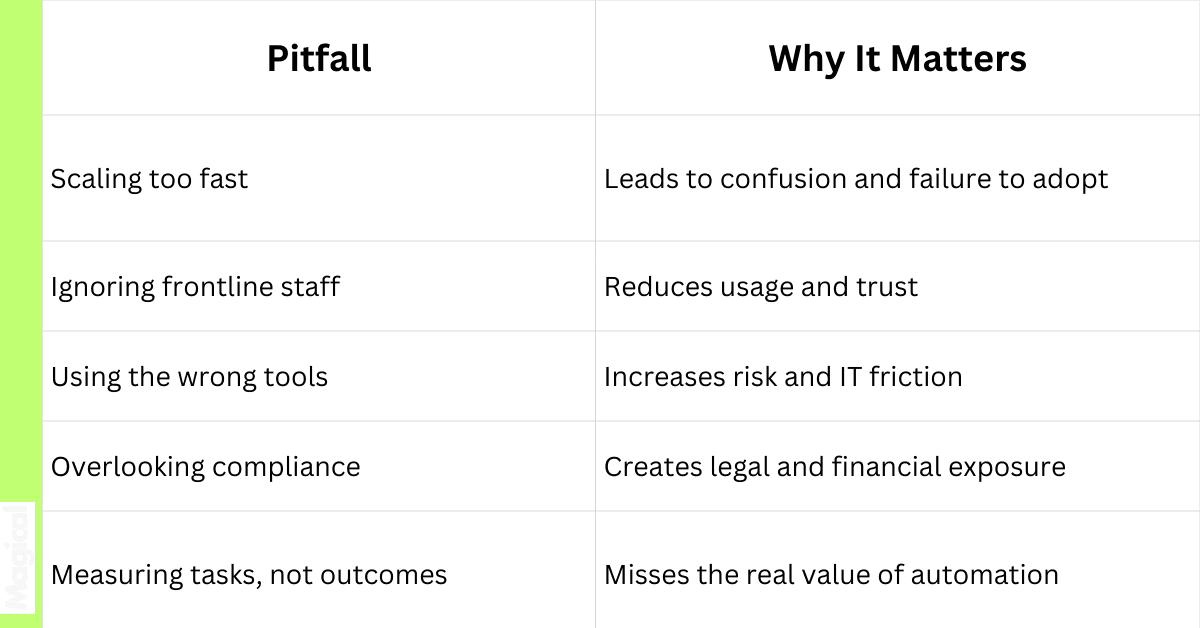
Common Mistakes to Avoid When Scaling AI
AI can create incredible momentum in medical billing when it’s applied with care. But there are patterns that show up across healthcare orgs that try to move too fast, too broadly, or without the right foundations.
Avoiding these mistakes can mean the difference between lasting ROI and a stalled project.
Automating Too Much, Too Soon
The temptation is real. Once one billing task is automated, it’s easy to assume everything should be.
But going wide before you go deep is risky.
Automating 15 workflows at once without proving ROI or adoption in a single one leads to confusion, poor data hygiene, and staff pushback.
Start with a small use case.
Prove success.
Then scale with structure.
Skipping Over Staff Training and Buy-In
Automation doesn’t stick if the people using it don’t trust it.
Admins, front-desk staff, and billing teams aren’t looking for one more thing to learn. They’re looking for something that actually helps. If rollout skips training, or if frontline teams aren’t part of the planning, usage drops fast.
The best AI rollouts treat end users like stakeholders, not afterthoughts.
Choosing Tools Not Built for Healthcare Workflows
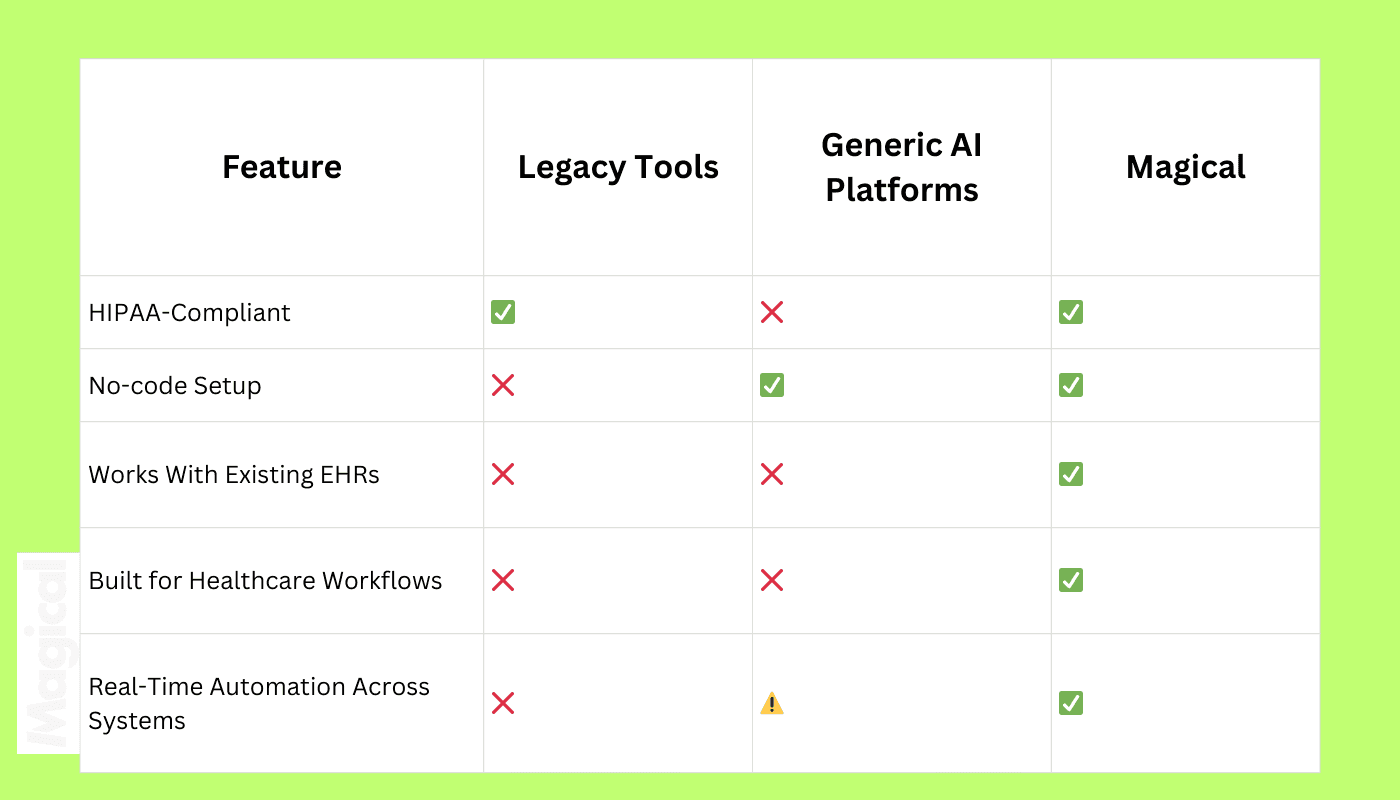
A generic AI tool might be impressive, but if it can’t handle HIPAA, won’t work with your billing platform, or requires an engineer to maintain, it creates more problems than it solves.
Healthcare admin teams need solutions that work with:
Existing tech stacks
Regulatory frameworks
The actual workflows billing teams follow every day
That means choosing tools like Magical, which are flexible, compliant, and designed for real-world admin use.
Focusing on Automation Outputs Instead of Business Outcomes
Faster isn’t always better if accuracy drops, costs rise, or patient billing issues increase.
The goal of scaling AI is not just doing more tasks.
It’s doing the right tasks better:
Fewer denied claims
More accurate reimbursement cycles
Less burnout across admin teams
If your automation strategy isn’t improving those metrics, it’s time to rethink what you’re scaling.
What to Look for in a Scalable AI Billing Tool
The right tool won’t feel like more work. It will quietly eliminate friction and leave teams wondering how they ever operated without it.
But not all AI platforms are built for the complexity of healthcare billing. Before committing to any solution, teams should evaluate tools through the lens of scalability, compliance, and usability.
Here’s what to prioritize.
Designed for Healthcare Workflows
Healthcare billing has its own language, pace, and compliance needs. A tool that’s too generic (or designed for a different industry) will create more roadblocks than results.
Look for platforms that:
Support structured data handling for billing codes, claims, and insurance fields
Work with browser-based EHR, billing, or intake systems
Include pre-built templates for common healthcare admin tasks
Magical, for example, is designed to work directly within browser environments, making it easy for billing teams to use automation inside the tools they already rely on.
Easy Implementation, No Engineers Required
If a tool takes months to roll out, it’s already too heavy.
The best AI tools deploy fast. They don’t need custom integrations or backend access. They let admin teams create and launch automations themselves.
Magical installs in seconds as a Chrome extension, allowing teams to automate repetitive fields and multi-step workflows across tabs without touching a line of code.
HIPAA-Ready and Security-First
Any tool touching patient data must meet strict compliance standards. That includes:
End-to-end encryption
No unauthorized data storage
Role-based access
Audit logs
Magical doesn’t store sensitive information. All automation is executed locally in the browser, giving teams total control and maintaining compliance with HIPAA and internal data policies.
Flexible and Customizable
Billing processes vary across departments and organizations. Tools need to adapt, not force teams into rigid templates.
The best platforms offer:
Custom automation flows
Editable variables and triggers
Easy sharing of workflows between staff members
This is critical for healthcare orgs where billing, intake, and scheduling workflows often intersect, and no two teams work exactly the same way.
Works Across Systems Without Breaking Them
Most teams can’t rip and replace their billing infrastructure. AI tools must integrate with what’s already there.
Magical operates as an overlay across any browser-based app or EHR. That means teams can automate workflows across billing portals, insurance websites, and scheduling tools, without needing API access or system downtime.
The Future of AI in Medical Billing
The first wave of automation tackled the basics: speed up data entry, reduce keystrokes, and eliminate redundant tasks.
That alone has saved healthcare teams thousands of hours.
But the next wave is already taking shape, and it’s more strategic.
Future-facing AI in medical billing will move beyond task automation and into decision support. It will help billing teams:
Predict denial risks before claims are filed
Surface documentation gaps in real time
Auto-generate claim narratives based on visit notes
Flag unusual billing patterns to avoid audits
Optimize workflows based on payer behavior
What used to take a team of analysts will soon happen passively in the background, guided by models trained on thousands of prior cases.
And the best part? Admins won’t have to become AI experts to use it.
As platforms like Magical evolve, the role of the admin becomes more proactive, not less relevant. Instead of chasing claims, teams will focus on preventing errors. Instead of reacting to bottlenecks, they’ll anticipate them.
AI won’t replace healthcare admin teams. It’ll give them superpowers.
Final Thoughts
Scaling AI in medical billing isn’t about getting more done.
It’s about getting the right things done faster, with fewer mistakes, and less stress on your team.
The tools exist. The wins are real.
And the most forward-thinking healthcare orgs aren’t waiting for perfect conditions, they’re automating where it counts, with platforms that actually fit their workflows.
Start with one process. One field. One workflow.
Then scale what works.
Try It Yourself
Download the free Magical Chrome extension or book a demo for your team today! Magical is used at 100,000+ companies and by nearly 1,000,000 users to save 7 hours a week on average.