
Two months.
That’s how long the average US healthcare organization now waits to see cash for work it’s already done.
In some specialties, it’s closer to 90 days.
By the time the money finally lands, the patient has forgotten the visit, the payer has issued three contradictory status updates, and your billing team has touched the claim five times…just to fix problems that could have been avoided in minutes.
This isn’t a billing department problem.
It’s a system problem:
Eligibility checks that miss inactive plans until after service
Prior auth requests that sit in a fax queue for days
Documentation gaps that trigger avoidable denials
Portal logins that eat hours chasing status updates
Every extra day is cash sitting in someone else’s account, not yours.
But here’s the shift: the workflows slowing you down are the same workflows AI agents can now handle in minutes, with fewer errors, and without asking your staff to burn another hour on a payer portal.
Let’s trace where the days disappear and show how an AI workforce can erase them, from scheduling to zero-balance.
Why Time to Payment Matters (and Why It’s Slipping)
Cash flow is oxygen for healthcare organizations. When it slows, everything feels tighter, from payroll to supply purchases to capital projects you’ve been pushing off.
And lately, the oxygen levels are dropping.
According to recent revenue cycle benchmarks, the median Days to Payment in US healthcare rose from 41 days in 2022 to over 53 days in late 2024 (with some high-complexity specialties seeing averages in the 70s).
For organizations operating on single-digit margins, that’s the difference between growth and constant triage.
Every extra day in the payment cycle compounds:
Staff spend more time chasing claims instead of preventing issues.
Denials pile up, creating new backlogs.
Prior auth bottlenecks delay scheduling and billing.
Patient balances age out of collectability.
This is more than an inconvenience. Delays in payment can lead to:
Reduced liquidity — forcing reliance on credit lines or delaying vendor payments
Higher administrative costs — as the same claim is touched multiple times
Increased write-offs — as aged AR slips past recovery windows
And the root causes aren’t mysteries. They’re front-end errors, slow prior auths, portal bottlenecks, and unstructured documentation, all predictable, all fixable.
The organizations that win in 2025 won’t just “work AR faster.” They’ll design their workflows so claims don’t get stuck in AR to begin with.
And that’s where AI agents come in.
What Time to Payment Means and How to Measure It
“Time to payment” isn’t a single metric. It’s a cluster of related measures that track how long it takes to turn work performed into cash in the bank.
If you don’t define it clearly, you can end up “improving” one metric while another gets worse.
Here are the core measurements to track:
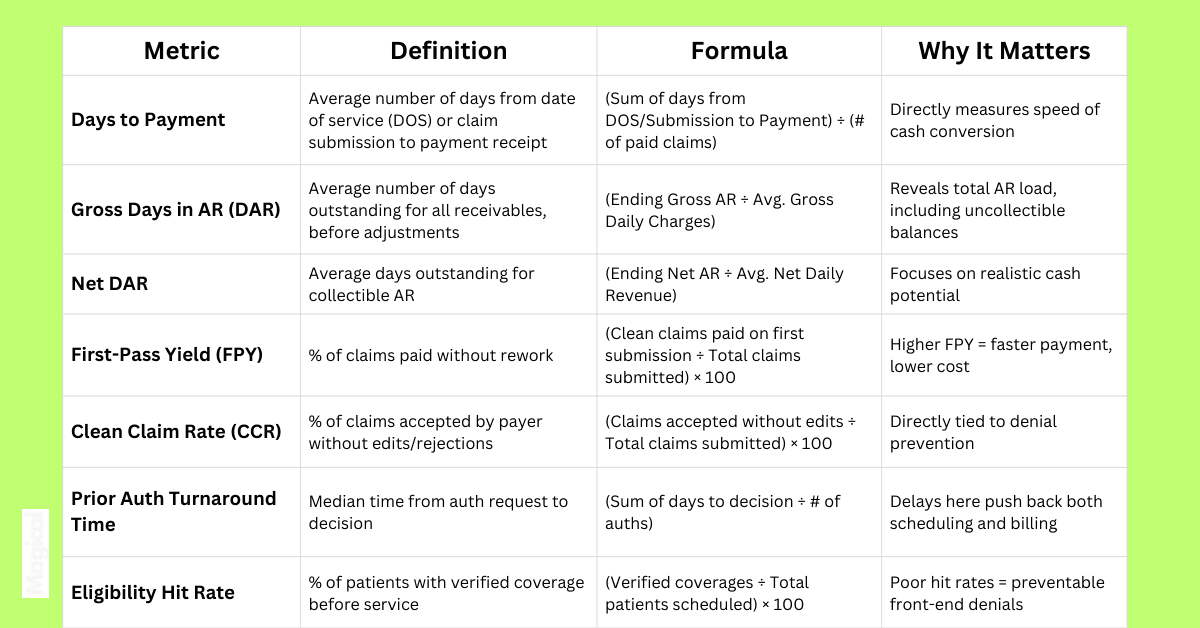
Why this matters: Most organizations look only at DAR and denial rate. That’s a mistake.
By tracking all of these metrics together, you can pinpoint where the delay is starting (intake, mid-cycle, or back-end) and where an AI workforce can remove the most days, fastest.
Where Days Get Added: A Root-Cause Map
The payment cycle doesn’t stretch because of one big delay. It’s death by a thousand paper cuts.
Each small holdup adds hours or days, and by the time the claim is paid, you’ve lost weeks.
Here’s where those days hide:
Front-End (Before the Visit)
Eligibility gaps — inactive coverage, wrong plan codes, or missed secondary insurance discovered after service
Prior auth requirements missed — no request filed, incorrect CPT/DX pairing, or expired approval
Scheduling errors — wrong service location, incorrect provider assignment, or mismatched NPI
Incomplete intake data — typos in demographics, missing subscriber info
These are the fastest denials to prevent, but the most expensive if caught late, often requiring rebilling, appeals, or patient rework.
Mid-Cycle (From Visit to Submission)
Slow documentation completion — clinicians close charts late, delaying coding
Coding/charge capture errors — missing modifiers, incorrect laterality, or undercoding
Packet assembly delays — missing operative notes, lab results, or imaging needed for auth or claim
Missed CCI/MUE edits — errors caught only after payer submission
Days here accumulate quietly; they’re often invisible until the claim is finally submitted.
Back-End (After Submission)
Clearinghouse rejects — syntax errors, missing fields, or payer-specific formatting
Portal-only status checks — staff waiting days between logins
Unworked denials — items sit in worklists because no one saw the status change
Late appeals — delays in gathering documentation push past payer deadlines
Underpayment blind spots — partial denials or contractual short pays not flagged
This is where DAR explodes, especially for teams with manual status checks and no automated appeal triggers.
Structural Issues
Limited ERA/EFT adoption — paper checks and manual posting add days
High fax dependency — slow retrieval, scanning, and routing of key documents
Fragmented worklists — tasks split across multiple systems with no single source of truth
If you mapped every delay point in your payment funnel, you’d see that 60–80% are repetitive, rule-driven, and data-based. The exact type of work AI agents excel at removing.
The AI Workforce Approach (Agentic AI, Not Just RPA)
Most revenue cycle teams already have automation somewhere, eligibility batch checks, claim scrubbers, or macros for data entry.
But if those tools worked well enough, your Days to Payment wouldn’t still be climbing.
The problem isn’t the lack of automation. It’s the kind of automation.
Why Traditional Automation Falls Short
RPA follows static scripts — it breaks when a payer portal changes its layout.
Rules engines flag issues, but don’t fix them — the task still lands on a human’s desk.
Point solutions only cover one step — eligibility, or coding, or status checks — but not the whole cash cycle.
What An AI Workforce Does Differently
Understands unstructured data — reads faxes, PDFs, scanned insurance cards, operative notes, and payer letters without manual prep.
Reasons over rules — matches CPT/DX codes to payer policy requirements, catches mismatches, and takes the right next step.
Acts in multiple systems — EHR/PM platforms, clearinghouses, and payer portals, without waiting for APIs.
Orchestrates multi-step flows — assembles a prior auth packet, submits it, monitors status, and resubmits with added documentation if pended.
Learns and adapts — improves over time based on which claims are paid vs. denied, which appeals are overturned, and how payer rules evolve.
Governance and Compliance By Design
With HIPAA-compliant infrastructure, BAAs, audit logging, and human-in-the-loop queues, AI agents aren’t a black box. They’re a documented, auditable part of your revenue cycle team.
Why it matters: Instead of just moving errors downstream faster, AI agents prevent those errors from happening at all. Removing the days from your payment cycle before they can even be added.
Front-End Acceleration: Get It Right Before the Claim
Fixing front-end errors is the fastest, cheapest way to accelerate payment.
Every eligibility mismatch, missing prior auth, or intake typo you prevent is a denial you never have to appeal. And a claim that hits “paid” weeks sooner.
Here’s where AI agents can erase days before they even appear on your AR report.
Eligibility & Benefits Verification at Scale
Real-time checks before the visit — Agents run RTE for every scheduled patient, not just a batch the night before.
Secondary coverage detection — Identify and verify additional plans, coordinate benefits, and update the EHR before DOS.
Benefit limit alerts — Flag caps on visits, procedures, or dollar amounts that could cause non-coverage.
Stops inactive plan denials before the first service, keeping claims in the 0–30 day bucket.
Estimates & Upfront Collections
Agents pull contract rates and benefit details to auto-generate patient estimates.
Trigger scripted outreach for pre-service collection or payment plans.
Offer multi-language messaging to improve patient understanding and reduce nonpayment risk.
Improves POS collections, shortens patient-pay AR, and prevents later write-offs.
Referral & Authorization Pre-Checks
Compare orders to payer medical policies in real time.
Assemble prior auth packets automatically from clinical notes, labs, and imaging.
Submit to payer portals and track status without waiting for manual action.
Prevents the #1 growing denial category: prior auth failures.
Digital Intake Accuracy
Extract and validate ID and insurance card data using OCR/NLP.
Standardize address formats and demographic fields to avoid downstream rejections.
Cross-check subscriber and dependent info for accuracy.
Case Study Connection
ZoomCare: AI-enabled patient access improvements eliminated back-and-forth scheduling delays and reduced eligibility-related denials.
TCPA: Automated prior auth packet assembly and submission reduced reschedules and sped billing starts.
Front-end fixes aren’t just about accuracy. They’re about velocity.
An AI workforce doesn’t wait for batch jobs or human prompts. It validates, corrects, and moves patients to “claim-ready” status before the visit even happens.
Prior Authorization Compression (Deep Dive)
Prior authorization is the single most fixable delay in the payment cycle, and yet it’s often the longest.
Every day an auth request sits in a fax queue or waits on missing documentation is another day the patient isn’t scheduled, the service isn’t delivered, and the claim isn’t submitted.
AI agents shrink that timeline by attacking all three delay points: packet creation, submission, and follow-up.
Packet Assembly & Requirements Matching
Read orders, clinical notes, labs, and imaging directly from the EHR or fax inbox.
Match against the payer’s current medical policy — correct CPT/DX, required documentation, and site-of-service criteria.
Auto-flag missing elements before submission and request them from the clinical team in real time.
Prevents back-and-forth with payers over incomplete packets.
Portal Submission & Confirmation
File the request directly in the payer portal, without waiting for manual login.
Attach all required documents in the correct formats.
Log the confirmation number, submission date, and expected decision timeline.
Starts the clock sooner and ensures a complete, auditable record.
Status Monitoring & Exception Handling
Poll payer portals at defined intervals to catch pended or decisioned cases immediately.
Auto-attach requested clinicals for pending cases; route true exceptions to human review.
Escalate urgent cases approaching service date without decision.
Eliminates the “we didn’t see the status change” problem that causes last-minute cancellations.
Every prior auth day you save is a day your claim moves forward sooner.
AI agents don’t just speed up the paperwork. They make it nearly impossible for an auth-related denial to occur in the first place.
Coding, Charge Capture, and Claim Readiness
Even if your front-end is flawless, sloppy mid-cycle execution can send claims straight into denial purgatory.
Delays here are quieter (no reschedules or patient complaints), but they’re deadly for Days to Payment because you often don’t see the problem until weeks later.
AI agents keep the mid-cycle airtight by ensuring charges are complete, codes are correct, and every claim clears the “clean claim” gate before submission.
Documentation-to-Charge Flow
Match encounter notes, operative reports, and ancillary results to the correct visit and patient in the EHR.
Flag missing elements, like unsigned notes, incomplete dictations, and absent pathology reports that would block coding.
Notify providers in real time with a single-click completion request.
Reduces coding delays by hours or days and prevents missing charge lines.
Automated Edits & Medical Necessity Checks
Run NCCI edits and MUE thresholds before claim creation.
Validate modifier usage (25, 59, X{EPSU}) and ensure laterality is documented.
Compare CPT/DX to LCD/NCD requirements; insert relevant excerpts from documentation to support necessity.
Denials for bundling, modifier misuse, or medical necessity drop before they start.
Clean Claim Gate
Confirm ordering and servicing provider info matches NPI records.
Ensure all required attachments (op notes, PA letters, ABNs) are linked to the claim file.
Verify place-of-service and taxonomy codes.
Case Study Connection
WebPT: By tightening documentation-to-charge workflows with AI validation, WebPT reduced manual mid-cycle fixes and saw a measurable jump in first-pass yield.
In the mid-cycle phase, speed is important, but clean is king. AI agents make “clean on first submission” the default, not the exception.
Claim Submission, Status, and Rapid Rework
Once a claim leaves your EHR, the clock doesn’t just keep ticking; it accelerates.
Every day a claim sits unworked after a rejection or denial is another day of lost cash and compounding AR.
AI agents compress this stage by turning submission into a continuous, monitored process and by intercepting problems within hours, not weeks.
Submission & Clearinghouse Hygiene
Monitor 837 claim file acknowledgments in real time.
Identify syntax errors, missing fields, and payer-specific format issues instantly.
Auto-correct known reject patterns (e.g., wrong ZIP code format, taxonomy code) and resubmit within hours.
Prevents rejections from aging into multi-day or multi-week delays.
Payer Portal Status Tracking
Log into payer portals automatically — no waiting for staff to “get around to it.”
Detect status changes immediately, from “received” to “pended” to “denied.”
Create actionable worklist items with reason codes, payer messages, and required next steps.
Eliminates the lag between payer status change and staff awareness.
Rapid Denial & Appeal Automation
Draft appeal letters with cited policy language, attach relevant clinical excerpts, and include prior auth proof.
Route to human review for submission.
Track payer appeal SLAs and escalate overdue responses.
Cuts appeal turnaround from weeks to days.
ERA/EFT Acceleration & Auto-Posting
Proactively enroll providers in payer ERA/EFT programs.
Normalize 835 remit formats and auto-post clean payments.
Flag variances or underpayments for review and follow-up.
Reduces manual posting workload and shortens the path from payment to zero-balance.
AI agents make that kind of vigilance automatic.
Patient Responsibility: Faster, Friendlier Collections
For many healthcare organizations, patient responsibility isn’t just a side note. It’s 20–30% of total revenue.
But the longer you wait to request payment, the less likely you are to collect it. By 90 days, recovery rates can drop below 20%.
AI agents close this gap by making patient billing immediate, accurate, and empathetic.
Same-Day Outreach After Adjudication
As soon as the payer adjudicates a claim, agents generate a clear, itemized statement for the patient.
Deliver via preferred channel (text, email, portal) often within hours of the payer’s remit.
Include a secure payment link, not just an instruction to “mail a check.”
Dramatically shortens the patient-pay AR cycle.
Smart Payment Options
Offer pre-approved payment plans based on balance thresholds and past payment behavior.
Support multiple languages for clarity and compliance.
Present zero-interest plans where policy allows to improve conversion.
Impact: Removes friction and fear from the payment process.
Sensitivity and Timing
Trigger gentle reminders at defined intervals (e.g., 7, 14, 30 days).
Use soft, empathetic language that maintains the patient relationship while encouraging payment.
Patient balances age quickly. AI agents make sure those balances are communicated immediately, paid faster, and handled in a way that preserves patient trust.
Security, Compliance, and Governance
In the healthcare revenue cycle, speed means nothing if you can’t prove compliance. Payers, regulators, and your own legal team all want the same thing: airtight handling of protected health information (PHI) with a traceable record of every action.
An AI workforce should meet (and document) those expectations by design.
HIPAA Compliance and BAAs
All AI agent workflows operate in HIPAA-compliant environments.
Business Associate Agreements (BAAs) ensure legal accountability for PHI handling.
Role-based access controls enforce least-privilege permissions.
Audit Logging and Traceability
Every agent action, from portal login to document upload, is logged with a timestamp, user/agent ID, and data source.
Immutable logs support both internal QA and external audit demands (RAC, MAC, UPIC, payer SIU).
Human-in-the-Loop Oversight
Exception queues route edge cases to authorized staff for review before submission.
Redaction tools strip non-required PHI from packets, appeals, or reporting.
Environment and Data Separation
PHI data is processed in secure, isolated environments.
No PHI is used for model training; AI agents operate only on the data relevant to the active workflow.
A compliant AI workforce doesn’t just do the work. It leaves a provable trail showing what was done, when, and why.
That’s how you keep automation an asset instead of a liability.
30-60-90 Day Implementation Plan
The fastest way to cut Days to Payment isn’t a year-long “big bang” project. It’s stacking quick wins in the first 90 days, then scaling what works.
Days 0–30: Baseline & Quick Wins
Goal: Find the biggest leaks and fix them immediately.
Audit current Time to Payment, First-Pass Yield (FPY), and denial rate to create benchmarks.
Identify the top 2–3 delay points (e.g., eligibility errors, prior auth lag, slow status checks).
Deploy AI agents in one or two workflows where the benefit is immediate — such as real-time eligibility checks or prior auth packet assembly.
Set up KPI dashboards to track improvement.
Expected impact: Early proof of value, measurable in days saved per claim.
Days 31–60: Expand & Automate
Goal: Cover the high-volume workflows that drive the most AR days.
Add claim status automation to catch pends and denials instantly.
Turn on AI-driven clearinghouse reject repair.
Introduce automated appeal drafting for 1–2 common denial types.
Increase provider adoption of electronic remittance (ERA) and payment (EFT).
Expected impact: Reduction in avoidable rework, faster denial turnaround, fewer claims aging past 30 days.
Days 61–90: Scale & Standardize
Goal: Embed automation into your daily revenue cycle muscle.
Expand to underpayment detection and patient-pay acceleration.
Formalize exception handling protocols and SLA escalation paths.
Standardize reporting cadence for leadership review.
Train staff to work alongside agents, focusing their time on true exceptions, not repetitive tasks.
Expected impact: Sustainable drop in Time to Payment, improved cash predictability, and staff freed for higher-value work.
Frequently Asked Questions
How are AI agents different from RPA or claim scrubbers?
RPA bots follow scripts. Claim scrubbers flag errors. AI agents do both…. and more.
They can read unstructured data (like faxes), reason over payer rules, act in EHRs and portals, and adapt when formats or policies change.
Will AI agents work with our EHR and clearinghouse?
Yes. Agents operate through available APIs when possible and can also perform secure, credentialed actions in portals and desktop applications, without waiting for vendor integration cycles.
Are payer portal terms of use a concern?
AI agents function as credentialed, authorized users (just like human staff) and follow your organization’s existing access policies.
What tasks still require human review?
Clinical judgment, complex appeal narratives, and true edge cases remain human-owned. Agents handle the repetitive, rules-based work so staff can focus where their expertise adds the most value.
How is PHI protected?
All workflows run in HIPAA-compliant environments with BAAs, role-based access, encryption in transit and at rest, and immutable audit logs.
What KPIs improve first?
Most organizations see early lifts in:
First-Pass Yield
Denial rate (especially eligibility/auth-related)
Days to Payment
Claim volume worked per FTE
Final Thoughts: Time to Payment Is a Choice, Not a Fate
Long payment cycles aren’t an inevitability of healthcare. They’re the sum of a thousand small process delays.
The good news? Most of those delays are predictable, repeatable, and completely removable.
From verifying coverage the moment a patient is scheduled, to assembling a prior auth packet in minutes instead of days, to catching denials within hours of posting. AI agents make faster payments the default, not the exception.
In 2025, the healthcare organizations that lead won’t just have skilled revenue cycle teams. They’ll have an AI workforce that works 24/7, never misses a portal update, and turns weeks of work into minutes of execution.
The cash you’re waiting for today could be in your account a month sooner. All it takes is replacing the bottlenecks with speed, accuracy, and automation that never sleeps.
Ready to make faster payment your new normal?
Try the free Magical Chrome extension or book a demo for your team. Magical is used at more than 100,000 companies and by nearly 1,000,000 users to save 7 hours a week on average.
Hours you can put back into patient care, growth, and financial stability.