
You can almost hear the collective sigh when a prior authorization request comes in.
The physician needs the treatment approved.
The patient is waiting.
The payer’s rules read like a legal puzzle.
And somewhere between the EHR, the fax machine (yes, still), and the insurer portal, your afternoon vanishes.
Prior authorization isn’t just a form. It’s a bottleneck that slows treatment, frustrates patients, and burns out staff.
The AMA reports that 94% of physicians say prior auth delays patient care (AMA Prior Authorization Survey).
And it’s not getting simpler.
Each payer has its own requirements, forms, and quirks.
Miss one detail, and the request bounces back like it never happened.
AI changes the math.
Instead of billers and coordinators chasing documents, double-checking codes, and retyping information into multiple systems, AI agents do it for you.
It pulls data from the EHR, filling out insurer-specific forms, submitting requests, and tracking statuses.
The difference isn’t just speed, it’s certainty.
Fewer missing fields.
Higher first-pass approvals.
And more patients getting the care they need, when they need it.
Why Prior Authorization Is So Challenging
Prior authorization is supposed to ensure medical necessity. In reality, it often feels like a slow-moving obstacle course where every hurdle costs time and erodes trust between providers, payers, and patients.
Complex and Changing Payer Requirements
No two payers ask for the same thing. Documentation requirements vary not only by insurer but also by procedure, diagnosis, and even provider network.
One missing lab result or outdated CPT code can send a request straight to the “denied” pile.
Manual Data Gathering Across Multiple Systems
Coordinators often have to dig through EHR records, lab reports, imaging results, and clinician notes to collect what the payer wants. This means logging in and out of multiple platforms, retyping information, and triple-checking for accuracy.
Risk of Incomplete Submissions
A single unchecked box or a missing signature can mean starting the entire process over. According to the CAQH Index, prior authorization remains one of the most manually intensive administrative processes in healthcare.
Back-and-Forth Delays with Insurers
Even when the request is complete, insurers may ask for “additional information” days later, forcing another round of document collection and submission.
Staff Burnout from Repetitive, High-Volume Tasks
When every request follows the same repetitive structure but still requires human hands, staff efficiency plummets. In one AMA survey, 40% of physicians reported that prior auth burdens led to staff turnover.
This is the daily grind AI is built to dismantle. Not by making humans work faster, but by taking over the parts of the process that humans shouldn’t be doing in the first place.
What AI Brings to the Prior Authorization Process
AI is about precision, adaptability, and reducing the human bottlenecks that stall patient care. In prior authorization, this means transforming a maze of forms, rules, and follow-ups into a streamlined, largely autonomous workflow.
Multi-System Data Retrieval
AI agents can log into EHRs, pull the right clinical notes, lab results, and imaging reports, and compile them into a payer-ready package, without staff toggling between systems.
Pre-Submission Validation
Before a request even hits the insurer’s queue, AI can cross-check it against payer-specific rules to ensure every required field, code, and attachment is included.
This helps prevent the 15–20% of prior auth requests initially denied due to missing or incorrect information (CAQH Index).
Insurer-Specific Form Completion
Instead of humans retyping the same patient details into different insurer portals, AI fills those forms automatically. It adapts to differences in layout, terminology, and required documentation.
Real-Time Status Tracking
AI can monitor submission statuses across multiple payers and send alerts the moment an insurer requests additional documentation or makes a decision. No more waiting days for a paper notice or manual portal check.
Compliance Safeguards
Magical’s HIPAA-ready automation ensures PHI stays secure throughout the process, meeting both legal requirements and internal compliance standards.
With AI, the goal isn’t to remove humans from the loop entirely. It’s to ensure that when a human does touch the process, it’s for true exceptions, not for routine copy-paste work.
Step-by-Step: How to Use AI for Prior Authorization
AI transforms prior authorization from a paper chase into a predictable, high-efficiency workflow. Here’s how healthcare teams are putting it into practice:
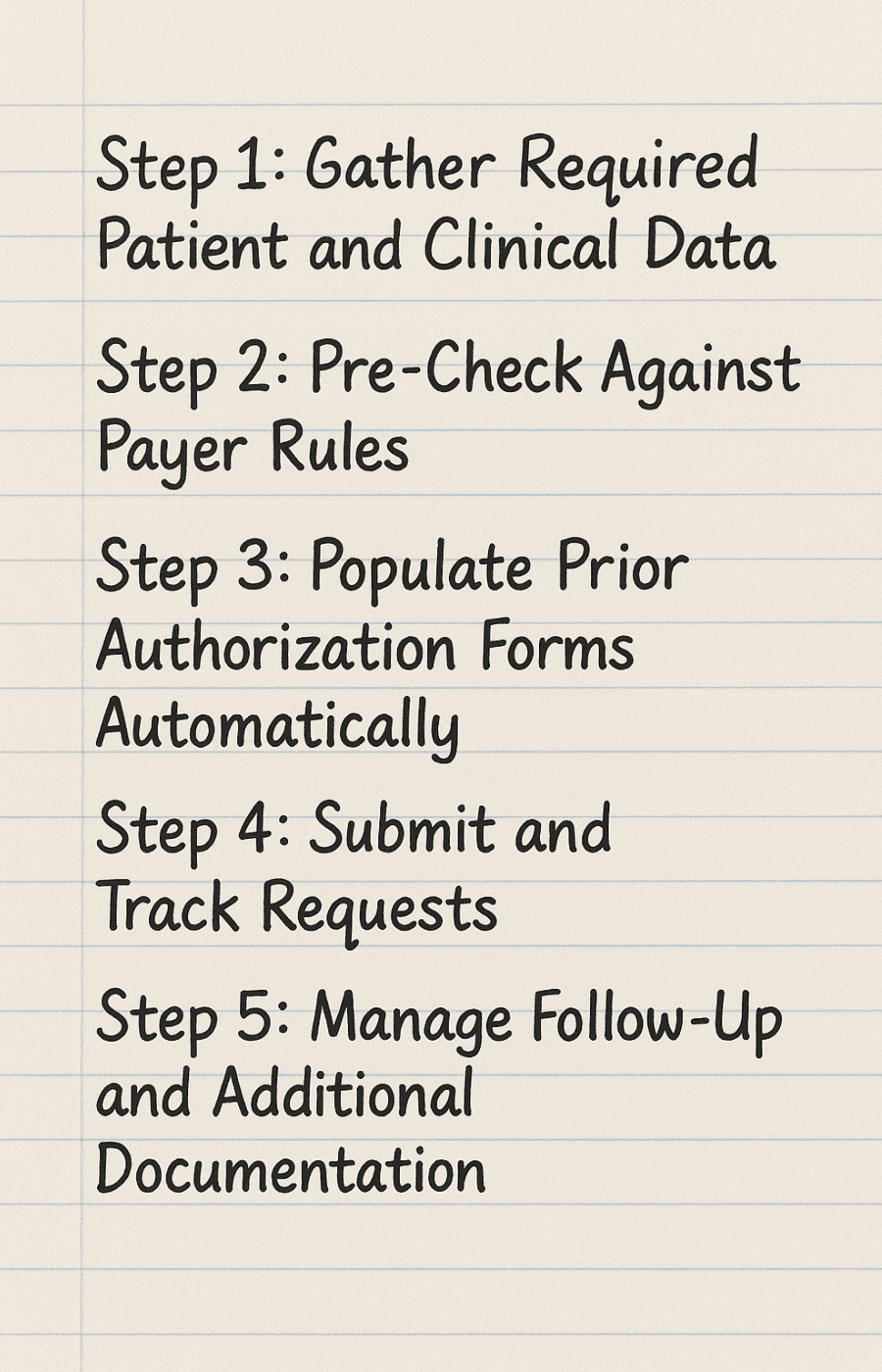
Step 1: Gather Required Patient and Clinical Data
AI agents pull relevant information from the EHR (demographics, diagnosis codes, procedure details, lab results) without staff manually searching through records.
Why it matters: Cuts hours of repetitive lookup work and eliminates the risk of missing critical documents.
Step 2: Pre-Check Against Payer Rules
Before the request is even submitted, AI validates it against payer-specific requirements to catch missing information or incorrect codes.
Why it matters: This can reduce denials caused by preventable errors, which account for up to 20% of prior auth rejections.
Step 3: Populate Prior Authorization Forms Automatically
AI fills in insurer-specific forms with the correct patient and clinical data, adapting to different layouts and required fields.
Real-world win: WebPT used Magical to streamline repetitive form entry for payer submissions, reducing both manual effort and submission errors.
Step 4: Submit and Track Requests
AI submits forms directly through payer portals and monitors them for status changes. Any update (approval, denial, or request for more info) triggers an instant notification to staff.
Step 5: Manage Follow-Up and Additional Documentation
If an insurer asks for more information, AI gathers the necessary documents from the EHR, packages them correctly, and resubmits without starting the process from scratch.
Real-world win: ZoomCare reduced prior auth follow-up delays, improving turnaround times and patient satisfaction.
From start to finish, AI handles the heavy lifting, while staff focus on cases that genuinely need their judgment or escalation.
Benefits of AI-Driven Prior Authorization
When AI takes over the repetitive, rules-heavy parts of prior authorization, the results are immediate and measurable. Not just for your admin team, but for providers and patients.
Dramatically Faster Approval Times
By automating data collection, form completion, and submission tracking, AI can shrink prior auth turnaround from days to hours. Faster approvals mean treatment starts sooner, which can directly improve patient outcomes.
Reduced Administrative Workload
Magical users save an average of 7 hours a week per person across all automated workflows. In a prior auth department, that can translate to hundreds of hours reclaimed monthly, without adding staff.
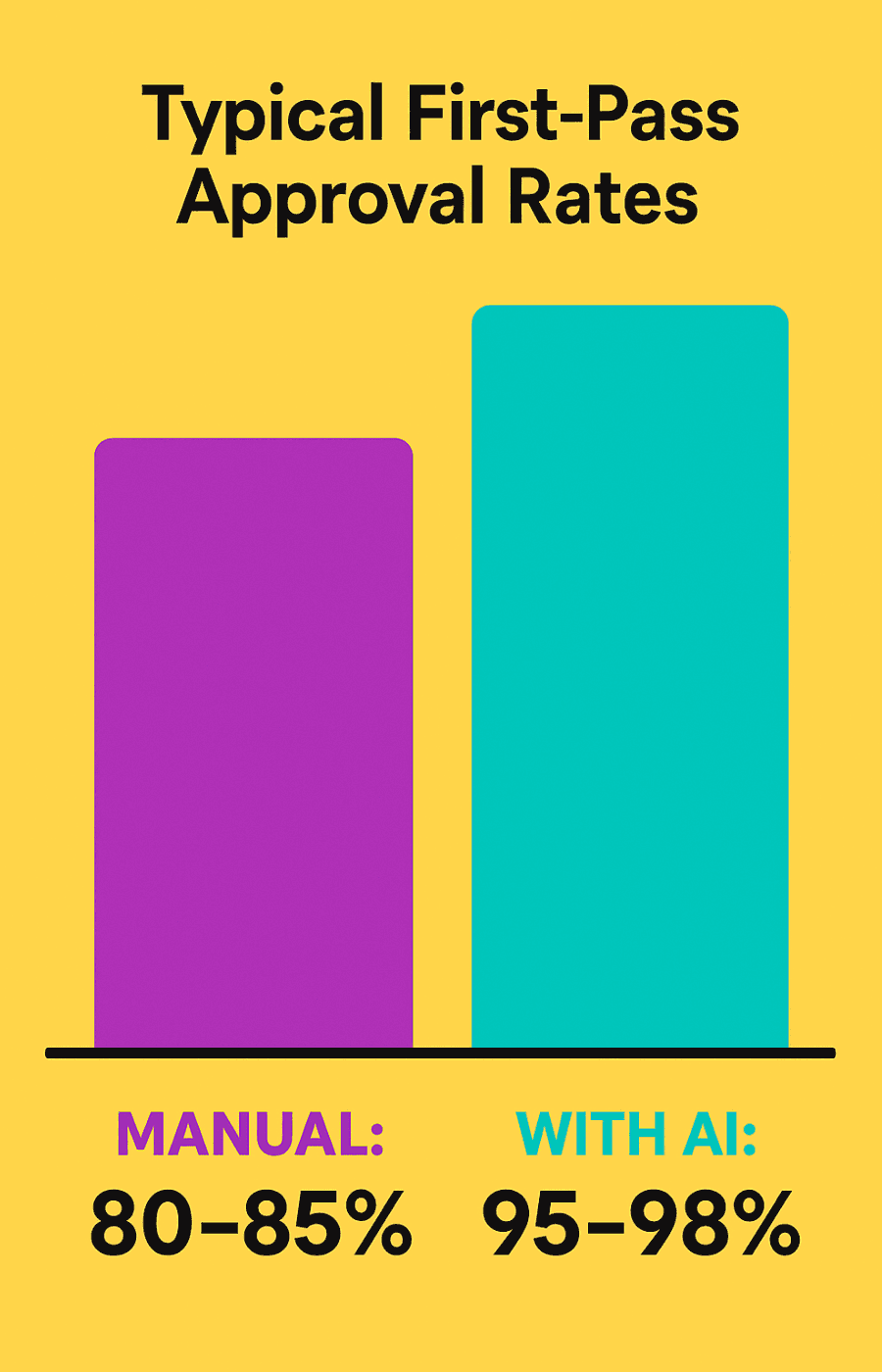
Higher First-Pass Approval Rates
AI’s pre-submission validation catches missing documents and incorrect codes before requests go out, helping reduce the 15–20% initial denial rate common in prior auth.
Less Staff Burnout
Removing the copy-paste grind frees staff to focus on more complex cases and patient communication. The two areas where human expertise actually moves the needle.
Improved Patient Experience
Every day a prior auth request sits in limbo is a day a patient waits for care. AI speeds up the process, leading to better satisfaction scores and fewer complaints.
AI doesn’t just make prior authorization faster. It makes it more accurate, less stressful, and more patient-friendly.
How Magical Simplifies Prior Authorization Workflows
Prior authorization is the kind of workflow that should be automated. It’s high-volume, rules-heavy, and full of repetitive steps that don’t require human judgment. Magical was built to take that load off your team without forcing a full system overhaul.
Here’s how it works in practice:
Works Inside Your Existing Systems
Magical runs as a Chrome extension, automating workflows directly in your EHR, insurer portals, and document management tools. No integrations, no new logins.
Automates End-to-End
From gathering EHR data to filling insurer-specific forms, attaching documentation, and submitting requests, Magical’s AI agents execute the entire prior auth process.
Tracks and Alerts in Real Time
If a payer updates a request status or asks for more documentation, Magical flags it instantly. This means no more manual portal checks.
Secure and HIPAA-Ready
Patient data is encrypted and handled in compliance with HIPAA requirements, so PHI stays protected.
Proven in Real Healthcare Workflows
WebPT: Reduced manual data entry errors in payer submissions.
ZoomCare: Shortened follow-up delays for prior auth requests.
Trusted by over 100,000 companies and nearly 1 million professionals worldwide.
With Magical, prior authorization moves from being a chronic bottleneck to a fast, predictable, almost hands-off process, freeing your team to focus on patients instead of paperwork.
Best Practices for Implementing AI in Prior Authorization
Rolling out AI in prior authorization doesn’t have to be complex. The key is starting small, measuring impact, and scaling strategically.
Start with a High-Volume Request Type
Choose the most common procedure or service your team requests prior auth for. This maximizes early ROI.
Map the Current Workflow
Document every step, from data gathering to payer submission. This makes it easier to identify what the AI agent should handle.
Train the AI on Your SOPs
Feed the AI your existing standard operating procedures so it mirrors your compliance requirements and payer-specific nuances.
Pilot with One Payer
Launch with a single insurer to prove out efficiency gains before expanding to all payers.
Track Results and Iterate
Measure hours saved, first-pass approval rates, and turnaround time improvements in the first 30–60 days. Use those wins to drive adoption across your team.
With the right approach, AI can become a seamless extension of your prior auth process. One that your staff trusts and your patients benefit from.
Final Thoughts: From Paper Chase to Patient Care
Prior authorization shouldn’t be the reason patients wait for treatment.
But in too many healthcare organizations, it’s exactly that. A slow, manual, error-prone process that eats staff hours and tests patient patience.
AI flips the script.
By automating the repetitive steps (data gathering, form filling, submission, and tracking), your team can move requests through faster, with fewer denials and less burnout.
The result is more than time saved.
It’s care delivered when it’s needed, without the administrative drag.
Magical makes this shift possible today. No massive IT project, no replacing your current systems, and no long learning curve for staff.
Just faster approvals, happier patients, and a calmer, more efficient team.
Don’t let another request get stuck in the queue:
Try the free Magical Chrome extension and see how quickly the hours start adding up.
Or book a demo and watch your prior auth bottlenecks disappear.
The difference between delay and delivery is the tools you choose.