The subject line is short and sharp: Audit Notification.
One email, and suddenly the entire billing team’s week changes.
Stacks of claims get pulled.
Staff scramble to find documentation.
Every small mistake becomes a big problem under the auditor’s spotlight.
The truth is, most billing audits don’t uncover intentional fraud. They uncover avoidable errors.
A missing note.
An outdated code.
A duplicated claim.
Small cracks in the workflow that add up to massive risk.
In 2025, when automation can flag those cracks before a claim is ever submitted, why are billing teams still preparing for audits like it’s damage control?
Why Medical Billing Is So Vulnerable to Audits
Medical billing sits at the intersection of patient records, payer policies, and federal regulations. With so many moving parts, even the smallest inconsistency can trigger an audit.
The vulnerability doesn’t come from lack of effort. It comes from the sheer complexity of the system.
The Volume and Complexity of Codes
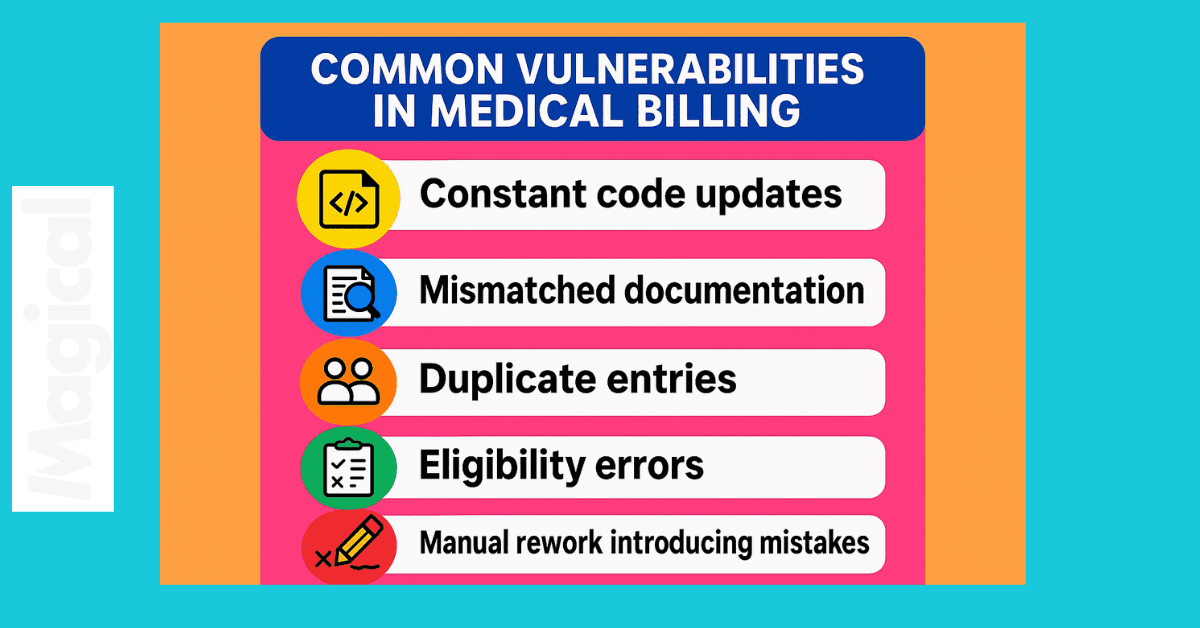
ICD-10, CPT, and HCPCS codes create thousands of possible combinations. Each year brings updates, revisions, and new requirements.
Even for experienced billers, keeping up with this volume leaves room for errors. CMS publishes frequent updates that ripple across every workflow.
Documentation Gaps that Trigger Reviews
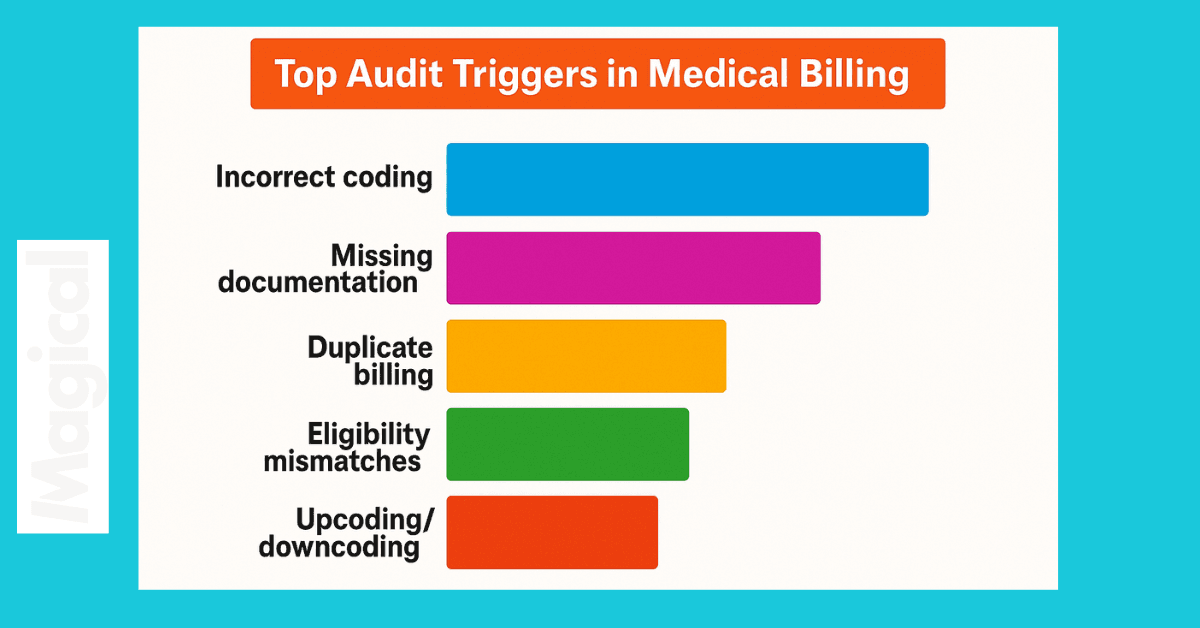
Billing depends on complete, accurate documentation. But in a busy clinic, notes may be incomplete, mismatched, or duplicated. These gaps often invite payer scrutiny.
According to the Office of Inspector General (OIG), documentation deficiencies are among the top reasons claims are flagged for review.
The Real Cost of a Billing Audit
An audit isn’t just an inconvenience. It’s a drain on finances, staff time, and reputation.
Even when errors are unintentional, the impact can ripple across an entire organization.
Direct Financial Penalties and Denials
Improper billing practices can result in fines, clawbacks, and delayed reimbursements.
In 2024, billions of dollars in improper Medicare and Medicaid payments were reported by the OIG, much of it linked to billing errors rather than fraud. Each denied claim chips away at revenue that providers depend on.
Staff Time and Operational Disruption
Preparing for an audit consumes hundreds of staff hours. Instead of working on patient care or revenue cycle tasks, teams spend weeks gathering documentation, reviewing claims, and responding to requests.
The opportunity cost is just as damaging as the penalties.
Reputation and Compliance Risk
Even when audits don’t uncover fraud, the perception of non-compliance can damage payer relationships. Once flagged, providers often face ongoing scrutiny, increasing the likelihood of future audits.
How Automation Reduces Audit Risk in Billing Workflows
Audits happen because small errors slip through unchecked. Automation reduces that risk by embedding compliance and accuracy checks into every billing step long before a claim reaches the payer.
Automated Error Checking
Automation (in the form of AI agents) can flag missing modifiers, mismatched codes, and incomplete documentation in real time. Instead of finding problems during an audit, staff resolve them before the claim ever leaves the system.
Staying Aligned with Policy Updates
Medicare and commercial payer policies change constantly. Automation tools update rulesets instantly, so teams don’t need to memorize every new guideline. That consistency removes one of the biggest drivers of audit risk: outdated information.
Proof in Action: WebPT
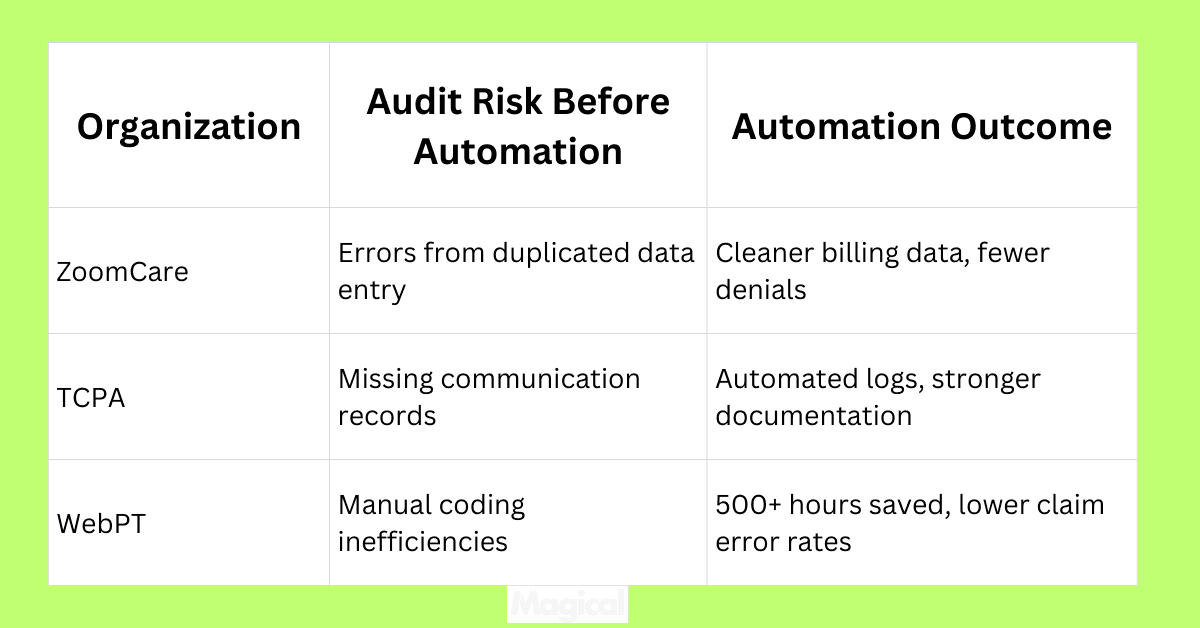
At WebPT, automation helped billing teams reduce errors that could have triggered audits. By removing duplicate entry and cutting down on manual rework, clinics reclaimed over 500 hours of staff time while keeping claims cleaner and more compliant.
Case Studies: Healthcare Teams Reducing Audit Risk with Automation
Audit risk isn’t hypothetical. Clinics and healthcare organizations face it every day. By integrating automation, several teams have already reduced their exposure and improved billing accuracy.
ZoomCare: Faster, Cleaner Billing Workflows
ZoomCare’s front desk and billing teams were bogged down by duplicated data entry, which created errors that could ripple into billing. With automation, records stayed accurate from intake through claims, cutting down on denials and minimizing audit triggers.
TCPA: Automated Communication Strengthened Documentation
Patient communication records are essential for billing accuracy and compliance. TCPA used automation to ensure every outreach was logged consistently. That meant less risk of missing documentation and fewer opportunities for auditors to flag gaps.
WebPT: Scaling Compliance Across Thousands of Clinics
With more than 7,000 clinics, WebPT couldn’t afford inconsistent billing processes. Automation reduced manual rework, eliminated repetitive errors, and provided a stronger compliance framework across the organization.
The result: cleaner claims and reduced audit exposure.
How to Choose the Right Billing Automation Tool
Not all automation platforms are designed with billing and compliance in mind. The right solution should reduce audit exposure, support regulatory updates, and work seamlessly with existing systems.
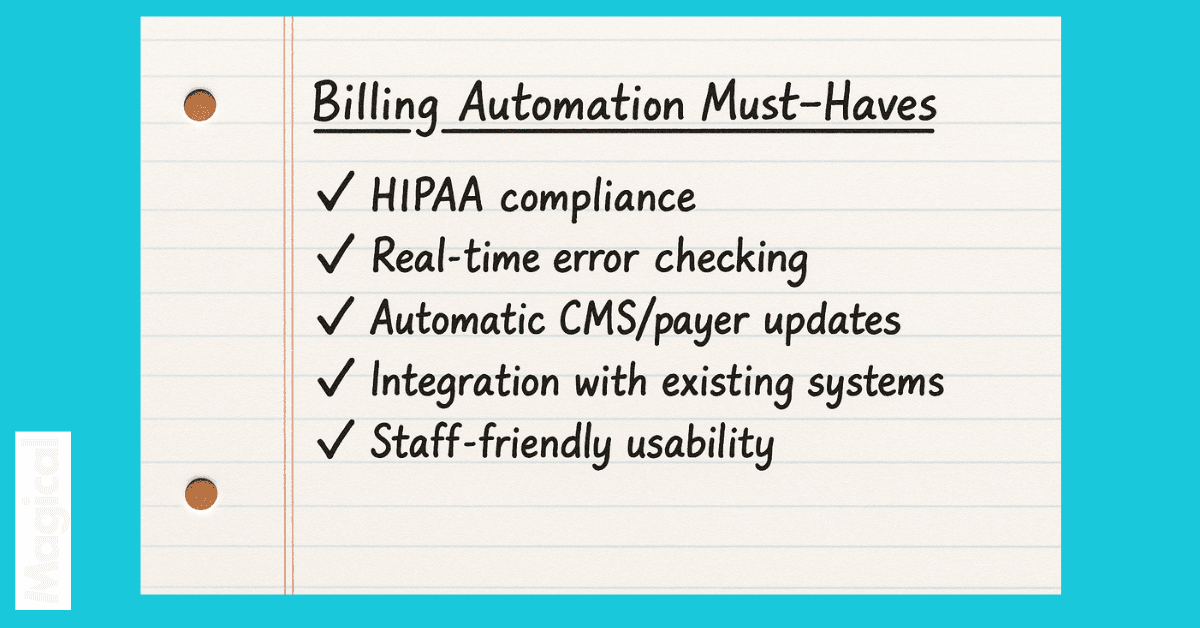
Key Features to Look For
HIPAA-compliant security to protect patient data.
Real-time error detection to catch issues before claims are submitted.
Automatic policy updates aligned with CMS and commercial payer rules.
Cross-platform compatibility with EHR and billing systems.
Ease of adoption so non-technical staff can use it right away.
Questions Billing Teams Should Ask
Can it flag high-risk claims before submission?
Does it scale across multiple payers and specialties?
How much time does it save per claim cycle?
Will it provide an audit trail to strengthen compliance readiness?
Choosing a tool with these capabilities ensures audit risk is reduced at the source, not just patched after the fact.
Final Thoughts: From Audit Anxiety to Audit Readiness
Audits will always be part of healthcare billing. The difference is whether they arrive as a disruption or a formality.
With automation, billing teams move from defensive cleanup to proactive readiness.
Claims are cleaner, documentation is consistent, and compliance checks happen before submission.
Instead of bracing for the next audit notification, teams can focus on their real priorities, serving patients and strengthening revenue cycles.
All while knowing compliance is already built into their workflows.
Download the free Magical Chrome extension or book a demo for your team today! Magical is used at 100,000+ companies and by nearly 1,000,000 users to save 7 hours a week on average.