
Your inbox isn’t a to-do list anymore.
It’s a fire alarm.
Another urgent “PA request” flagged by a physician.
A payer portal that’s mysteriously down (again).
A compliance report due in two days, and the spreadsheet template is already giving you errors.
This is healthcare administration in 2025: a stack of essential tasks so time-consuming, they end up competing against each other for priority.
Patients wait.
Staff burn out.
Leaders cut budgets and expect magic.
Here’s the twist: the magic already exists.
Healthcare process automation with AI isn’t just about moving faster. It’s about having digital co-workers that handle the repetitive, high-volume tasks your team shouldn’t be doing in the first place.
Pulling patient data, filling forms, checking codes, sending confirmations, syncing records across systems, done automatically, 24/7, without coffee breaks or sick days.
Automate patient data retrieval, form completion, code verification, confirmation sending, and record synchronization across systems.
This can all be done automatically, 24/7, without the need for breaks or sick days.
And the payoff isn’t just hours saved. It’s a healthcare team that finally has the bandwidth to focus on patients, not paperwork.
What Is Healthcare Process Automation?
Healthcare process automation is exactly what it sounds like—using technology to take over the repetitive, rules-based tasks that keep admin teams stuck in busywork. But in 2025, that definition is evolving.
Old-school automation meant rigid macros or RPA scripts that clicked through the same screens the same way every time.
It worked… until the portal changed, or a payer updated its requirements, or a form had one field out of place.
Then it broke.
AI-driven automation is different. It can:
Understand unstructured data like physician notes, scanned forms, or PDFs.
Make decisions, like choosing the right CPT code or routing a request to the right payer queue.
Adapt in real time when rules, systems, or formats change.
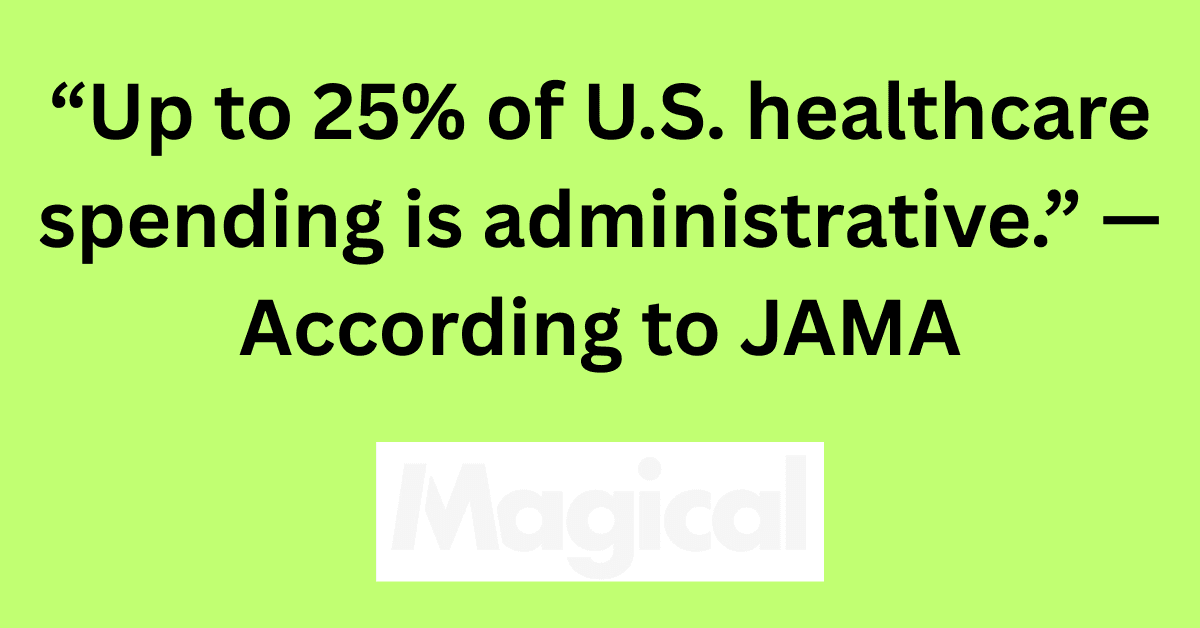
Why it matters: Admin tasks account for up to 25% of U.S. healthcare spending (JAMA), and much of that cost comes from manual processes that could be automated.
Worse, they’re directly tied to delays in patient care. 86% of physicians say prior authorization delays necessary treatment (AMA).
In other words, automating the right processes doesn’t just save money. It speeds up care, reduces burnout, and keeps healthcare organizations compliant without drowning staff in forms.
Why Healthcare Teams Need Automation Now
Healthcare administration isn’t just busy. It’s buckling under the weight of rising demand, shrinking staff, and regulatory pressure.
Automation isn’t a “someday” project anymore. It’s survival.
Staff Shortages and Burnout
The healthcare workforce crisis isn’t slowing down. By 2026, the U.S. is projected to face a shortage of up to 3.2 million healthcare workers, including critical non-clinical roles in billing, scheduling, and compliance.
Existing staff are burning out under the load. One in five healthcare workers say they’ve considered leaving their job.
Increasing Complexity of Payer and Compliance Requirements
Every year brings new payer rules, coding updates, and reporting mandates. Manual tracking is a losing battle, especially when up to 80% of healthcare data is unstructured and doesn’t fit neatly into spreadsheets.
Rising Patient Expectations
Patients expect the speed and convenience they get from retail and banking. Only in healthcare, delays can be life-altering.
A slow prior authorization or a billing error isn’t just inconvenient; it can keep someone from getting treatment on time.
Pressure to Reduce Operational Costs
Margins are razor-thin, especially for smaller providers. With administrative costs eating up nearly a quarter of healthcare spending, cutting manual tasks is one of the fastest ways to free up budget without touching clinical care.
Healthcare teams can’t simply “work harder” out of this problem. They need technology that can take over repetitive, high-volume workflows.
Securely, accurately, and at scale.
Where AI Fits into Healthcare Process Automation
Not all automation can handle healthcare’s complexity. Static RPA scripts and macros are great for clicking the same buttons over and over.
But the moment a payer changes a portal layout or a compliance form gets updated, they stall. AI automation doesn’t just keep going.
It gets better as it works.
Here’s what makes AI different:
Understands messy, unstructured data
Physician notes, scanned lab reports, insurer PDFs, AI can read them, extract the relevant details, and drop them into the right system. This matters when 80% of healthcare data is unstructured.
Adapts to change automatically
When a payer tweaks their submission rules or a form layout shifts, AI can recognize and adjust without weeks of IT reprogramming.
Makes decisions, not just moves data
An AI agent can choose the correct CPT code from clinical documentation, flag missing prior auth documentation, or route a case to the right team, all autonomously.
Learns across workflows
Once AI masters one process (say, prior authorization), it can apply those learnings to related workflows like claims submission or denial management.
For healthcare teams, that means automation that’s resilient in a changing regulatory environment, precise enough for compliance, and fast enough to keep patient care moving.
High-Impact Use Cases of AI in Healthcare Process Automation
AI automation isn’t just about “working faster.” It’s about removing the repetitive, error-prone tasks that keep healthcare teams from focusing on patients.
Here’s where it’s making the biggest difference right now:
Medical Billing & Claims Processing
AI agents pull patient demographics, diagnosis codes, and procedure details directly from EHRs, validate them against payer rules, and submit claims, without manual copy-paste.
Real-world win: WebPT used Magical to automate repetitive billing data entry, reducing human error and speeding up claims submission.
Prior Authorization
AI gathers documentation, fills insurer-specific forms, and submits them automatically, while tracking status updates.
Reduces delays that can postpone patient care.
Also boosts first-pass approval rates by ensuring all required info is included.
Patient Intake and Scheduling
When a new patient fills out an intake form, AI moves their information into scheduling systems, EHRs, and billing software without anyone retyping it.
Cuts appointment booking time, eliminates duplicate entries, and improves accuracy.
Compliance Reporting
AI collects required data for HIPAA audits or state reporting, formats it correctly, and sends it to the right recipients.
Real-world win: TCPA used Magical to securely handle sensitive patient information at scale while staying compliant.
Denial Management
AI monitors claim statuses, flags denials instantly, and prepares resubmission packets with supporting documents already attached.
Real-world win: ZoomCare cut follow-up delays, leading to faster reimbursements and better cash flow.
These are live workflows in healthcare organizations right now. The result is fewer bottlenecks, faster reimbursements, and admin teams with breathing room.
Benefits of AI-Driven Healthcare Process Automation
When AI takes over repetitive, rules-heavy workflows, the ripple effects go far beyond “time saved.” Teams see measurable improvements in accuracy, compliance, staff retention, and patient satisfaction.
Significant Time Savings
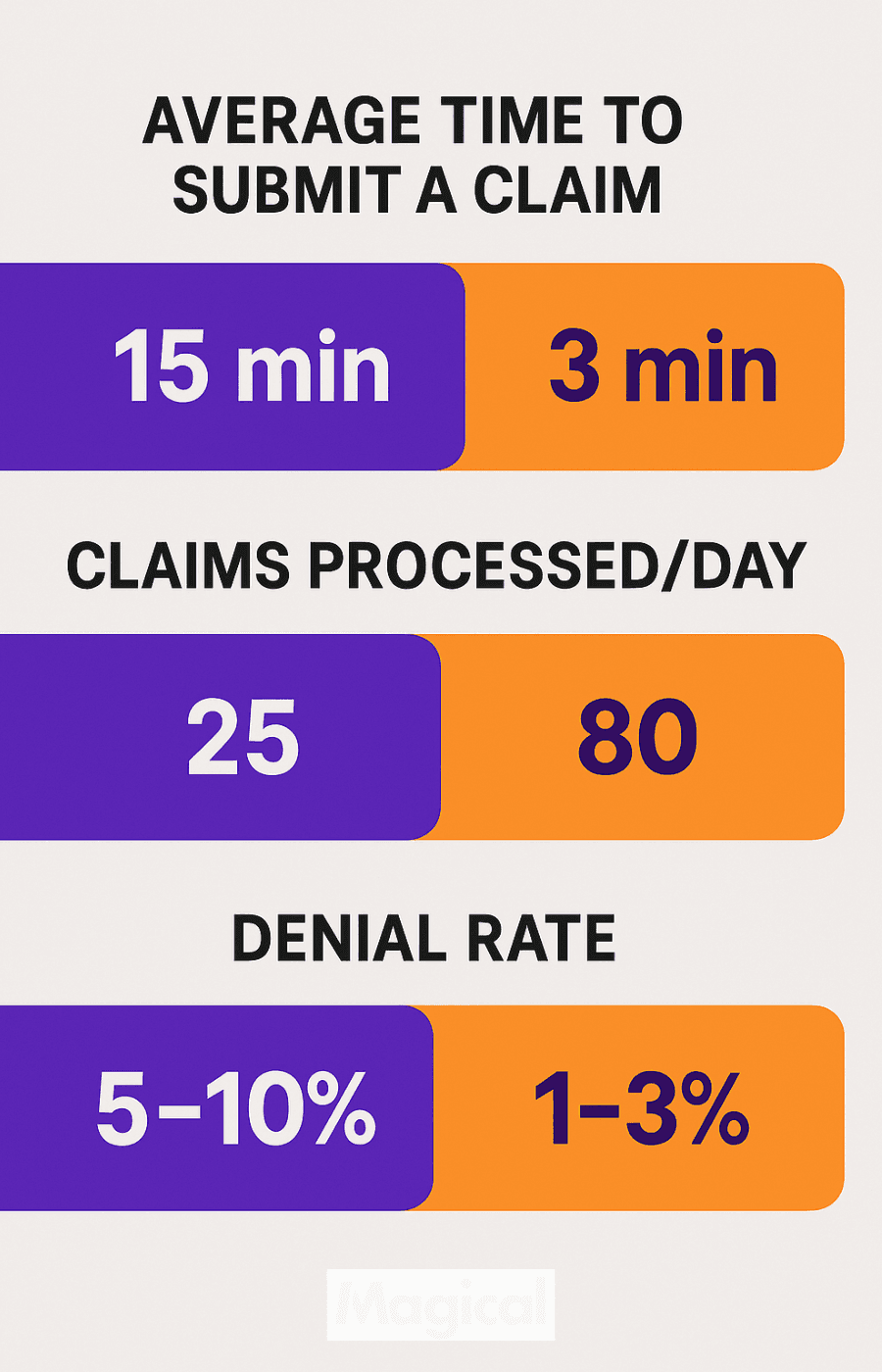
Magical users save an average of 7 hours per week per person by automating manual tasks, time that can be reallocated to patient-facing or high-priority work. Scale that across a 10-person admin team, and you’re looking at over 3,600 hours reclaimed annually.
Improved Accuracy and Fewer Errors
Manual data entry errors are a leading cause of claim denials. Up to 80% of medical bills contain errors (Medical Billing Advocates of America). AI cross-checks and validates data before submission, drastically reducing costly rework.
Better Compliance and Audit Readiness
AI can be configured to ensure all submissions meet HIPAA and payer-specific rules. This reduces compliance risk and makes surprise audits far less disruptive.
Happier Staff, Lower Turnover
By automating repetitive work, AI lightens the load on admin teams. Burnout drops, job satisfaction rises, and turnover-related costs decrease.
Faster Patient Service
When billing, prior auth, and scheduling move faster, patients get treatment sooner. That’s not just good for satisfaction scores. It’s good for outcomes.
AI-driven automation pays for itself in labor savings alone. And the secondary benefits (better compliance, happier teams, faster patient care) are just as valuable.
Overcoming Common Concerns
Healthcare teams don’t hesitate to automate because they don’t believe in the benefits. They hesitate because they’ve been burned by tech that’s expensive, disruptive, or risky.
Here’s how AI automation addresses those concerns.
“Will it be secure and HIPAA-compliant?”
Yes, if you choose the right tool. Magical’s automation is designed for handling PHI safely, with enterprise-grade encryption and HIPAA-ready architecture. Data stays within your systems, and nothing is stored where it shouldn’t be.
“Will it work with our existing software?”
Magical works inside your browser, so it’s compatible with your EHR, billing platform, insurer portals, and spreadsheets without needing formal integrations. No rip-and-replace. No six-month IT project.
“Will our staff actually use it?”
Tools that require heavy training or coding skills die on the vine. Magical is built for non-technical users. If you can click and type, you can run automated workflows.
Adoption is typically immediate because it solves problems staff feel every day.
“What if payer rules or forms change?”
This is where AI outshines traditional RPA. Agentic AI recognizes changes and adapts without manual reprogramming, so your workflows keep running without downtime.
AI automation can be as secure, seamless, and user-friendly as any tool you’ve ever implemented, if it’s designed with healthcare realities in mind.
How Magical Powers AI Automation for Healthcare Teams
Magical was built for the exact kind of repetitive, high-volume, error-sensitive work that keeps healthcare admin teams underwater. Instead of replacing your systems, it works inside them, quietly running the workflows you shouldn’t be wasting human hours on.
Here’s what that looks like in action:
Works Where You Already Work
Magical runs as a Chrome extension, so it integrates directly into your existing EHR, billing system, insurer portals, and spreadsheets. No API builds, no new logins, no disruptions.
Automates Multi-Step Workflows
From patient intake to claim resubmissions, Magical’s agentic AI can execute complex processes end-to-end: pulling data, validating it, filling forms, submitting requests, and tracking status updates.
Secure, HIPAA-Ready Automation
PHI is encrypted and handled in compliance with HIPAA requirements. Your patient data stays in your systems, not on some third-party server.
Adapts When Things Change
If a payer updates their form layout or modifies a rule, Magical’s AI adjusts without IT intervention. No broken scripts, no downtime.
Proven Time Savings and Scale
Average of 7 hours saved per user each week.
Trusted by over 100,000 companies and nearly 1 million professionals.
Healthcare clients like WebPT, TCPA, and ZoomCare have cut manual work, improved accuracy, and reduced processing delays without adding headcount.
With Magical, automation stops being an IT project and starts being a force multiplier for your team. Freeing up hours, reducing errors, and accelerating the pace of patient care.
Getting Started with AI Automation in Healthcare
You don’t need a multi-million-dollar transformation plan to see results from AI automation. The fastest path to value is to start small, prove the ROI, and expand from there.
Here’s the rollout path many healthcare teams follow:
Identify the Bottleneck
Pick the one workflow that eats the most time: claims prep, prior authorization, denial resubmissions, or intake data transfer.
Automate It First
Use Magical’s Chrome extension to let AI agents handle that process directly in your existing systems. No integrations, no IT downtime.
Measure the Win
Track hours saved, denials prevented, and turnaround times improved in the first month.
Expand the Scope
Once you’ve proven the value, scale automation across more processes, like compliance reporting, scheduling, and patient communication.
The key is momentum. Every workflow you automate frees up hours and headspace for your team, and those gains compound quickly.
Final Thoughts: From Overload to Operational Excellence
Healthcare admin teams aren’t short on skill. They’re short on time.
The daily grind of billing, prior auth, compliance, and data entry isn’t just exhausting your staff; it’s slowing down patient care and bleeding money from your organization.
AI automation changes the equation.
With the right tools, the workflows that once devoured hours now run on autopilot.
Securely, accurately, and without constant oversight.
Magical makes it possible to implement that shift today, without ripping out your systems or waiting for a long IT rollout.
The result? Fewer errors, faster turnaround times, happier patients, and a team that can finally focus on the work that matters most.
Don’t let another week vanish into administrative drag:
Try the free Magical Chrome extension and see the hours start adding up.
Or book a demo and watch your team’s workflows transform.
Automation in healthcare is here.
The question is whether your team will lead the change or lag behind it.