
The phone rings…..again.
A claims processor is asking for the same documentation you sent last week.
You pull up the patient file, hunt down the CPT code, copy-paste details into the insurer portal… and just like that, another 15 minutes of your day disappears into billing limbo.
Multiply that by hundreds of claims, dozens of payers, and a codebook that seems to grow thicker by the hour.
It’s not just inefficient.
It’s a system designed to drain time, energy, and revenue.
Agentic AI flips that script.
Instead of humans babysitting every form, code, and portal login, AI agents handle the heavy lifting: extracting data from EHRs, validating codes, submitting claims, chasing denials, all without you hovering over their shoulder.
And the kicker? It’s not theoretical.
Healthcare teams are already using it to slash hours of billing work, improve first-pass approvals, and give staff time back for the work that actually matters.
What Is Agentic AI And Why It Matters for Medical Billing
Agentic AI isn’t your typical “predictive” AI that spits out suggestions and waits for you to act. It’s AI with initiative, systems that can plan, decide, and execute multi-step workflows without a human babysitter.
Think less “calculator” and more “colleague who doesn’t need coffee breaks.”
In a billing context, that means:
Logging into insurer portals.
Pulling and cross-checking patient data from EHRs.
Validating CPT/ICD codes against payer-specific rules.
Submitting claims and tracking statuses.
Flagging denials and resubmitting, without you lifting a finger.
This matters because medical billing errors cost the U.S. healthcare system an estimated $935 million annually.
And those errors aren’t just expensive. They slow down care.
The American Medical Association found that 86% of physicians describe prior authorization and claim processing delays as a “high” or “extremely high” burden.
Traditional automation (macros, RPA scripts) breaks when a portal updates or a payer changes a form. Agentic AI adapts. It learns, adjusts, and keeps moving without a ticket to IT.
For healthcare billing teams, that means stability in a landscape where rules, forms, and requirements shift constantly.
Instead of chasing tasks, you get to focus on the exceptions. The edge cases that need human judgment, while AI agents handle the rest.
Common Pain Points in Medical Billing Today
Medical billing isn’t complicated because humans can’t do it.
It’s complicated because the system is designed like a maze with moving walls.
Every payer, every claim type, every medical specialty adds its own twists. The result? Hours of administrative drag that no amount of “working faster” can fix.
High Error Rates
Even with the best billers on staff, mistakes happen. CPT and ICD code mismatches, missing documentation, and payer-specific rule slips are common.
Up to 80% of medical bills contain errors, which means denied claims, delayed payments, and endless back-and-forth with insurers.
Slow Claims Processing
Every claim is a race against the clock, but the clock is controlled by the payer. Manual entry and submission can take days, and when something is missing, the clock resets. The average claim takes 7–10 days to process, but denials can drag resolution out to 30+ days.
Staff Burnout
Billing teams aren’t leaving because they can’t handle the work. They’re leaving because they’re trapped doing the same work over and over.
The administrative load in healthcare has grown so heavy that one in five healthcare workers have considered leaving their job since the pandemic (KFF).
Revenue Leakage
Denied claims aren’t always resubmitted, not because teams don’t care, but because there’s no time. Every unresubmitted denial is lost revenue. Hospitals lose an average of $262 billion annually due to denied claims.
This is the daily grind Agentic AI is built to dismantle. Not by adding more staff, but by removing the repetitive work that keeps staff stuck in the loop.

5 Examples of Agentic AI in Medical Billing
Agentic AI isn’t a theory. It’s already at work in billing teams across healthcare, quietly removing hours of grunt work from every week.
Here’s how:
Automated Data Extraction from Patient Records
Instead of staff hunting through EHR tabs for the right date of service, diagnosis code, or provider info, AI agents pull the data automatically, validate it, and drop it directly into billing platforms.
Real-world win: WebPT uses Magical to automate repetitive data entry between patient records and billing systems, cutting manual work and reducing input errors.
Why it matters: Even a small error (like a mistyped CPT code) can delay payment by weeks. AI extraction prevents that from happening in the first place.
Intelligent Claim Preparation & Submission
Agentic AI does more than copy-paste. It checks the claim for missing data, validates coding against payer rules, and then submits it to the insurer.
This isn’t static RPA. If a payer’s portal changes fields or forms, AI can adapt without starting from scratch.
According to the American Academy of Family Physicians, up to 5% of claims are denied due to incomplete or incorrect information. Errors AI can catch before submission.
Proactive Denial Management
Instead of waiting for a denial letter in the mail, AI tracks claim status in real time, flags issues instantly, and even prepares resubmission packets with supporting documentation.
Real-world win: ZoomCare used Magical to reduce claim follow-up delays, ensuring denials were addressed quickly and payments flowed faster.
Automated Prior Authorization Requests
For services that require prior auth, AI gathers the right documentation, fills out payer-specific forms, and submits them automatically.
Cuts turnaround from days to hours in many cases.
Lays the groundwork for higher approval rates on the first try, reducing the need for manual resubmissions.
Cross-System Data Syncing
Healthcare teams often have to jump between EHRs, billing software, CRM platforms, and payer portals. Agentic AI acts as a bridge, keeping all relevant systems updated without manual duplication.
Real-world win: TCPA uses Magical to securely transfer sensitive patient and claims data between systems at scale, staying compliant while eliminating repetitive manual work.
From claim prep to denial resubmissions, these examples share a common theme: AI agents are doing work once reserved for human staff. Only faster, more accurately, and without getting burned out.
Why Agentic AI Beats Traditional Automation in Medical Billing
Legacy automation in billing (macros, RPA bots, templated workflows) works great… until it doesn’t. The moment a payer changes a form, a field label, or a login process, the automation breaks, and IT has to patch it.
Meanwhile, your claims queue keeps piling up.
Agentic AI doesn’t just follow static instructions. It understands context, adapts to change, and completes the workflow even when the inputs shift. Here’s what that means in real life:
Handles Exceptions Without Pausing the Line
Traditional RPA stops when a claim is missing a code or a portal login fails. Agentic AI finds the missing data or retries with updated credentials. No ticket to IT required.
Learns as It Works
If a payer changes how they want claims submitted, AI agents adjust automatically. No reprogramming, no downtime.
Works Across Unstructured Data
PDFs, scanned documents, free-text clinical notes—Agentic AI can parse them and pull exactly what’s needed for billing. RPA can’t.
This matters because 80% of healthcare data is unstructured (according to IBM).
Faster ROI
RPA projects often take months to implement and require dedicated IT resources to maintain. Agentic AI can be deployed in days and run directly in a browser without disrupting existing systems.
RPA moves the mouse for you. Agentic AI thinks, decides, and gets the claim paid.
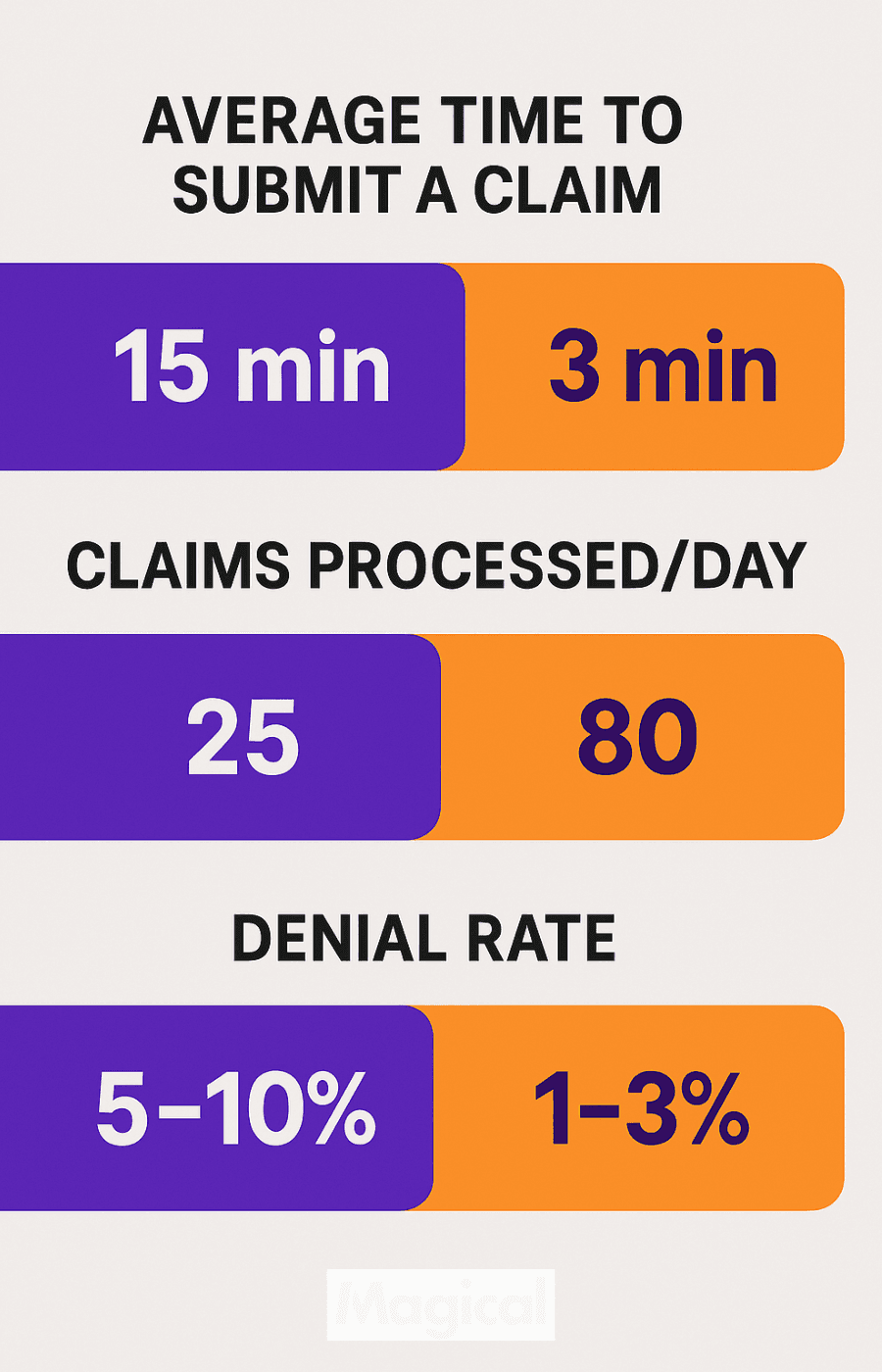
How Magical Powers Agentic AI for Medical Billing Teams
Most billing software promises to make you “more efficient.” Magical skips the buzzwords and gives healthcare teams what they actually need: an AI co-worker that sits in your browser and takes over the repetitive, high-volume tasks that drain your day.
Here’s how it works in the real world:
Lives Where You Work
Magical runs as a Chrome extension, so it works inside your existing tools (EHRs, insurer portals, spreadsheets, billing software) without expensive integrations or IT overhauls.
Secure, HIPAA-Ready Automation
Patient data stays protected with enterprise-grade encryption. Magical’s automation is designed for handling PHI safely, meeting HIPAA compliance requirements.
Trained for Healthcare Billing Workflows
From CPT/ICD validation to payer-specific form completion, Magical’s AI agents can execute multi-step billing workflows without manual oversight.
Adaptable Across Payers and Portals
If a portal changes its layout or a payer updates requirements, Magical’s agentic AI adjusts on the fly. No reprogramming needed.
Proven Time Savings at Scale
Across industries, Magical’s users save an average of 7 hours a week per person. Multiply that across a billing team and the ROI becomes impossible to ignore.
Used at over 100,000 companies and by nearly 1,000,000 professionals worldwide. Healthcare teams like WebPT and ZoomCare have cut manual work and improved claim turnaround without hiring more staff.
Magical doesn’t just automate tasks. It delivers outcomes: faster claims, fewer denials, happier billing teams, and patients who aren’t stuck waiting because of a missing form field.
The ROI of Agentic AI in Medical Billing
When billing teams think about automation ROI, the first number they usually look at is hours saved.
But with agentic AI, the impact runs deeper, into fewer denials, faster reimbursement, and even improved patient satisfaction scores.
Here’s what the math looks like:

*Based on a 6-person billing team with $80k fully loaded cost per FTE.
Tangible Gains Beyond Labor Savings
Faster cash flow: Reducing claim processing time from 10 days to 2 days can significantly improve working capital.
Lower rework costs: According to Change Healthcare, the average cost to rework a denied claim is $25–$118. AI prevents many of these errors before they happen.
Better staff retention: Burnout drops when repetitive work is automated, reducing turnover costs (which can exceed 20% of annual salary per role, per Gallup).
When you add up the labor savings, recovered revenue from fewer denials, and the financial boost of faster reimbursements, agentic AI doesn’t just pay for itself.
It funds future growth.
Getting Started With Agentic AI in Your Billing Workflow
You don’t need a six-month IT project to start reaping the benefits of AI in billing. The fastest wins come from automating one high-impact workflow first, then expanding from there.
Here’s a simple rollout path healthcare billing teams use:
Identify Your Bottleneck
Look for the most repetitive, time-consuming task in your claims process, like pulling patient data from EHRs or resubmitting denials.
Automate One Workflow
Use Magical’s Chrome extension to let an AI agent take over that process inside your existing tools. No integrations, no new logins.
Measure the Impact
Track time saved, claims processed, and denials reduced in the first month.
Expand to More Processes
Once you’ve proven the value, scale automation across prior auth, claims prep, denial management, and more.
In less time than it takes to get a coffee refill, you can have an AI agent working alongside your team. And those minutes add up to hours, then weeks, saved over the course of a year.
Final Thoughts: From Bottleneck to Breakthrough
Every denied claim, every resubmission, every “just checking the status” call chips away at your team’s time and your organization’s revenue.
Agentic AI changes the equation, turning medical billing from a reactive grind into a proactive, self-running process that frees your staff to focus on work that matters.
Magical puts that power in your hands today, without ripping out your current systems or waiting months for an implementation team to show up.
It’s fast, secure, and already helping healthcare billing teams process more claims in less time, with fewer errors and fewer headaches.
Don’t spend another week fighting the billing backlog.
Try the free Magical Chrome extension and see how quickly the hours start adding up.
Or book a demo for your team and watch your billing workflows transform.
The future of medical billing is already here.
The only question is whether your team will still be stuck doing things the old way.