
The portal crashed halfway through a prior auth submission. Again.
The eligibility check that was supposed to be automated? It returned blank.
So now, someone on your team is on the phone with the payer (on hold for 28 minutes) just to confirm the patient is, in fact, still covered.
Meanwhile, yesterday’s batch of claims came back.
A dozen of them rejected.
The reasons? A missing modifier, an outdated form version, and a payer rule that changed last week without notice.
Rework is underway. Again.
This is the normal that healthcare admin teams have been forced to accept.
It’s not just frustrating.
It’s expensive, unsustainable, and driving skilled staff to burnout at a time when every hour matters.
But here’s the shift: admin work is no longer a labor problem.
It’s a system problem.
And AI software, when designed for actual payer-provider workflows, not generic automation, is becoming the way out.
The best platforms today don’t just speed things up. They reduce errors, anticipate issues, and free human teams to focus on what actually needs human attention.
So let’s break down what that looks like: which tools stand out, what to look for, and how the most effective healthcare teams are getting their time back.
What We Mean by "AI Software" in This Context
Let’s be clear: we’re not talking about chatbots, virtual scribes, or voice recognition tools.
When we say AI software in this context, we’re talking about tools built to automate and optimize backend workflows between healthcare providers and payers.
These platforms don't handle patient communication or clinical tasks. They’re focused on the high-friction, low-visibility admin work that delays care, increases costs, and stretches your staff to the edge.
Here’s what that means in practice.
AI That Reduces Administrative Burden Looks Like This:
Fewer touchpoints per task. Instead of logging into four portals to submit one claim, your team enters the data once, and the system handles the formatting, validation, and submission behind the scenes.
Smarter documentation and form generation. AI can pull relevant details from your EHR or system of record and auto-generate documentation that meets payer-specific formatting and language requirements.
Real-time eligibility checks and prior auth validation. The software integrates with payer systems to verify benefits and authorization needs instantly, eliminating hold times and manual lookups.
Pattern recognition to prevent rework. AI learns from past denials, identifies trends, and flags risky submissions before they go out. It doesn’t just follow rules; it learns the playbook.
This Is Where the Burden Lives and Where AI Belongs
The administrative load in healthcare isn’t just inconvenient. It’s a major cost driver.
A recent study found that administrative spending accounts for nearly 25% of total U.S. healthcare costs, with much of that driven by inefficient payer-provider interactions.
That includes:
Prior authorization management
Claims formatting and submission
Rejections and appeals
Documentation rework
Audit preparation
These aren’t side tasks. They’re full-time jobs, and AI, when implemented properly, is proving to be a better teammate than yet another FTE.
How AI Eases the Payer-Provider Logjam (4 Ways)
For most admin teams, the term “workflow” doesn’t feel like flow. It feels like a traffic jam.
Too many systems. Too many steps. Too many avoidable denials.
AI software, when designed for payer-provider workflows, removes the blockers that slow everything down. It’s not about automating for automation’s sake. It’s about eliminating the friction that prevents work from getting done the first time, accurately.
Here’s how that actually plays out.
1. AI Predicts the Gaps Before They Become Denials
Most denials happen because of missing information, outdated payer rules, or formatting errors. AI systems learn from historical submission data to flag risky claims before they leave the building.
The result? Fewer rejections. Fewer appeals. More cash collected on the first pass.
2. It Auto-Fills Forms Across Systems Instantly and Accurately
Instead of retyping patient information, CPT codes, or diagnosis details into multiple portals, AI-powered tools pull that data from the source system and populate every field, in the right format, for the right payer.
It works like a universal translator for compliance forms, saving time and preventing copy/paste errors.
3. It Integrates with the Systems You Already Use
The best AI software doesn’t force teams to learn another platform. It works inside your EHR, your billing tool, your payer portal, wherever your team already operates.
For example, Magical’s AI workforce sits as a Chrome extension and overlays directly onto the tools your team is using today.
No switching tabs. No onboarding nightmares.
4. It Tracks What’s Happening So You Don’t Have To
Good automation doesn’t just execute. It logs. Every step, every action, every submission.
This turns your AI tool into a built-in audit trail, ready whenever you need to answer a compliance question or resolve a dispute.
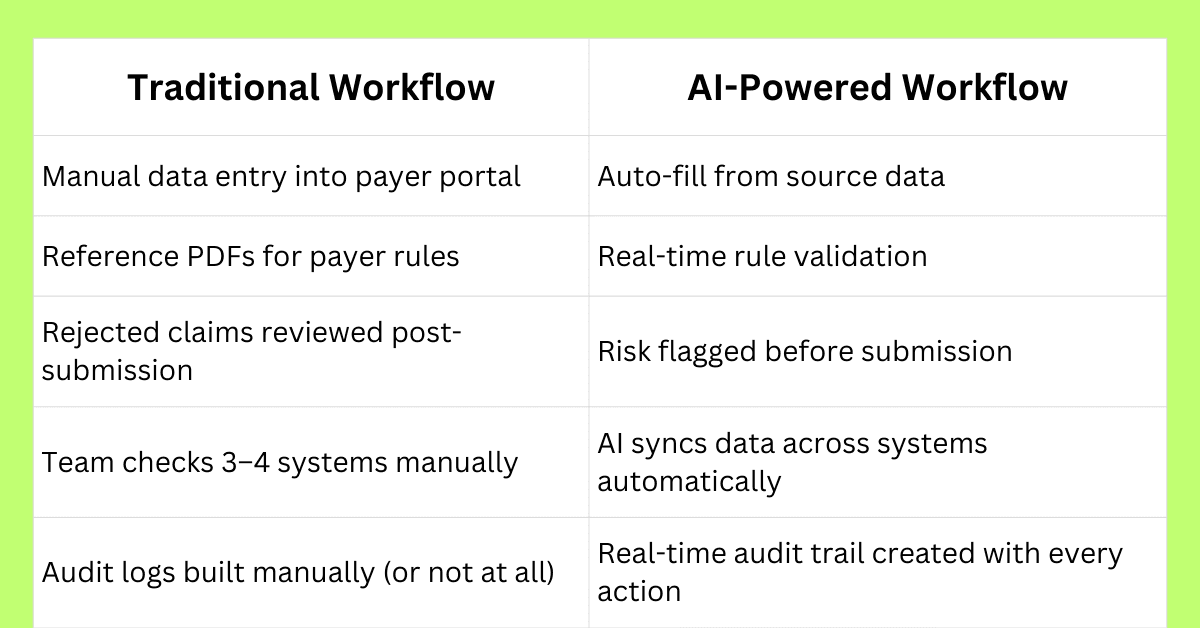
This helps teams see what AI actually changes. Not in theory, but in daily practice.
Core Features to Expect in the Best AI Software for Admin Burden
Plenty of tools promise to automate your workflows. But few are built specifically for the unique (and constantly shifting) requirements of payer-provider operations.
The best AI software doesn’t just handle tasks. It understands context, adapts to changing rules, and keeps teams ahead of rejections, rework, and delays.
Here’s a breakdown of what high-performing AI platforms offer and why these features matter in real healthcare settings.
Feature Comparison Table
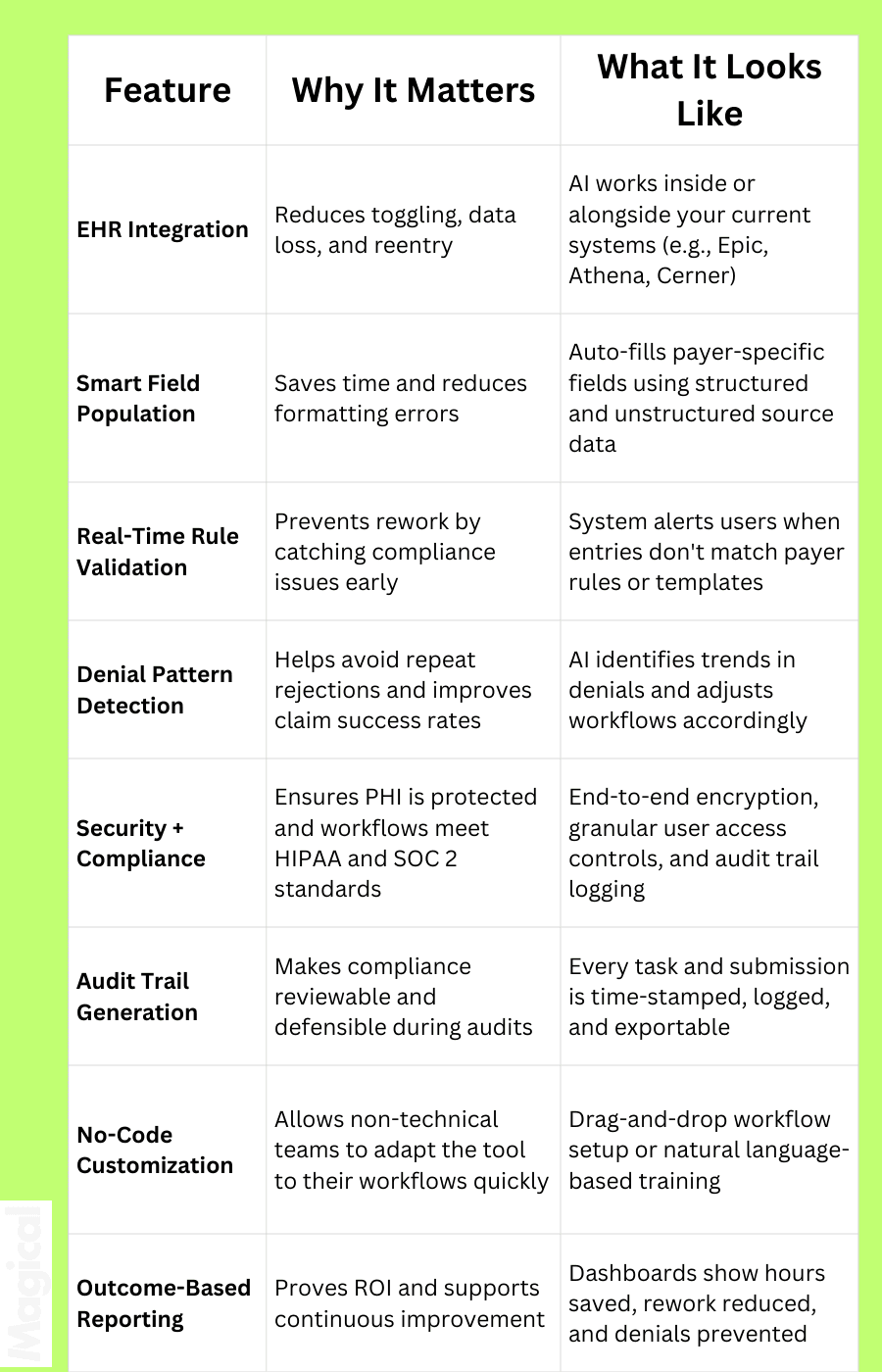
If a Tool Lacks These Features, It’s Not Built for Your Workflows
Many general automation tools miss the mark because they weren’t designed for the nuance of payer requirements. Without real-time validation, audit trails, or denial insights, these tools simply speed up bad processes, and that’s not progress.
Healthcare admin teams don’t need faster chaos. They need smarter systems.
Head-to-Head: Top AI Tools for Reducing Admin Burden in Healthcare
There’s no shortage of “AI” platforms in healthcare right now. But very few of them are designed to reduce administrative friction between providers and payers; the kind that leads to missed deadlines, denials, and rework.
Below is a comparison of the top players in this space. Each has a different focus.
Some specialize in revenue cycle management. Others handle intake, billing, or patient-facing automation.
A few try to do it all.
The key is knowing what your team actually needs, and choosing a tool that solves for that.
Top AI Platforms Comparison
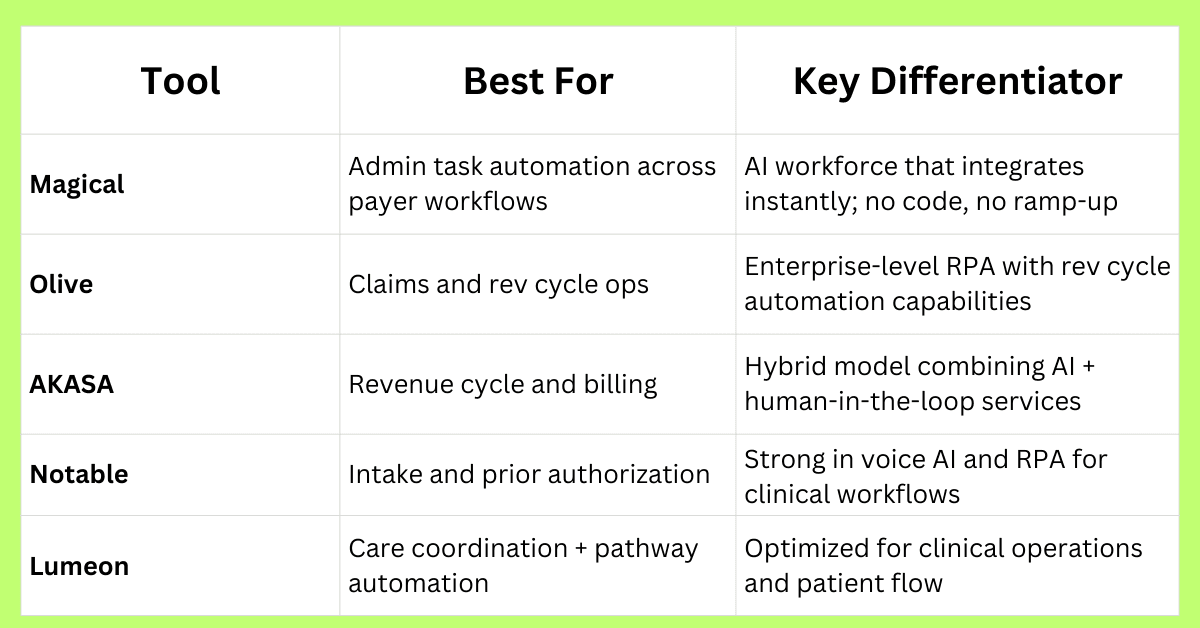
Why Magical Leads for Administrative Teams
Magical was built specifically to relieve the burden on healthcare operations and admin teams, not just billing departments or rev cycle execs.
It’s fast to deploy. It requires no technical support. And it adapts to your workflow. Whether that’s filling in compliance documentation, reducing payer denial loops, or auto-generating forms based on payer rules.
Used by nearly 1,000,000 professionals
Trusted by over 100,000 companies
Saves an average of 7 hours per week per user
If your team is stretched thin, overloaded with compliance work, or manually submitting claims into disconnected portals, Magical meets you where you are and lightens the load.
Magical in Action: Healthcare Teams Reclaim Their Time
The best proof isn’t in the promise.
It’s in the outcome.
Healthcare admin teams across the country are already using Magical to eliminate tedious payer-facing tasks, reduce documentation errors, and get claims out the door faster, with fewer denials.
Here’s what that looks like in practice.
WebPT: Scaling Without Scaling Admin Headcount
WebPT, the leading rehab therapy platform, handles millions of patient visits a year across a growing network of providers. With that scale came a huge admin challenge. Keeping up with payer documentation standards while avoiding burnout and staffing overload.
Before Magical, their team spent hours each week re-entering data into different payer systems and formatting documentation manually.
With Magical in place, they:
Automated repetitive data entry across compliance forms
Reduced documentation errors significantly
Scaled operations without scaling admin headcount
The result? A faster, more efficient revenue cycle and a team that could finally focus on high-value work.
ZoomCare: 20+ Hours Saved Weekly in Manual Compliance Tasks
ZoomCare operates a network of on-demand care clinics focused on fast, accessible patient service. But behind that speed was a manual compliance burden that slowed everything down.
Payer forms had to be filled in repeatedly. Fields had to be double-checked and formatted manually. Documentation errors were common.
With Magical, ZoomCare:
Eliminated 20+ hours of manual work per week
Auto-filled repetitive payer fields across multiple forms
Improved submission accuracy and sped up reimbursements
TCPA: 70% Less Time Spent on Payer Compliance
The TCPA Compliance Center handles detailed, payer-specific documentation for healthcare clients. Accuracy isn’t optional; it’s essential.
But before automation, their team was overwhelmed. Formatting requirements changed constantly. Documentation had to be updated and resubmitted frequently.
Magical helped TCPA:
Reduce payer compliance documentation time by 70%
Improve documentation accuracy
Automate manual inputs while maintaining control over quality
These aren’t isolated wins. They’re the new standard for how AI automation supports healthcare admin teams.
When the tools are built for the real work, the results speak for themselves.
What to Consider When Choosing AI for Admin Burden
The wrong AI tool can slow your team down faster than manual work ever could.
Healthcare operations teams don’t need flashy tech. They need software that fits their workflows, secures their data, and delivers measurable results without months of onboarding.
Here’s how to evaluate your options the right way.
Fit Over Flash
A sleek dashboard doesn’t matter if the tool can’t integrate with your existing EHR, billing software, or payer portals. Too many organizations get sold on features that never make it into production because the tool doesn’t fit their tech stack.
Ask: “Can this AI work inside the platforms my team already uses every day?”
Security Isn’t a Feature. It’s a Requirement
Any tool handling PHI or compliance documentation must meet strict security standards. HIPAA and SOC 2 compliance are table stakes, not extras.
Ask: “How is data stored, encrypted, and accessed, and do you have a SOC 2 report to prove it?”
Skip the IT Bottleneck
If a tool needs a month-long implementation and three engineers to customize, it’s not built for admin teams. Look for no-code tools that allow your team to launch, test, and improve workflows on their own.
Ask: “Can my operations team set this up without engineering support?”
Look for Outcome-Driven Proof
If a vendor can’t point to measurable results, it’s a red flag. You should be able to see how the tool impacts:
Denial rates
Time savings
Error reduction
Team satisfaction
Ask: “What kind of time and error reductions have your customers actually seen?”
Make Sure It’s Built to Learn
Static rules break when payers update policies. Good AI software is dynamic. It adapts, learns from denial patterns, and improves performance over time.
Ask: “How does the system handle changing payer requirements or submission rules?”
Decision Checklist: Ask These 5 Questions Before You Buy
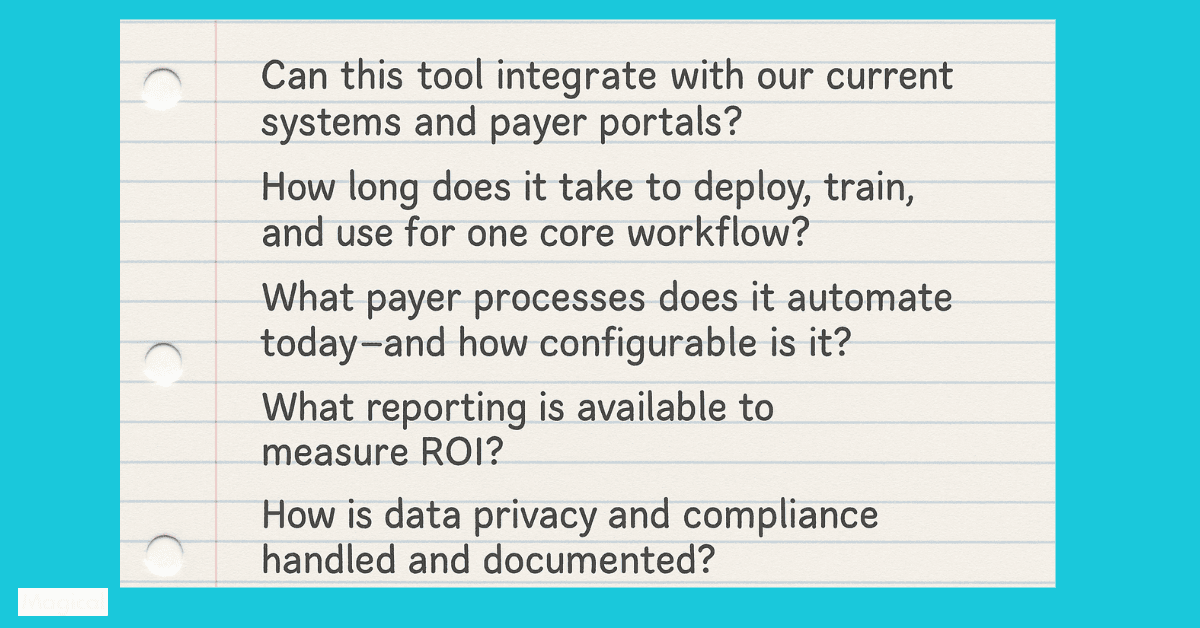
If a tool can’t answer these quickly and clearly, it’s probably not ready for the realities of payer-provider administration.
Looking Ahead: AI That Works Like Part of the Team
The future of administrative work in healthcare isn’t about replacing people. It’s about giving teams the kind of support that scales, adapts, and never burns out.
AI tools are already evolving into intelligent collaborators. Instead of just executing instructions, they’re starting to anticipate what teams need before they ask.
And for admin-heavy workflows like payer interactions, that shift is game-changing.
Here’s where things are headed and where forward-thinking teams are already investing.
Predictive Compliance, Not Just Policy Matching
AI isn’t just checking if documentation meets a payer’s current rules. It’s starting to predict when rules will change, or when a submission will likely be denied based on past claims.
This helps teams course-correct before the rejection ever happens, cutting down on rework and revenue leakage.
LLMs That Understand Context and Learn From Patterns
Large language models (LLMs), like the ones that power Magical, are being trained to recognize clinical and payer context across systems.
That means they can:
Auto-generate payer-compliant documentation based on real-time EHR data
Suggest which modifiers or attachments are required for a specific insurer
Flag missing components based on patterns, not just static rules
The more you use it, the smarter it gets.
Conversational Interfaces That Speed Up Complex Tasks
Imagine being able to type:
“Generate a prior auth form for a patient on Aetna with a CPT code of 97110.”
And having the system instantly produce a pre-filled, policy-aligned form, ready for review and submission.
These kinds of natural-language interfaces are already rolling out in forward-leaning systems, making complex admin tasks feel as easy as sending an email.
Autonomous, Always-On Compliance Support
AI that never sleeps, never forgets payer rules, and never misses a deadline. That’s the kind of teammate most admin teams wish they had. And now, it’s not hypothetical.
Tools like Magical are building toward that future today:
No-code AI assistants
Real-time data sync across portals
Constant rule monitoring and pattern updates
Predictive flags for denial risks and submission gaps
It’s not about replacing your team. It’s about unburdening them, so they can focus on what only humans can do: judgment, nuance, and connection.
Final Thoughts: The Best AI Software Doesn’t Just Reduce Work. It Delivers Outcomes
Healthcare admin teams don’t need one more platform to manage. They need results.
The best AI tools reduce the burden that’s been quietly crushing productivity for years.
They streamline workflows.
They prevent denials.
They make compliance a background process, not a full-time job.
And most importantly, they give time back to the people doing the work.
If your current workflows involve toggling between portals, re-entering the same data three times, or chasing down formatting errors after a claim is denied, there’s a better way to work, and it’s already here.
Download the free Magical Chrome extension or book a demo for your team.
Magical is used at 100,000+ companies and by nearly 1,000,000 users to save 7 hours a week on average.