
Denials aren’t a surprise anymore.
They’re an expectation.
You send a clean claim, follow the policy, attach every required note, and still get the dreaded “Denied” status.
In 2025, denial management isn’t just about fixing the problem after the fact.
Payers are using their own AI to spot (and reject) claims faster than ever. They’re not waiting for audits; they’re scanning submissions in real time and flagging anything that looks off.
The result?
Prior auth approvals that mysteriously don’t match the CPT you billed.
Denials for “insufficient documentation” when the proof is sitting in your EHR.
Medical necessity disputes for services that have been covered for years.
The volume isn’t just rising. It’s changing shape.
The biggest risk now isn’t a huge, obvious billing error.
It’s the subtle mismatch or missing element an overworked team member doesn’t catch before the payer’s algorithm does.
The good news? AI works both ways.
An AI workforce can run the same kind of constant, ruthless review before you submit the claim, finding and fixing the denial triggers payers are now trained to spot.
Denials by the Numbers: Where We Stand in 2025
Denials have always been part of the revenue cycle, but in 2025, they’ve become a defining performance metric.
The latest industry data paints a clear and costly picture.
Overall Denial Rates Are Climbing
Average initial denial rate for hospitals and health systems: 11% (up from 9% in 2022)
Some specialties, especially orthopedics, cardiology, and behavioral health, report rates exceeding 15%.
Prior authorization-related denials have grown by over 20% in the past two years.
Top Denial Reasons (2025)
Prior authorization missing/invalid — Accounts for 20–25% of all denials.
Eligibility/coverage issues — 15–20%.
Medical necessity disputes — 10–12%.
Coding errors — 10–12%, often tied to modifier usage or CCI edits.
Late submission — 5–8%, driven by staffing shortages and bottlenecks.
The Hidden Cost
Every denied claim costs $25–$118 to rework, not counting lost opportunity costs.
65% of denials are recoverable, but only if they’re worked within the payer’s timeline.
Denials slow payment, increase AR days, and erode First-Pass Yield.
Denials aren’t just eating into margins. They’re becoming a predictable drag on cash flow.
The organizations winning in 2025 are the ones that prevent them before the payer ever sees the claim.
5 Denial Trends Shaping 2025
Payers aren’t just denying more claims. They’re changing how and why they deny them.
The biggest shifts in 2025 are coming from automation on their side, constant policy churn, and an increased focus on pre-payment reviews.
1. AI-Driven Payer Screening
Payers are now using machine learning to review claims in real time. These algorithms:
Flag mismatched CPT/DX combinations even if they pass traditional edits.
Identify “high-risk” providers or service types for additional scrutiny.
Auto-trigger requests for documentation before the claim is processed.
Impact: Denials arrive faster, sometimes within 24–48 hours of submission.
2. Rising Prior Authorization Complexity
More services require PA, especially imaging, specialty drugs, and outpatient procedures.
Auths are more likely to be denied for documentation gaps or policy mismatches.
Even approved auths can be overturned if final claim details differ from the request.
3. Policy Churn and Benefit Design
Payers are updating medical necessity and coverage rules quarterly (or more often).
Narrow network and tiered benefits increase eligibility pitfalls.
Out-of-network penalties applied more aggressively.
4. Pre-Payment Audits
Growth in pre-pay reviews, where payment is held until extra documentation is reviewed.
Often triggered by payer AI detecting “risk” patterns.
Adds 2–6 weeks to payment timelines.
5. Specialty-Specific Scrutiny
High-dollar claims in oncology, orthopedics, and infusion therapy face more manual review.
Even standard treatments may require evidence beyond what’s in the EMR.
The payer playbook in 2025 is built on speed, automation, and tighter rules. Meaning providers need equally fast, adaptive tools to defend against denials.
How Denials Erode Revenue (and Morale)
Denials don’t just delay cash. They multiply work, stall care, and grind down teams.
The drag shows up everywhere, from your balance sheet to your break room.
The Financial Hit (Visible and Invisible)
Cash held hostage: Each denied claim adds days (or weeks) to payment, pushing more volume into 60+ day buckets and inflating Net DAR.
Higher rework cost: Every denial spawns a mini-project (status checks, doc gathering, corrected claims, appeals), consuming hours you can’t bill for.
Write-offs & leakage: Appeals miss deadlines, partial denials become accepted “short pays,” and small balances drift into “not worth chasing.”
Opportunity cost: While staff chase denials, clean, high-dollar claims wait; front-end prevention never gets built; payer strategy stays reactive.
Operational Ripple Effects
Clinic throughput: Auth-related denials force reschedules; future appointments get reshuffled; providers lose billable time.
Fragmented worklists: Denials scatter across portals, inboxes, and spreadsheets; ownership blurs; items go stale.
Slow feedback loops: A pattern (e.g., a modifier issue) lingers for months before anyone notices, creating hundreds more denials.
Patient Experience (and Bad Debt)
Confusion and callbacks: “Why am I getting this bill?” drives call volume and staff fatigue.
Delayed statements: The longer adjudication drags, the colder the patient’s memory, and the lower the odds of payment.
Trust erosion: Repeated re-bills feel like errors to patients, even when payers caused the delay.
Team Morale & Retention
Perpetual fire drills: Constant “workdown days” and end-of-month blitzes burn people out.
No-win loops: Staff fix the same denial reasons repeatedly with no time to address root causes.
Talent drain: The most experienced billers become de facto firefighters, not problem solvers.
How Denial Types Drain Value
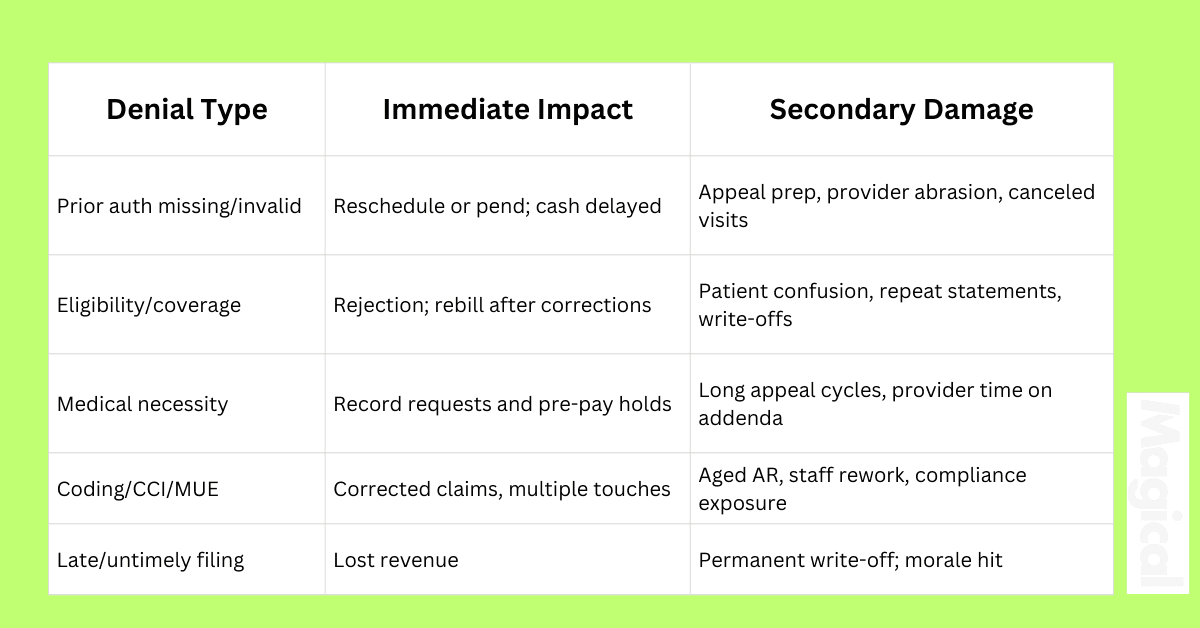
Denials tax every part of your operation. Preventing them isn’t just a billing goal; it’s a margin, experience, and retention strategy.
5 Denial Categories and How to Prevent Them
Every denial falls into a category. And every category has repeatable triggers you can target, automate, and eliminate before the claim ever leaves your system.
1. Prior Authorization Missing/Invalid
Triggers:
Auth not requested before service
CPT/DX mismatch between auth and claim
Auth expired or outside valid date range
AI Prevention:
Match orders to payer PA requirements instantly
Build and submit auth packets automatically from clinical notes, labs, imaging
Track auth expiration and validity against appointment dates in real time
2. Eligibility/Coverage Issues
Triggers:
Inactive coverage at date of service
Wrong plan code or network tier
Secondary coverage missed
AI Prevention:
Real-time eligibility checks at scheduling and pre-registration
Detect secondary insurance and initiate COB steps
Cross-check demographics and subscriber data against payer records
3. Medical Necessity
Triggers:
CPT/DX not supported by payer policy
LCD/NCD mismatch
Missing or incomplete documentation
AI Prevention:
Match diagnosis and procedure codes against current LCD/NCD and payer-specific rules
Auto-insert documentation excerpts that support necessity
Flag unsupported codes before claim creation
4. Coding/CCI/MUE Edits
Triggers:
Incorrect modifier usage
Bundled services billed separately
Units exceeding payer limits
AI Prevention:
Pre-bill CCI/MUE edit checks with explanations
Validate modifier application (25, 59, XE, XS, XP, XU)
Suggest compliant coding alternatives before submission
5. Late Submission
Triggers:
Chart closure delays
Missing attachments delaying submission
Payer filing deadlines missed due to manual rework
AI Prevention:
Monitor open charts and trigger provider alerts for unsigned notes
Auto-attach required documents to claims
Track filing deadlines per payer and escalate at risk claims
Denials are rarely a mystery. With AI agents running constant pre-checks, you can eliminate most of them before they ever appear on a worklist.
The AI Denial Prevention and Resolution Model
A strong denial strategy isn’t just about catching issues earlier. It’s about closing the loop so those issues never repeat.
AI agents excel because they can operate continuously, across systems, without losing track of a single claim.
Prevention Layer (Pre-Submission)
Eligibility & Coverage Check: Run at scheduling, pre-reg, and day-of-service.
Prior Auth Validation: Match CPT/DX to auth record, check validity dates, and request missing docs instantly.
Policy Compliance: Validate medical necessity using real-time LCD/NCD and payer-specific policies.
Clean Claim Gate: Require all edits cleared and attachments linked before claim release.
Outcome: Fewer denials ever make it into the payer’s system.
Early Detection Layer (Post-Submission)
Daily Payer Portal Monitoring: Identify denials, pends, or info requests within 24 hours.
Clearinghouse Reject Repair: Fix format/data errors and resubmit same day.
ERA/835 Variance Detection: Flag underpayments and partial denials.
Outcome: Denials are addressed while appeal windows are wide open.
Resolution Layer (Appeals & Rework)
Appeal Packet Assembly: Auto-generate appeal letters with policy citations and attach supporting docs from EHR.
Deadline Tracking: Monitor and escalate claims approaching filing limits.
Trend Feedback Loop: Update pre-submission rules when patterns emerge (e.g., repeated modifier denials).
Outcome: Higher overturn rates and fewer repeat denials.
Case Study:
TCPA: Used AI agents to automate prior auth verification, portal monitoring, and appeal prep — reducing overturn times and improving denial recovery rates.
WebPT: Leveraged documentation-to-charge checks to prevent coding-related denials and improve First-Pass Yield.
With AI agents running both prevention and resolution layers, denial management shifts from reactive firefighting to proactive revenue protection.
Special Focus: Prior Authorization Denials
Prior authorization (PA) is now the single biggest driver of avoidable denials in U.S. healthcare, and one of the easiest for AI agents to prevent.
Why PA Denials Are Exploding
Expansion of PA requirements into imaging, specialty meds, and even common outpatient procedures.
Shorter turnaround times for submission before services are rendered.
Policy mismatches when billed CPT/DX don’t exactly match the approved request.
Lost or expired auths due to manual tracking errors.
The Financial Impact
PA denials delay cash by 14–45 days on average.
Many require rescheduling or canceling services, a direct hit to provider productivity.
Rework cost is high because it often involves coordinating across clinical, scheduling, and billing teams.
AI Agent Prevention Playbook
Automated policy match: At order entry, match the CPT/DX to payer PA requirements instantly.
Smart packet assembly: Pull necessary clinical notes, imaging, and labs into the auth request automatically.
Portal submission & tracking: Submit through payer portals and check status daily until approved.
Expiry alerts: Monitor auth validity against appointment dates, trigger renewals proactively.
Cross-claim validation: Ensure billed CPT/DX exactly match the approved auth before submission.
With the right AI workflows, PA denials can go from a top-three denial reason to a statistical blip, and your AR moves faster as a result.
Measuring Denial Management Success
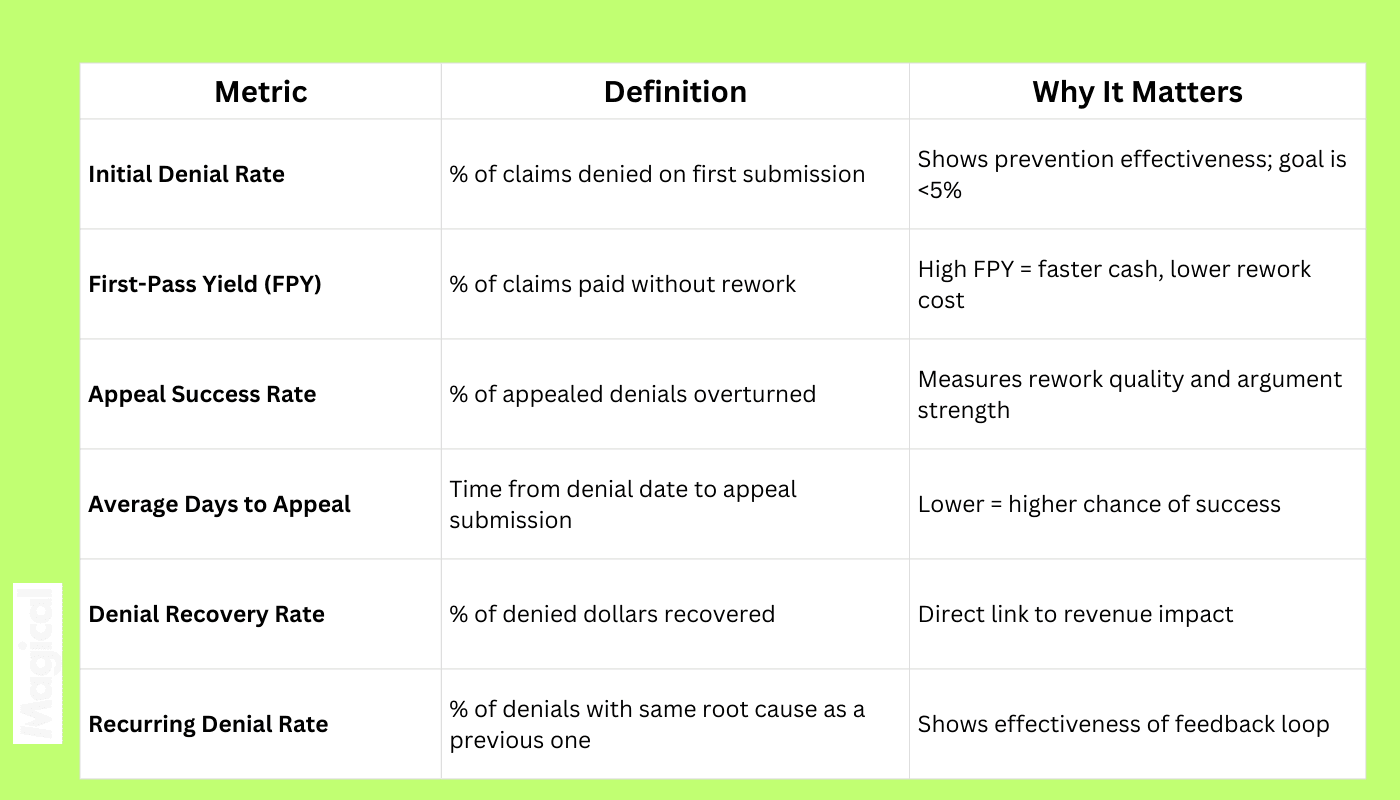
You can’t claim denial prevention is working unless you can show it in the numbers. The key is tracking the right mix of outcome metrics and process metrics and making sure they move in the right direction together.
Core KPIs
Leading Indicators
Pre-Submission Error Intercept Rate — % of issues caught by AI agents before submission.
Portal Response Time — Average time between payer posting a denial/pending status and AI agent action.
Auth-to-Claim Match Rate — % of billed CPT/DX perfectly aligned with PA approval.
Benchmarking & Targets
Initial Denial Rate: <5%
FPY: >90%
Appeal Success Rate: >65%
Average Days to Appeal: <5 days
If these metrics aren’t improving within 60–90 days of implementing AI agents, it’s a signal to adjust your prevention logic or expand coverage into more workflows.
30-60-90 Day Denial Reduction Plan
Cutting denials takes more than a single “blitz day.”
The fastest wins come from hitting the most common triggers first, proving ROI, and then expanding AI coverage.
Days 0–30: Baseline & High-Impact Quick Wins
Goal: Identify top denial drivers and stop them at the source.
Audit last 90 days of denials by volume, dollar value, and preventability.
Target top two denial reasons (often PA and eligibility) for automation.
Deploy AI agents for:
Real-time eligibility checks at scheduling and pre-reg
Prior auth validation against CPT/DX
Early detection of portal denials
Track Initial Denial Rate and FPY weekly.
Expected impact: Visible drop in the top denial category within weeks.
Days 31–60: Expand Prevention Coverage
Goal: Close more gaps across the claim lifecycle.
Add AI-driven policy checks for medical necessity and coding edits.
Implement automated appeal packet assembly for top 3 denial reasons.
Begin tracking recurring denial rate to measure feedback loop effectiveness.
Expected impact: More denials prevented, faster appeal turnaround for those that slip through.
Days 61–90: Standardize & Scale
Goal: Make denial prevention part of daily revenue cycle operations.
Expand agent coverage to all high-volume workflows identified in baseline.
Formalize human-in-the-loop review for complex or high-dollar denials.
Launch quarterly denial trend reviews using AI-generated reports.
Expected impact: Sustained Initial Denial Rate under 5% and higher recovery on worked denials.
In 90 days, a prevention-first denial strategy powered by AI agents can shift your revenue cycle from reactive firefighting to proactive cash protection.
Frequently Asked Questions
Have questions? We have answers:
Will AI agents replace my denial management staff?
No. AI agents take over the repetitive, time-sensitive denial prevention and resolution tasks, like eligibility checks, prior auth validation, and portal monitoring. So your staff can focus on exceptions, payer negotiations, and strategy.
How quickly can we see results?
Most organizations see measurable drops in Initial Denial Rate and increases in First-Pass Yield within 30–45 days of targeted AI deployment.
Do AI agents work with our existing EHR and clearinghouse?
Yes. Agents integrate through APIs where available, and can also securely log into payer portals and other systems as authorized users, maintaining HIPAA compliance and full audit trails.
What about payer portal or policy changes?
Unlike static RPA bots, AI agents adapt to changes in layouts, forms, and rules without requiring full reprogramming, keeping denial prevention workflows running without downtime.
How do we measure success?
Track:
Initial Denial Rate
First-Pass Yield
Appeal Success Rate
Average Days to Appeal
Recurring Denial Rate
Denial Recovery Rate
All should trend in the right direction within 90 days.
Is it HIPAA-compliant?
Yes. All workflows operate in HIPAA-compliant environments, with BAAs, encryption, role-based access, and immutable logs.
Final Thoughts: Stop Chasing, Start Preventing
In 2025, denials aren’t just a nuisance. They’re a predictable drain on cash, staff time, and patient trust.
Payers have weaponized speed and automation.
If you’re still relying on manual checks and after-the-fact appeals, you’re already behind.
An AI workforce shifts the game.
It runs the same constant, ruthless review payers do. But before you submit the claim.
It prevents the most common denial triggers, detects issues within hours instead of weeks, and closes feedback loops so the same problem never appears twice.
The result:
Lower Initial Denial Rate
Higher First-Pass Yield
Faster cash in the door
A team that works strategically, not reactively
You don’t need more denial worklists.
You need fewer denials in the first place.
Ready to turn denial prevention into your competitive advantage?
Try the free Magical Chrome extension or book a demo for your team. Magical is trusted by more than 100,000 companies and nearly 1,000,000 users to save 7 hours a week on average — hours you can reinvest in clean claims, faster payments, and fewer headaches.