
There are no “small” tasks in healthcare ops.
Just thousands of invisible ones that add up to burnout, budget overruns, and bottlenecks no one has time to fix.
Appointment scheduling.
Staff calendars.
Claims.
Intake forms.
Compliance checks.
Insurance verification.
Each one takes minutes.
Together? They take teams down.
That’s the backend reality healthcare leaders rarely talk about. It’s a system so buried in manual admin work, it leaves no room for scale, strategy, or sanity.
And while digital health boomed for patients, most backend workflows still rely on outdated tech duct-taped to outdated processes.
If your backend still depends on humans to do what automation can do better, you’re burning time and payroll at scale.
AI-powered automation is not the future of healthcare ops.
It’s the only way forward.
Let’s get under the hood of what’s slowing you down and show you how to fix it.
What Are Healthcare Backend Workflows?
Think of backend workflows as the operational heartbeat of a healthcare organization. They don’t touch the patient directly.
But they touch everything that makes patient care possible.
These are the systems, processes, and handoffs that happen behind the scenes to keep revenue flowing, staff scheduled, and compliance boxes checked. They’re also where the most wasted time, duplicated effort, and preventable errors live.
Core Backend Workflows Include:
Patient intake and registration
Appointment scheduling + reminders
Medical coding and documentation prep
Claims submission and tracking
Billing and payment processing
Staff credentialing and scheduling
Compliance and audit reporting
EHR data entry and reconciliation
According to the CAQH 2023 Index, automating just the top 9 administrative functions in healthcare could save the system $25 billion annually, with backend workflows representing the bulk of those tasks.
The problem? Most of these workflows still run on:
Spreadsheets
Manual logins to payer portals
Copy-paste shortcuts between systems
Staff knowledge trapped in someone’s head
And every delay, mistake, or dropped ball in these backend systems creates downstream damage. Like denials, compliance gaps, patient dissatisfaction, and revenue leakage.
Workflow Impact Table
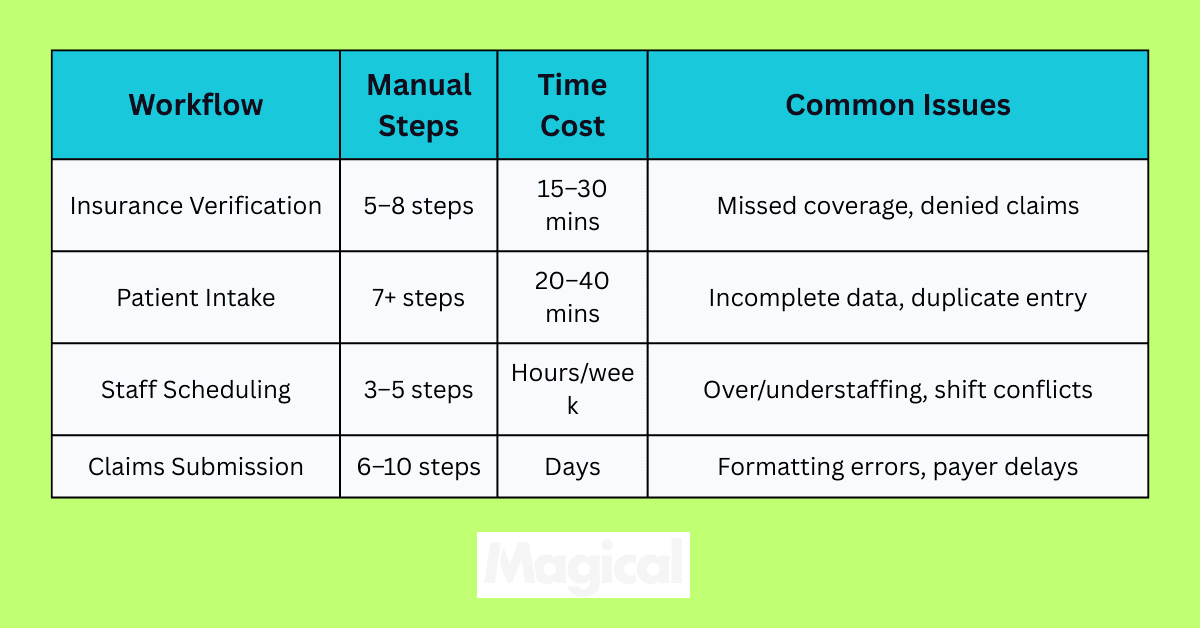
These workflows aren’t just inefficient. They’re preventing your team from doing the work that matters.
The Hidden Costs of Manual Backend Operations
Manual backend work doesn’t just slow things down. It quietly drains your budget, erodes your margins, and wears out your team.
The worst part? Most of it goes unnoticed because it’s “just how we’ve always done it.”
Here’s what it’s costing you:
Wasted Staff Hours
Backend workflows consume a massive chunk of operational labor. Most of it is unnecessary.
According to a report from Health Affairs, administrative tasks account for nearly 25% of U.S. healthcare spending, much of it tied to manual processes that could be automated.
If your billing coordinator spends 3 hours a day chasing claim statuses or your front desk is still calling patients to confirm appointments, you’re burning high-cost labor on low-value tasks.
Increased Risk of Errors and Denials
Manual data entry means inevitable mistakes:
Wrong patient info
Incomplete documentation
Missed pre-authorizations
Incorrect coding
And each of those errors leads directly to denials.
Denials cost more than just time. They result in lost revenue, frustrated patients, and hours of rework. The average denial rework cost? Between $25–$118 per claim, per MGMA.
Compliance Exposure
HIPAA audits don’t care if someone “forgot to log it.”
Manual processes are harder to track, harder to audit, and far more likely to result in documentation gaps that open you up to risk, especially when dealing with Protected Health Information (PHI).
Automation brings not just speed, but consistency, traceability, and security.
Team Burnout and Turnover
Repetitive backend tasks drain mental bandwidth.
When high-skilled staff are buried under data entry, portal logins, and hand-coded Excel sheets, morale drops fast.
Burnout increases. Turnover rises. Training costs skyrocket.
Replacing good staff is a lot harder than replacing bad workflows.
According to a Harvard Business Review study, burnout is driven more by broken systems than by individual resilience.
Manual work isn’t harmless. It’s expensive, exhausting, and entirely avoidable.
What Can (and Should) Be Automated with AI?
You don’t need to automate everything. Just the right things.
The highest-value backend workflows to automate share three traits:
High volume
Repetitive logic
Tight impact on revenue, compliance, or patient experience
Here’s where AI-powered agents can make the biggest difference, today, not months from now.
Insurance Verification
Time-consuming. Error-prone. Frequently the root cause of claim denials.
AI agents can:
Instantly extract patient insurance info from intake forms
Run real-time eligibility checks across multiple payers
Flag missing pre-auths or out-of-network issues before the visit
Auto-update the EHR or billing system with verified info
Case Study: TCPA
By automating insurance verification and intake, TCPA cut patient wait time and admin effort by 75%, allowing their staff to focus on care, not portals.
Claims Submission and Reconciliation
AI can fully handle:
Code validation
Form population
Submission via clearinghouses
Real-time tracking of payer responses
Escalation of any exceptions
Instead of manual entry, copy-paste errors, and “did it go through?” guesswork, AI agents manage this from start to finish, accurately, and at scale.
AI agents can identify patterns in denials and auto-adjust future submissions based on payer feedback.
Appointment Scheduling and Reminders
Still calling patients manually? Still juggling appointment books?
AI agents can:
Auto-schedule based on provider availability, patient preferences, and visit types
Send reminders via email, SMS, or in-app
Reschedule or cancel with minimal human intervention
This eliminates no-shows, reduces call volume, and improves the patient experience, especially in high-volume clinics.
Staff Scheduling and Credentialing
AI agents streamline backend HR ops by:
Managing licenses and credential expiry alerts
Matching staff availability with patient demand
Balancing shift coverage across locations and roles
Generating audit-ready logs for compliance
Case Study: WebPT
WebPT used Magical agents to automate provider credentialing workflows, accelerating approvals and unlocking faster revenue realization.
EHR Data Entry and Compliance Documentation
One of the most dreaded backend tasks in healthcare? Manual documentation.
AI agents can:
Extract relevant info from patient forms, dictation, or PDFs
Auto-fill structured EHR fields
Prepare audit-ready compliance reports with time stamps and tracking
This reduces burnout, improves documentation quality, and ensures that nothing slips through the cracks.
AI doesn’t just make backend work faster. It makes it work the way it should’ve all along.
Why Traditional RPA Falls Short in Healthcare
Robotic Process Automation (RPA) had its moment.
It promised hands-free workflows and operational efficiency.
But in healthcare? Most of the time, it delivers… frustration.
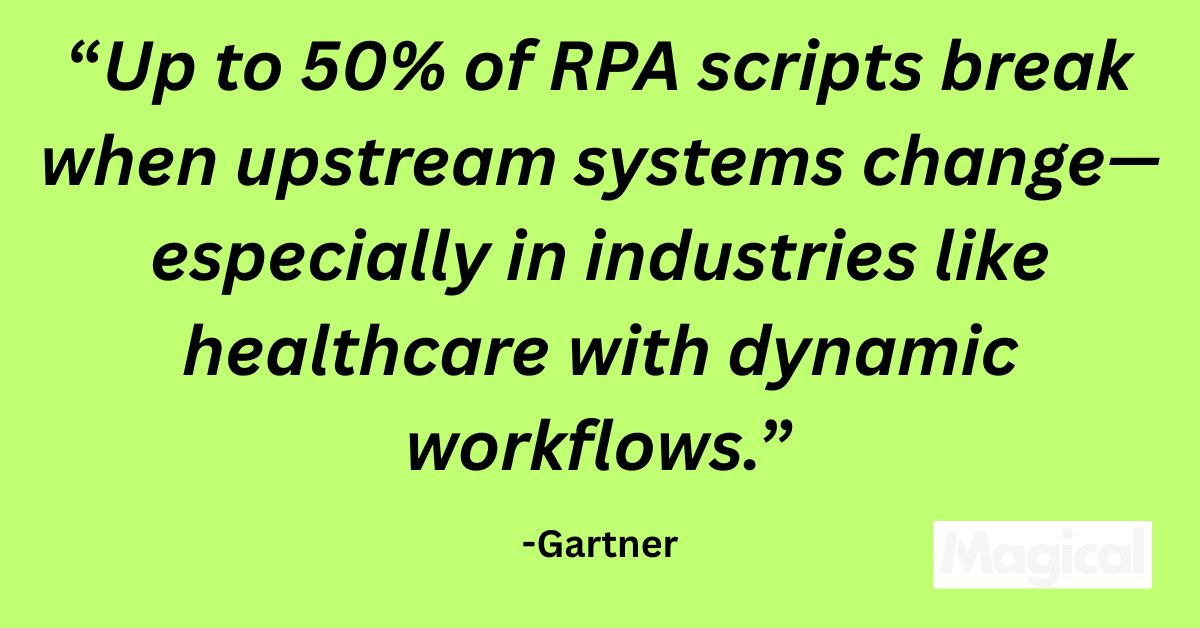
The truth is that RPA breaks in healthcare because healthcare breaks the rules.
Rule-Based Automation Can’t Handle Chaos
Traditional RPA is built on rigid logic:
“If this, then that”
Predefined clicks, keystrokes, and screen positions
Fixed data formats
But healthcare workflows are anything but predictable. You’re dealing with:
Unstructured data (PDFs, faxes, handwritten forms)
Frequent payer changes
Human error
Exceptions that become the norm
So when a portal layout shifts, or a payer adds a new requirement, or a patient name is typed in two different formats?
The bot fails. The work bounces back. And your team ends up doing it manually anyway.
RPA Is Expensive to Maintain and Slow to Deploy
With RPA, even a small change means:
Developer time
QA testing
IT team involvement
Potential downtime
In a compliance-heavy environment like healthcare, that lag isn’t just inconvenient — it’s risky.
AI Agents Adapt. RPA Doesn’t.
Intelligent agents powered by LLMs (like Magical’s) don’t rely on screen scraping or hard-coded paths. They:
Read and understand context
Adapt to variability in data and systems
Make decisions on the fly
Learn from past outcomes
That means fewer failures, fewer rebuilds, and fewer emails to IT at 6 a.m.
Magical Is Built for the Messiness of Healthcare
Magical’s agents don’t just automate. They navigate:
Inconsistent payer systems
Fragmented EMRs
Staff-dependent workflows
And unlike brittle RPA tools like UiPath or Make, Magical delivers:
Healthcare-specific logic
No-code deployment
Real-time adaptability
RPA follows rules.
Magical achieves results.
Business Outcomes: What Backend Automation Delivers
It’s easy to talk about “saving time” or “increasing efficiency.” But what does backend AI automation do for your business?
Here’s where the impact shows up as measurable, scalable, and deeply felt by your team and your bottom line.
Faster Patient Onboarding = Faster Revenue
When insurance is verified instantly, intake is digitized, and scheduling happens without back-and-forth calls, patients move from “new lead” to “confirmed visit” in a fraction of the time.
This doesn’t just reduce admin lag. It accelerates revenue cycles.
You get more appointments on the calendar, more claims out the door, and fewer missed opportunities.
Case Study: TCPA
Magical helped TCPA cut admin intake time by 75%, improving access and creating space for more patient visits per day.
Reduced Claim Denials = Recovered Revenue
Eligibility mistakes, missing documentation, and coding errors are top denial drivers—and all are preventable with intelligent automation.
AI agents catch issues before submission, ensuring claims are clean, complete, and compliant.
The industry average denial rate sits at ~10% (Change Healthcare).
Denials cost $25–$118 per rework, according to MGMA.
Recovering just 5% of lost revenue can mean hundreds of thousands in annual gains for mid-size orgs.
Improved Staff Retention
Automation saves time, and it saves your team.
When admin staff spend less time on data entry, portal logins, or fixing avoidable errors, they’re not just more productive. They’re less burned out.
And they’re more likely to stay.
According to AHIMA, organizations that implemented backend automation saw higher job satisfaction and retention among rev cycle staff.
Lower Operational Overhead
Every minute saved = direct cost reduction.
AI agents don’t take breaks. They don’t log off. And they don’t require multiple FTEs to scale.
Once deployed, they handle high-volume tasks like eligibility checks, documentation, or scheduling 24/7.
CAQH estimates the healthcare system could save over $25 billion annually by automating key administrative workflows, most of it sitting in backend operations.
Better Patient Experience
The backend may be invisible to patients, but its effects aren’t.
Fewer billing issues = happier patients
Faster intake = less time waiting
Fewer scheduling gaps = better continuity of care
Patients don’t thank your billing software, but they feel it when things just work.
Backend Automation ROI Chart
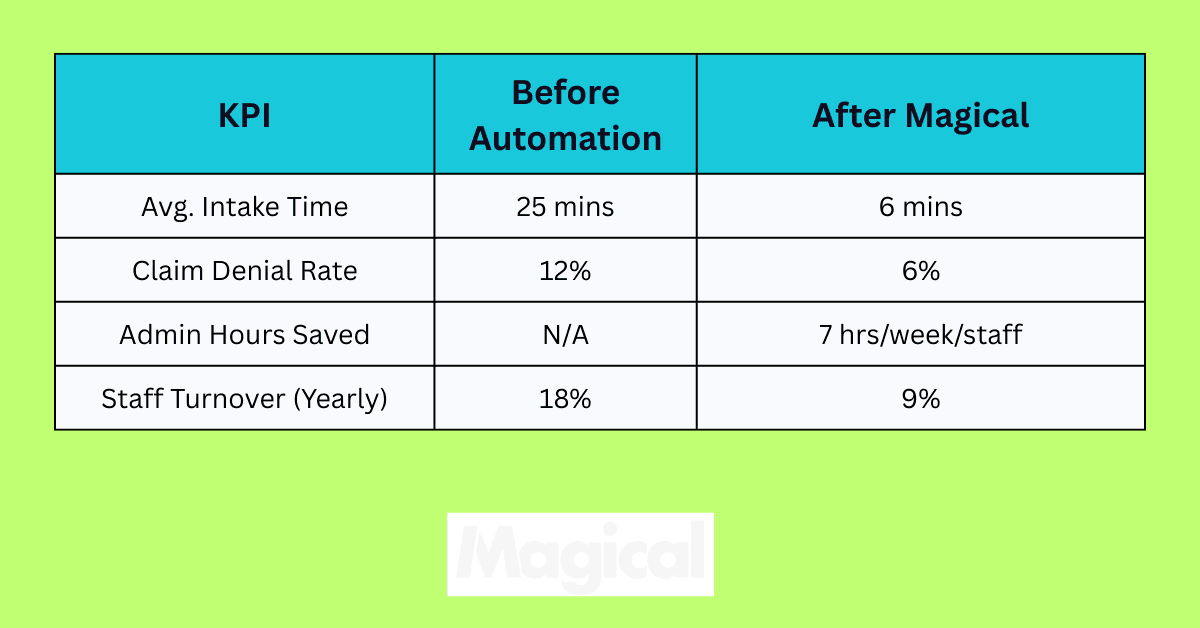
Backend automation isn’t back-office.
It’s front-line transformation.
Case Studies in Action: Real-World Wins with Magical
Automation isn’t the future. It’s already working.
Here’s how three healthcare organizations used Magical to automate their most painful backend workflows and what happened next.
ZoomCare: From Manual Billing to Accelerated Payments
Challenge: ZoomCare’s billing team was buried in manual claim submissions and payer follow-ups. Errors and delays led to long reimbursement cycles and growing denial volumes.
What Magical Automated:
Claim preparation and submission
Billing data entry
Real-time reconciliation and escalation
Results:
Faster claim processing
Fewer billing errors
Noticeable drop in resubmissions
Outcome: ZoomCare reclaimed staff time, accelerated payments, and improved cash flow, with zero disruption to their existing systems.
WebPT: Streamlining Credentialing and Documentation
Challenge: Credentialing and compliance documentation were major bottlenecks for WebPT’s clinical and admin teams. Delays led to onboarding gaps and claims held in limbo.
What Magical Automated:
Provider credentialing workflows
EHR data syncing and documentation prep
Notifications and reminders for compliance tasks
Results:
Credentialing timelines cut significantly
Fewer compliance delays
Smoother onboarding = faster claim readiness
Outcome: With automation in place, WebPT saw an immediate improvement in process speed and operational visibility.
TCPA: Cutting Patient Intake Time by 75%
Challenge: TCPA’s intake process was slow and frustrating—for both patients and staff. Manual insurance verification and form processing caused bottlenecks across the board.
What Magical Automated:
Insurance verification
Patient registration
Intake data sync to EHR
Results:
75% reduction in admin intake time
Faster access to care
Better patient and staff experience
Outcome: By automating just one critical workflow, TCPA unlocked system-wide improvements in speed, accuracy, and staff capacity.
These aren’t edge cases.
They’re signals of where the entire industry is headed, and proof that backend automation pays off fast.
Addressing Security & Compliance Concerns
Let’s be honest: healthcare doesn’t get the luxury of “move fast and break things.”
Every workflow that touches patient data must be locked down, traceable, and compliant from intake to claims to billing. So when people hear “AI,” they assume risk.
But the reality is, AI automation, when built for healthcare, can make your operations more secure and more compliant, not less.
Magical is Built for Healthcare-Grade Security
You’re not using a Chrome plug-in held together by open-source scripts. Magical is designed for the real-world needs of healthcare operations, with enterprise-grade infrastructure that meets and exceeds compliance standards.
Key safeguards include:
HIPAA compliance baked into every workflow
End-to-end encryption for all data in transit and at rest
Role-based access control and permission management
Audit trails for every task completed by an agent
Zero PHI stored outside compliant environments
Agents Reduce Human Error (and Risk)
Ironically, many of today’s compliance breaches come from human behavior:
Screens left unlocked
Copy-paste errors
Misfiled documents
Forgotten steps in credentialing or claim review
Magical’s intelligent agents remove those variables:
No screenshots
No skipped steps
No compliance tasks falling through the cracks
Everything is logged. Everything is repeatable. Everything is auditable.
Designed for IT and Rev Cycle Peace of Mind
Magical integrates with your existing stack without needing deep backend access or custom code. That means:
Minimal security risk
Fewer IT dependencies
Faster governance reviews
AI doesn’t have to be risky.
With Magical, it’s not.
How to Start: Automate One Workflow at a Time
Automation doesn’t have to mean a total overhaul. The smartest path is also the simplest:
Pick one high-friction workflow.
Automate it.
Watch what happens. Start with the one that’s eating your team’s time right now:
Insurance verification? Easy win.
Claim submission? High ROI.
Credentialing? Time saver + compliance boost.
Scheduling? Massive efficiency + fewer no-shows.
With Magical, implementation doesn’t require custom builds, consultants, or IT bottlenecks. Just:
Choose the workflow
Connect your existing tools
Deploy an AI agent
Let it run and scale from there
You’ll start seeing results in days, not months.
And once your team sees what one agent can do, you’ll never go back to “normal.”
Final Thoughts
If your backend workflows still rely on human effort to do what AI can do faster, cleaner, and more accurately, you’re not just behind.
You’re bleeding time and revenue.
Manual insurance checks. Portal logins. Missed credentials.
They’re not small inefficiencies.
They’re massive opportunity costs, happening quietly across your organization every single day.
But the fix isn’t a rebuild. It’s a shift.
From reactive to proactive. From manual to intelligent.
From barely holding it together… to actually moving forward.
And it starts with automation that works.
Try it for yourself:
Download the free Magical Chrome Extension — used by nearly 1,000,000 users to save an average of 7 hours a week.
Or book a live demo to see how Magical is helping over 100,000 companies automate the workflows that slow healthcare down the most.
Because backend work doesn’t have to feel this hard.
Not anymore.