
The script runs perfectly….until it doesn’t.
A payer changes a form field.
An insurer portal adds a login step.
Your “fully automated” RPA bot freezes mid-process, and now your team is scrambling to catch up while the claims backlog grows.
For years, robotic process automation (RPA) was the go-to fix for healthcare’s repetitive admin work. And it did help when the process never changed.
But healthcare processes do change.
Constantly.
Payer rules update.
Portals shift.
Compliance requirements evolve.
RPA can’t keep up without costly reprogramming and IT intervention.
AI automation plays a different game.
Instead of mindlessly repeating clicks and keystrokes, it understands data, adapts to changes, and makes decisions on the fly. It can pull information from messy PDFs, fill out insurer forms that look nothing alike, and keep running when the rules change overnight.
In a world where healthcare admin work never stops evolving, the choice isn’t just about technology.
It’s about whether your automation grows with you or leaves you chasing it.
Quick Definitions: RPA vs AI Automation
Before we dig into which approach delivers more value, it’s worth making the distinction clear.
What Is RPA?
Robotic process automation (RPA) mimics human clicks, keystrokes, and field entries to execute a predefined workflow. It works well for static, rules-based tasks, like moving data from one form to another when nothing changes.
Strengths: Fast at repetitive work, predictable in stable environments.
Weaknesses: Breaks when portals, forms, or rules change. Requires constant IT updates to keep running.
What Is AI Automation?
AI automation uses machine learning and agentic AI to understand, adapt, and act in dynamic environments. It can read unstructured data, make decisions based on context, and modify its process when something changes.
Strengths: Handles exceptions, adapts automatically, works across structured and unstructured data.
Weaknesses: Requires upfront training to align with your workflows and compliance rules.
The “Agentic” Difference
Agentic AI doesn’t just execute. It plans, decides, and adjusts mid-task.
That means in healthcare billing or prior authorization, it can see a missing document, retrieve it, and continue without waiting for a human to intervene.
RPA follows a script. AI automation writes one as it goes.
Where RPA Works Well in Healthcare
For all its limitations, RPA can still be valuable in healthcare, especially for tasks that rarely change and don’t require judgment. In stable, structured workflows, it’s a reliable workhorse.
Static Claims Submission
When claim formats, payer portals, and coding requirements remain consistent, RPA can quickly copy data from one system to another without human input.
Batch Data Entry
If your team needs to transfer patient demographics from one database to another and the format never changes, RPA can handle the repetition efficiently.
Appointment Reminders
Pre-set scripts can send SMS or email reminders to patients at scheduled intervals using fixed templates.
Compliance Reporting with Rigid Formats
For standardized reports (like certain CMS submissions) RPA can pull and compile data exactly the same way every time.
In these scenarios, RPA’s biggest advantage is speed and predictability. The trouble comes when the rules, forms, or systems evolve, which in healthcare happens constantly.
Limitations of RPA in Healthcare
RPA’s strength is in repetition, but that’s also its weakness. In healthcare, “unchanging” processes are rare.
Payers update rules, compliance standards shift, and even a small UI tweak can throw an RPA bot off script.
Breaks When Interfaces or Rules Change
If a payer adds a new form field or alters a dropdown menu, an RPA bot doesn’t adapt, it stops. Every fix requires IT time and reprogramming.
Requires Constant Maintenance
Healthcare processes aren’t static, which means RPA scripts need frequent updates to stay accurate. This ongoing upkeep can eat into the cost savings automation is supposed to deliver.
Can’t Handle Exceptions
If a claim is missing documentation or a prior auth request is flagged for review, RPA won’t know what to do next. It needs human intervention to continue.
Lacks Contextual Understanding
RPA can move data from one place to another, but it can’t interpret free-text physician notes, scanned lab reports, or payer-specific guidelines.
RPA is fine for a frozen-in-time process. But in a living, changing healthcare environment, it’s brittle and high-maintenance.
How AI Automation Expands Possibilities
AI automation doesn’t just copy human actions. It understands context, adapts when conditions change, and can make decisions in real time.
That adaptability is exactly what healthcare workflows need.
Works Across Unstructured Data
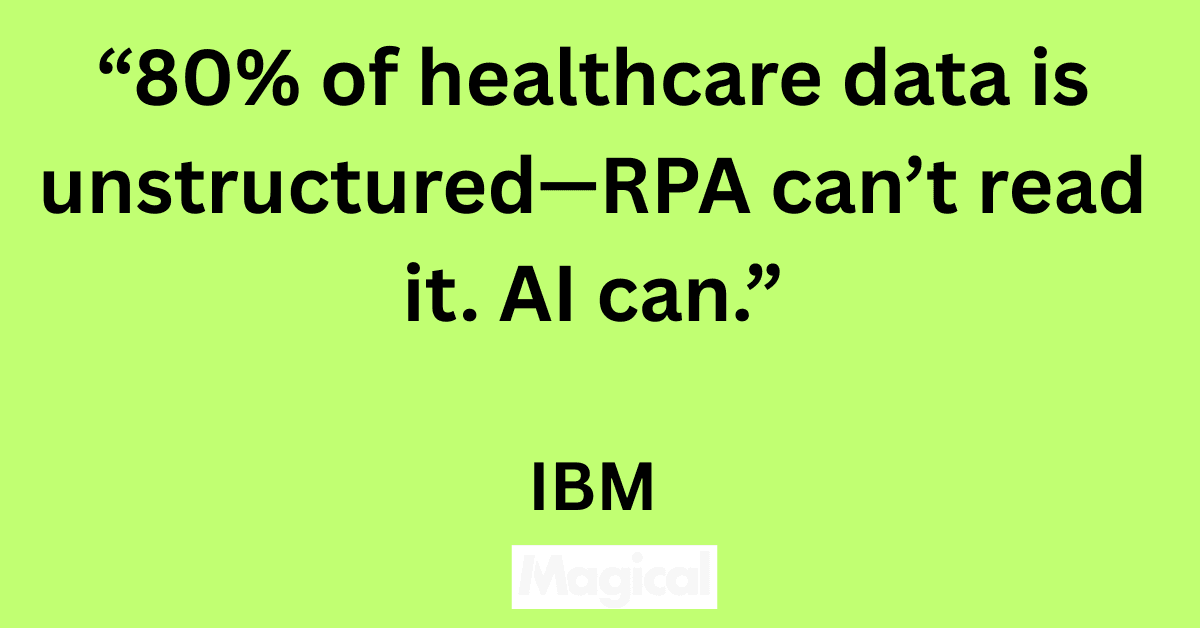
AI can interpret and extract information from physician notes, scanned PDFs, lab reports, and insurer correspondence. Data types that make up 80% of healthcare records.
Adapts Automatically to Change
When a payer modifies submission rules or a portal changes its layout, AI adjusts its workflow without requiring IT to rewrite a script.
Makes Decisions, Not Just Moves Data
An AI agent can recognize when a claim is missing a document, retrieve it from the EHR, and proceed. This reduces the stop-start cycle that slows RPA to a crawl.
Integrates Securely Across Platforms
With HIPAA-ready infrastructure, AI automation like Magical can operate across EHRs, billing systems, payer portals, and spreadsheets without risking PHI compliance.
Learns and Improves Over Time
Every process run adds to the AI’s knowledge, allowing it to spot efficiency gains and prevent errors in future runs.
Where RPA is reactive, AI automation is proactive, anticipating changes, handling exceptions, and keeping workflows moving even when the environment shifts.
Use Cases in Healthcare Where AI Automation Wins
AI automation shines in processes that are too variable, too complex, or too data-heavy for RPA to handle reliably. These are workflows where adaptability and decision-making make all the difference.
Medical Billing & Coding
AI can pull patient data from EHRs, validate CPT/ICD codes against payer-specific rules, and submit claims without manual oversight—adapting if formats or requirements change.
Real-world win: WebPT used Magical to automate repetitive billing workflows, reducing human error and speeding claim turnaround.
Prior Authorization
Instead of retyping patient data into multiple payer-specific forms, AI agents gather documentation, complete forms, and submit requests while tracking status changes automatically.
Cuts the high 15–20% initial denial rate often caused by missing or incorrect information (CAQH Index).
Denial Management
AI monitors claims in real time, flags denials instantly, and assembles resubmission packets with the right supporting documents.
Real-world win: ZoomCare shortened claim resolution times by reducing delays in payer follow-up.
Compliance Data Collection
For audits or mandated reporting, AI can gather, format, and submit the required data, adapting when reporting formats or regulations change.
Real-world win: TCPA leveraged Magical to securely transfer sensitive healthcare data between systems while maintaining HIPAA compliance.
These aren’t edge cases. They’re the everyday workflows bogging down healthcare teams.
AI automation handles them faster, more accurately, and without constant IT babysitting.
Comparing RPA vs AI Automation in Healthcare
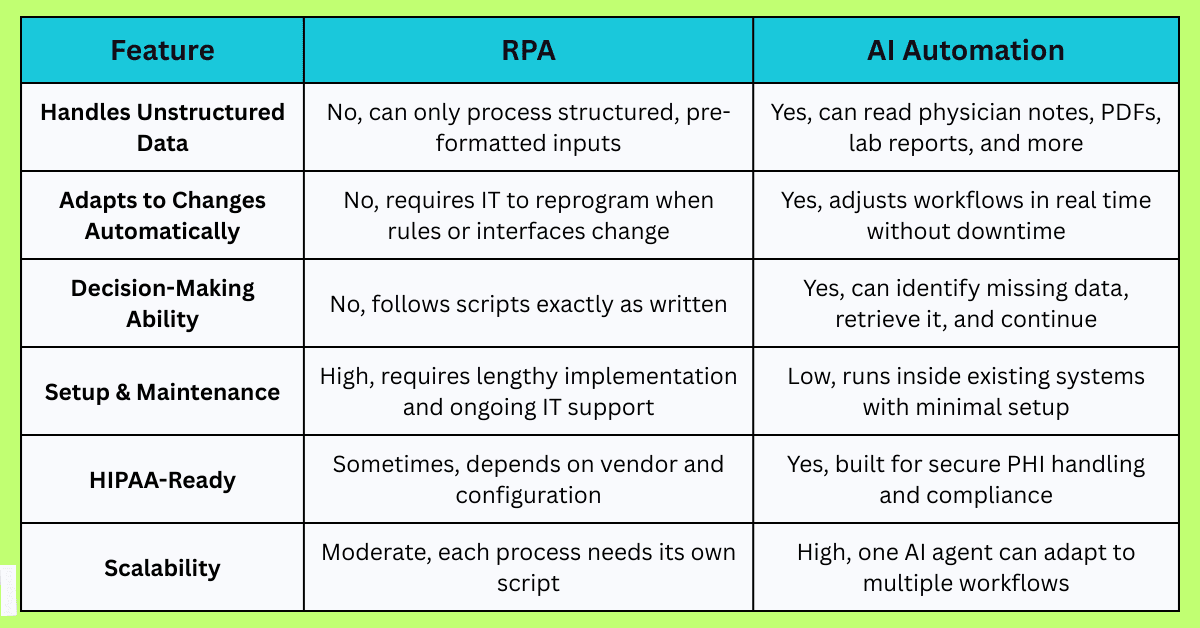
When you put RPA and AI automation side by side, the difference comes down to adaptability, intelligence, and long-term ROI.RPA works when nothing changes. AI automation works when everything does.
Why AI Automation Is the Future for Healthcare Teams
Healthcare administration isn’t slowing down. It’s getting more complex.
Payer rules change mid-quarter. Compliance requirements evolve. Patients expect faster communication and fewer delays.
Static automation tools like RPA weren’t built for that reality.
AI automation thrives in it.
It keeps workflows moving when rules change. No waiting for IT to rewrite a bot.
It handles the messy data healthcare runs on. Unstructured notes, scanned forms, insurer-specific templates. It can read and process them all.
It scales without duplicating effort. One AI agent can adapt across multiple payers, processes, and systems.
It reduces the human burden. Staff spend less time chasing missing data and more time on patient-facing work.
The organizations that adopt AI automation now won’t just be more efficient.
They’ll be more resilient, better prepared to handle the next regulatory shift, and more competitive in a market where patient experience increasingly drives loyalty.
Healthcare will always be complex. The question is whether your automation can keep pace.
How Magical Powers AI Automation for Healthcare
Magical was built for healthcare teams that need automation to be fast, flexible, and reliable, not a months-long IT project. Instead of replacing your systems, it works inside them, automating the processes that take the most time and cause the most frustration.
Works Where You Already Work
Magical runs as a Chrome extension, directly inside your EHR, billing platform, insurer portals, spreadsheets, and compliance tools. No integrations or new logins required.
Automates Complex, Multi-Step Workflows
From medical billing and prior authorization to denial management and compliance reporting, Magical’s agentic AI executes end-to-end processes: pulling data, validating it, filling forms, submitting requests, and tracking statuses.
Secure, HIPAA-Ready Automation
All PHI is encrypted and handled in compliance with HIPAA requirements, keeping patient data safe while meeting regulatory standards.
Adapts When Things Change
If a payer updates a form or changes submission rules, Magical adjusts in real time with no broken scripts, no workflow downtime.
Proven Results in Healthcare
WebPT: Reduced manual billing data entry errors and sped up claims.
TCPA: Automated secure data transfers at scale while maintaining compliance.
ZoomCare: Shortened claim resolution times by automating denial follow-ups.
With Magical, you get automation that doesn’t just “do tasks.”
It delivers outcomes like faster reimbursements, fewer denials, lower burnout, and more time for your team to focus on care.
Getting Started with AI Automation in Place of RPA
Switching from RPA to AI automation doesn’t mean ripping out what you already have. It means targeting the processes where RPA is failing and letting AI take over.
Audit Your Current RPA Workflows
Identify which scripts break most often or require the most IT maintenance.
Pick a High-Impact Process
Start with a workflow that’s variable and exception-heavy, like prior authorization, denial management, or multi-payer billing.
Deploy AI in Parallel
Use Magical to automate that process directly in your existing systems. This allows for side-by-side comparison with RPA performance.
Measure the Results
Track time saved, error rates, and completion speed. AI should outperform RPA in both efficiency and adaptability.
Scale Across Workflows
Once proven, expand AI automation into other processes RPA can’t handle well, gradually reducing dependence on brittle scripts.
With this phased approach, you get quick wins without risking operational disruption. And your team experiences the benefits of AI automation right away.
Final Thoughts: Don’t Automate Yesterday’s Processes with Yesterday’s Tools
RPA had its moment in healthcare. But it was built for a world where processes stayed the same.
That’s not the world you work in.
Payer rules change.
Portals shift.
Compliance evolves.
The workflows that keep your organization running are too dynamic for brittle, static automation.
AI automation is built for change. It adapts in real time, handles the messy unstructured data that healthcare runs on, and makes intelligent decisions mid-process.
The result? Fewer errors, less downtime, faster reimbursements, and a team that spends more time on patient care instead of fixing broken scripts.
Magical puts that capability directly in your hands today, without replacing your systems or waiting months for an implementation team.
Don’t let your automation hold you back:
Try the free Magical Chrome extension and see the hours start adding up.
Or book a demo and watch your workflows transform.
In healthcare, adaptability isn’t optional and neither is the tech you choose to power it.