
Nobody signs up to work in healthcare admin because they’re passionate about... clicking through 14 EHR tabs to find one denial code.
And yet, here we are.
The EHR is the heartbeat of your organization….and the bottleneck of your workflows.
It's where everything lives, but nothing flows.
You need it.
You depend on it.
But if you're honest? You’re working around it just as much as you’re working inside it.
Because here's the truth that no EHR vendor wants to admit:
The EHR was built to document, not to do.
It’s a system of record. Not a system of action.
You weren’t meant to run complex operational workflows through a tool designed for medical charting. And the more you try to force it, the more fragile, rigid, and exhausting your processes become.
The good news? You don’t have to live there anymore.
Because the future of healthcare workflows isn’t inside the EHR. It’s around it.
Modular.
Interoperable.
Agentic.
No-code.
HIPAA-compliant.
Built for outcomes, not clicks.
You still need your EHR. But it’s time to stop pretending it can be everything.
This is the next chapter. Let’s open it.
The Role (and Limits) of the EHR
Let’s start with some respect.
EHRs were never supposed to be workflow automation tools. They were built to:
Store patient records
Maintain compliance
Support clinical documentation
Provide a centralized system of truth
And in those areas, they deliver.
They’ve helped reduce paperwork. They’ve created searchable histories. They’ve moved healthcare past manila folders and file cabinets.
But somewhere along the way, the EHR became the default dumping ground for everything.
Billing processes.
Intake workflows.
Referral routing.
Task management.
Denial rework.
The problem? It was never designed for that.
What EHRs Do Well
Centralized patient records
Clinical documentation + encounter logging
Audit trails for compliance
Regulatory reporting + data exports
Medication reconciliation + order sets
Up to 96% of non-federal hospitals use certified EHR technology.
They’re here to stay. But that doesn’t mean they’re built for everything.
Where EHRs Break Down
Workflow routing (e.g., "if X happens, send to team Y")
Multi-system tasks (CRM → billing → portal)
Custom logic for payer rules or appeal workflows
Task automation beyond templated macros
Real-time adaptability when processes shift
And perhaps most importantly? EHRs lock you into their logic.
You follow their path, even if it’s inefficient, outdated, or built for someone else’s workflow.
Stat Spotlight
Clinicians and administrators spend an average of 4.5 hours per day in the EHR, and still end up creating workarounds in email, spreadsheets, and sticky notes.
That’s not a workflow. That’s a cry for help.
The EHR isn’t the enemy.
But it’s not your automation platform either.
It’s time to stop asking your EHR to do something it was never meant to do and start building around it, with tools that are actually designed for operational flow.
The Problem with Forcing Workflows Into the EHR
Here’s what every admin team knows, even if no one says it out loud.
You’re duct-taping workflows onto a system that actively resists them.
Trying to build complex, multi-step admin processes inside the EHR is like trying to run a call center from inside Excel.
Can it store information? Sure.
But is it designed to move work forward, flex with real-world changes, or automate intelligently across systems?
Absolutely not.
The Symptoms of Workflow Cramming
If this sounds familiar, you’re not alone:
"Workflow templates" that break every time a form is updated
Denial rework that’s buried in a task queue no one monitors
Staff bouncing between tabs because the EHR can’t communicate with the billing system
Patient data entered twice because no field-mapping exists
Workarounds outside the system (email, Slack, sticky notes) to keep things moving
EHRs were never designed to orchestrate cross-platform workflows. They were designed to document what already happened, not to actively manage what needs to happen next.
When Workflows Live in the Wrong Place, People Pay the Price
Time is wasted duplicating effort
Processes are fragile and hard to update
Staff burnout increases as they juggle “in-EHR” vs. “real-life” task tracking
Errors slip through because accountability is scattered
To be clear, it’s not because your team isn’t trying hard enough.
It’s because the system wasn’t designed for this kind of work.
You’re forcing high-complexity workflows into a low-flexibility tool. That’s not a tech stack. It’s a trap.
The solution isn’t to rip out your EHR.
It’s to stop asking it to do more than it should and start using tools that are built for execution, adaptability, and outcome-focused work.
Where the Future Actually Lives: Modular, Agentic Workflows
The answer isn’t replacing your EHR. It’s liberating your workflows from it.
The future of healthcare operations isn’t one giant system that tries (and fails) to do everything.
It’s modular.
It’s interoperable.
It’s powered by AI agents that work across systems, execute intelligently, and adapt in real time.
This is where agentic automation enters the picture.
Modular Workflows > Monolithic Systems
Modern healthcare ops teams don’t want one “platform to rule them all.” They want flexibility.
They need tools that:
Work with their EHR, not inside it
Integrate with other systems (CRM, billing, scheduling, payer portals)
Allow for iteration without breaking everything
Give non-technical staff the ability to automate on their own
Modular systems are composable. If something breaks, you replace the part, not the whole engine.
That’s not just good design. It’s resilient design.
Enter Agentic Automation
Agentic AI takes things further by not just executing tasks, but making informed decisions along the way.
What makes an AI agent different?
It’s goal-oriented, not step-oriented
It works across multiple platforms
It can adapt in real time
It understands context, not just commands
And unlike legacy bots or static workflows, AI agents aren’t locked to one system. They operate around your EHR, leveraging it as needed, but never limited by it.
Example: Denial Management Workflow
Without AI agents:
Denial shows up in the EHR
Billing team pulls the code, cross-checks the reason
Admin digs into patient documentation
Rework is manually submitted or escalated
With AI agents (powered by Magical):
Agent detects the denial reason
Cross-references payer rules + patient record
Pulls supporting documentation
Drafts a corrected claim or routes to the right person—automatically
Every action is logged, compliant, and transparent
No tabs. No bottlenecks. No burnout.
The EHR still stores the record.
The agent gets the work done.
That’s what the future looks lik, and it’s already happening.
4 Workflows That Shouldn’t Live Inside the EHR
You can store a lot in the EHR.
But you shouldn't run everything through it.
Here are four workflows that break down when forced into EHR environments and what happens when you move them out and let intelligent automation take over.
1. Denial Management
Why it breaks in the EHR:
Denials are logged, but follow-up is manual
No decision support for next steps
High dependency on billing team bandwidth
Payer-specific nuances aren’t captured in templates
What AI agents do instead:
Automatically read and interpret denial reasons
Cross-reference patient record and payer policy
Assemble appeal packets or correction steps
Log every action in a HIPAA-compliant audit trail
Result: Faster rework, fewer missed appeals, less revenue lost.
2. Referral Routing
Why it breaks in the EHR:
Most EHRs don’t handle external communication well
Routing rules are limited or hard-coded
Documentation uploads are manual
Eligibility checks happen after submission (too late)
What AI agents do instead:
Identify referral triggers automatically
Pre-check for documentation and eligibility requirements
Populate forms, attach files, and initiate handoff
Alert staff only when exceptions arise
Result: Less referral ping-pong. More patients seen, faster.
3. Prior Authorization Preparation
Why it breaks in the EHR:
No built-in logic for payer-specific requirements
Too easy to miss a required document or code
Delays care, frustrates staff, drives up denials
What AI agents do instead:
Interpret payer rules for each procedure
Scan patient records for supporting documentation
Auto-compile prior auth packets
Escalate only if critical info is missing
Result: More first-pass approvals. Shorter delays. Better care.
4. Intake & Registration QA
Why it breaks in the EHR:
Data validation is limited
Duplicate records often go unnoticed
Manual review drains time and increases errors
What AI agents do instead:
Cross-reference submitted data with existing records
Flag incomplete or mismatched entries
Auto-correct formatting and field inconsistencies
Sync with other systems to ensure consistency
Result: Cleaner records, smoother intake, fewer billing issues downstream.
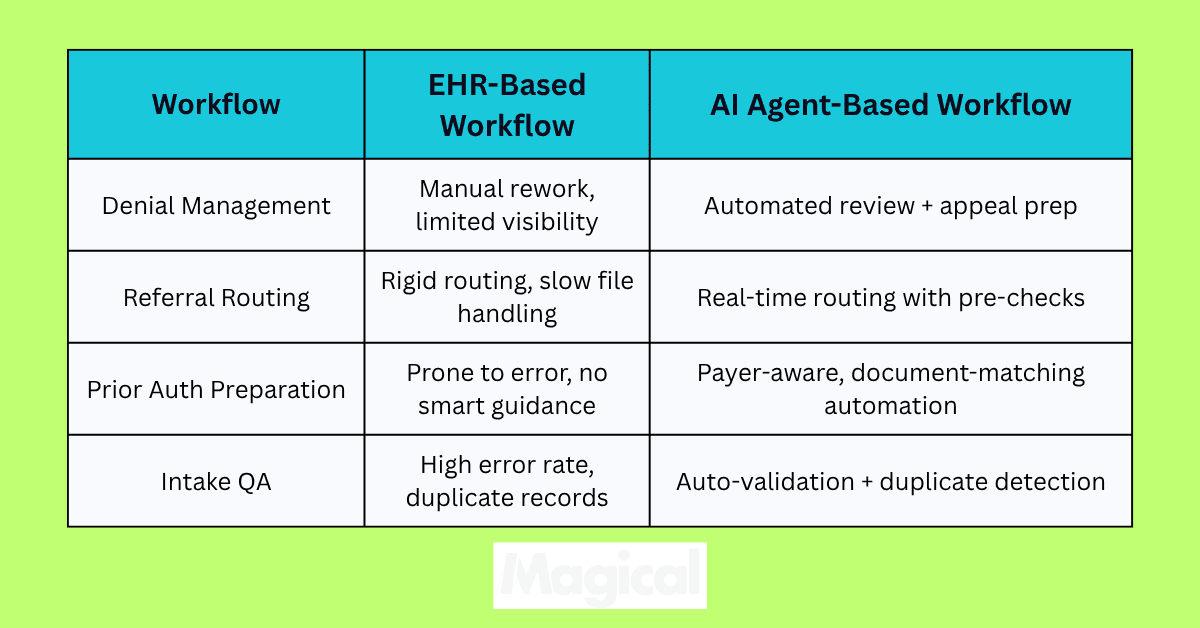
These aren’t edge cases. They’re everyday bottlenecks.
And the only reason they live inside the EHR is because no one gave your team a better option.
Now you have one.
The New Model: EHR as System of Record, AI as System of Action
If your EHR is the vault, your workflows shouldn't be trapped inside it.
Here’s the model that works in today’s healthcare reality:
EHR = System of Record: A secure, compliant, centralized repository of truth. Great for storing and documenting, not for doing.
AI Agent Platform (like Magical) = System of Action: A flexible, intelligent layer that executes workflows across tools, teams, and systems.
This isn’t just better in theory. It works better in practice.
Why It Works
EHRs maintain compliance: AI agents ensure workflows actually happen on time, with fewer errors.
EHRs store the data: Agents activate it, transforming inputs into real-time actions and decisions.
EHRs are the truth: Agents are the movement.
Together, they form a complete system, without relying on outdated, brittle automations or building new workflows on a foundation never meant to support them.
How Magical Fits Into the Model
Magical connects to your existing systems through the browser (no deep integration needed) and securely powers agentic workflows like:
Denial follow-up
Referral routing
Intake validation
Prior auth pre-checks
Data syncing across EHR, CRM, and billing tools
All without code, without risk, and without relying on engineering.
You keep your EHR.
You just stop asking it to carry the whole weight of your operations.
Case Study Proof Points
WebPT: Automated denial follow-up outside the EHR—slashing rework cycles and increasing claims success
ZoomCare: Used Magical to manage patient data across systems—no IT tickets, no custom EHR changes
TCPA: Automated HIPAA-compliant patient workflows—while keeping their EHR as the system of record
You’re not choosing between systems.
You’re choosing between stagnation and flow.
Let the EHR do what it’s great at.
Let agents do the rest.
What Teams Need to Make This Shift
The future isn’t waiting. But you don’t need a capital “T” transformation to start stepping into it.
The smartest healthcare ops teams aren’t overhauling their EHR.
They’re layering smarter workflows on top of it, starting with one use case, one agent, one bottleneck that’s ready to break.
Here’s what it takes to make that shift.
The Mindset Shift
Stop asking:
“How do we automate this inside the EHR?”
Start asking:
“What’s the best way to get this workflow done securely, accurately, and without burning out my team?”
That question unlocks smarter tools. It opens the door to no-code agents. And it reframes your EHR as a partner, not a prison.
The Tactical Shift
You don’t need to rip and replace. You need to start small and smart.
Look for workflows that are:
Repetitive but critical
Prone to delay or error
Require cross-system coordination
Don’t justify an IT ticket every time they break
That’s your launch point.
From there, you scale agent by agent, workflow by workflow.
The Technology Shift
To make this model work, your team needs tools that are:
No-code (so ops teams can deploy without IT)
HIPAA-compliant (built for PHI from day one)
Agent-powered (not just task automation—actual decision-making)
EHR-agnostic (works with any system, across your stack)
Magical checks every box.
It’s used by 100,000+ companies, trusted by nearly 1 million users, and helps healthcare teams save an average of 7 hours per week, per person, without writing code, exposing PHI, or depending on dev cycles.
The shift doesn’t require a 12-month roadmap.
It requires a better question and a better tool.
Final Thoughts: Start Building Outside the EHR, Without Losing Control
Your EHR isn’t the enemy.
It’s just not the engine for the kind of intelligent, cross-functional workflows your team needs to run today.
You’ve seen it firsthand:
Denials that get buried
Tasks that never get escalated
Intake forms that need double entry
Authorizations that stall care
Teams juggling between systems just to keep the lights on
The truth?
The future of your workflows doesn’t live inside your EHR.
It lives in secure, flexible, agent-powered automation that works with your EHR, but doesn’t depend on it.
That’s what Magical delivers.
AI agents that operate around your EHR
HIPAA-compliant automation, audit-logged by default
No-code deployment your ops team can own
Real-time workflow execution, not passive data storage
Trusted by 100,000+ companies and 1 million+ users
Teams using Magical save 7 hours per week, per user, because their work isn’t trapped in outdated systems. It’s flowing where it needs to.
Try Magical Free or Book a Demo
Install the free Magical Chrome extension to start saving time instantly
Book a personalized demo to explore how AI agents can reshape your workflows. No EHR rebuild required
You don’t need permission. You need a better process.
Start building outside the EHR and take back control.