
It’s not that automation failed.
It just stopped being enough.
You can feel it in the micro-glitches. The bot that breaks because someone renamed a field in your EHR.
The macro-chaos. The denial rework backlog that’s still growing, even though you “automated that” last quarter.
The brittle processes duct-taped together with rules, scripts, and manual oversight that someone has to remember to double-check every Friday before 5.
This is the automation plateau.
And if you’re leading ops in healthcare, you’ve probably hit it already.
Because the reality is that automation was built for a different era. One with fewer systems, fewer regulations, fewer variables.
It was designed to do what it was told and only what it was told.
But healthcare isn’t static. It’s high-stakes, fast-moving, and constantly shifting under your feet.
Which is why the next evolution isn’t more automation.
It’s autonomy.
Autonomy is the ability to adapt. To think in context. To pursue outcomes, not just execute tasks.
And it’s not coming "someday."
It’s here.
Right now.
Running in the background at orgs like WebPT, TCPA, and ZoomCare, one workflow at a time.
This is the shift you’ve been waiting for, even if you didn’t have a name for it until now.
Defining the Difference: Automation vs. Autonomy
We’ve been trained to treat “automation” as the end goal.
But automation, in its legacy form, was only ever a bridge.
A bridge from pure manual labor to something more efficient, but not necessarily smarter.
And the cracks in that bridge are widening. Because what most admin teams in healthcare are still using isn’t automation.
It’s glorified scripting.
Copy this.
Paste that.
Click here.
Send email.
Move on.
Great… until the format changes, the policy updates, or the claim type doesn't fit the mold.
Then?
Breakdown.
Escalation.
Back to the human.
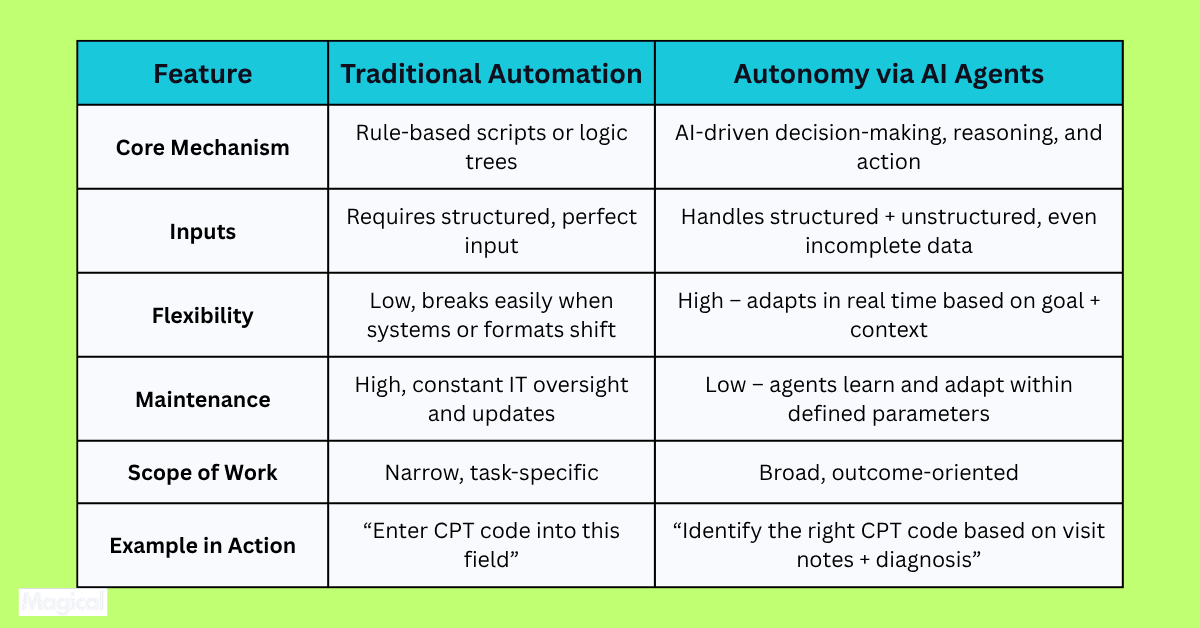
So What’s The Difference Between Automation And Autonomy? Everything.
Let’s break it down:
Why This Difference Matters in Healthcare
In a field where regulatory rules shift, payer policies change overnight, and EHR systems are never truly “stable,” rigid automation just can’t keep up.
For example:
40% of healthcare executives report that existing automation tools break at least monthly due to system changes or integration issues.
And yet, 63% of providers still rely on traditional RPA tools that can’t adapt or reason.
This creates a dangerous paradox: You're "automated," but your team still works overtime to fix the fallout.
Autonomous agents don’t eliminate humans from the loop.
They elevate them by handling the parts of the workflow that require repetition, pattern recognition, and judgment at scale.
So you can stop babysitting your bots and start solving actual operational problems.
What’s Driving the Shift in Healthcare Admin?
This shift isn’t happening because AI agents are shiny or new.
It’s happening because the old way is breaking down, systematically, expensively, and at scale.
Healthcare ops leaders aren’t waking up one day and deciding to “try AI.” They’re reacting to compounding pressures that traditional automation simply can’t handle anymore.
Let’s break down the top four drivers forcing the move from automation to autonomy.
The Complexity of Admin Work Keeps Increasing
Healthcare admin isn't getting simpler. It’s getting messier.
New payer policies. More complex claims. A growing web of disconnected systems that don’t speak the same language.
The American Hospital Association reports that hospitals and health systems now manage over 600 distinct regulatory requirements, many of which trigger downstream admin processes.
This creates fragility in traditional automation:
A new claim format breaks a script
A policy update changes denial logic
A system upgrade erases a field a bot depends on
Autonomy can interpret these changes in context and adapt, without requiring an engineer to rewrite the rules.
Staffing Shortages and Burnout Are Hitting a Breaking Point
The healthcare workforce is exhausted. Full stop.
According to the 2023 Commonwealth Fund report, over 60% of healthcare workers report experiencing burnout, with administrative burden ranking as a top contributor.
At the same time, roles that handle back-office work, such as medical billing, patient intake, scheduling, are harder to fill and retain.
Automation helped buy time.
Autonomy helps reclaim it.
AI agents remove the need for humans to babysit bots, catch exceptions, and re-run failed workflows. They do more than move data.
They make decisions within guardrails and reduce the constant drag on your team’s energy.
Accuracy and Speed Are Now Directly Tied to Revenue and Reputation
The margin for admin error in healthcare keeps shrinking:
A single coding error can delay a claim by weeks
Late prior authorizations delay care and hurt patient trust
Bad data ripples across compliance, billing, and clinical outcomes
As health systems shift toward value-based care, the speed and accuracy of backend processes impact both patient outcomes and financial performance.
Autonomous agents don’t just execute, they optimize:
They correct incomplete data
They anticipate documentation needs
They adapt to policy rules across different payers and workflows
This kind of flexibility and foresight just isn’t possible with static automation.
LLMs and Agentic AI Have Reached Operational Maturity
We’re finally past the hype curve.
Thanks to large language models (LLMs), AI agents can now:
Interpret natural language
Parse payer policy documents
Extract intent from denial codes
Act on unstructured EHR data
And platforms like Magical make these agents deployable without engineers, HIPAA-compliant out of the box, and adaptable across your stack.
This isn’t just theoretical anymore. It’s working in the field, in real workflows, at scale.
What Autonomy Looks Like in Real Workflows
If automation is like programming a player piano, autonomy is like giving a musician a goal and letting them improvise the best path there.
In healthcare admin, that means fewer errors, faster turnaround, and less time stuck in repetitive, brittle workflows.
Here’s what autonomy looks like on the ground—not in theory, but in workflows your team is already struggling to maintain.
Patient Data Syncing Across Systems
The Problem: Patient info is entered in the intake system, but it needs to land in the EHR, CRM, and insurance portal. A field label changes, a new dropdown appears, or a record is incomplete, and suddenly, the whole workflow stalls.
Traditional Automation:
Relies on hard-coded field maps
Breaks when labels or data formats shift
Requires manual override when fields are missing
Autonomous Agents:
Use LLMs to understand field meaning, not just name
Match and map patient data across different systems dynamically
Flag inconsistencies or gaps in real time—before they cause downstream issues
Result: Seamless, adaptable syncing that reduces duplications, improves record accuracy, and keeps intake flowing.
Denial Appeals and Rework
The Problem: Denials pour in. Each one needs review, documentation correction, form re-submission, and follow-up. It's tedious, error-prone, and revenue-draining.
Traditional Automation:
Flags denials based on code
Sends generic alerts
Still needs a human to open the case, locate the issue, and fix it
Autonomous Agents:
Parse denial reason in natural language
Check if required documentation exists
Generate or assist in drafting appeal forms
Route unresolved edge cases to the right team, without dropping the ball
Case in Point: WebPT slashed denial backlog using Magical AI agents, reclaiming both revenue and team bandwidth.
Intake & Registration Review
The Problem: Patient intake forms are riddled with inconsistencies, nicknames instead of legal names, missing fields, typos, insurance mismatches. Humans catch these... if they have time.
Traditional Automation:
Can autofill fields
Can’t validate data integrity or cross-reference entries
Often leads to errors that delay scheduling or billing
Autonomous Agents:
Cross-check name, DOB, and insurance info across internal systems
Flag potential duplicates or invalid entries
Auto-correct formatting and escalate only true exceptions
Result: Cleaner records, fewer back-and-forths with patients, and less stress on scheduling teams.
Prior Authorization Prep
The Problem: Missing documentation leads to delays in care. Ops teams scramble to compile clinical notes, diagnosis codes, and referrals before submission deadlines.
Traditional Automation:
Can fill out known fields
Can’t check if all required documentation is present for that specific payer
Relies heavily on humans for last-mile validation
Autonomous Agents:
Interpret payer-specific prior auth requirements
Match required documentation to what’s in the patient file
Identify gaps and generate to-do lists or reminders before submission
Result: More first-pass approvals, faster care delivery, less chaos for your care coordination team.
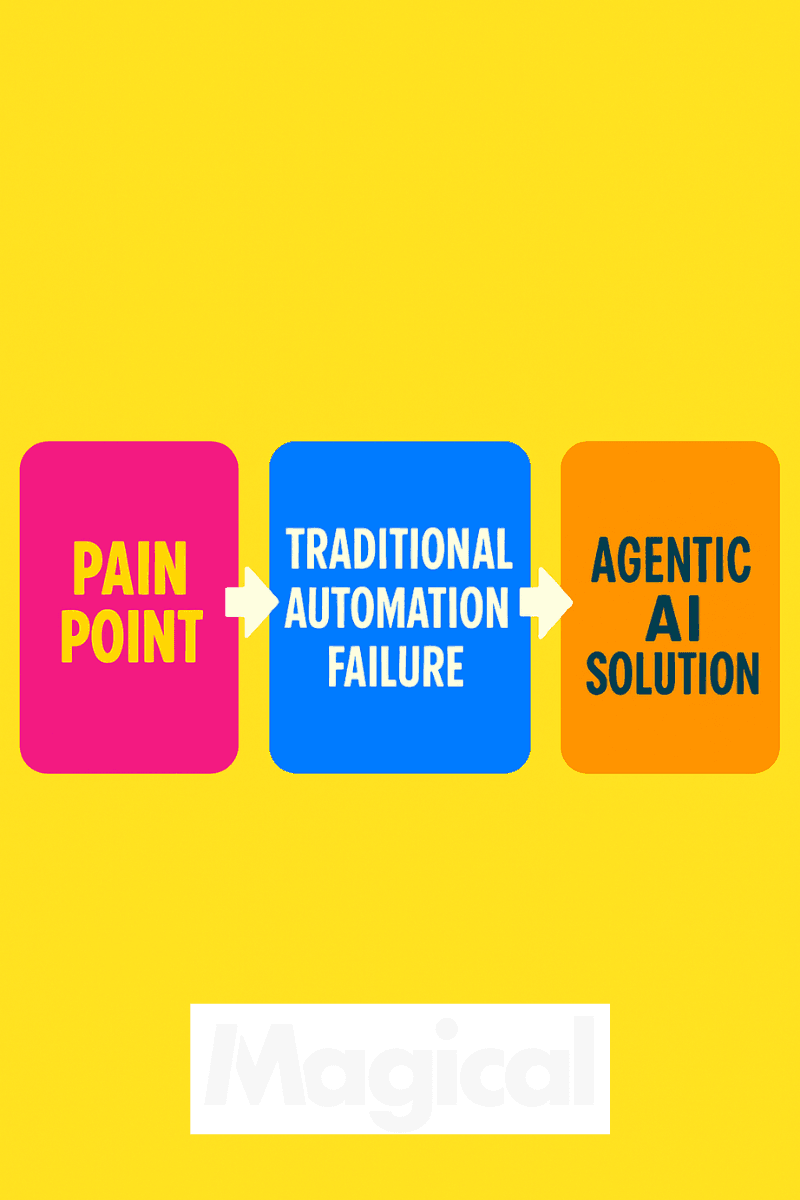
Each of these workflows represents a low-hanging opportunity for teams to begin the shift. Not with a full AI transformation plan, but with one workflow, one agent, and one measurable win.
Why This Shift Matters Now
The shift from automation to autonomy isn’t a future concept.
It’s happening right now because the systems, staffing models, and margins healthcare teams rely on are already maxed out.
Sticking with rigid, script-based automation in 2025 is like using a flip phone in a telehealth consult. It technically works… until it doesn’t.
Here’s why forward-thinking healthcare teams are making the move today.
The Cost of Fragility Keeps Rising
Traditional automation might feel cheaper up front, but it’s expensive in the long run.
Every time a bot breaks, a policy changes, or an integration fails, your team steps in to:
Rework the task manually
Escalate to IT for fixes
Lose hours that were “saved” in theory
These micro-failures add up. In fact, studies show that nearly 30% of healthcare organizations experience frequent automation breakdowns that require daily manual intervention.
Autonomous agents reduce that fragility. They:
Adjust dynamically to changes
Operate within defined guardrails
Surface exceptions proactively instead of stalling
Less breakage. Less babysitting. Less stress.
Speed Is Now a Competitive Advantage
Whether you’re managing authorizations, scheduling, or claims, speed to resolution matters more than ever.
Why?
Payers are tightening turnaround windows
Patients expect faster responses
Staffing gaps mean less room for delays
Autonomy creates operational velocity by:
Removing handoffs
Reducing exception escalations
Allowing one agent to handle what used to take five steps (and three people)
Teams using Magical save an average of 7 hours per user, per week, not by working harder, but by automating intelligently.
Ops Leaders Are Finally in the Driver’s Seat
For years, automation was locked behind IT backlogs and vendor integrations.
But no-code platforms like Magical change that equation:
Ops teams can deploy agents themselves
Workflows can be tested, iterated, and scaled in days—not quarters
Compliance isn’t an afterthought—it’s built in from the start
That’s why teams at ZoomCare, TCPA, and WebPT didn’t just automate.
They stepped into autonomy and took control of their operational destiny.
The First Movers Are Already Reaping the Rewards
This isn’t just a nice idea. It’s a measurable advantage.
Teams that move early:
Spend less time in rework loops
Get faster reimbursement
Reduce risk exposure
Improve retention by offloading repetitive, thankless work
As autonomy becomes the new standard, the question won’t be: “Should we do this?”
It’ll be: “Why didn’t we do this sooner?”
Common Myths About Autonomy (And the Truth)
You’ve seen what AI agents can do.
You’ve seen why traditional automation is breaking.
But let’s be real, there are still some persistent fears, misconceptions, and objections that keep healthcare teams stuck.
Time to clear the air.
Myth 1: “Autonomous AI will replace my team.”
Truth: It doesn’t replace your team. It rescues them from work they shouldn’t have to do in the first place.
AI agents take on the soul-sucking tasks, manual data entry, record-matching, denial rework, so your people can focus on what matters: patients, strategy, and improvement.
Human judgment isn’t replaced, it’s elevated.
Think of it as a workforce multiplier, not a workforce reducer.
Myth 2: “Autonomy means loss of control.”
Truth: With the right platform, you have more control, not less.
Magical’s AI agents work within your parameters:
You define the scope
You set the permissions
You get real-time logs of every action they take
They don’t go rogue. They don’t make assumptions. They act with purpose, inside the lines you draw.
Myth 3: “We need a massive IT project to adopt this.”
Truth: You can launch your first agent without writing a single line of code.
Platforms like Magical are built for ops teams. You can:
Install the Chrome extension
Train an agent using plain language
Deploy it in a live workflow today
No dev tickets. No long ramp-up. No months of waiting for “readiness.” You’re ready now.
Myth 4: “Only big hospitals can use this kind of tech.”
Truth: AI agents are already running inside lean clinics, rev cycle teams, and regional health groups.
You don’t need enterprise headcount to benefit from autonomy. Magical’s agents are already powering workflows at 100,000+ companies, saving time for teams of every size.
Autonomy isn’t a future for giants. It’s a present advantage for doers.
These myths keep ops teams from leveling up.
Let them go, and the path to autonomy gets a lot clearer and faster.
How to Begin the Shift (Without Breaking Everything)
You don’t need to tear down your ops stack to build something better.
That’s the beauty of autonomy: you can layer it into your existing workflows, without blowing anything up.
Here’s how healthcare teams are making the shift, without triggering a 12-month IT roadmap, an EMR integration nightmare, or a full reorg.
Step 1: Start with One Workflow
Don’t try to automate everything.
Find one friction-heavy, low-strategic-value workflow that your team hates doing manually.
Look for:
Daily repetition
Frequent human error
Low tolerance for failure
Cross-system copy/paste
Escalations due to breakdowns
Examples:
Denial rework
Eligibility verification
Intake data syncing
Prior auth documentation pre-checks
Step 2: Deploy an Agent (Not a Script)
Instead of setting up a brittle automation sequence, use a no-code AI agent platform like Magical.
You’ll be able to:
Train your agent with natural language (not code)
Connect the tools and systems you already use
Give the agent clear constraints and fallback rules
Monitor every action in a secure, auditable log
Most teams can go from idea to working agent in under a day.
Step 3: Track the Right Metrics
You’re not tracking clicks. You’re tracking outcomes.
Start by measuring:
Time saved per task
Error reduction
Escalation volume
Turnaround time
Staff satisfaction (seriously)
Once that first agent pays off, you’ll build internal buy-in to deploy the next one and the one after that.
Step 4: Scale What Works, Ignore the Rest
Autonomy doesn’t mean automating everything. It means optimizing where it matters.
Use your initial win as a proof point:
Socialize results internally
Create an internal “agent playbook”
Start documenting other agent-ready workflows
Before long, your team will have a living AI workforce. One that evolves as your org does.
The shift to autonomy doesn’t require perfection.
It just requires momentum.
Final Thoughts: Start Your Shift with Magical
The future of healthcare operations isn’t more bots.
It’s fewer broken workflows.
Autonomy is already here, quietly transforming how leading ops teams manage patient data, claims, authorizations, and admin chaos.
Not with massive system overhauls or a 100-slide roadmap… but one workflow at a time.
And now it’s your move.
Magical gives you everything you need to start:
AI agents that understand goals, not just tasks
HIPAA-compliant, SOC 2 certified infrastructure
No-code deployment your ops team can own
Full transparency with built-in audit logs
Real-world results, trusted by 100,000+ companies and 1,000,000+ users
Teams that use Magical save 7 hours per week, per user, by turning repetitive tasks into autonomous workflows that just work.
Try Magical Free or Book a Demo
Install the free Magical Chrome extension to start saving time instantly
Book a personalized demo to explore what autonomy could look like in your team’s workflows
You don’t need a revolution. You need a smarter way forward.
Start the shift. Own the outcome. Let’s go.