
You don’t need a software engineer to fix your biggest billing bottlenecks.
You need automation that actually works for the people who chase claims, manage denials, and re-enter the same patient ID into the same five systems every single day.
Across the U.S., healthcare billing teams are losing hours (and revenue) to copy-paste work.
It’s not because they lack systems. It’s because the systems don’t talk to each other.
Most automation tools are too complicated or too rigid to help.
Enter: no-code automation.
It’s not a buzzword.
It’s not a shortcut.
It’s the practical, scalable way for healthcare admin teams to take control of their workflows, without relying on IT or writing a single line of code.
Let’s cut through the noise.
Get real use cases, tool comparisons, and proven strategies to modernize billing operations from the inside out.
Why No-Code Tools Matter in Healthcare Billing
The billing work isn’t broken. It’s buried
Most billing teams don’t need a new system. They need breathing room.
Eligibility checks, status lookups, denial rework, and coding updates.
These aren’t broken processes.
They’re just buried under clicks, logins, spreadsheets, and endless re-entry.
The tools already exist. EHRs, clearinghouses, RCM platforms.
But between them? Gaps.
Manual gaps. Gaps that get filled by the same people (often doing the same repetitive work) over and over.
That’s where no-code tools come in.
No-Code Means Power Without Permission
Forget waiting on dev cycles or vendor tickets to automate a task. No-code tools are designed for frontline teams to build their own solutions, fast.
Think drag-and-drop logic, AI-assisted workflows, and form-based builders.
No scripting.
No backend configuration.
Just tools that let operations and billing staff streamline their own work.
You don’t need to become a technologist. You just need to stop repeating what a machine can do better.
Why Healthcare Teams Are Finally Embracing It
For years, no-code platforms were seen as too general, too risky, or too clunky for healthcare. That’s changing fast.
Security has caught up. Many no-code vendors now offer HIPAA-compliant workflows, encryption, and auditability.
The interfaces have matured. They’re usable by non-technical staff from day one.
Healthcare-specific use cases are driving demand. Denial workflows. Patient data syncs. Claims follow-ups. These are tasks no-code tools can now handle without breaking anything—or anyone.
And the biggest shift? Leadership is listening.
When admins show they can cut repetitive work, reduce denials, and move money faster (without IT support), it’s no longer “just a tech experiment.”
It’s operational strategy.
Key Use Cases for No-Code Tools in Healthcare Billing Teams
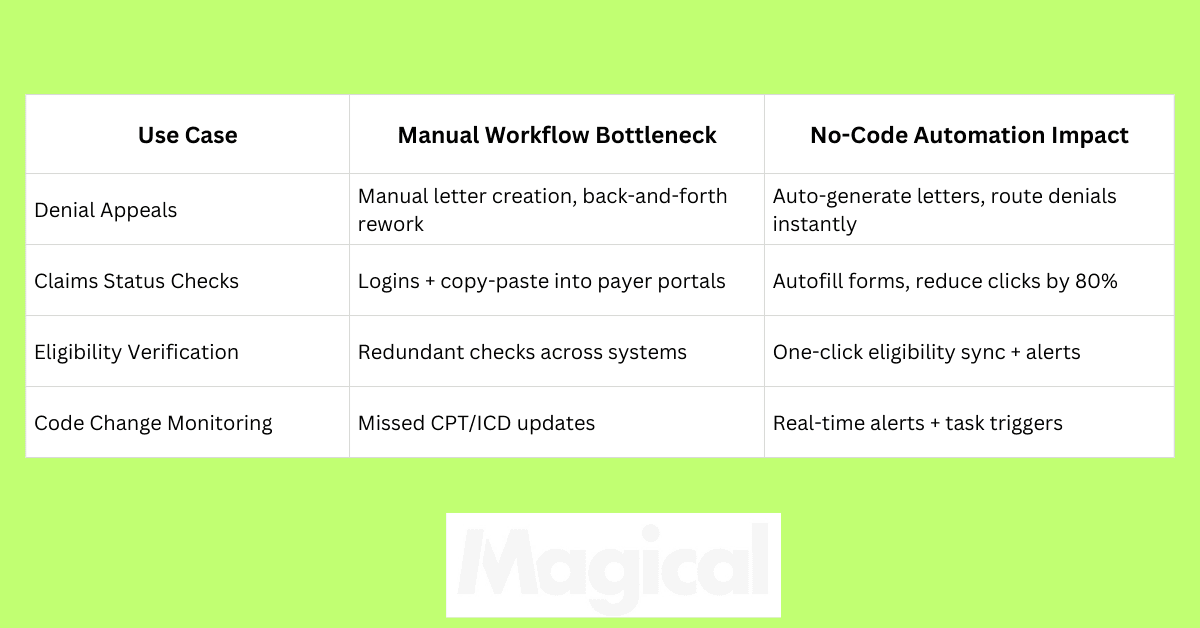
Here are 4 use cases for no-code tools in healthcare billing:
Denial Management and Appeals
Denials aren’t the exception anymore. They’re baked into the system.
But the way teams respond is still painfully manual: pulling remits, cross-checking codes, writing up appeals, chasing the clock.
With no-code automation, billing teams can:
Auto-generate appeal letters based on denial type
Pull payer responses directly into templates
Trigger workflows the moment a denial hits the RCM
It’s not just faster. It’s repeatable.
And repeatable wins every time in the revenue cycle.
Claims Status Checks That Don’t Eat Hours
Ask any billing team what task eats up the most time with the least return. Claims status checks will top the list.
Most payers still rely on login-based portals or limited EDI access. That means team members spend hours retyping the same patient and claim info into different interfaces.
No-code tools like Magical let staff build automations that:
Autofill claim status forms across payer websites
Pull in data from spreadsheets or EHRs
Move between browser tabs without missing a beat
The Result: Fewer clicks. Fewer errors. A lot more time back.
Insurance Eligibility and Patient Info Syncing
Eligibility verification doesn’t just happen once. It’s often repeated multiple times across intake, scheduling, and billing, especially for recurring care.
No-code workflows can:
Pull patient data from your EHR or intake forms
Autofill payer portals or third-party verification tools
Flag coverage changes instantly to avoid downstream denials
Faster verifications mean fewer claim rejections and happier patients who aren’t blindsided by billing surprises.
CPT/ICD Code Monitoring and Alerts
Keeping up with code changes is critical, but no one has time to watch CMS bulletins all day.
With no-code tools, you can:
Set up keyword or data triggers that watch for code updates
Automatically flag affected workflows or templates
Distribute alerts across billing, coding, and compliance teams
It’s like having a smart assistant that watches for revenue risk in real time.
Top No-Code Tools for Healthcare Billing Teams (2025 Edition)
Not all no-code tools are built for healthcare. Many promise automation but can’t support the security, complexity, or system fragmentation that billing teams deal with every day.
Below is a curated list of platforms that either specialize in healthcare or have proven use in billing operations.
All offer automation without writing a single line of code, and several are HIPAA-compliant out of the box.
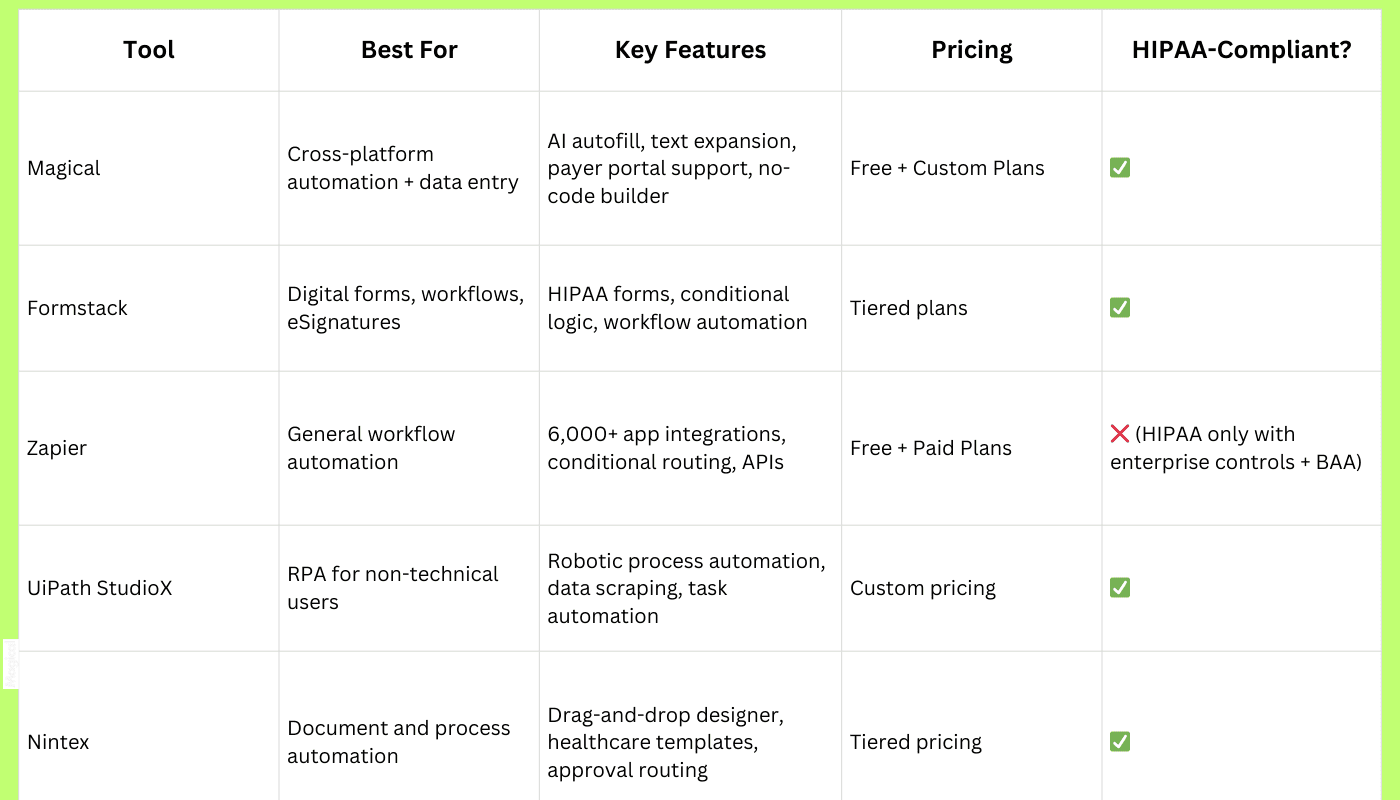
Tool Highlights:
Magical: Built specifically for repetitive, browser-based workflows. Works inside payer portals, EHRs, CRMs, and spreadsheets. Enables billing teams to create and run automations across tabs with no engineering support.
Formstack: Ideal for digitizing intake forms, capturing e-signatures, and automating document workflows. Great fit for front office billing coordination.
Zapier: Broadly used across industries, though less secure for PHI unless set up with strict enterprise controls. Best for connecting web apps in non-clinical workflows.
UiPath StudioX: A robust RPA platform that supports non-coders. Often used for complex backend tasks like claims processing or EHR system interactions.
Nintex: Focused on enterprise process automation with strong compliance options and built-in healthcare templates.
Most teams don’t need the most powerful tool. They need the right one for their daily friction points.
For healthcare billing teams working inside browser-based systems, Magical offers a fast, secure, and lightweight way to automate high-volume admin tasks without IT intervention.
How Magical Helps Healthcare Billing Teams Work Faster
Want to know how Magical can help save you time? Here’s how:
Built for the Work You're Already Doing
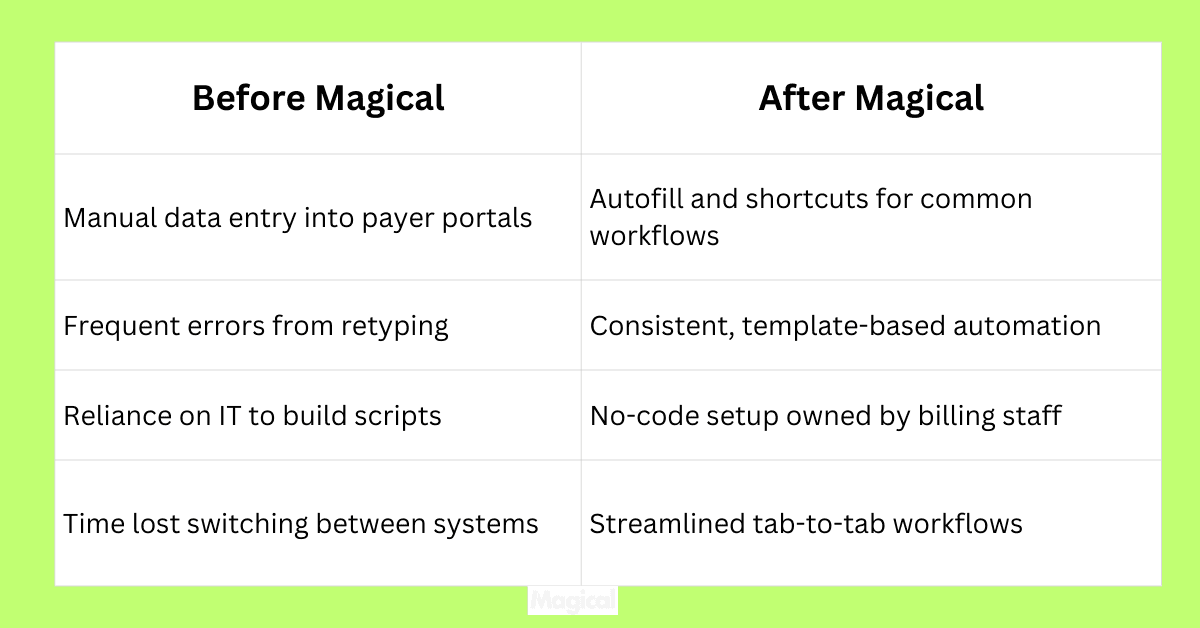
Magical doesn’t ask your team to change platforms, retrain staff, or wait on IT to build automations.
It works on top of the tools you already use, whether that’s your RCM software, EHR portal, a spreadsheet, or a web-based payer system.
Think of it as a fast, intelligent layer that makes every task smoother, smarter, and repeatable.
Instead of retyping patient names or claim numbers, Magical fills them in. Instead of manually building the same denial appeal for the 40th time this week, Magical generates it with a shortcut.
Instead of switching tabs 300 times a day, Magical bridges the gap.
Teams Are Already Seeing Real Results
Healthcare orgs aren’t guessing. They’re using Magical and getting results they can measure.
ZoomCare:
Built smart workflows without engineering support. Reduced task switching and manual steps in billing and patient coordination. Empowered staff to create their own automations in a secure, HIPAA-compliant way.
WebPT:
Used Magical to reduce administrative drag across their platform. Billing teams saved time on data entry, streamlined eligibility checks, and scaled processes without adding new software.
TCPA:
Automated patient outreach and coordination tasks. Protected PHI through built-in security and compliance features. Created fast workflows for distributed teams—no IT dependencies required.
Fast. Compliant. Actually Useful.
HIPAA-compliant. Magical is built to meet the strictest standards for healthcare data privacy.
No-code. If you can use a browser, you can use Magical.
Scalable. Start with one team, expand to every department.
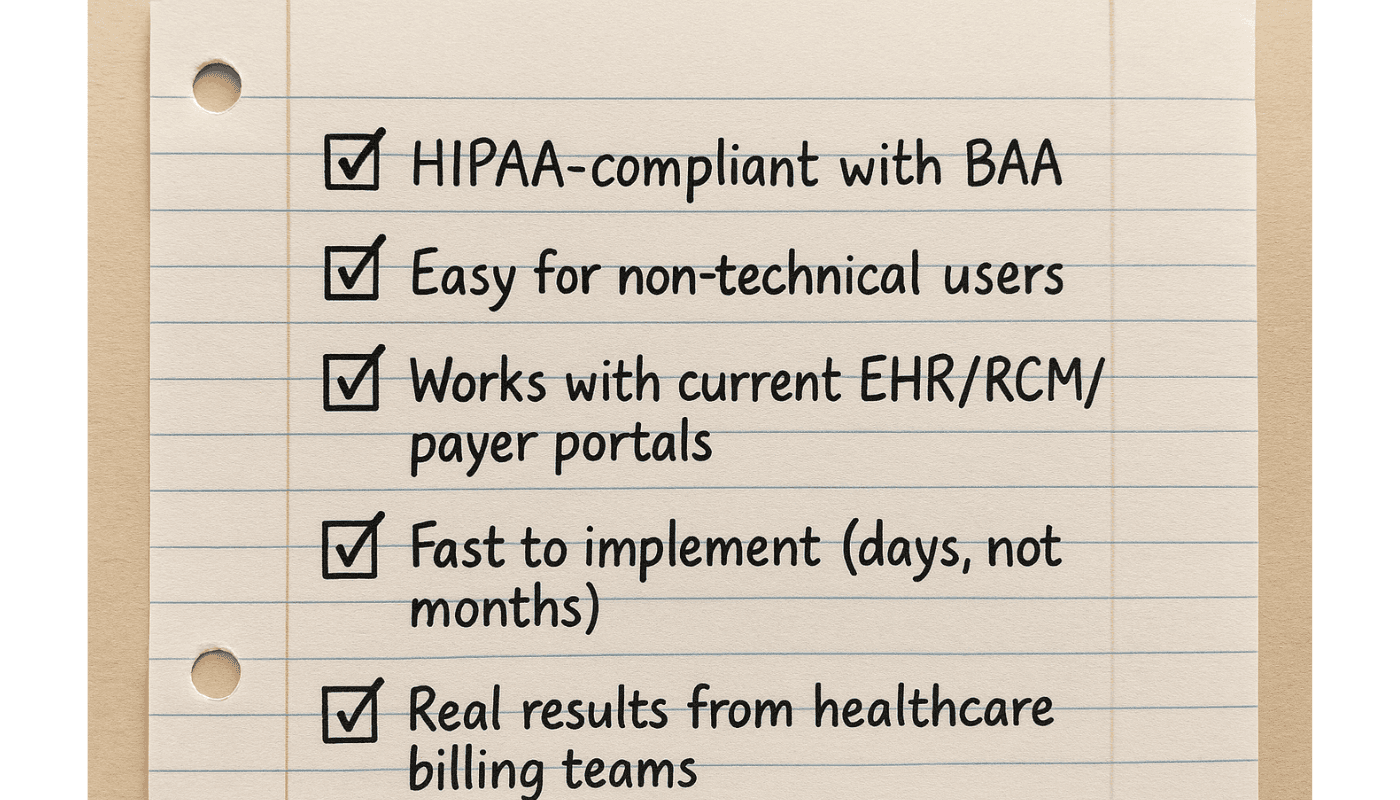
4 Key Criteria for Choosing a No-Code Tool in Healthcare Billing
There are dozens of no-code tools on the market. But only a few are built to support the complexity, compliance, and speed healthcare billing teams actually need.
Here’s what to look for (and what to avoid) when evaluating your options.
1. HIPAA Compliance and Security Standards
If a vendor can’t clearly explain how they protect PHI, stop the conversation.
Do they offer encryption in transit and at rest?
Will they sign a Business Associate Agreement (BAA)?
Do they provide audit logs and access controls?
Are they SOC 2, HITRUST, or ISO 27001 certified?
Magical, for example, is HIPAA-compliant out of the box and trusted by organizations handling sensitive patient and financial data daily.
2. Usability for Non-Technical Teams
A “no-code” tool isn’t useful if it requires a full onboarding course or daily IT support.
Look for:
Intuitive browser-based interfaces
Drag-and-drop or template-based workflow builders
AI-powered setup guidance
Clear documentation and in-app support
The best tools enable billing staff to build automations in minutes, not days.
3. Seamless Integration with Existing Systems
Avoid platforms that try to replace your core stack. No-code tools should extend, not disrupt, your current workflows.
Questions to ask:
Does it work with your EHR, RCM, or clearinghouse?
Can it automate across tabs, browsers, and desktop tools?
Does it require backend integration or can it operate with your existing front-end processes?
Magical, for instance, doesn’t require deep integrations. It runs wherever your team works.
4. Proven Results in Healthcare
Generic automation is one thing. Healthcare-grade, field-tested automation is another.
Ask for:
Case studies from similar-sized orgs
Measurable time or cost savings
Specific billing or revenue outcomes
Testimonials from billing or admin teams (not just IT leads)
You want a partner who understands both the pressures of billing work and the stakes of healthcare compliance.
Final Thoughts: The Future of Billing Is Automated and Accessible
Healthcare billing doesn’t need another enterprise platform.
It needs tools that help real people do real work, better, faster, and with fewer headaches.
No-code automation isn’t about replacing teams. It’s about unlocking their time and energy by eliminating the repetitive, manual tasks that slow everything down.
With secure, easy-to-use tools like Magical, billing teams don’t have to wait for IT or suffer through long vendor rollouts.
They can take control of their workflows starting with the tasks they handle every day.
And once they see what’s possible with one workflow? They build ten more.
Try It Yourself
Download the free Magical Chrome extension or book a demo for your team. Magical is used at 100,000+ companies and by nearly 1,000,000 users to save 7 hours a week on average.