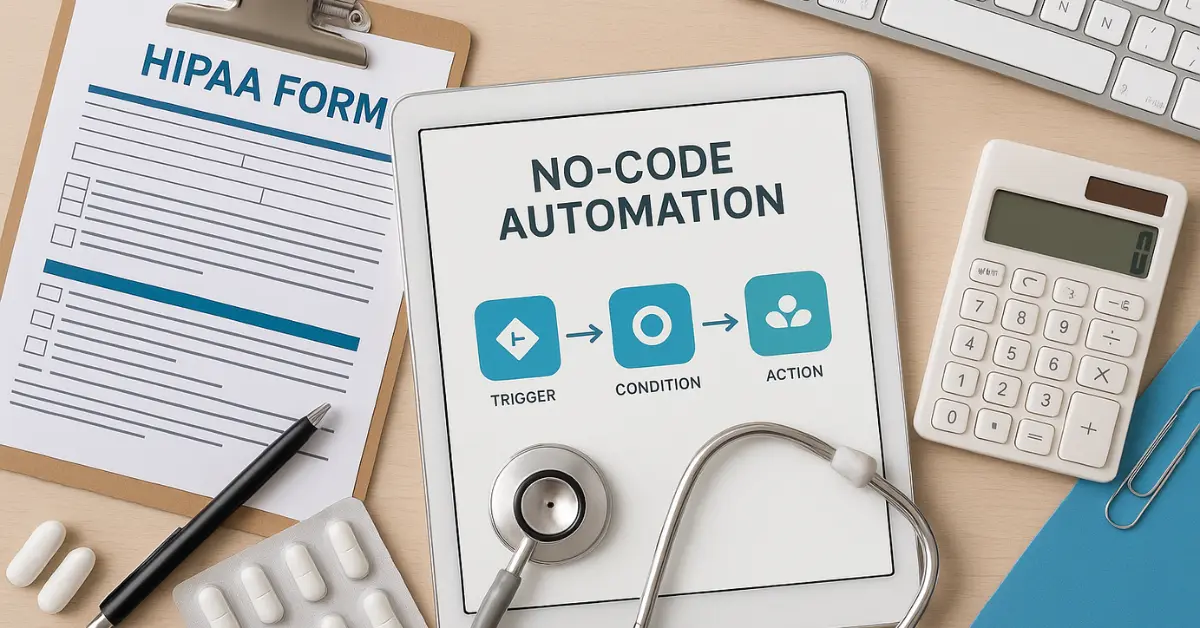
For years, healthcare teams have been stuck in a no-win game.
You either got automation that was powerful, but locked behind engineering teams, six-month implementation plans, and a legal review that gave everyone anxiety…
Or you got something usable, a Chrome plug-in, a macro, a workaround, something lightweight and fast… that definitely couldn’t touch protected health information (PHI), didn’t scale, and definitely wasn’t HIPAA-compliant.
That tradeoff has slowed down innovation.
It's forced admin teams to duct-tape solutions together while waiting for “approved tools” to catch up.
And it’s kept healthcare stuck in workflows that are manual, fragile, and constantly breaking.
But here’s the truth:
You don’t have to choose anymore.
Today, no-code platforms exist that let non-technical healthcare teams automate complex, PHI-sensitive workflows without engineers, without risk, and with full HIPAA-compliance baked in from day one.
This isn’t about buzzwords. It’s about control.
It’s about security and speed. Compliance and usability.
This is what automation actually looks like when it's built for the people doing the work.
What “No-Code” Really Means for Admin Teams
“No-code” gets thrown around a lot. Usually by software companies trying to sound edgy.
But here’s what it actually means if you’re on a healthcare admin team:
You can build, test, and deploy workflow automations without developers, without IT bottlenecks, and without breaking anything.
No-code platforms use visual interfaces or natural language inputs instead of programming.
You don’t need to know JavaScript.
You don’t need a backend system integration.
You just need to know your workflow.
That’s it.
It’s Not Just Simpler. It’s Smarter
No-code doesn’t mean dumbed-down.
It means:
You can create automations that respond to real logic
You can trigger actions based on conditions, timing, or field changes
You can build agents that operate across EHRs, CRMs, payer portals, and internal systems, without writing a line of code
No-code gives power back to the people doing the work. Instead of waiting on an engineer to automate the thing that broke again, your team lead can fix it on the spot, with compliance still fully intact.
Real-World Wins from No-Code
Here’s what no-code unlocks for healthcare admin teams:
Speed: Automate in hours, not quarters
Control: You own your workflows (not IT)
Scalability: Once you build it, it’s repeatable across locations, teams, and workflows
Resilience: No more scripts that collapse the moment a field label changes
And because Magical is no-code and AI-powered, the agents you build aren’t just automating tasks.
They’re working toward actual outcomes.
By 2025, 70% of new business apps will be built using low-code or no-code platforms, according to Gartner.
That includes healthcare. And it’s accelerating fast.
Because when time is tight, budgets are tighter, and IT is overloaded, no-code is no longer a nice-to-have. It’s a competitive advantage.
What HIPAA-Compliant Automation Requires
Honestly, just about every software vendor targeting healthcare slaps “HIPAA-compliant” on their website.
But what does that really mean?
It’s not a vibe. It’s not a setting you turn on.
HIPAA compliance is a legally enforced standard that governs how protected health information (PHI) is accessed, transmitted, stored, and used.
If you're handling PHI (and nearly every healthcare admin team does), you’re bound by HIPAA.
And if your automation tool isn’t compliant, you’re on the hook.
Compliance ≠ A Checkbox
A real HIPAA-compliant automation platform needs to include the following at a minimum:
✅ End-to-End Encryption
All data, both in transit and at rest, must be encrypted using modern standards (TLS 1.2+ or equivalent).
✅ Access Controls
Only authorized users should be able to access or modify PHI. Role-based permissions are mandatory.
✅ Audit Trails
The system must log who did what, when, and where. That includes automated actions taken by agents.
✅ Business Associate Agreement (BAA)
If a vendor touches PHI on your behalf, you need a BAA in place. No exceptions.
✅ Data Segregation and Minimal Use
The system should avoid handling unnecessary PHI, and isolate data to only what’s needed for the task.
Magical meets every one of these standards and provides clear documentation and BAA support for healthcare teams that need it.
What Happens If You Get It Wrong?
HIPAA violations don’t just mean compliance headaches. They mean real consequences.
Fines can reach $50,000 per violation, per record, with a cap of $1.5 million per year per provision violated.
In 2023 alone, over 25 million patient records were involved in reported HIPAA breaches.
You don’t want your workflow tool or a copy/paste error from an unvetted script to be the reason your organization ends up in the next OCR bulletin.
Why Admin Teams Can’t Afford to Guess
Admin teams are the most frequent handlers of PHI, but often the least supported when it comes to secure tools.
That’s why it’s critical that your automation platform:
Assumes PHI is involved
Builds compliance into the architecture
Supports your team with clarity, not legalese
With Magical, every agent action is logged. Every data exchange is encrypted. And every workflow operates within a secure, auditable, HIPAA-safe environment.
You don’t need to guess.
You don’t need to hope someone from IT has it covered.
You just need to build and know it’s safe.
Why the Intersection of No-Code + Compliance Is So Powerful
In the past, healthcare teams were told: Pick one.
Easy-to-use tools built for speed and access, but totally off-limits for PHI
Or enterprise-grade platforms built for security, but locked behind technical teams, endless approvals, and painful onboarding
No-code and HIPAA compliance were treated like opposites.
But when you combine them, something transformational happens.
You give admin teams the ability to build secure, scalable automation on their own terms.
No IT gatekeeping. No integration delays. No compromise on compliance.
Previously:
Automating a workflow meant logging a ticket… and waiting
Handling PHI meant avoiding fast tools or workarounds (even if they saved time)
Security meant complexity and complexity killed adoption
Now (with platforms like Magical):
Admins can build, launch, and manage their own agents
Workflows involving PHI stay fully HIPAA-compliant by design
Every click, data transfer, and system interaction is logged and auditable
Tools are intuitive enough to use and robust enough to trust
No more compromises. No more shadow IT. No more settling.
Real-World Proof:
ZoomCare deployed Magical agents to automate patient record syncing—without IT help
TCPA automated patient data updates and workflow logging—with HIPAA-safe agents that never exposed PHI
These teams didn’t just get faster.
They got freedom + protection at the same time.
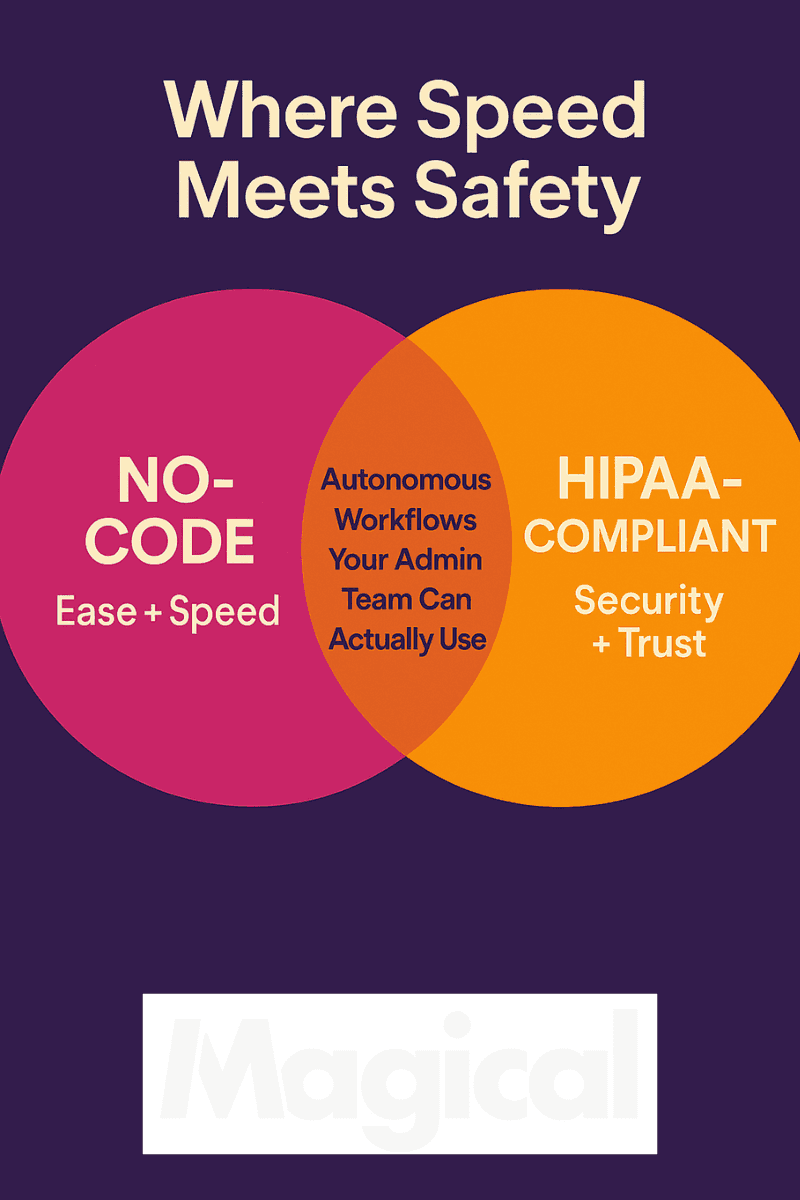
This is the future of automation in healthcare: Smart, fast, secure, and built by the people who know the work best.
3 Admin Workflows That Can Be Automated Today. Securely and Without Code
You don’t need to wait for a digital transformation strategy.
You don’t need a project sponsor.
And you definitely don’t need another round of vendor evaluations.
If your team is handling PHI manually, you’re already doing the work.
Now, you can automate it, without writing code, without hiring engineers, and without risking compliance.
Here are three common admin workflows that teams are already automating safely with Magical.
1. Intake & Registration Validation
The Problem: Patients submit forms online or in-office, but the data is often incomplete, inconsistent, or duplicated across systems. Staff have to manually clean up and re-enter information into the EHR, CRM, and scheduling platform.
Traditional Automation:
Can fill fields, but can’t validate or cross-reference
Breaks when field names or data formats shift
Can’t flag inconsistencies across systems
Magical’s No-Code, HIPAA-Compliant Agent:
Auto-extracts patient data from submissions
Validates for completeness and formatting
Flags duplicates or errors before they create downstream issues
Logs all actions in a secure audit trail
Impact: Cleaner data, faster onboarding, fewer manual corrections, no PHI exposure risk.
2. Claims Denial Follow-Up
The Problem: Denied claims require digging into EOBs, identifying the issue, gathering documentation, and resubmitting. It’s time-consuming, repetitive, and costly.
Traditional Automation:
Sends alerts or flags denials, but can’t take meaningful action
Requires a human to do all follow-up steps
Zero audit visibility on what was done and why
Magical’s No-Code, HIPAA-Compliant Agent:
Reads the denial reason code
Checks the patient record and insurance policy
Drafts a corrected claim or flags missing documents
Logs each decision point and action for compliance
Impact: Shorter denial cycles, less manual follow-up, improved collections, complete audit readiness. See how WebPT did just that.
3. Referral Management & Prior Authorization Prep
The Problem: Referrals often bounce back due to missing documentation. Staff waste hours collecting clinical notes, diagnosis codes, and eligibility info for each submission.
Traditional Automation:
Limited to form-filling, no context awareness
Doesn’t know what documentation is needed for each payer
High denial rate due to preventable oversights
Magical’s No-Code, HIPAA-Compliant Agent:
Understands prior auth requirements by payer and service
Gathers and attaches the right documentation from EHR
Auto-submits or flags for manual review if risk is detected
Operates securely inside your ecosystem—no data leak risk
Impact: Higher first-pass approval rates, faster access to care, less stress for care coordinators.
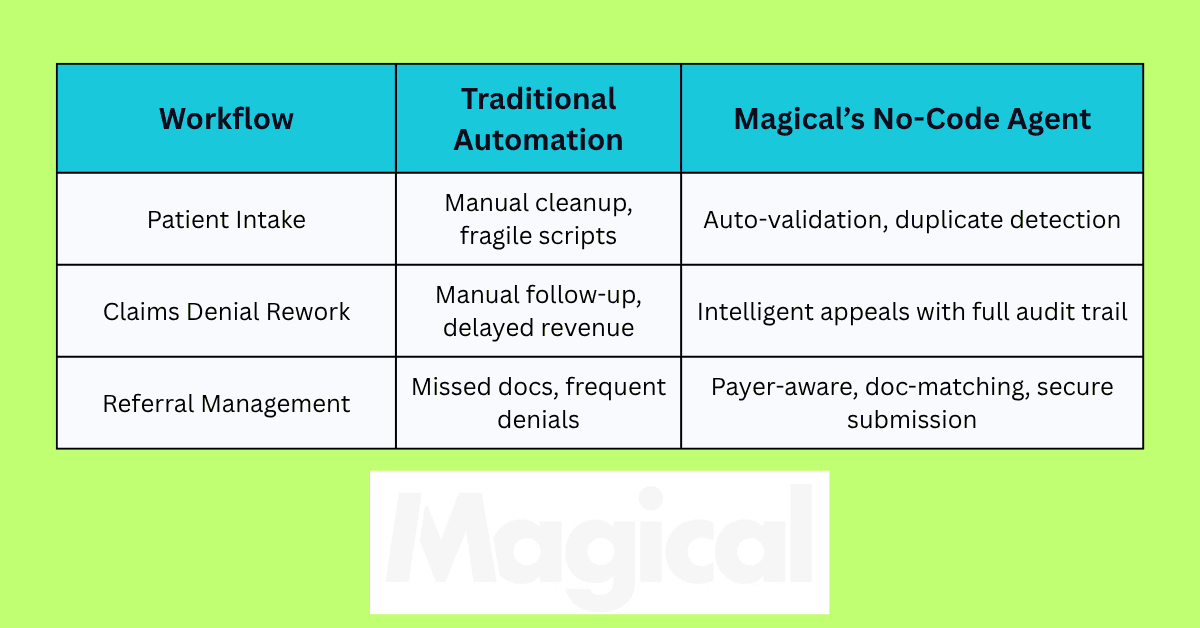
These aren’t future use cases. They’re running right now inside healthcare orgs that chose to stop patching broken workflows and start owning them.
Common Misconceptions That Hold Teams Back
Let’s be honest, most admin teams aren’t resisting automation because they don’t want it.
They’re resisting it because they’ve been burned before.
By brittle bots that broke.
By IT-led “solutions” no one could actually use.
By compliance teams that made “fast” and “secure” feel mutually exclusive.
So it’s time to clear up the most common myths still keeping teams stuck in outdated workflows.
Myth #1: “If it’s no-code, it’s too simple to handle real work.”
Truth: No-code isn’t a toy.
With AI agents powered by LLMs and built-in logic, platforms like Magical can handle:
Multi-step workflows
Conditional branching
Dynamic data handling
Cross-platform integrations
You don’t need to write code to do real work. You just need a platform that understands it.
Myth #2: “HIPAA compliance means IT has to run everything.”
Truth: Not anymore. With Magical, HIPAA compliance isn’t bolted on. It’s baked in:
All agent actions are logged and traceable
All data is encrypted end-to-end
Role-based access controls keep PHI protected
You can sign a BAA with Magical from day one
You stay compliant without needing to go through IT for every workflow change.
Myth #3: “Automation is risky; if something breaks, we’re liable.”
Truth: Traditional automation is risky.
Because it breaks easily.
Because it runs silently.
Because it leaves you guessing what went wrong.
Agentic automation built on a HIPAA-compliant platform like Magical:
Operates within defined guardrails
Surfaces exceptions and risks in real time
Keeps a full audit trail of every action
Gives you control without the chaos
If something changes in your system, your agent adapts or asks for help. That’s the opposite of risky.
Myth #4: “We’re too small to need this kind of solution.”
Truth: You’re too small not to. When you’re lean, every hour counts.
Every FTE matters.
Every delay compounds.
That’s why clinics, specialty groups, and non-hospital systems are some of the biggest winners with Magical. They automate exactly what they need, nothing more, nothing less, and get results fast.
If these myths sound familiar, you’re not alone.
But now you know better and you’ve got better tools to work with.
What to Look for in a No-Code, HIPAA-Compliant Platform
Let’s say you’re ready to stop duct-taping workflows together. You want to empower your team, keep PHI secure, and actually move faster, not just talk about it.
Good news: platforms like that exist.
Bad news: not all “no-code automation” tools are created equal. And “HIPAA-compliant” often means… “we put it in the footer.”
Here’s how to separate the signal from the noise.
Must-Have #1: Audit-Ready Logging
If you’re automating workflows that touch patient data, you need a full breadcrumb trail:
What happened
When it happened
Who triggered it
What data was touched
Look for a platform that keeps real-time logs of all agent actions and lets you export them if needed during audits or internal reviews.
Magical gives you full transparency, without making you dig for it.
Must-Have #2: Role-Based Access Control
Not everyone on your team should have the same level of access to PHI, agent configurations, or data.
A good platform will:
Let you define access by role or permission level
Control who can view, create, and run agents
Prevent unauthorized use or data exposure by design
Magical supports granular control so your workflows stay tight, no matter how big your team grows.
Must-Have #3: Built-In HIPAA and Security Standards
If a platform claims HIPAA compliance, they should offer:
End-to-end encryption (in transit + at rest)
Secure infrastructure (SOC 2, HITRUST, or equivalent)
Signed BAA
Clear documentation of how PHI is handled
Magical meets all of these and provides SOC 2 certification, along with healthcare-specific security protocols.
Must-Have #4: Natural Language Agent Training
No-code shouldn’t mean hunting through dropdowns for hours.
The best platforms allow natural language workflows, meaning you tell the agent what to do, and it builds the logic for you. This lowers the barrier to entry and helps teams iterate fast.
With Magical, you can create AI agents using simple instructions, just like talking to a team member.
Must-Have #5: Proven Results in Healthcare
Your workflows aren’t the same as a SaaS sales team’s.
Look for a platform already being used by real healthcare ops teams (handling scheduling, referrals, claims, and patient data).
Magical is trusted by 100,000+ companies and nearly 1 million users, including teams at ZoomCare, WebPT, and TCPA, who are saving 7 hours per user, per week.
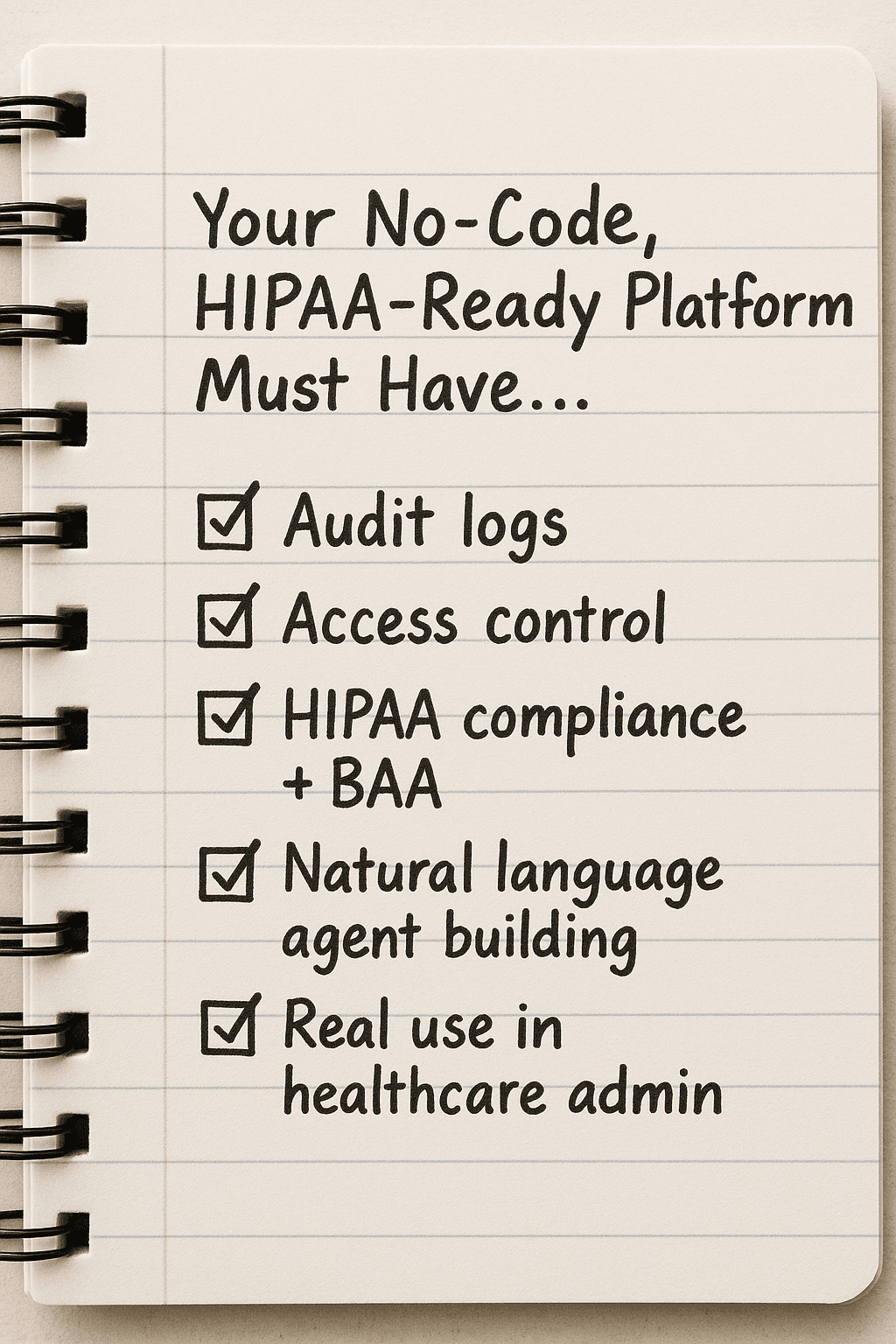
If your automation platform can’t check these boxes, it’s not ready for healthcare.
Magical is.
Final Thoughts: Start Automating Safely. With the Platform Built for Admin Teams
Here’s the truth: Healthcare admin teams aren’t waiting for innovation.
They are the innovation.
You’re the one who sees where workflows break.
You’re the one copy-pasting across five systems.
You’re the one working late because the automation “kind of” worked, but still needed a human to finish the job.
It’s time you had automation that’s built for your world.
Magical makes that possible.
No code
No IT tickets
No compliance gray areas
Just fast, flexible, HIPAA-compliant automation you control
With Magical, you can:
Automate protected workflows without touching code
Trust that your agents operate securely, with full audit trails
Deploy across teams, without sacrificing control or exposing PHI
Save real time: 7 hours per week, per user, on average
Join 100,000+ companies and nearly 1 million users already using Magical to work smarter
Try Magical Free or Book a Demo
Install the free Magical Chrome extension to get started in minutes
Book a personalized demo to explore HIPAA-compliant automation built for your workflows
Compliance isn’t the barrier.
It’s the reason to start now.
Automate boldly. Operate safely. Own your workflows.