
A new Medicare rule drops.
Another coding update.
A policy revision buried in a 200-page CMS release.
By the time the information reaches the front desk or the billing team, staff are already scrambling to make sense of it.
In most clinics, compliance means printing PDFs, attending last-minute trainings, and hoping no one misses a step.
It’s a constant race against change, with penalties waiting at the finish line.
Yet in 2025, when automation can flag errors in real time and apply new rules instantly, why are teams still managing Medicare compliance by hand?
What Medicare Compliance Really Demands
Medicare compliance isn’t just about filling out forms correctly. It’s a constant balancing act between evolving regulations, accurate documentation, and timely billing.
For healthcare teams, it means maintaining precision across thousands of patient encounters while rules change beneath their feet.
The Growing Complexity of Medicare Rules
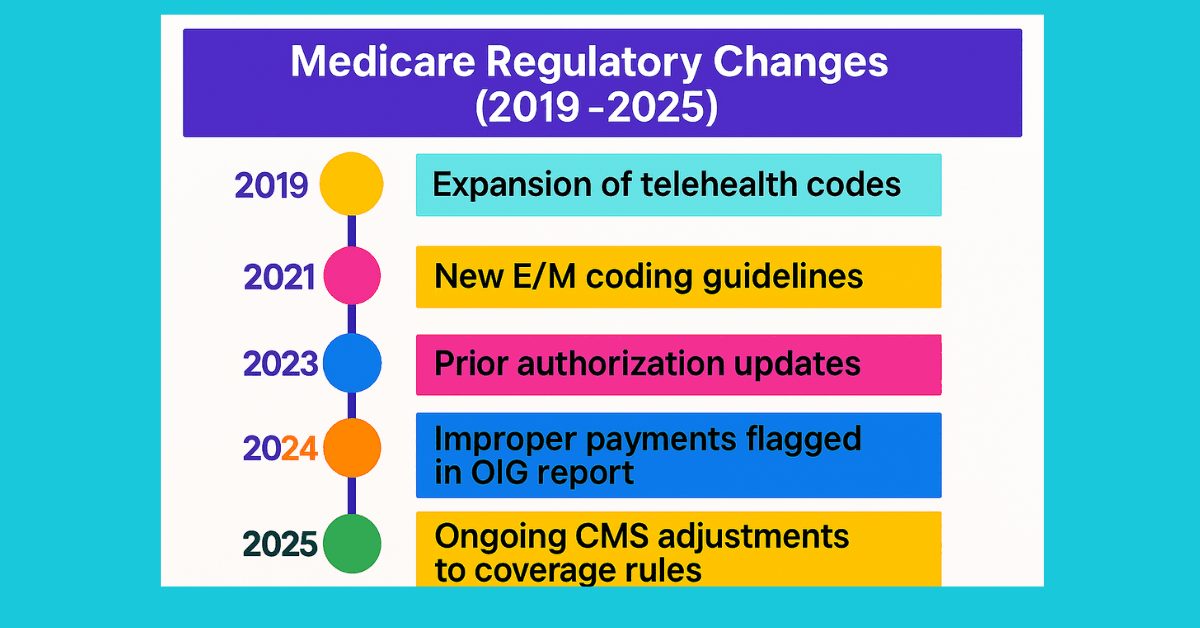
Each year brings updates to coverage, coding, and documentation requirements.
Telehealth regulations shift.
Prior authorization rules expand. ICD-10 and CPT codes get revised.
Even small adjustments create ripple effects across entire workflows.
According to CMS, improper Medicare payments accounted for billions of dollars in 2024, much of it tied to administrative and compliance errors.
Teams aren’t ignoring compliance. They’re overwhelmed by the speed of change.
Where Manual Compliance Breaks Down
Relying on staff to manually track updates is inefficient and risky.
Rules are interpreted differently by different people.
Documentation gaps slip through unnoticed.
Training lags behind new requirements.
The result: claims get denied, audits get triggered, and staff spend more time chasing compliance than focusing on patients.
Medicare Regulatory Changes (2019–2025)
The Cost of Non-Compliance in Medicare Workflows
Non-compliance isn’t just a paperwork problem. It’s a financial, operational, and reputational risk that can shake the foundation of a healthcare organization.
Even small mistakes (eg, an incomplete form, a misapplied code) can spiral into costly consequences.
Financial Penalties and Denials
Medicare billing errors are expensive. Improper payments lead to clawbacks, fines, and denied claims that slow down cash flow.
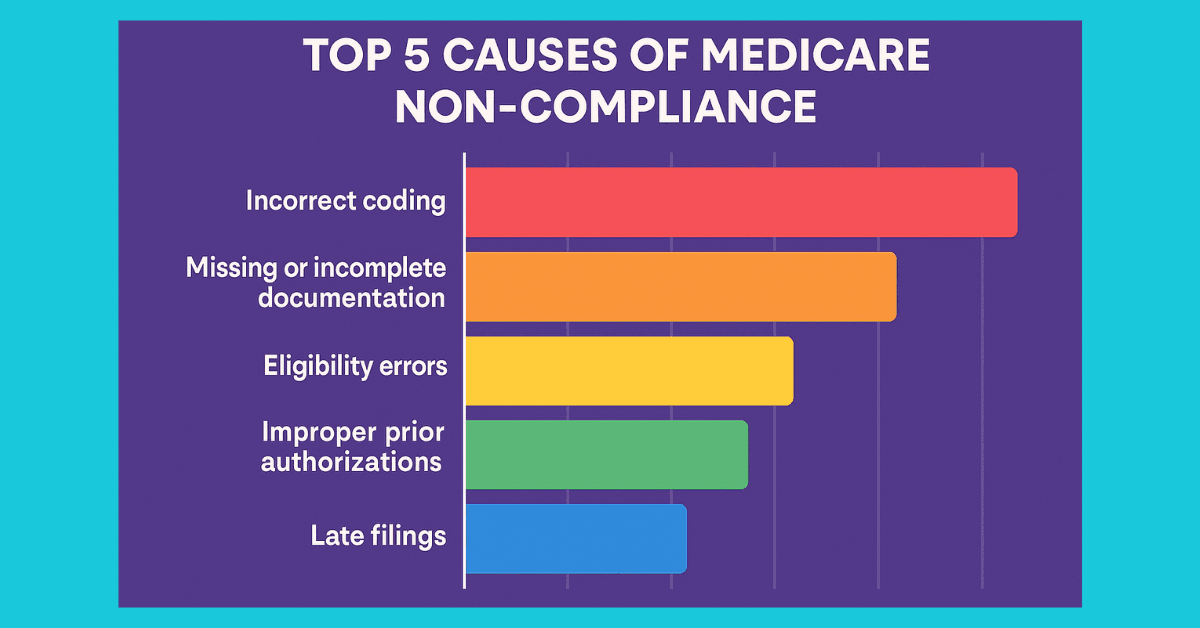
According to the Office of Inspector General (OIG), billions of dollars in improper Medicare payments were reported in 2024, much of it tied to documentation and coding issues.
Audit Stress and Resource Drain
When an audit notification arrives, staff spend weeks digging through records to prove compliance. Hours that should go to patient care and billing workflows are consumed by audit prep. The opportunity cost is enormous.
Reputation and Trust
Repeated compliance issues don’t just harm finances. They erode trust with payers and regulators. Once a provider is flagged, the likelihood of ongoing scrutiny increases.
How Medicare Compliance Automation Works
Automation doesn’t replace compliance teams. It empowers them.
Instead of relying on manual reviews and outdated training binders, automation applies Medicare’s latest rules instantly across workflows. Errors are flagged before claims go out, keeping compliance proactive instead of reactive.
Real-Time Rule Application
Automation tools embed CMS requirements directly into billing and documentation workflows. Updates that used to take weeks to train on can be applied in seconds.
Staff no longer have to interpret long policy documents. The system does it for them.
Error Detection and Prevention
Compliance automation continuously scans for gaps. Missing documentation, mismatched codes, or eligibility oversights are flagged in real time. Instead of fixing problems after a denial, teams prevent them at the source.
Scalability Across Teams
One compliance update can be rolled out across hundreds of providers instantly.
No extra trainings.
No inconsistent interpretations.
Everyone works with the same rules at the same time.
At WebPT, this approach translated into more than 500 hours saved across thousands of clinics. By automating repetitive checks, their teams reduced errors without disrupting workflows.
Automation in Action: Healthcare Teams Meeting Medicare Compliance
The clearest way to understand the impact of compliance automation is to look at how healthcare organizations are already using it.
By removing duplication, automating checks, and reducing manual documentation, these teams have turned compliance from a constant headache into a background process.
ZoomCare: Keeping Patient Data Clean and Accurate
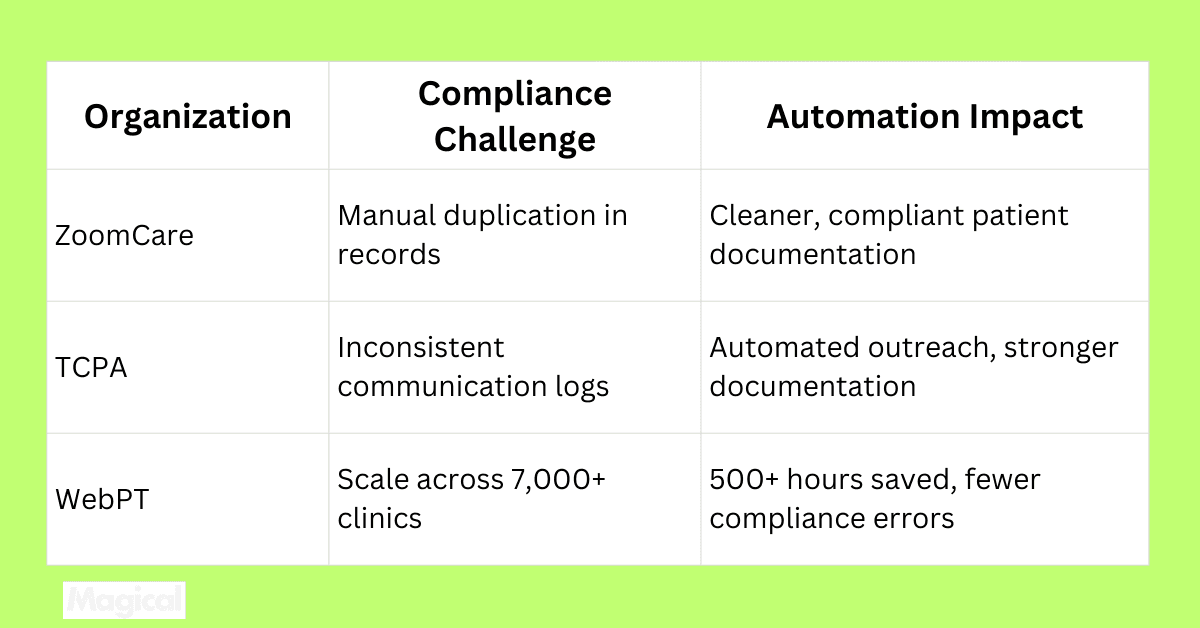
For ZoomCare, speed and convenience are central to the patient experience. But their front desk teams were slowed by manual duplication, creating compliance risks in patient records.
With automation, data moved seamlessly between systems, reducing errors and keeping records audit-ready from the start.
Read the full ZoomCare case study.
TCPA: Streamlining Communication with Patients
Medicare requires strict documentation of patient communications. TCPA used automation to reduce the chance of missing or inconsistent outreach.
Automated workflows ensured that every patient interaction was logged, strengthening compliance while also improving scheduling efficiency.
WebPT: Scaling Compliance Across 7,000+ Clinics
At scale, manual compliance checks become impossible to manage. WebPT integrated automation to eliminate repetitive data entry and reduce errors across thousands of clinics.
The result: 500+ hours saved and stronger compliance processes without slowing operations.
Choosing the Right Medicare Compliance Automation Software
The wrong automation tool can create more problems than it solves. For healthcare teams, the right fit must blend security, accuracy, and ease of use, while keeping up with Medicare’s constant changes.
Key Features to Look For
HIPAA + CMS compliance support: Must align with both privacy and billing regulations.
Automatic updates: Medicare rules evolve constantly; tools should update instantly.
Cross-platform compatibility: Works across EHR, billing, and claims systems without custom integrations.
Ease of adoption: Staff should be able to use it without heavy IT involvement or long training cycles.
Questions Compliance Teams Should Ask
Can this system catch compliance errors before claims go out?
Does it update in real time with Medicare rule changes?
Will it scale across multiple sites, specialties, and providers?
How much staff time does it realistically save per claim cycle?
Choosing a tool with these qualities doesn’t just lower compliance risk. It transforms compliance from a reactive burden into a proactive safeguard.
From Reactive Compliance to Proactive Confidence
Most compliance strategies are reactive. Teams wait for a denial, an audit notice, or a policy update before taking action.
By then, it’s already too late. The damage is done in lost revenue, wasted hours, and regulatory risk.
Automation flips that model.
Instead of chasing errors, staff prevent them. Instead of scrambling to prepare for audits, they’re already audit-ready. Instead of guessing at the latest Medicare changes, the system applies them instantly.
For healthcare teams, this shift creates confidence. Compliance stops being a source of daily stress and becomes a quiet safety net running in the background, catching issues before they ever surface.
Final Thoughts: Ready to Automate Medicare Compliance?
Medicare compliance will always be complex, but it doesn’t have to overwhelm your team. With automation, updates apply instantly, documentation stays accurate, and claims leave the door cleaner than ever.
Instead of losing hours to manual reviews and last-minute trainings, your staff can focus on patients while compliance runs silently in the background.
Download the free Magical Chrome extension or book a demo for your team today! Magical is used at 100,000+ companies and by nearly 1,000,000 users to save 7 hours a week on average.