
Every claim delay is a ticking revenue time bomb.
Not just for your bottom line, but for your staff, your patients, and your ability to keep care moving.
Still, across thousands of healthcare orgs, claims processing is trapped in outdated systems and bloated workflows.
Manual handoffs.
Clunky portals.
Human error.
The same claim ping-pongs between staff, software, and payers, draining hours and dollars in the name of “process.”
Here’s the part no one wants to admit: denial management isn’t the problem.
It’s the symptom.
The real problem? Your workflows are built for admin survival, not financial outcomes.
Enter intelligent agents. AI-powered teammates that work faster than any RCM specialist, never make the same mistake twice, and don’t need a login or a lunch break.
They’re not here to “streamline” a broken process.
They’re here to rebuild it from the ground up.
Claims don’t have to be a bottleneck. With intelligent agents, they become a competitive advantage.
Let’s get into it.
What Are Intelligent Agents?
Forget everything you think you know about automation. Intelligent agents aren’t scripts.
They’re not macros.
And they’re definitely not static bots that break the moment something changes in a workflow.
Intelligent agents are autonomous, goal-driven AI systems designed to perceive context, make decisions, and act, without needing a human to micromanage every step.
They don’t just follow rules; they adapt, learn, and optimize outcomes in real time.
Think of them like digital coworkers with superpowers. Trained on large language models (LLMs), intelligent agents can:
Pull and validate data across disconnected systems
Understand and resolve complex claim logic
Communicate with other systems, tools, or agents autonomously
Identify and solve workflow bottlenecks before they escalate
Unlike traditional robotic process automation (RPA), which depends on brittle, rule-based scripts, intelligent agents can respond to dynamic environments. That means less time managing your tech and more time watching it work.
And in healthcare claims processing, that difference is everything.
Claims processing touches every part of your revenue cycle. One error, one missed field, or one outdated portal connection can delay payments for weeks.
With intelligent agents handling the heavy lifting, organizations can significantly reduce errors, speed up reimbursements, and slash denial rates.
This isn't theoretical. Organizations already deploying intelligent agents are seeing tangible results:
According to a recent CAQH Index report, automating medical claim submissions alone can save the U.S. healthcare system $20.6 billion annually.
Intelligent automation has been shown to improve claim accuracy rates by up to 85%, according to RevCycle Intelligence.
In short, intelligent agents don’t just automate tasks.
They transform operations.
The Bottlenecks in Traditional Claims Processing
Claims processing wasn’t designed for speed. It was built for compliance, control, and insurance company convenience.
That’s why it’s one of the slowest, most error-prone parts of healthcare operations, especially when it's still handled manually.
Let’s break down what that looks like on the ground.
Here’s The Traditional Claims Process:
Patient intake → front desk staff gather insurance info (often incomplete or inaccurate).
Eligibility verification → staff log into payer portals or clearinghouses to confirm coverage.
Coding and documentation → clinical data is translated into CPT/ICD-10 codes, often manually.
Claim submission → billing teams format and send claims through clearinghouses.
Adjudication → payers review and approve, deny, or flag for more info.
Follow-ups and appeals → staff chase down denials, correct errors, resubmit.
That’s a multi-system, multi-touchpoint process filled with friction. And the results speak for themselves.
The Toll of Manual Claims Processing:
~10% of claims are denied upon first submission, according to Change Healthcare.
Of those denials, up to 65% are never reworked or resubmitted (Becker’s Hospital Review).
Reworking a denied claim can cost $25–$118 per claim, based on data from MGMA.
And that’s just the financial cost. There’s also:
Lost staff productivity as teams toggle between systems
Delayed reimbursements are impacting cash flow
Compliance risk from manual data errors or missed deadlines
Burnout from repetitive, high-stress tasks with low strategic value
Manual Claims Processing Bottleneck Map
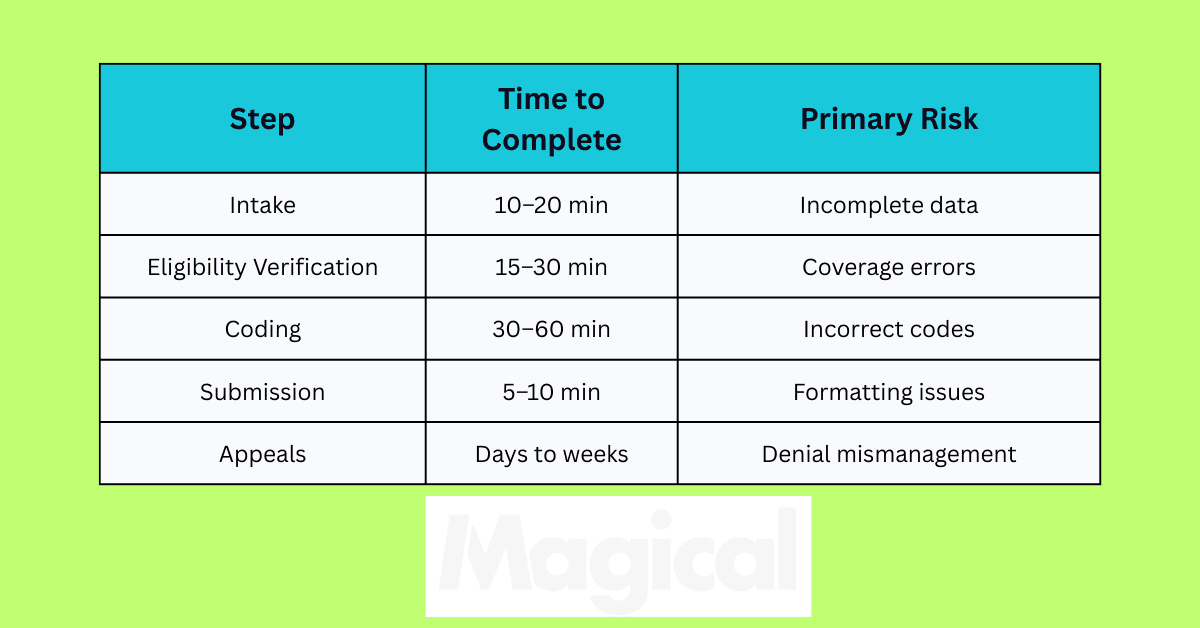
When even one of these steps breaks, the entire workflow suffers.
That’s why more healthcare teams are turning to AI-powered intelligent agents, not to speed up a broken process, but to reimagine it entirely.
How Intelligent Agents Improve Claims Processing
AI doesn’t belong in a silo. And when it comes to claims, neither should your workflows.
Intelligent agents are most powerful when they move freely across your systems. They are automating tasks, making decisions, and solving problems without needing a human to press “go.”
In claims, that means handling everything from verifying eligibility to resolving denials faster and with fewer mistakes.
Let’s break down exactly where the lift happens.
End-to-End Workflow Automation
Traditional tools automate single steps. Intelligent agents automate outcomes.
They don’t just extract data. They understand what it means, where it needs to go, and what to do if something looks off. In the context of claims:
They collect patient information at intake and instantly verify coverage.
They auto-fill billing fields across disconnected systems (EHR, PMS, payer portals).
They file the claim, confirm successful transmission, and log everything, without human intervention.
According to CAQH, automating claims management across systems could save up to $20.6 billion annually in the U.S. healthcare system alone.
Real-Time Decision-Making
Intelligent agents do more than follow scripts. They apply logic, learn from patterns, and take action in real time.
Example:
If a patient is missing a referral or pre-auth, the agent flags it before the claim is submitted.
If coding inconsistencies are detected, the agent alerts a human or applies corrections based on historical approvals.
If a certain payer rejects a specific CPT code repeatedly, the agent adapts its future submissions.
The result is first-pass claim acceptance rates increase significantly, reducing both denials and rework.
Integrations Without IT Drama
No-code/low-code platforms like Magical allow intelligent agents to work within your current stack. That means:
No long dev cycles
No custom integrations
No ripping out your EHR or billing systems
Agents connect to what you already use, whether that’s a clearinghouse, a legacy EMR, or a secure payer API and start delivering value in days, not quarters.
Compared to heavy-lift tools like UiPath or Kore.ai, Magical delivers healthcare-specific automation with a much faster time-to-outcome.
They Learn as They Work
The more agents run, the smarter they get.
That’s because intelligent agents (unlike static bots) are powered by LLMs and trained on outcomes. They learn from:
Payer response patterns
Claim acceptance rates
Historical error trends
Instead of repeating past mistakes, they correct course. And unlike traditional automation, they don’t break every time a payer portal changes its layout.
Case Study: ZoomCare
ZoomCare leveraged Magical’s intelligent agents to overhaul its backend billing process. Instead of routing every claim through manual reviews, they trained agents to handle submission, validation, and routing. This resulted in faster reimbursement, fewer errors, and a significant drop in rejected claims.
Visibility Without the Noise
With intelligent agents, you’re not guessing what’s happening in your claims funnel. You’re watching it in real time.
Every action (whether it’s data entry, submission, or escalation) is tracked, logged, and auditable. That means:
Better compliance
Easier audits
Real-time analytics to catch patterns before they turn into problems
This kind of visibility isn’t just helpful. It’s revenue-protecting.
5 Business Outcomes That Matter
Automation isn’t about saving seconds. It’s about reclaiming millions of dollars, thousands of staff hours, and months of organizational drag.
Here’s what intelligent agents unlock when deployed across your claims workflow:
1. Fewer Denials = More Revenue Collected
The biggest ROI driver? Denial prevention.
AI-powered claims processing reduces the chance of human error, catches missing data before submission, and adapts to payer-specific logic. That translates into higher first-pass claim acceptance.
According to Change Healthcare, denial rates are trending up, with 1 in 10 claims denied on first submission.
Even a 10% reduction in denials can lead to hundreds of thousands in recovered revenue annually for mid-sized healthcare orgs.
2. Faster Reimbursement Cycles
AI agents don’t wait. They validate, code, submit, and confirm faster than any manual process, shrinking your days in A/R and accelerating revenue recognition.
Automating the claim submission and status process can cut processing time from weeks to days.
3. Reduced Administrative Overhead
You don’t need more hands. You need fewer handoffs.
Intelligent agents eliminate the need for:
Manual portal logins
Redundant data entry
Endless email follow-ups
Status check calls to payers
This unlocks capacity across billing, coding, and rev cycle teams, without hiring or retraining. You also reduce burnout and turnover, which are sky-high in healthcare admin roles.
4. Happier Patients, Fewer Surprises
When eligibility is verified, pre-auths are secured, and claims go through cleanly, the patient notices. They’re not stuck with unexpected bills or delays in care.
And happy patients don’t just come back, they refer.
According to McKinsey, patient satisfaction directly correlates with operational efficiency, particularly around billing and insurance interactions.
5. Actionable Insights, Not Just Automation
Every claim your agents touch becomes a data point.
Over time, you’ll get insights like:
Most common denial reasons (by payer or procedure)
Where workflows break down most often
Which payers are outliers in rejection behavior
These aren’t reports you have to dig for. They’re surfaced automatically so you can fix problems upstream, not after the fact.
Visual Suggestion: Bar graph showing key before/after KPIs:
Denial rate: ↓ 25%
Days in A/R: ↓ 30%
Staff hours per claim: ↓ 60%
First-pass resolution rate: ↑ 40%
Intelligent agents don’t just improve your claims process. They improve your entire business.
Common Myths About AI in Claims Processing
AI has officially crossed the hype threshold, but that doesn’t mean everyone trusts it. In healthcare especially, skepticism is earned.
Let’s break down a few of the biggest misconceptions that keep teams stuck in manual mode.
Myth #1: “AI will replace my staff.”
Nope. Intelligent agents aren’t here to replace humans.
They’re here to take the repeatable, soul-sucking work off their plates so your team can focus on what actually requires critical thinking.
AI doesn’t log in at 8 a.m. and call payers. It doesn’t follow up on denied claims or clean up billing messes.
Your staff still leads the strategy. AI just handles the heavy lifting behind the scenes.
Organizations that automate claim workflows report higher staff retention, according to AHIMA, not layoffs.
Myth #2: “AI is risky with PHI.”
If you're using the wrong tools, yes. But intelligent automation platforms like Magical are built from the ground up with healthcare-grade security:
End-to-end encryption
Role-based access
Complete audit logs
AI agents also reduce compliance risk by minimizing human error and ensuring consistent documentation.
No sticky notes.
No workarounds. No screenshots on someone’s desktop.
Learn more about HIPAA and AI security best practices from HHS.gov.
Myth #3: “AI is too complicated to implement.”
Old-school RPA? Yes.
Modern intelligent agents? Absolutely not.
Platforms like Magical are designed for non-technical teams. That means:
No-code setup
Minimal training required
Works with the systems you already use (EHRs, PMS, clearinghouses, etc.)
Your team doesn’t need to write a line of code or manage an “AI transformation.” You just pick the workflow, and the agent handles the rest.
Case in point: WebPT implemented Magical agents to streamline credentialing and eligibility workflows—without disrupting their day-to-day operations.
Why Magical Is Different
The healthcare automation space is crowded. But most tools are either too rigid, too complex, or too generic to handle the realities of claims processing in the real world.
Magical was built differently (from the ground up) for teams that care about outcomes, not just outputs.
Here’s what sets Magical apart:
Built for Outcome-Driven Automation
While competitors like UiPath, Zapier, or Kore.ai focus on task automation or static workflows, Magical is built to own the outcome. That means:
Full claims processed, not just data copied
Denials prevented, not just logged
Staff hours recovered, not just reduced
Magical’s intelligent agents aren’t reactive scripts. They’re proactive digital coworkers that understand, decide, and act across complex workflows.
Designed for Healthcare Complexity
Magical isn’t a generic platform slapped onto healthcare use cases. It’s engineered to work with:
Fragmented EHR systems
Clearinghouses with inconsistent APIs
Payer-specific rules and documentation logic
HIPAA and enterprise-grade security standards
This means less time forcing systems to talk to each other, and more time seeing claims move through cleanly, from intake to adjudication.
Case Study: WebPT
By automating complex credentialing and documentation workflows with Magical, WebPT accelerated approvals and eliminated redundant admin work that previously caused claim delays.
No-Code, No Headaches
You don’t need an IT army to deploy Magical.
Unlike traditional RPA platforms, Magical is:
No-code
Fast to implement
Easy to maintain without developer support
This means billing, rev cycle, and operations teams can take the lead, without waiting months for a system overhaul.
Fast Time-to-Value
Forget six-month implementation timelines.
Magical’s agents can go live in days, not quarters.
That means faster ROI, quicker team adoption, and a shorter path to fewer denials, cleaner claims, and faster payments.
Proven Results in Healthcare
Let’s recap a few real-world outcomes:
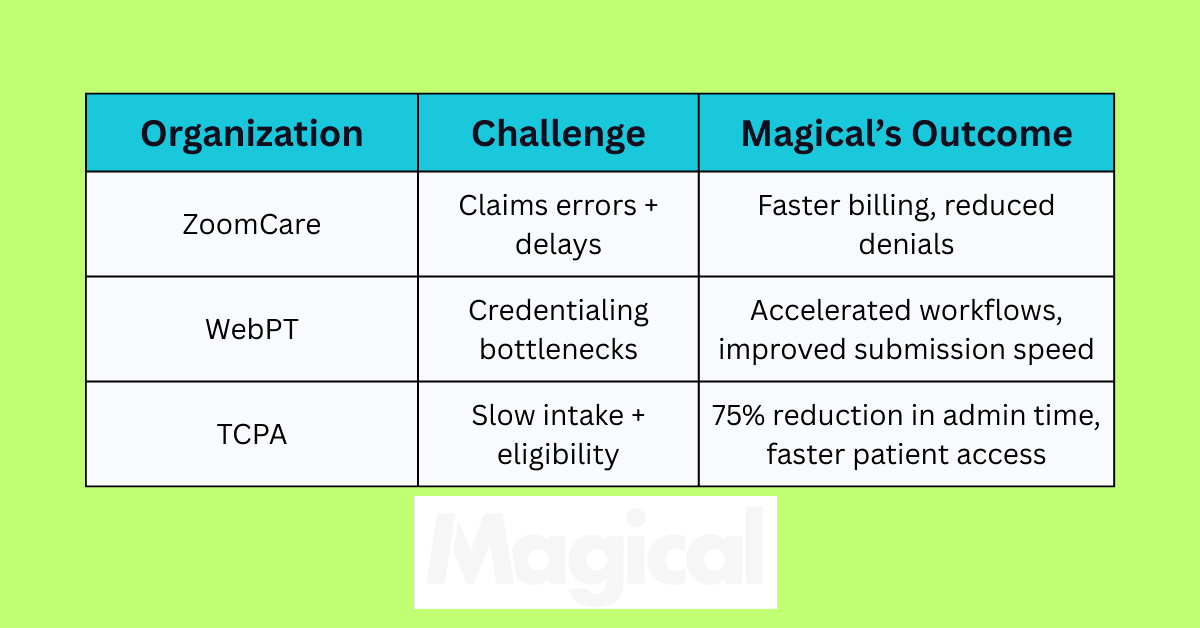
These aren’t pilots or experiments. They’re working, proven use cases with measurable business outcomes.
Getting Started with AI Agents for Claims
Start small. But start now.
If your team is still logging into payer portals, double-checking eligibility by hand, or resubmitting denied claims every week, you already know where the friction lives.
Start with one workflow.
Pick your most time-consuming, denial-prone task.
Maybe it’s eligibility verification.
Maybe it’s claims submission. That one workflow is your wedge.
Then plug in an intelligent agent.
With Magical, setup doesn’t require engineers, custom APIs, or a six-month strategy deck. You can go live in days, watch it run, and scale from there.
Final Thoughts
Healthcare claims processing shouldn’t be a black hole for time, revenue, and staff morale. But when it's buried under portals, paperwork, and patchwork fixes, that’s exactly what it becomes.
Intelligent agents aren’t a nice-to-have. They’re your unfair advantage.
They don’t just automate tasks. They prevent denials, speed up payments, and give your team back hours every week to focus on care, not chaos.
You can stay stuck chasing claims.
Or you can deploy automation that actually learns, adapts, and delivers results from day one.
Try it for yourself:
Download the free Magical Chrome Extension — used by nearly 1,000,000 users to save an average of 7 hours per week.
Or book a demo for your team and see how Magical is already helping over 100,000 companies automate high-friction workflows without the tech headaches.
Because the future of claims processing isn’t coming.
It’s already here, and it’s intelligent.