
Every day in AR is money you’ve earned but can’t use.
It’s sitting in a payer’s account, or in a patient’s mailbox, or buried in a worklist waiting for someone to notice it’s there.
The ugly truth? Most of that waiting is avoidable.
Claims get stuck because eligibility wasn’t verified.
Because a prior auth sat in a fax queue.
Because a rejection email was missed.
Because someone’s “to-do” list was 300 lines long and the oldest claims fell off the bottom.
You don’t need more spreadsheets, more daily huddles, or more “AR blitz days” to fix this.
You need to stop claims from getting stuck in the first place and to pounce on the ones that do, before they age into oblivion.
That’s where AI agents come in.
They don’t sleep, don’t lose track of claims, and never wait a week to check a payer portal.
They watch every claim from the moment it’s born until it’s at zero-balance, intercepting the slowdowns and closing the gaps that stretch AR from 30 days to 90.
Why Days in AR Matters Now
Days in AR (DAR) isn’t just another metric on a revenue cycle dashboard.
It’s a daily measure of how fast your organization can turn care into cash and whether your operating margin can breathe or is gasping for air.
Cashflow Pressure Is At A Breaking Point
Industry benchmarks show median net DAR in US healthcare climbed from 40 days in 2022 to 53+ days by late 2024, with some specialties creeping past 70.
For hospitals and practices running on single-digit margins, every extra day is a hit to liquidity; money that could fund payroll, equipment, or expansion stuck in limbo.
The Compounding Effect of Delays
Payroll & vendor strain — More days in AR means juggling cash to cover expenses.
Higher administrative costs — Every day a claim sits unworked, it costs staff time to chase it.
Lost revenue — Denials and patient balances that age out past recovery windows.
Why This Is Urgent In 2025
Payers are tightening payment timelines on their sid, but not yours.
Staffing shortages are forcing smaller RCM teams to handle larger volumes.
Policy complexity, especially around prior auth and documentation, is making clean claims harder to achieve.
Every day in AR costs you cash, staff hours, and momentum.
Reducing it isn’t about working harder. It’s about building a system where claims keep moving without waiting for a human to nudge them forward.
Definitions & Formulas: Build a Common Language
You can’t fix Days in AR without measuring it the same way across your organization. Different teams often track “AR” differently, which leads to confusion when leadership asks why the numbers don’t match.
Here’s the shared language every revenue cycle leader should use:
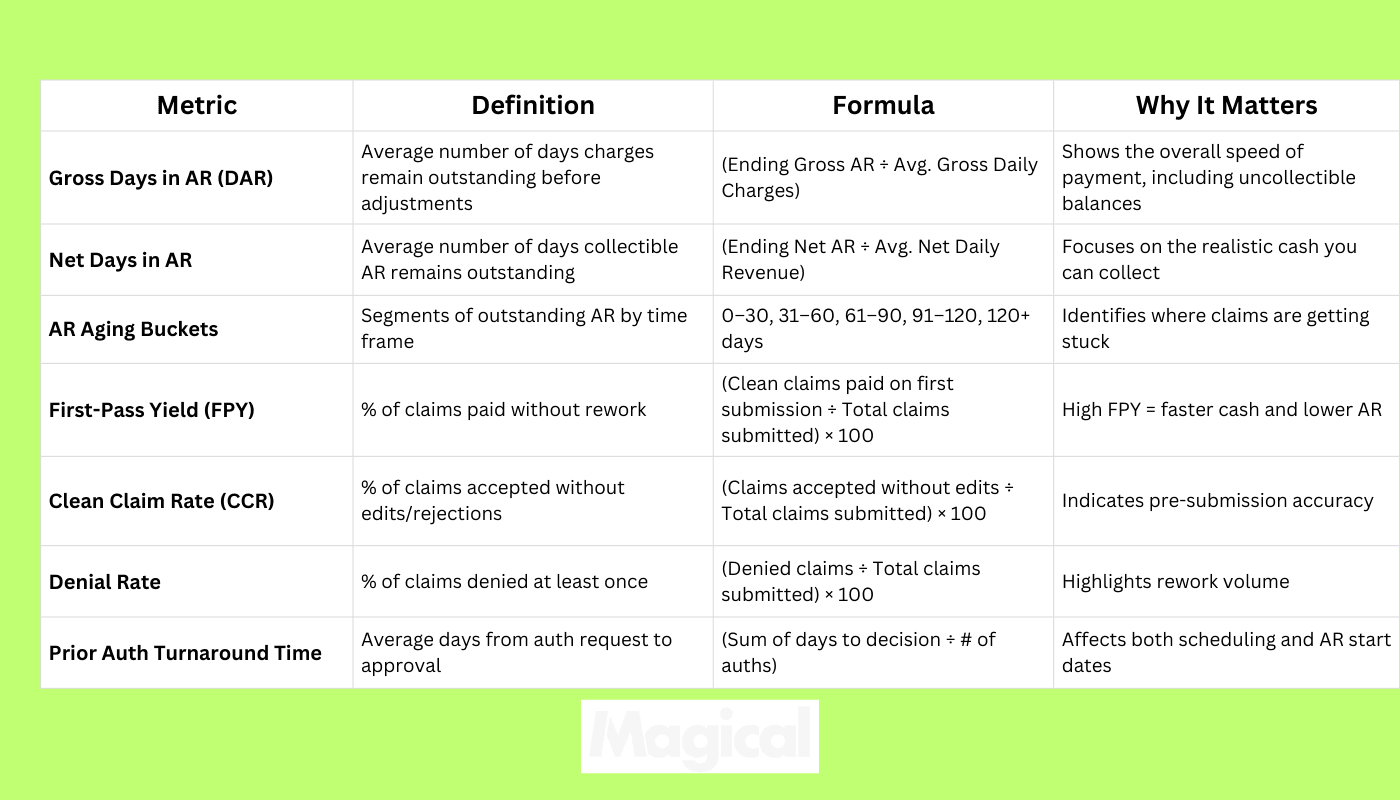
Magical Tip: Track both DAR and FPY together. A short DAR with a low FPY can mean you’re just moving bad claims faster, not actually fixing the system.
Where AR Days Accumulate: A Root-Cause Map
Days in AR rarely balloon because of one big delay.
It’s the stacking of small, avoidable slowdowns across the revenue cycle, each adding hours or days that compound into weeks.
Front-End (Before the Visit)
Eligibility gaps — Inactive coverage, wrong plan codes, missed secondary insurance
Prior auth misses — Request never filed, wrong CPT/DX pairing, expired approval
Scheduling errors — Incorrect service location, provider mismatch, wrong NPI
Incomplete intake data — Typos in demographics, missing subscriber info
Impact: Preventable denials that send clean claims straight into AR aging buckets.
Mid-Cycle (From Visit to Submission)
Slow documentation — Charts left open, dictations not completed
Coding errors — Missing modifiers, incorrect laterality, undercoding
Packet assembly delays — Missing op notes, lab results, or imaging for claim support
Missed CCI/MUE edits — Errors caught only after payer submission
Impact: Delays submission and pushes AR start dates later.
Back-End (After Submission)
Clearinghouse rejects — Formatting errors, missing data fields
Portal status lag — Waiting days between payer status checks
Unworked denials — Items sit in queues until appeal windows close
Late appeals — Documentation gathering takes too long
Underpayment blind spots — Contractual short pays unnoticed for weeks
Impact: Claims that should be worked in hours take weeks, inflating AR.
Structural Barriers
Paper checks & manual posting — Adds days to cash application
Fax-heavy workflows — Slows document retrieval and submission
Fragmented worklists — Tasks spread across multiple systems, no single source of truth
If you mapped every AR delay in your organization, most would be repetitive, rules-based, and ideal for AI agents to handle instantly.
The AI Workforce (Agentic AI) Model for AR Reduction
Reducing Days in AR isn’t about pushing staff harder. It’s about eliminating the reasons claims stall in the first place.
An AI workforce does this by watching every claim from creation to payment, acting instantly when delays appear.
Why Traditional Tools Fall Short
Rules engines only flag issues; a human still has to fix them.
RPA bots crumble when a portal layout changes or a workflow has exceptions.
Point solutions only address one piece of the process, leaving gaps between systems.
What AI Agents Do Differently
Read unstructured data — Faxes, PDFs, scanned ID cards, operative notes.
Reason over payer rules — Match CPT/DX codes to current policies, catch mismatches early.
Act across systems — EHRs, clearinghouses, payer portals, document repositories.
Orchestrate end-to-end — From eligibility to appeal submission, without handoffs.
Learn from outcomes — Improve over time as they process more claims and denial patterns.
Governance Built In
Operate in HIPAA-compliant environments with BAAs, encryption, and role-based access.
Maintain immutable logs of every action for compliance and audit defense.
Route exceptions to humans for review before submission or appeal.
AI agents don’t just speed up bad processes. They prevent delays entirely, ensuring claims keep moving toward payment without falling into AR quicksand.
Front-End Fixes that Shrink DAR
Most AR problems are born before the visit ever happens. Fix them here, and you stop payment delays before they start.
Eligibility & Benefits Verification (Pre-Visit)
Run real-time eligibility checks at scheduling, not just the night before.
Detect secondary coverage and coordinate benefits proactively.
Flag benefit caps and plan mismatches before the patient arrives.
Impact: Eliminates inactive plan denials that can age claims past 30 days.
Prior Authorization Pre-Checks
Match orders to payer policy requirements the moment they’re created.
Assemble prior auth packets automatically from clinical notes, labs, and imaging.
Submit to payer portals and track status without human delay.
Impact: Prevents the #1 growing denial category and keeps scheduling on track.
Digital Intake Accuracy
Extract ID and insurance card data with OCR/NLP, auto-validate against payer records.
Standardize address and demographic formats to avoid rejections.
Cross-check subscriber/dependent information for accuracy.
Case Study:
ZoomCare: Automated intake and eligibility checks reduced front-end errors, enabling earlier and cleaner claim submission.
TCPA healthcare client: Prior auth acceleration reduced reschedules and pushed claims into AR days sooner.
When AI agents guard the front end, the clean-claim rate jumps and AR days drop because every claim starts its life ready for payment.
Mid-Cycle Compression: Coding, Charges, and Claim Readiness
By the time a claim reaches coding, the visit is over, but the payment clock hasn’t stopped. Any delay here pushes the AR start date further out, and any coding error can send the claim straight into denial.
AI agents keep this stage clean and fast by ensuring charges are complete, codes are correct, and every claim is truly submission-ready.
Documentation-to-Charge Flow
Match clinical notes, operative reports, and ancillary results to the right encounter automatically.
Flag missing or incomplete documentation, like unsigned notes, incomplete dictations, absent pathology reports.
Trigger real-time provider notifications to close charts immediately.
Impact: Prevents coding delays and missing charge lines.
Automated Edits & Medical Necessity Checks
Run NCCI edits and MUE checks before claim creation.
Validate modifier usage (25, 59, X{EPSU}) and ensure laterality is documented.
Compare CPT/DX to LCD/NCD or payer-specific policies, inserting supporting note excerpts.
Impact: Stops bundling, modifier, and necessity denials before submission.
Clean Claim Gate
Verify provider data (ordering, servicing) matches NPI registry.
Confirm all required attachments (op notes, PA letters, ABNs) are linked to the claim file.
Check place-of-service and taxonomy codes for accuracy.
Case Study:
WebPT: AI-driven documentation-to-charge validation reduced mid-cycle rework, boosting First-Pass Yield and cutting AR days.
When mid-cycle work is automated, claims don’t just leave faster. They leave clean, which keeps them out of the 60+ day AR bucket.
Back-End Acceleration: Submission to Zero-Balance
Once a claim is submitted, it should move smoothly to payment. In reality, it often gets stuck in a clearinghouse queue, a payer portal, or a denial worklist.
The longer it sits, the older your AR gets.
AI agents prevent those stalls by monitoring every step and acting before delays snowball.
Real-Time Submission & Reject Repair
Monitor 837 submissions and acknowledgments instantly.
Auto-correct common rejects (e.g., invalid ZIP code, missing taxonomy) and resubmit within hours.
Eliminate the multi-day lag between reject and rework.
Intelligent Claim Status & Worklists
Log into payer portals automatically to check claim status daily or at defined intervals.
Detect pends, requests for information, and denials as soon as they appear.
Create prioritized worklists based on payer, balance, and aging bucket.
Denial & Appeal Automation
Draft appeal letters with policy citations and attach relevant clinical excerpts, prior auth proofs, and operative notes.
Route to staff for review and submission.
Track payer appeal deadlines and escalate overdue responses.
Underpayment Detection & Recovery
Compare ERA/835 payments to contract terms or historical benchmarks.
Flag short pays and undercoded claims for follow-up.
ERA/EFT & Auto-Posting
Drive provider enrollment in ERA/EFT programs.
Normalize 835 remits, post clean payments automatically, and trigger immediate patient billing workflows.
Back-end automation means claims don’t sit idle. They’re either on their way to payment or actively being worked, with no wasted days in between.
Patient Responsibility: Prevent Leaks and Delays
Patient balances aren’t just “small change.” They can represent 20–30% of total revenue.
And they’re the part of AR most likely to age past collectability.
Once a balance hits 90 days, recovery rates can drop below 20%. AI agents make sure patient-pay AR starts and ends faster.
Same-Day Patient Billing
As soon as the payer adjudicates a claim, agents generate a patient statement.
Deliver through preferred channels such as text, email, portal, within hours, not weeks.
Include a secure payment link so patients can pay immediately.
Impact: Starts the patient-pay clock sooner, cutting average collection time.
Automated Payment Plan Offers
Present pre-approved payment plans based on balance size and patient history.
Offer zero-interest plans where policy allows to increase acceptance rates.
Provide multi-language support for clarity and accessibility.
Gentle, Timely Reminders
Send automated follow-ups at set intervals (e.g., 7, 14, 30 days).
Use empathetic language to maintain patient trust while encouraging payment.
Fast patient billing isn’t about chasing harder. It’s about starting sooner, removing friction, and making it easy for patients to pay.
30-60-90 Day AR Reduction Plan
Reducing Days in AR doesn’t require a complete system rebuild. The fastest path is to start where the delays hurt most, prove value quickly, and then scale.
Days 0–30: Baseline & Quick Wins
Goal: Identify where AR days pile up and remove the fastest blockers.
Audit current DAR, FPY, and denial rates.
Pinpoint 2–3 high-volume delay points (e.g., eligibility rejects, prior auth lags, unworked denials).
Deploy AI agents for immediate wins — like real-time eligibility checks or clearinghouse reject repair.
Stand up dashboards to measure improvement daily.
Impact: First visible drop in preventable AR days within weeks.
Days 31–60: Expand Automation Coverage
Goal: Cover more stages of the AR cycle.
Add AI-driven coding/documentation alignment and attachment verification pre-submission.
Turn on automated payer portal status monitoring and early denial appeals.
Introduce underpayment detection on high-dollar claims.
Impact: Fewer claims moving into 60+ day buckets.
Days 61–90: Standardize & Scale
Goal: Make AR reduction part of daily operations.
Expand agent coverage to all high-risk workflows identified in the baseline review.
Formalize exception queues and escalation protocols.
Launch quarterly AR review using AI-generated reports to drive continuous improvement.
Impact: Sustainable DAR reduction with predictable cash flow gains.
By the end of 90 days, AR should be shorter, cleaner, and easier to manage, because every claim moves without waiting for a human to remember it exists.
Frequently Asked Questions
Have questions? We have answers:
Will AI agents replace my AR team?
No. AI agents handle the repetitive, time-sensitive tasks that keep claims moving, like eligibility verification, status checks, and rejection repair. Your team stays focused on exceptions, payer negotiations, and higher-value judgment work.
How do AI agents interact with my EHR and clearinghouse?
Agents connect through APIs when available and can securely log in as authorized users in portals or applications (just like human staff) while maintaining compliance and full audit trails.
What KPIs improve first?
Most organizations see early wins in:
First-Pass Yield (FPY)
Denial rate for eligibility/auth/documentation
Reduction in 60+ day AR bucket volume
Shorter average DAR across all payers
What about payer portal changes?
Unlike rigid RPA scripts, AI agents adapt to layout and rule changes without manual reprogramming, keeping workflows running even when payer systems update.
Is this HIPAA-compliant?
Yes. All workflows operate in HIPAA-compliant environments with BAAs, encryption, role-based access, and immutable logs.
Can AI agents help with patient-pay AR?
Yes. Agents can send same-day statements, offer payment plans, and automate reminders, thereby reducing the time from statement to payment.
Final Thoughts: AR Days Are Optional
Long AR cycles aren’t just a byproduct of healthcare. They’re the result of avoidable delays.
Every eligibility miss, every slow status check, every unworked denial is a day your cash sits in someone else’s account.
An AI workforce changes that.
It monitors every claim in real time, fixes issues before they age, and keeps the AR pipeline moving without the human lag that drives DAR upward.
The result is cleaner claims, fewer 60+ day balances, and a revenue cycle that moves at the speed your organization needs.
You don’t need another AR blitz or more manual worklists.
You need claims that never stop moving until they’re paid.
Ready to make fewer AR days your new normal?
Try the free Magical Chrome extension or book a demo for your team. Magical is used at more than 100,000 companies and by nearly 1,000,000 users to save 7 hours a week on average — hours you can reinvest in care, growth, and stability.