
Admin burden doesn’t announce itself.
It creeps in.
A new form here.
A new portal there.
Another payer requirement added to the stack.
Soon, your team spends more time clicking through tabs than caring for patients.
Claims pile up.
Errors multiply.
Staff burnout spikes.
And here’s the truth: healthcare isn’t drowning in clinical work. It’s drowning in paperwork.
Reducing admin burden isn’t about finding more hours in the day. It’s about stripping away the work that never should have landed on your team in the first place.
That’s what this guide is about: how healthcare orgs can finally cut the weight of admin overload and give teams the breathing room they need.
The Reality of Administrative Overload in Healthcare
Healthcare isn’t short on talent. It’s short on time.
And most of that time isn’t being lost to patient care. It’s being swallowed by administration.
A 2021 Health Affairs study found that physicians spend nearly half their workday on EHR and desk work rather than direct patient interaction. Support staff are in the same position, buried under intake, billing, insurance verification, and documentation.
The ripple effects are huge:
25% of U.S. healthcare spending is consumed by administrative complexity, an estimated $250 billion annually (JAMA)
The average denial rate for medical claims is 8–10%, much of it due to clerical errors and missing data (AAPC)
Nearly 50% of healthcare workers now report burnout, with admin workload cited as a leading cause (Medscape)
This isn’t sustainable.
When workflows break down, patient experience suffers. Billing slows. Staff turnover rises.
And every hour wasted on clerical work is an hour that can’t go toward care.
Admin burden isn’t just an inconvenience. It’s one of the biggest operational risks in healthcare today.
What Causes High Admin Burden in Healthcare Teams?
Admin overload doesn’t happen by accident. It’s the result of systems, processes, and policies that pile up over time without ever being streamlined.
Here are the biggest drivers:
Outdated, Manual Workflows
Much of healthcare still runs on processes designed for paper files and fax machines. Even with EHRs in place, admins are retyping the same patient data into multiple systems.
Each click is a tiny drag multiplied across thousands of patients per month.
Lack of Interoperability
Most EHRs and billing systems don’t talk to each other. Instead, staff are forced into “swivel chair” work, copying information from one screen and pasting it into another. A 2023 ONC report found that more than 70% of hospitals still report challenges exchanging patient data between systems.
Inconsistent Processes Across Teams
Without standardization, every department (and sometimes every individual) creates their own way of handling intake, billing, or claims.
What works for one person can create errors or delays for the next. Lack of consistency means higher denial rates and more rework.
Staff Shortages and High Turnover
Burnout and attrition hit admin roles hard. New staff take time to train, and in many cases, they inherit broken workflows from day one.
According to the American Hospital Association, nearly 60% of healthcare organizations are facing critical workforce shortages, especially in administrative and support functions.
The result is a cycle: outdated tools + broken processes + short-staffed teams = an ever-growing admin load that feels impossible to escape.
5 Practical Ways to Reduce Admin Burden in Healthcare
Admin overload doesn’t go away with more meetings, more training, or more overtime. It shrinks when workflows are rethought and the right tasks are handed to automation.
Here are five proven strategies healthcare teams are already using to reduce admin burden.
1. Automate High-Friction Workflows
Not every task needs a human touch. The ones that don’t should be automated.
Examples:
Populating patient intake fields
Copying insurance info into billing portals
Submitting and tracking claims
Filling prior authorization requests
The payoff is measurable. A CAQH report estimates the U.S. healthcare system could save $25 billion annually by automating standard administrative transactions.
Case Study Tie-In: ZoomCare cut down front-desk intake and billing work with Magical, giving staff more time for face-to-face patient interactions.
2. Standardize and Simplify Processes
Every variation in process adds risk.
Use templates for:
Prior authorization forms
Follow-up messages
Claims documentation
Consistency reduces errors, accelerates training, and makes automation easier to scale.
3. Use No-Code Tools That Work With Existing Systems
Healthcare teams don’t have time (or budget) for year-long IT projects. The right tools should work on top of existing systems, not replace them.
That means:
No-code setup
Browser-based workflows
HIPAA-ready compliance
Case Study Tie-In: WebPT automated documentation with Magical inside their existing EHR workflows without touching backend code or requiring new integrations.
4. Train Staff to Use Automation Confidently
Tools only work if people trust them.
Make onboarding simple:
Start with one workflow per person
Hold short pilot sessions
Collect quick feedback to improve
When staff see automation giving them hours back, they lean in.
5. Track Results and Optimize as You Go
Don’t stop at rollout. Measure the impact.
Track:
Time per intake
Claim denial rate
Admin hours saved
Staff satisfaction
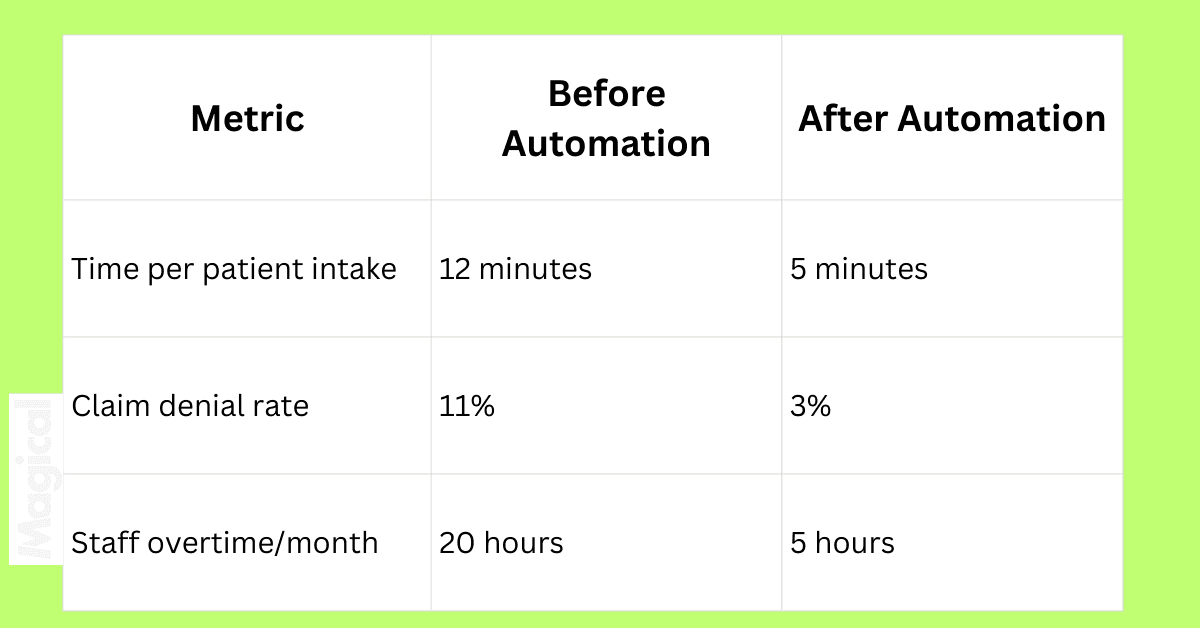
Case Study Tie-In: TCPA reduced onboarding time and data errors by automating repetitive entry tasks, freeing staff to focus on families instead of forms.
The ROI of Reducing Admin Burden
Admin work isn’t just busywork. It’s one of the biggest cost drivers in healthcare. Cutting that burden has a measurable return, both financially and operationally.
Here’s what happens when teams take automation and workflow redesign seriously:
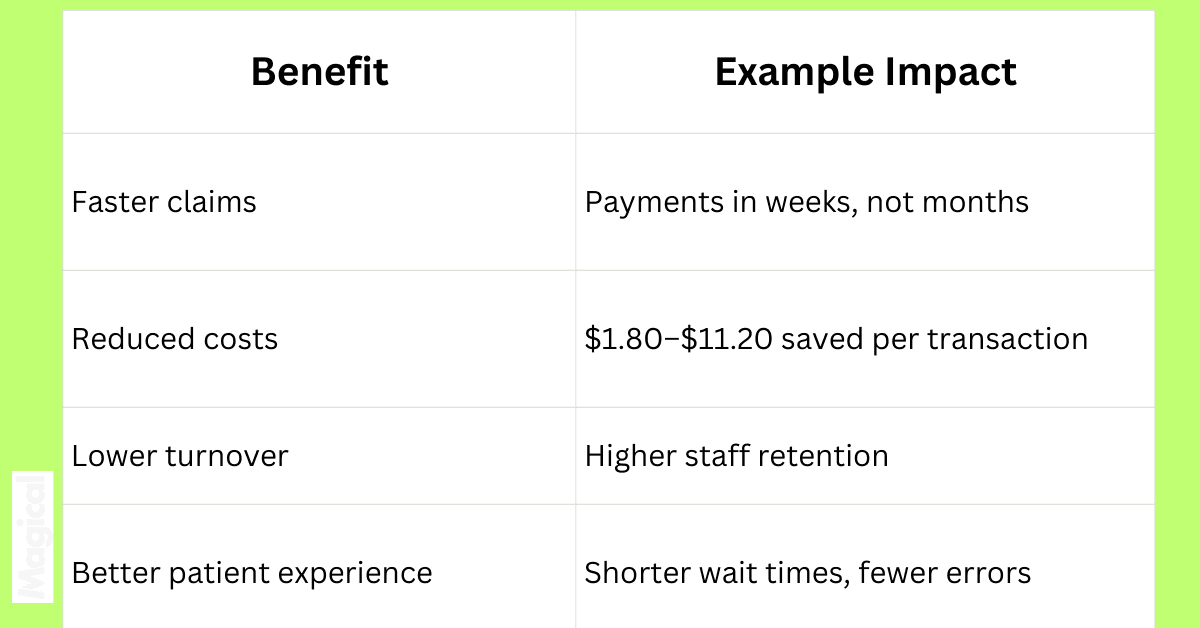
Shorter Billing Cycles
Less manual entry means fewer errors. Fewer errors mean fewer denials. That translates directly into faster reimbursement and steadier cash flow.
On average, denied claims take up to 90 days to rework and resubmit. Preventing those denials up front saves weeks of delay.
Lower Operational Costs
Every repetitive task automated is staff time recovered.
A CAQH analysis found the average savings per automated healthcare transaction is $1.80–$11.20, depending on complexity. Multiplied by thousands of transactions per month, those savings add up fast.
Fewer Burnout-Driven Exits
Replacing an admin employee costs thousands in recruiting, onboarding, and training. Automation reduces the grind that drives people out, which means higher retention and lower turnover costs.
Nearly half of healthcare workers say they’re considering leaving their jobs, with administrative overload cited as a top factor (Medscape). Reducing that load isn’t just about efficiency. It’s about keeping teams intact.
Better Patient Experience
Admin friction shows up in patient outcomes too. Long intake times, billing errors, and scheduling delays all hit patient satisfaction scores.
Automating repetitive steps means patients spend less time waiting and more time receiving care, an ROI that’s harder to measure but just as important.
How Magical Helps Healthcare Teams Lighten Their Admin Load
The weight of admin work looks different in every healthcare organization. But the pain points are familiar: too many systems, too much copy-paste, too much time lost on tasks that don’t require judgment.
Here’s how three very different healthcare orgs used Magical to reduce their load and give staff hours back.
TCPA: Faster Onboarding, Fewer Errors
TCPA, a high-volume pediatric practice group, struggled with repetitive patient onboarding tasks. Staff spent too much time entering the same information across scheduling and billing systems.
With Magical:
Automated intake fields and repetitive entry points
Reduced onboarding time per patient
Freed staff to focus on families instead of forms
Read the full TCPA case study →
WebPT: Streamlining Documentation
WebPT supports over 150,000 rehab therapy professionals nationwide. Their operations team faced inefficiencies in documentation processes that slowed down billing.
With Magical:
Automated standardized documentation entries
Improved billing accuracy
Saved hours per week for admin teams
Explore the WebPT case study →
ZoomCare: Smoother Front-Desk Workflows
ZoomCare’s neighborhood clinics were bottlenecked at the front desk. Staff had to juggle intake, insurance, and billing tasks manually, creating delays for patients.
With Magical:
Automated data population across scheduling and billing platforms
Shortened patient check-in times
Ensured cleaner, more consistent data across systems
Each team solved a different problem. But the outcome was the same: fewer manual tasks, faster workflows, and happier staff.
The Future of Admin Work in Healthcare
Admin work won’t vanish from healthcare. But its shape will change.
The days of endless typing, copying, and cross-checking are numbered. Future-facing AI and automation are already moving beyond repetitive tasks and into proactive support.
Here’s what’s on the horizon:
Smarter denial prevention: Systems that flag missing codes or risky claims before they’re submitted.
Real-time documentation support: AI filling in gaps and suggesting compliant entries while staff work.
Workflow orchestration: Automation connecting intake, scheduling, and billing without swivel-chairing between systems.
Adaptive learning: Tools that improve over time, recommending the fastest way to complete recurring admin tasks.
The role of admins won’t be replaced. It will be elevated. Instead of fighting fires, they’ll own workflows, guide automation, and spend more time solving problems that require a human touch.
Tools like Magical are already putting this power in the hands of healthcare teams today without waiting for a massive IT overhaul.
The future isn’t about removing people from the process. It’s about removing the weight that keeps them from doing their best work.
Final Thoughts
Admin burden is one of the heaviest weights on healthcare today. It drains time, adds costs, and pushes good people out of the field. But it isn’t inevitable.
With the right workflows and the right tools, teams can cut through the noise. They can shrink intake times, reduce claim errors, speed up billing, and reclaim hours that used to vanish into paperwork.
Reducing admin burden doesn’t start with massive system overhauls. It starts small, with one workflow, one automation, one win. From there, momentum builds.
Every hour saved is time your team can spend on what matters most: delivering better care.
Try it Yourself
Download the free Magical Chrome extension or book a demo for your team today! Magical is used at 100,000+ companies and by nearly 1,000,000 users to save 7 hours a week on average.