
An audit isn’t a problem until it’s your problem.
One day, you’re working through the claims backlog.
The next, you’re staring at a payer letter asking for 150 charts, three years of documentation, and proof that you didn’t bill for something you shouldn’t have.
By then, the damage is already done: claims delayed, cash frozen, and staff scrambling to find records you thought were “somewhere in the system.”
The real kicker? Most audit failures don’t start at the audit.
They start months earlier:
A prior auth mismatch nobody caught
A missing modifier that sailed past the claim scrubber
A required attachment that was never linked
A documentation gap buried in a fax folder
Every one of these gaps is fixable before the claim is submitted.
But that takes constant vigilance across thousands of moving parts; the kind of work AI agents now excel at doing 24/7 without missing a beat.
We’re not talking about doing more audits.
We’re talking about building a system so tight that when the auditors show up, you’re already ready, and so are your payments.
What Counts as a Medical Billing Audit (and Why It’s Expanding)
For years, “billing audit” meant a post-payment review. A payer or CMS contractor sampling a handful of claims and checking them for accuracy.
Those days are gone. In 2025, audits are broader, faster, and often automated on the payer side.
Three Main Audit Types
Pre-bill audits – Internal revenue integrity checks before a claim is sent. These verify coding accuracy, medical necessity, and required attachments.
Post-bill audits – Internal QA after submission, looking for patterns in denials, underpayments, or compliance risks.
External audits – Reviews by payers, RAC/MAC contractors, UPIC, or SIUs, often triggered by patterns or anomalies.
Why Audits Are Expanding
Payer automation – Insurers are using their own AI tools to flag anomalies before payment.
Policy churn – LCDs, NCDs, and commercial payer policies now change faster, increasing the risk of outdated coding or documentation.
Compliance enforcement – CMS and private payers are more aggressively pursuing overpayment recovery.
Specialty-specific scrutiny – High-cost imaging, infusions, and surgical claims are under heavier review.
What used to be a once-in-a-while disruption is now an ongoing reality. The only sustainable defense is to treat every claim as if it will be audited.
And to use AI agents to catch problems before the payer does.
Where Audits Fail Today (Root Causes and Costs)
Most billing audit failures aren’t the result of one glaring oversight.
They’re the cumulative effect of small misses at multiple points in the revenue cycle, each one adding risk, cost, and time to payment.
The Most Common Breakdowns
Sampling bias – Manual spot checks miss systemic errors that show up in other claims.
Siloed teams – Patient access, coding, and billing each run their own checks with no shared audit log.
Unstructured data overload – Faxes, scanned PDFs, and emailed payer letters sit in inboxes, disconnected from the claim.
Policy lag – Payer or CMS rule changes are applied to audits weeks or months after they go into effect.
Static tools – Claim scrubbers flag issues but don’t fix them; RPA bots fail when a portal layout changes.
The Cost of Failure
Delayed payments – Days to Payment and Days in AR jump when claims are held for review.
Write-offs – Aged denials pass appeal deadlines.
Administrative waste – Staff chase documents and rework claims instead of preventing errors up front.
Compliance risk – Overpayments slip through and trigger repayment demands or penalties.
By the time an audit reveals a problem, it’s already a revenue problem. The fastest fix is to catch errors before submission, which requires 24/7, detail-level monitoring that humans simply can’t maintain alone.
Types of Billing Audits and What to Check
Every audit, whether internal or external, has the same goal: find what’s wrong before it costs you money.
But each type looks at different parts of the revenue cycle and requires different checks to pass cleanly.
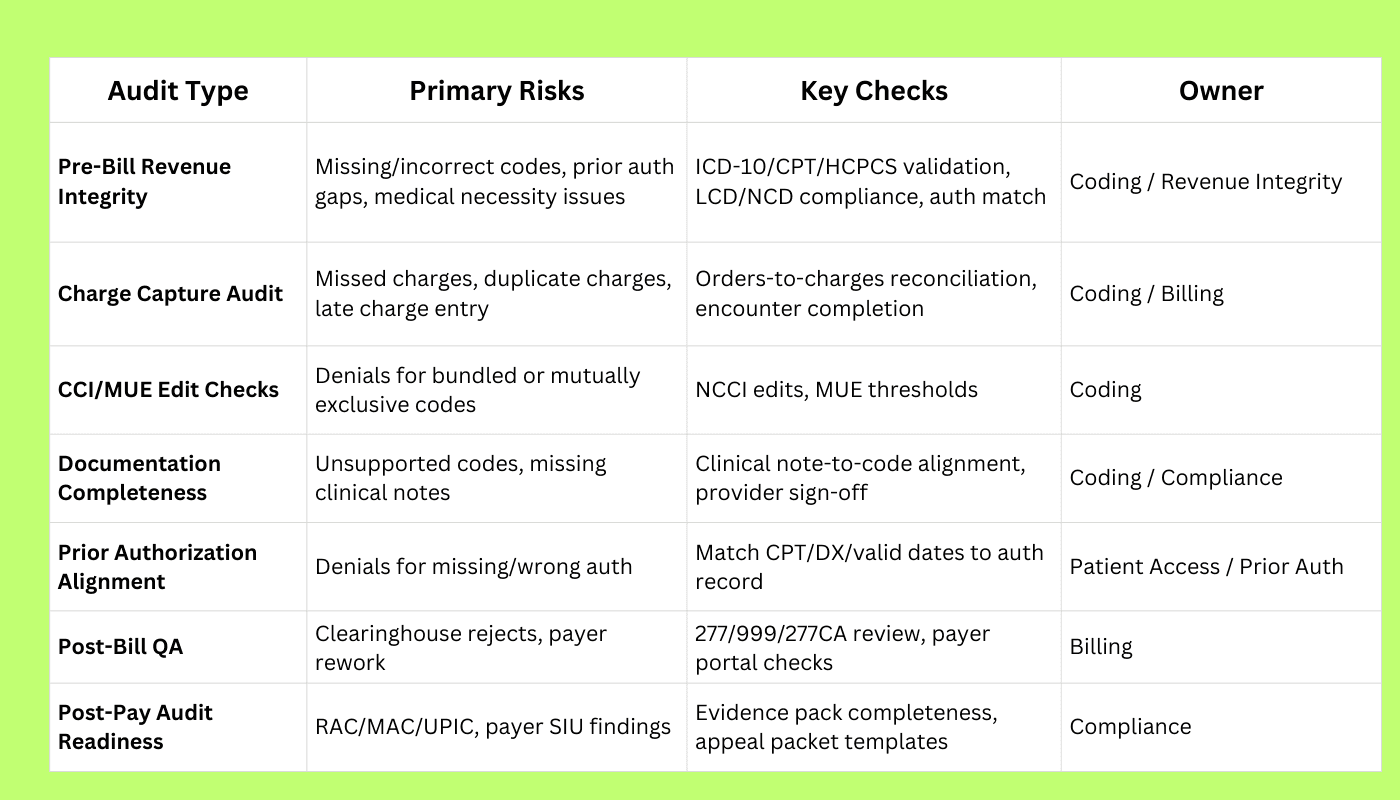
An effective audit program doesn’t just check these boxes once. It checks them continuously, which is why AI agents are so well-suited to run these audits in the background while your team works on exceptions.
Why AI Agents (Not Just Rules or RPA)
Traditional audit tools can flag problems, but they can’t fix them. And in 2025, that’s not enough.
Where Rules Engines Fall Short
They only catch what you tell them to look for.
They can’t parse unstructured inputs like faxes, PDFs, or scanned operative notes.
They stop at alerts; the correction still lands on a human’s desk.
Where RPA Breaks
RPA follows scripts that crumble the moment a payer portal changes layout.
It can’t adapt to new payer rules without manual reprogramming.
It works step-by-step, not end-to-end, so it can’t “see” the bigger workflow.
What AI Agents Do Differently
Read unstructured data — Operative notes, ID cards, EOBs, prior auth letters.
Reason over policies — Match CPT/DX codes to the latest LCD/NCD or payer medical policy.
Act in multiple systems — EHR, clearinghouse, payer portals, document repositories.
Orchestrate end-to-end — From flagging an auth mismatch to gathering the missing note to updating the claim.
Learn from outcomes — Adapts rules when denials or appeals reveal a new pattern.
Rules flag. RPA clicks. AI agents think, act, and adapt; exactly what’s needed to keep every claim “audit ready” before it ever leaves your system.
Pre-Bill Automation: Catch Errors Before Submission
The most valuable audit is the one that happens before the payer sees the claim. When you consider that 60-65% of denied claims are never resubmitted, having a system to reduce (or eliminate) errors is key. Every error prevented here avoids rework, denials, and compliance headaches later.
Eligibility & Plan Validation
Verify active coverage at scheduling and pre-registration.
Detect secondary insurance and coordinate benefits before DOS.
Flag plan mismatches that trigger instant rejections.
Impact: Stops eligibility-related denials before the claim is created.
Prior Authorization Alignment
Match CPT/HCPCS and diagnosis codes against the auth record.
Verify valid dates, place of service, and required provider credentials.
Request missing clinicals automatically from the care team.
Impact: Eliminates one of the top drivers of payer take-backs.
Coding & Documentation Consistency
Compare clinical documentation with assigned codes for alignment.
Validate modifier use and ensure laterality is properly documented.
Run medical necessity checks against LCD/NCD or payer-specific policies.
Impact: Prevents unsupported codes from ever hitting the claim.
CCI/MUE and Medical Necessity
Pre-bill edits for NCCI bundling and MUE limits.
Auto-insert documentation snippets to justify necessity.
Attachments & Evidence
Detect and attach required documents (operative notes, ABNs, prior auth letters) to the claim.
Case Study:
WebPT: Improved documentation-to-charge consistency with AI agents, leading to cleaner claims and fewer post-bill corrections.
TCPA healthcare client: Automated prior auth verification prevented downstream audit triggers.
In pre-bill, AI agents don’t just look for errors. They fix them in real time, creating an “audit-ready” claim before the payer ever touches it.
Post-Bill and Post-Pay Automation: Faster Rework, Stronger Defense
Even the cleanest claims can get caught in payer edits or post-payment review.
The key is to intercept issues as soon as they appear and respond with complete, compliant evidence before deadlines close.
Clearinghouse & Payer Responses
Monitor 277/999/277CA responses in real time.
Identify rejection patterns (missing taxonomy code, incorrect ZIP format) and auto-correct them within hours.
For portal-only payers, AI agents log in automatically to pull status updates and denial notices.
Impact: Prevents rejections from aging into multi-day delays.
Underpayment & Variance Detection
Compare ERA/835 remits to contract terms or historical benchmarks.
Flag partial denials and short pays for follow-up.
Impact: Recovers missed revenue that slips through manual posting.
Appeal Pack Generation
Draft appeal letters with cited LCD/NCD or payer policy language.
Automatically attach relevant documentation, such as operative notes, PA proofs, and encounter summaries.
Include submission history and timestamps to prove timeliness.
Impact: Cuts appeal prep from days to minutes and improves overturn rates.
External Audit Readiness
Maintain a living “evidence log” for every claim, including all clinical attachments and communications.
Generate complete audit packets on demand for RAC, MAC, UPIC, or SIU reviews.
Case Study:
ZoomCare: Improved intake accuracy meant fewer post-bill corrections, reducing payer review delays.
AI agents turn post-bill chaos into a fast, organized process, responding instantly, defending payment, and closing cases before they drain AR.
Auditor Assist: Sampling, Insights, and Feedback Loops
In most organizations, audit results get filed away after the fixes are made. The same errors resurface months later, because nothing changed in the underlying workflow.
AI agents turn audits into a continuous improvement engine.
Intelligent Sampling
Target high-risk areas — specific payers, providers, service lines, or codes with known issues.
Mix risk-based sampling with random audits to catch both predictable and emerging problems.
Real-Time Trend Analysis
Aggregate audit findings by denial reason, modifier use, DX/CPT pairings, and missing documentation types.
Identify systemic errors (e.g., a template missing a required field) before they spread to hundreds of claims.
Provider Education Packs
Auto-generate de-identified case examples highlighting what triggered an audit flag.
Deliver targeted education to specific providers or departments without shaming individuals.
Closed-Loop Learning
When agents find a recurring issue, they update their own rules to prevent it in future claims.
Example: if multiple denials cite “invalid place of service,” agents check and correct this before submission going forward.
Instead of treating audits as costly one-off events, AI agents turn them into a feedback loop, shrinking error rates with every cycle and making the next audit easier to pass.
30-60-90 Day Rollout Plan
A tighter audit process doesn’t require a massive system overhaul. The fastest results come from targeting the highest-risk gaps first, proving impact, and then scaling.
Days 0–30: Baseline & Quick Wins
Goal: Identify your top audit vulnerabilities and close them immediately.
Review recent denials, rejections, and external audit findings.
Pinpoint high-volume issues like prior auth mismatches, CCI/MUE edits, or missing documentation.
Deploy AI agents for one or two workflows with immediate ROI, such as pre-bill eligibility verification or attachment verification.
Establish baseline KPIs: pre-bill intercept rate, First-Pass Yield (FPY), denial rate.
Expected impact: First measurable drop in audit-triggering errors.
Days 31–60: Expand Coverage
Goal: Tackle additional pre-bill and post-bill checks to catch more errors earlier.
Add AI-driven coding/documentation alignment and NCCI/MUE edit checks.
Turn on clearinghouse reject repair and portal-based status monitoring.
Introduce automated appeal packet generation for top denial types.
Expected impact: Faster rework, fewer denials aging past appeal deadlines.
Days 61–90: Standardize and Scale
Goal: Build a sustainable audit program with automation as the backbone.
Expand AI coverage to all high-risk audit points identified in baseline review.
Implement closed-loop feedback so recurring errors are prevented automatically.
Formalize quarterly audit review meetings using AI-generated trend reports.
Expected impact: Continuous improvement cycle with fewer external audit findings and shorter payment timelines.
Frequently Asked Questions
Do AI agents replace human auditors?
No. AI agents handle the repetitive, rules-based checks that consume most of an auditor’s time, like verifying auth dates, attaching required documents, or running NCCI edits. Humans still handle complex judgment calls, nuanced coding scenarios, and clinical review.
Will AI agents work with my EHR and payer portals?
Yes. Agents integrate through APIs where available, and can also perform secure, credentialed actions in EHRs, clearinghouses, and payer portals. The same way a staff member would.
How do AI agents keep up with policy changes?
Agents update payer policies, LCD/NCD rules, and coding edits in real time from trusted sources. This means your audit checks are always based on the most current requirements.
Is this HIPAA-compliant?
Yes. All workflows run in HIPAA-compliant environments, with BAAs, role-based access, encryption, and immutable audit logs.
What happens when an AI agent finds an issue?
Depending on your configuration, the agent can fix it automatically (e.g., attach a missing document) or route it to a human in an exception queue for review.
What KPIs should improve first?
Most organizations see early gains in:
Pre-bill intercept rate
First-Pass Yield (FPY)
Denial rate for documentation/auth-related errors
Appeal turnaround time
Final Thoughts: Make Every Claim Audit-Ready
Audits don’t have to be fire drills.
When every claim is clean before it leaves your system (and fully documented for defense after submission), external reviews stop being threats and start being non-events.
An AI workforce makes that possible by running pre-bill checks around the clock, correcting errors instantly, monitoring payer responses, and preparing complete evidence packs on demand.
Your team stays focused on high-value judgment calls while the repetitive, error-prone work disappears into the background.
In 2025, audit readiness isn’t just a compliance goal. It’s a revenue strategy.
Clean claims mean faster payment, fewer denials, and less AR stuck in limbo.
Ready to make audit failures a thing of the past?
Try the free Magical Chrome extension or book a demo for your team. Magical is used at more than 100,000 companies and by nearly 1,000,000 users to save 7 hours a week on average — hours your team can spend accelerating cash, not chasing paperwork.