
Utilization management (UM) has always been at the heart of payer strategy. At its core, UM is about ensuring members receive the right care, at the right time, in the right setting — and that care is both medically necessary and cost-effective. For decades, the levers have been familiar: prior authorization, concurrent review, retrospective review, and medical necessity guidelines.
But in 2026, UM is being reshaped by forces far larger than internal policy. New regulations, provider pushback, member expectations, and the rise of AI are converging to create a turning point. What once was a back-office compliance function is now front-page news. Headlines about prior authorization delays, congressional hearings about member access, and billion-dollar fines over improper payments have pushed UM into the spotlight.
The next 12–18 months will determine whether payers adapt or risk falling behind. Below, we break down the six biggest utilization management trends shaping 2026 — and what health plans need to do now to stay ahead.
1. Payers Starting to Hire More AI Employees
The single biggest shift in UM isn’t about policy — it’s about people, or rather, the lack thereof.
For decades, payers scaled UM teams by hiring more nurses, more analysts, and more offshore processing staff. But labor costs are rising, clinical talent is in short supply, and provider networks are pushing back against long turnaround times. The old model simply doesn’t scale anymore.
That’s why we’re now seeing payers “hire” AI employees — digital workers that can review documentation, apply rules, and make determinations, often in minutes instead of days. Unlike traditional RPA bots, AI employees are designed to:
Adapt in real time when policies or regulations change
Explain their reasoning in plain language, creating transparency for regulators and providers
Work 24/7 without burning out or creating backlogs
Escalate complex cases to human reviewers, freeing staff for higher-value tasks
The implications for UM are enormous. Instead of hundreds of staff chasing prior auth paperwork, AI employees can handle routine requests, flag exceptions, and provide an auditable reasoning trail. Providers see faster decisions, members get quicker access to care, and payers lower costs without compromising compliance.
👉 Learn how Magical AI Employees are already transforming utilization management.
2. Stricter Prior Authorization Timelines and Transparency Rules
If there’s one regulatory theme defining 2026, it’s speed and transparency.
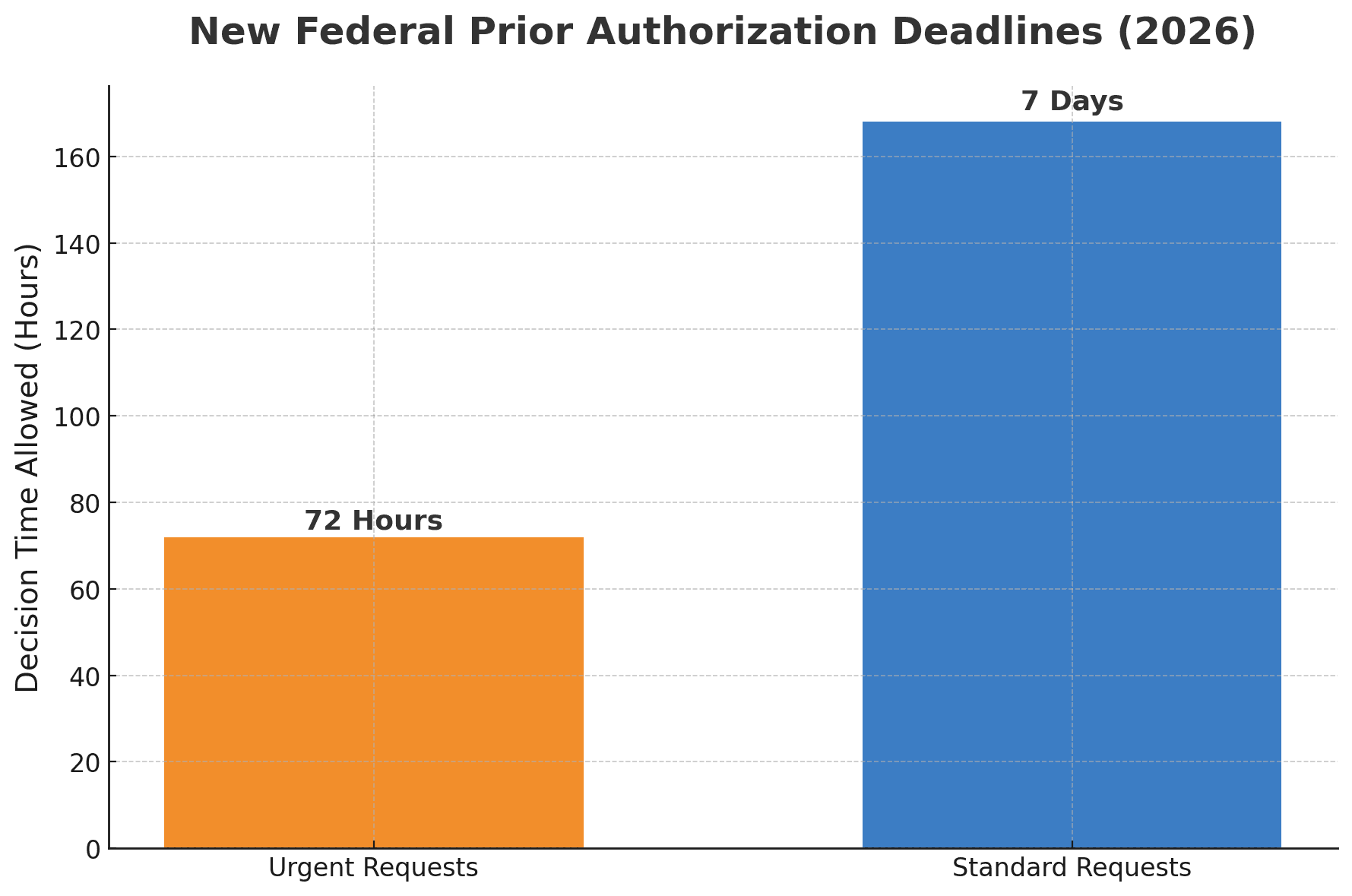
The federal government has finalized new rules requiring payers to:
Deliver decisions on urgent prior authorization requests within 72 hours
Respond to standard requests within seven calendar days
Provide clear explanations for denials, including the clinical rationale
Support electronic prior authorization through standardized APIs
These changes come after years of pressure from providers, members, and policymakers who criticized PA for delaying or denying care. A recent AMA survey found that 94% of physicians report prior authorization causes care delays and 80% say it can lead to treatment abandonment.
For payers, the new requirements mean that UM workflows must be:
Faster: Manual review queues won’t keep up with 72-hour SLAs
Transparent: Every denial must include a documented, defensible rationale
Digital-first: Paper faxes and manual uploads won’t satisfy electronic PA mandates
The upside? Payers that embrace automation and AI agents for prior authorizations will not only meet compliance deadlines but also differentiate themselves with providers. Imagine being the health plan known for lightning-fast, transparent approvals — that’s a reputational win as well as a compliance necessity.
3. Generative AI Driving Smarter Reviews
Until recently, most UM automation was rules-based: if a request matched guideline X, it was approved; if not, it was denied. While efficient, this approach lacked flexibility and nuance.
Enter generative AI. In 2026, payers are beginning to deploy AI not just for back-office tasks but for clinical document understanding and medical necessity reviews.
Key applications include:
Document summarization: AI can quickly parse clinical notes, lab results, and imaging reports to highlight what’s relevant for a PA decision.
Policy matching: AI can compare the specifics of a request against plan guidelines and coverage criteria, reducing the time reviewers spend searching policies.
Drafting rationales: Instead of nurses writing denial letters manually, AI can generate clear, CMS-compliant explanations — which human reviewers can approve or edit.
Continuous learning: Unlike static rules engines, AI models improve as they process more cases, catching patterns humans might miss.
According to Becker’s, “Generative AI will reshape utilization management by handling large-scale, complex data reviews, freeing clinicians to focus on exceptions and nuanced cases.”
The big caveat is trust. Payers must prove that AI-generated reviews are accurate, unbiased, and explainable. Black-box models won’t satisfy regulators. That’s why “reasoning transparency” is becoming just as important as speed.
4. Clinical Validation Moving Upstream
Traditionally, UM has been reactive: approve or deny after a request is made. In 2026, we’re seeing UM shift earlier in the care pathway, focusing on prevention rather than correction.
This trend has several dimensions:
Pre-service reviews: Instead of catching issues after services are delivered, payers are embedding clinical logic at the point of scheduling or ordering.
Predictive analytics: Using historical data to flag members who are at risk for high-cost, low-value care before it occurs.
Proactive outreach: Engaging providers with alternative care recommendations earlier, reducing the likelihood of denials later.
The National Pharmaceutical Council (NPC) notes that utilization management has been expanding in scope, increasingly targeting high-cost therapies and therapeutic classes upstream, with potential policy implications for patient access.
For payers, this shift reduces downstream denial volume, lowers administrative friction, and improves provider relationships. Instead of “deny and delay,” UM becomes “guide and prevent.”
5. “Gold-Carding” and Provider Collaboration
UM has always been a friction point between payers and providers. Doctors complain about excessive PA, while payers argue it’s necessary to control waste. In 2026, more payers are looking for middle ground through “gold-carding” programs.
Gold-carding exempts providers from certain UM requirements if they demonstrate:
High rates of guideline compliance
Low denial or appeal rates
Consistent documentation quality
By waiving or reducing PA for trusted providers, health plans can:
Cut administrative burden on both sides
Improve provider satisfaction and reduce abrasion
Free UM staff to focus on higher-risk providers and services
Some states have even begun legislating gold-carding requirements, which means payers may not just choose this path — they may be forced to. Getting ahead of the curve builds goodwill and avoids scrambling later.
6. Data Integration and Interoperability as the UM Backbone
At the heart of every UM trend is one fundamental truth: you can’t make good decisions with bad or incomplete data. In 2026, the shift toward interoperability is accelerating. CMS is pushing adoption of FHIR APIs and requiring payers to exchange data more seamlessly with providers and members.
For UM, this means:
Faster decisions: With direct access to EHR data (labs, imaging, notes), payers can validate necessity without endless faxes and phone calls.
Smarter rules: Combining claims + clinical data provides richer context for decision-making.
Better transparency: Members and providers can see the reasoning behind approvals/denials, reducing disputes.
The bottom line: interoperability isn’t optional. The payers who build UM systems that connect seamlessly to provider workflows will gain efficiency, reduce errors, and meet regulatory expectations.
Making Sense of These Trends
When you step back, the six UM trends for 2026 share a common thread: transformation through speed, transparency, and intelligence.
AI employees are redefining what the UM workforce looks like
Regulators are mandating faster and more transparent decisions
Generative AI is unlocking smarter reviews and rationales
Clinical validation is shifting upstream to prevent waste before it starts
Gold-carding is reducing friction with providers
Interoperability is providing the data foundation for all of the above
For payers, this isn’t just about compliance. It’s about competitive advantage. Health plans that can deliver fast, transparent, and accurate UM decisions will win favor with providers, regulators, and members — while those stuck in manual workflows risk penalties, lawsuits, and member churn.
What Should Payers Do Now?
Audit your UM processes: Where are the biggest bottlenecks? Which services generate the most denials?
Map regulatory deadlines: Ensure your workflows align with the 2026 PA mandates.
Pilot AI employees: Start small with high-volume PA categories and measure results.
Engage providers: Consider gold-carding or collaborative pilots with trusted provider groups.
Invest in interoperability: Upgrade data exchange systems to support real-time decision-making.
Conclusion
Utilization management is no longer just an administrative function — it’s a frontline battleground where payer costs, provider satisfaction, member access, and regulatory compliance all collide.
The year 2026 will be remembered as the year UM changed forever. The question for payers isn’t whether these trends will hit — it’s whether you’ll be ready when they do.
👉 Want to see how AI employees can help your health plan adapt to these trends? Get a demo with Magical today.