
Cardiology is one of the most revenue-intensive specialties in healthcare. Every part of the workflow—from scheduling a nuclear stress test to implanting a stent in a cath lab—involves high-cost services, complex payer rules, and high denial exposure. For years, practices survived by throwing more staff at the problem. But in 2026, that approach is no longer viable.
Margins are under pressure. Denials are up. Patients demand clarity. And CMS has unleashed a set of sweeping policy changes that directly reshape how prior authorization and outpatient cardiology services flow.
The good news? With the right automation, analytics, and strategy, cardiology practices can thrive. Here are the five most important revenue cycle trends for cardiology in 2026—and exactly what to do about them.
1. Prior Authorization Gets a Policy Shock: Speed, APIs, and Transparency
The Trend
For years, prior authorization (PA) has been the #1 friction point in cardiology RCM. Imaging, ablations, PCI, device implants—nearly every high-value service requires payer pre-approval. And delays directly harm patients.
In the AMA’s 2024 PA survey, physicians reported an average of 39 prior authorizations per physician per week, with 29% saying PA led to a serious adverse event, and 89% saying PA disrupted continuity of care .
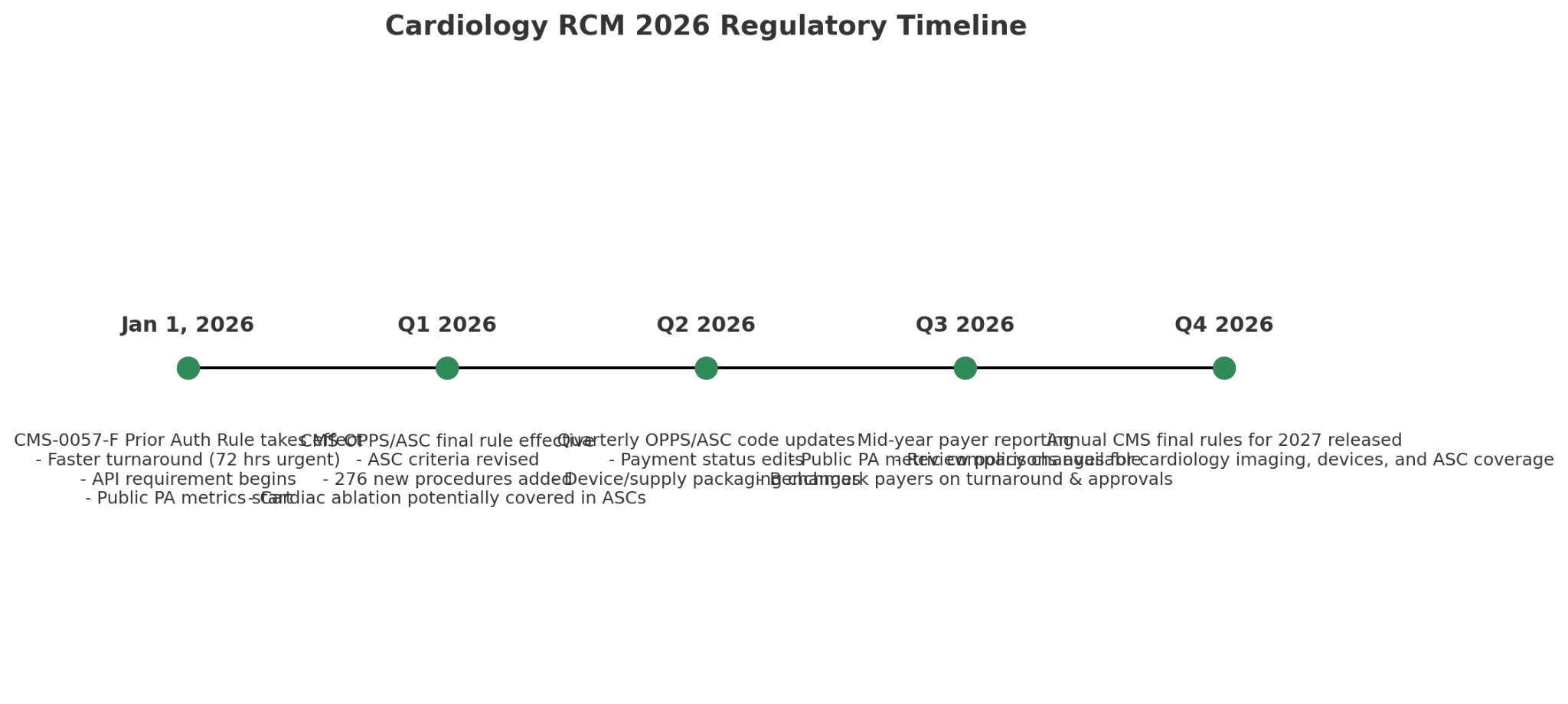
Enter CMS. In January 2025, the Interoperability and Prior Authorization Final Rule (CMS-0057-F) was published. Beginning January 1, 2026, payers must:
Provide faster turnaround times (72 hours for urgent, 7 calendar days for standard requests).
Build and maintain electronic PA APIs so providers can send, track, and receive PA responses digitally.
Publicly report PA metrics (average time to decision, approval rates, denial rates).
Why It Matters for Cardiology
Cardiology is one of the highest PA-volume specialties. Faster turnarounds and APIs could dramatically reduce cancelled cases, lost revenue, and patient harm. But only if practices are ready to connect and monitor.
How to Prepare
✅ Integrate PA at scheduling. Don’t wait until after the order is placed—embed real-time checks at the moment of booking.
✅ Adopt an API-ready platform. By Jan 2026, manual PA workflows will be obsolete. Start testing electronic connections now.
✅ Benchmark your payers. Once payers must report PA metrics publicly, compare them head-to-head and push back on underperformers.
✅ Automate documentation. Use AI employees to assemble and submit complete PA packets, minimizing “ping-pong” delays.
2. Outpatient Cardiology Expands: PCI and Ablation Move to ASCs
The Trend
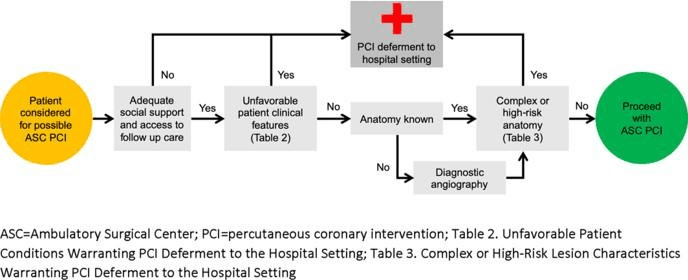
Cardiology is shifting out of the hospital and into outpatient settings—especially Ambulatory Surgical Centers (ASCs).
A Medicare analysis of 408,060 outpatient PCI patients (2020–2022) found only 1.8% were treated at ASCs, but the rate is rising quickly—from 0.01 to 0.87 per 10,000 person-years between 2018 and 2022 .
Safety outcomes were comparable to hospital outpatient departments in appropriately selected patients.
In the CY 2026 OPPS/ASC proposed rule, CMS proposed adding cardiac catheter ablation to the ASC Covered Procedures List (CPL) as part of a broader criteria change that would add 276 procedures to ASC eligibility .
Why It Matters for Cardiology
Procedures once restricted to hospitals—PCI and ablation—are now shifting into lower-cost ASC environments. This means new payer splits, site-of-service differentials, and bundling/reconciliation challenges.
How to Prepare
✅ Review payer contracts for ASC coverage rules and carve-outs.
✅ Build ASC-specific billing logic—professional vs. facility lines, supply/device cost reconciliation.
✅ Track margins by site. Benchmark AR days, denial rates, and payer behavior across ASC vs. HOPD.
✅ Prepare for ablation. Even if your ASC isn’t offering EP procedures yet, the rules are coming.
3. Imaging Documentation Shifts: The AUC Program is Rescinded
The Trend
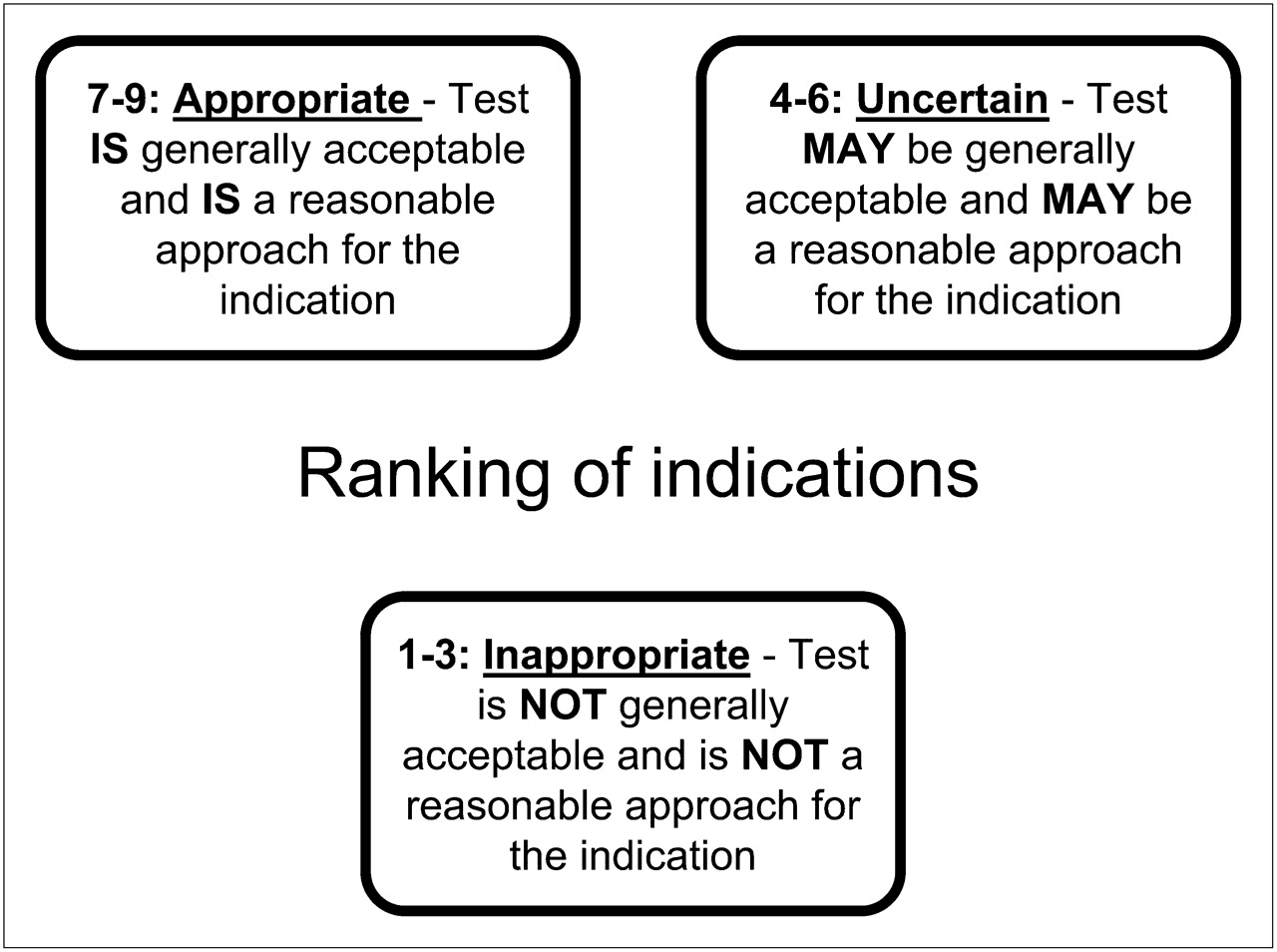
Cardiology practices invested heavily in workflows to meet the Appropriate Use Criteria (AUC) program for advanced imaging (CT, MRI, nuclear). But in 2024, CMS officially paused and rescinded the program.
As of Jan 1, 2024: Providers should not include AUC consultation data on Medicare FFS claims.
Grace period: Claims with 2023–2024 dates of service continued processing through Dec 31, 2024 .
Why It Matters for Cardiology
This removes a burdensome documentation requirement—but also eliminates a structured mechanism for appropriateness checks. Payers may respond by tightening their own documentation or PA rules.
How to Prepare
✅ Retire AUC claim attachments immediately to avoid denials.
✅ Keep internal stewardship. Use decision support to ensure appropriateness, even without CMS mandates.
✅ Monitor payer shifts. Some may replace AUC with stricter PA for advanced imaging.
✅ Automate order validation. Have AI employees check coverage, coding, and necessity before submission.
4. OPPS/ASC Coding & Payment Churn Demands Quarterly Vigilance

The Trend
Beyond headline coverage decisions, CMS makes quarterly updates to the OPPS and ASC payment systems. For 2026, proposed changes include:
Revised criteria for ASC coverage, adding 276 new procedures.
Packaging changes and status indicator edits that affect cardiology imaging and device billing .
Why It Matters for Cardiology
Even a single edit can shift reimbursement on a cath lab supply, a bundled diagnostic, or a pass-through device. Missing these updates means leaving money on the table—or facing denials for using outdated codes.
How to Prepare
✅ Subscribe to CMS update feeds. Don’t wait for your EMR vendor to push updates months later.
✅ Push quarterly code diffs into your claim scrubbers.
✅ Audit margins quarterly. Track where payment edits impact actual reimbursement.
✅ Let AI employees self-heal templates when edits change claim requirements.
5. Denials and Cost Pressures Demand Prevention, Not Management
The Trend
Denials are rising across specialties—and cardiology’s high claim values make every denial sting.
In early 2024, 60% of medical groups reported increased denial rates vs 2023.
92% reported higher operating expenses in 2024 vs 2023.
Together, that means cardiology practices are squeezed from both sides: higher costs, harder collections.
Why It Matters for Cardiology
Relying on back-end appeals is too slow and costly. The economics now demand denial prevention: predictive analytics, clean claims, and proactive payer rule adaptation. You can start to proactively automate this with an AI employee who specializes in prior authorizations, claim scrubbing, and denial management.
How to Prepare
✅ Predictive scrubbing. Use AI to score claims for denial risk before submission.
✅ Auto-attach documentation. Ensure PA proofs, operative notes, and device details are included up front.
✅ Track denial trends monthly. Build payer dashboards: “Top denial codes, top impacted procedures, recovery rate.”
✅ Prioritize appeals. Focus staff energy on claims with high likelihood of reversal.
Final Thoughts
2026 is a year of both disruption and opportunity for cardiology revenue cycles. CMS rules are changing the plumbing of prior authorization and outpatient coverage. Payers are shifting volume to ASCs. Imaging rules are being retired even as denials climb.
The practices that thrive will not simply “work harder”—they’ll work smarter by:
Wiring electronic PA into scheduling.
Building ASC-ready billing workflows.
Retiring AUC claims steps while retaining internal stewardship.
Monitoring OPPS/ASC updates quarterly, not annually.
Moving to denial prevention powered by predictive analytics and AI employees.
At Magical, we help cardiology groups automate these workflows end-to-end—PA, eligibility, scrubbing, submission, and follow-up—while giving staff full transparency into every click, every claim, every decision.
👉 Ready to see how AI employees can future-proof your cardiology RCM?Book a demo with Magical.