
Anesthesiology sits at the center of surgical revenue: every case rides on the anesthesia start/stop times, staffing model (physician-only, medical direction, CRNA-only), and a web of payer rules that can flip a clean claim into a denial with a single missing modifier. 2026 brings real shifts—policy deadlines that change prior-auth plumbing, outpatient migration that strains coverage, new CPT code paths, and persistent drug shortages that ripple straight into case volume and cash flow.
Below are five anesthesia-specific trends—each grounded in current rules, society guidance, or market data—and what they mean for your revenue cycle.
1. Declining Reimbursement Pressure / Conversion Factor Compression
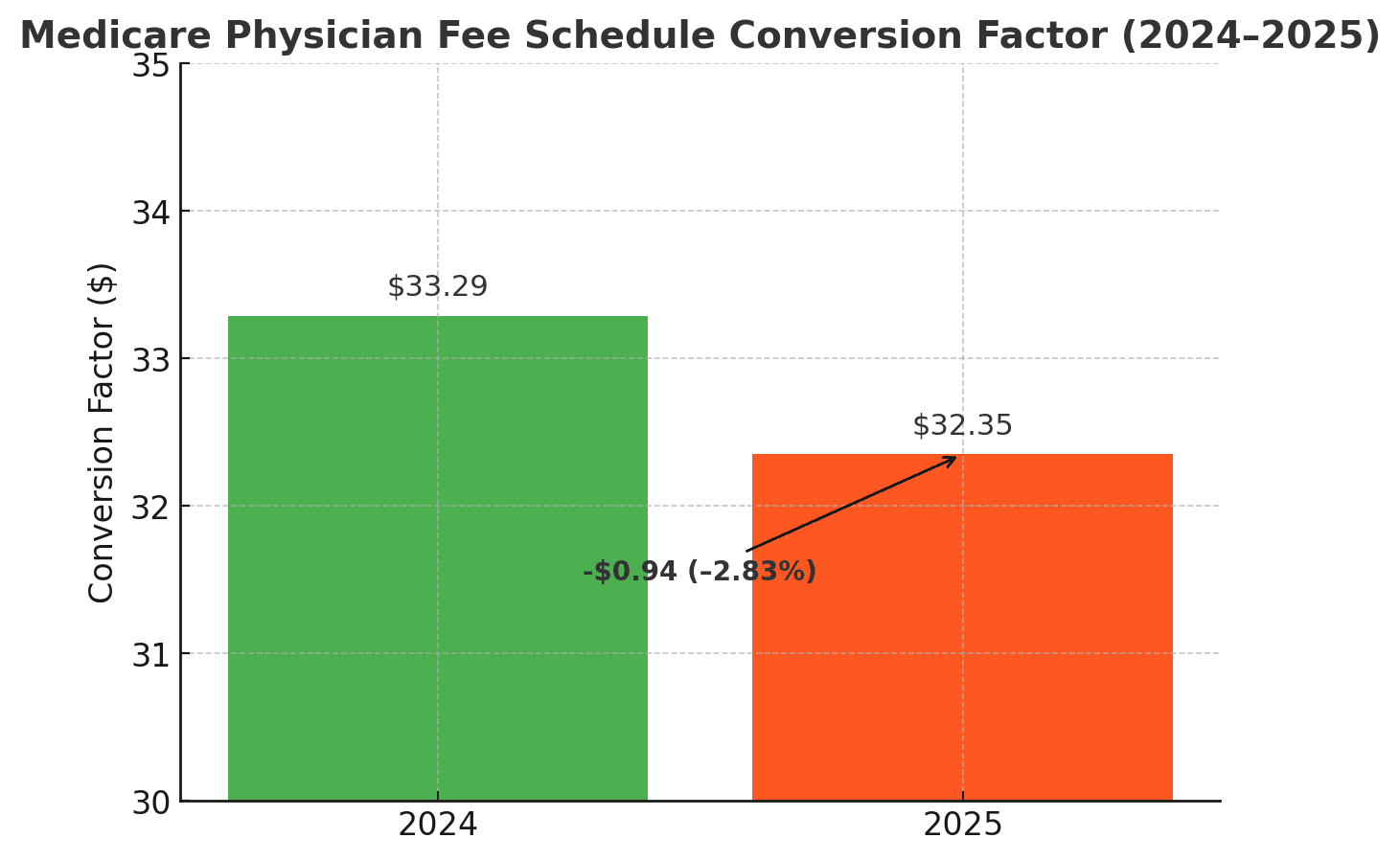
What’s happening: Anesthesia reimbursement via Medicare’s physician fee schedule continues to compress. The “conversion factor”—the dollar amount multiplied by anesthesia units—is under pressure, putting downward stress on revenue.
For example, CMS data show that the anesthesia base units remained unchanged in 2024 and 2025, but pressures on the conversion factor persist.
Another analysis from VMG Health notes that Medicare anesthesia reimbursement has declined from $22.2730 per unit in 2019 to $21.1249 in 2023, reflecting downward pressure over time.
Becker’s ASC Review reports that for 2025, the physician fee schedule conversion factor was reduced by 94 cents (2.83%), from $33.29 in 2024 to $32.35 in 2025, highlighting the ongoing squeeze in physician reimbursement.
What to change in your revenue cycle:
Anesthesia practices must optimize every unit and base calculation (time units, base units, add-ons).
Clean claims become even more critical—there’s less margin for error.
Practices may need to renegotiate contracts or subsidies with hospitals/ASCs to offset lost revenue.
Use AI employees to automate claim processing to avoid base/time unit mismatches, modifier conflicts, and undercoding to avoid leaving money on the table.
2. Growing Provider Shortages & Workforce Imbalance
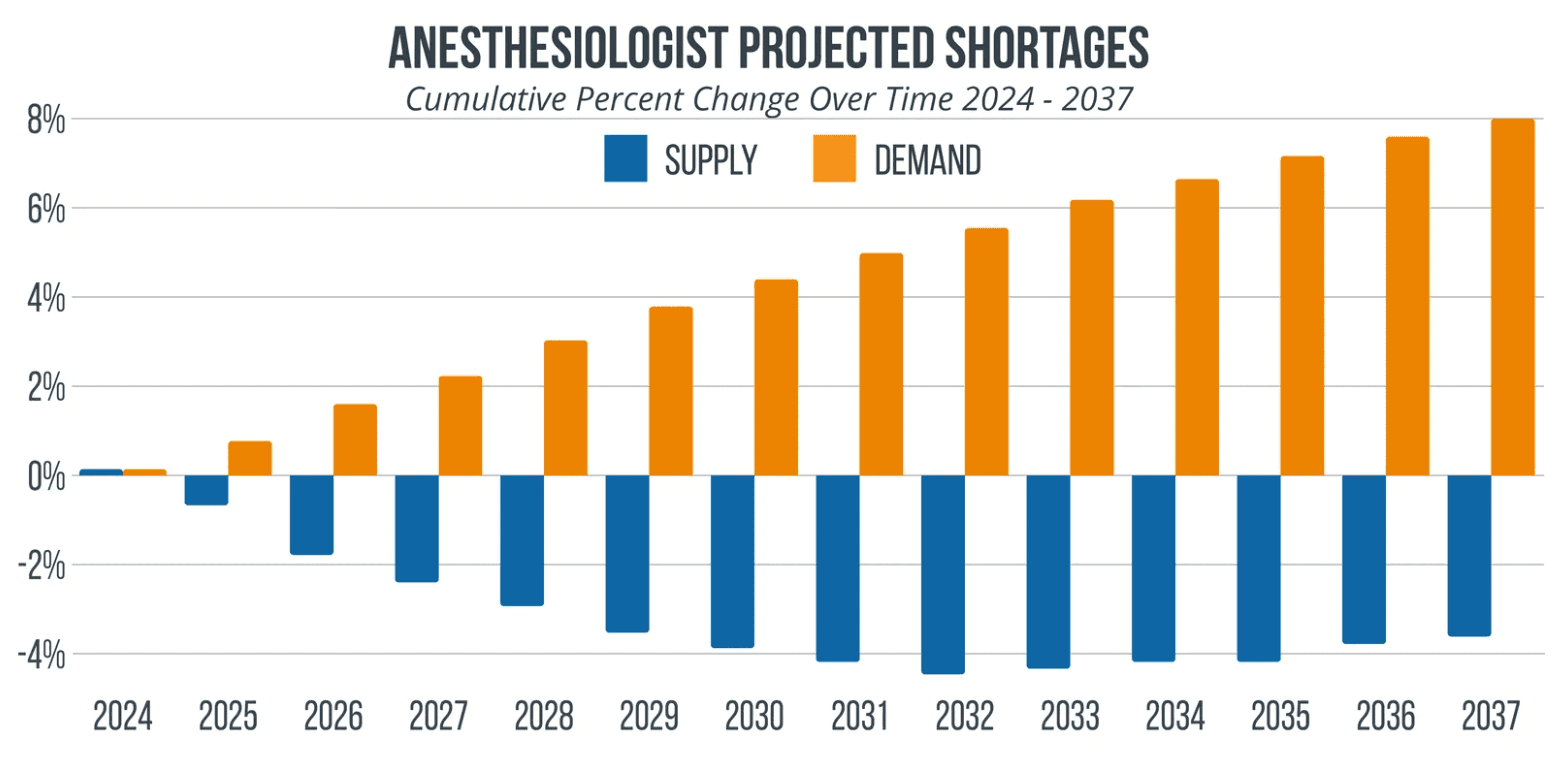
What’s happening: The mismatch between surgical demand and anesthesia provider supply is accelerating, which amplifies scheduling risk, staffing cost, and dependency on subsidies or guarantees.
HRSA projects a shortage of 8,450 anesthesiologists by 2037.
The American Society of Anesthesiologists (ASA) warns of a growing imbalance in supply vs. demand, posing critical challenges to coverage.
Some reports suggest that 12% of CRNAs intend to retire by 2027, increasing pressure on the pool of providers.
What to change in your revenue cycle:
Practices must build capacity forecasts aligned with demand, and flag cancellation risk when staffing is thin.
The financial burden of coverage may increasingly fall on the practice or the facility via stipends/subsidies.
Automate scheduling and backup coverage logic to minimize OR idle time and revenue loss.
3. ASC Subsidies, Stipends & Guarantee Agreements Are Becoming Inescapable
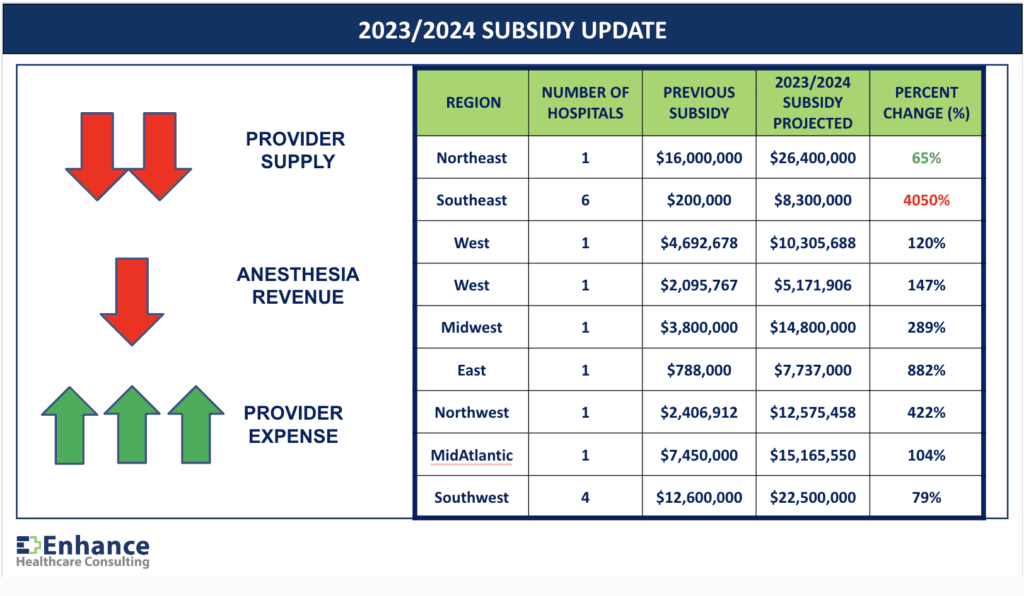
What’s happening: Because payers underpay anesthesia services relative to the necessary coverage, hospitals and surgery centers increasingly subsidize anesthesia practices via stipends, income guarantees, or “income support” models.
Coronis Health cites that anesthesia groups are increasingly requesting increased stipends/subsidies from facilities to make the economics work, given squeezed reimbursement.
VMG Health’s analysis notes that many hospitals or ASCs must guarantee income to anesthesia groups because commercial insurers typically reimburse below fair market value (FMV).
What to change in your revenue cycle:
Practices must be adept at negotiating and justifying subsidy levels based on collected revenue, demand, and case mix.
Build clear models for fair share (i.e., subsidy = facility’s margin shortfall vs. collected).
Automate reporting on collections vs. guarantee, so facility leaders see performance in real time.
4. Payer Pushback on Time-Based Reimbursement: Policies, Reversals, and Litigation Risk
What’s happening: Some payers have attempted to limit anesthesia reimbursement based on time thresholds or caps, triggering backlash from the anesthesia community and regulatory scrutiny.
For example, Anthem proposed capping anesthesia reimbursement based on “allowed time” beyond which claims would be denied. This policy was reversed after public criticism from the ASA and lawmakers.
UnitedHealthcare’s new CRNA reimbursement reductions (15% cut for independent CRNAs) was met with strong opposition from the AANA and criticized for harming access
What to change in your revenue cycle:
Track payer policy changes closely—policy reversals may happen if there’s public backlash, but the damage can linger (delayed payments, claim reprocessing).
Subgroup claims by payer and policy to isolate negative trends.
Strengthen appeal infrastructure and legal readiness for disputes around too-literal time-capping.
Use historical audit logs and case-by-case clinical justification to push back when time-limits are rigidly enforced.
5. AI/ML for Automated Dosing, Drug Utilization, & Charge Capture

What’s happening: There’s growing research in closed-loop anesthesia and AI-based dosing models—paving a future where the anesthetic administration is partially automated. While still emerging clinically, the trend points toward more precise, auditable anesthetic behavior, which also helps with billing accuracy and utilization control.
A recent study introduced a transformer-based model to predict anesthetic depth (BIS) from infusion data for propofol/remifentanil, outperforming traditional pharmacokinetic models.
Earlier work on reinforcement-learning for propofol infusion (Policy Constraint Q Learning) shows models that adapt doses while staying aligned with clinician decisions.
On the billing side, AI-based charge capture and payment posting AI agents are becoming more common in perioperative settings
What to change in your revenue cycle:
Pilot dose/monitoring models (even as decision support) that record decision paths and allow retrospective billing reconciliation.
Use AI to assist in charge capture from monitor logs, infusion data, and event timestamps to minimize skews.
Build audit trails for AI-supported dosing decisions so payers (or audits) can trace how the system arrived at a dose or billing unit.
Final Thoughts
Anesthesiology sits at the intersection of clinical necessity and financial fragility. Conversion factor cuts shrink the revenue base, workforce shortages make coverage harder to guarantee, payer policies are shifting under our feet, and drug shortages can derail entire OR days. In short: anesthesia RCM isn’t just about billing—it’s about making sure every case gets covered, coded, and collected without leaving gaps that compromise care or cash flow.
The anesthesia practices that thrive in 2026 will be those that:
Wire electronic prior auth directly into scheduling and pre-op workflows.
Model ASC economics realistically, accounting for anesthesia stipends and coverage risk.
Keep coding and modifier precision airtight as CPT and payer rules evolve.
Track and justify facility subsidies with data, not anecdotes.
Use AI and analytics to prevent denials, capture every unit, and keep ORs productive even when drug shortages or payer edits threaten throughput.
At Magical, we believe anesthesia revenue integrity is about more than collecting charges—it’s about building workflows that are resilient, transparent, and auditable. Our AI employees automate anesthesia RCM end-to-end—prior auth, eligibility, coding checks, submission, denial prevention—so your clinicians can focus on care, while your financial team has full visibility into every click, every claim, every outcome.
👉 Ready to future-proof your anesthesia RCM? Book a demo with Magical.