
Every denied claim is unpaid work.
Your staff did the intake.
The provider delivered care.
The coder filed the claim.
And the payer?
They hit reject. And now your team is stuck chasing dollars that should’ve been in your bank account weeks ago.
Multiply that by a few hundred claims per month, and you’ve got a broken system bleeding money.
The worst part is that most denials are preventable.
Not because your team isn’t working hard, but because they’re forced to work manually:
Manually checking eligibility
Manually chasing pre-auths
Manually correcting coding errors
Manually resubmitting clean claims that should’ve been right the first time
This isn’t a staffing issue. It’s a workflow failure.
AI doesn’t just reduce denials. It stops them at the source.
When intelligent agents handle the repeatable, error-prone parts of claims processing, denials drop fast, and revenue comes in clean.
This isn’t automation for automation’s sake.
It’s operational survival.
And it starts with fixing the first pass.
Denial Management by the Numbers
Denials don’t just slow you down.
They bleed revenue, bury your staff in rework, and destroy first-pass yield before a claim even leaves your system.
And the numbers don’t lie:
~10% of all claims are denied on first submission (Change Healthcare)
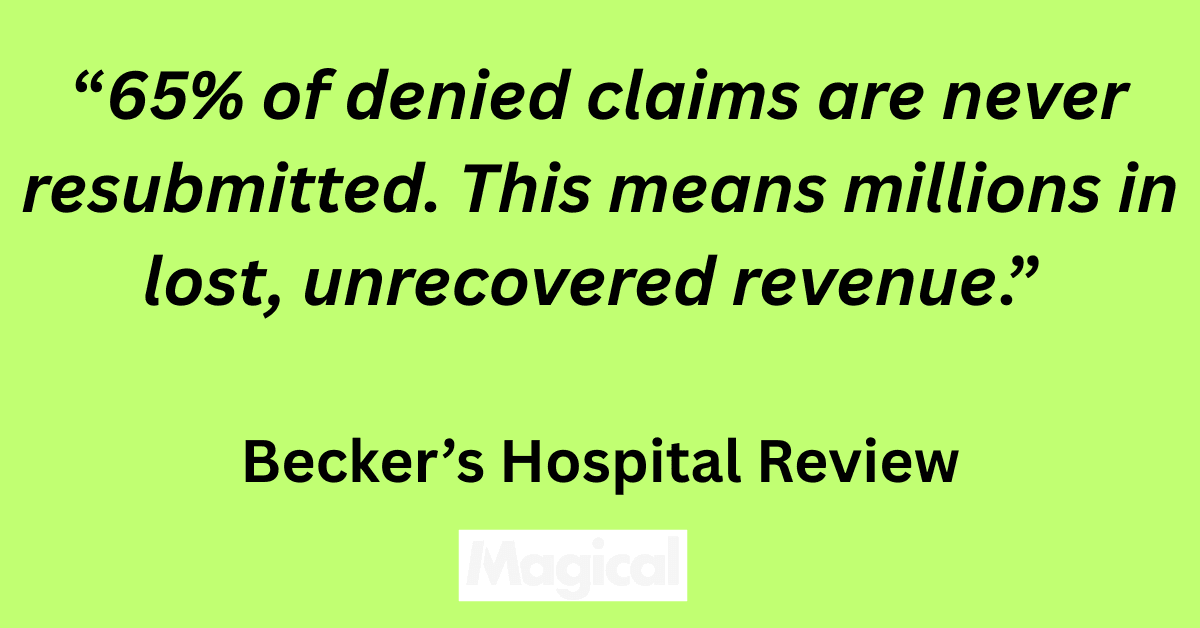
Up to 65% of those denials are never reworked or resubmitted (Becker’s Hospital Review)
Each denial costs an average of $25 to $118 to rework (MGMA)
The U.S. healthcare system loses billions annually from preventable claim denials
That’s not inefficiency.
That’s a system-wide leak.
The Most Common Denial Types:
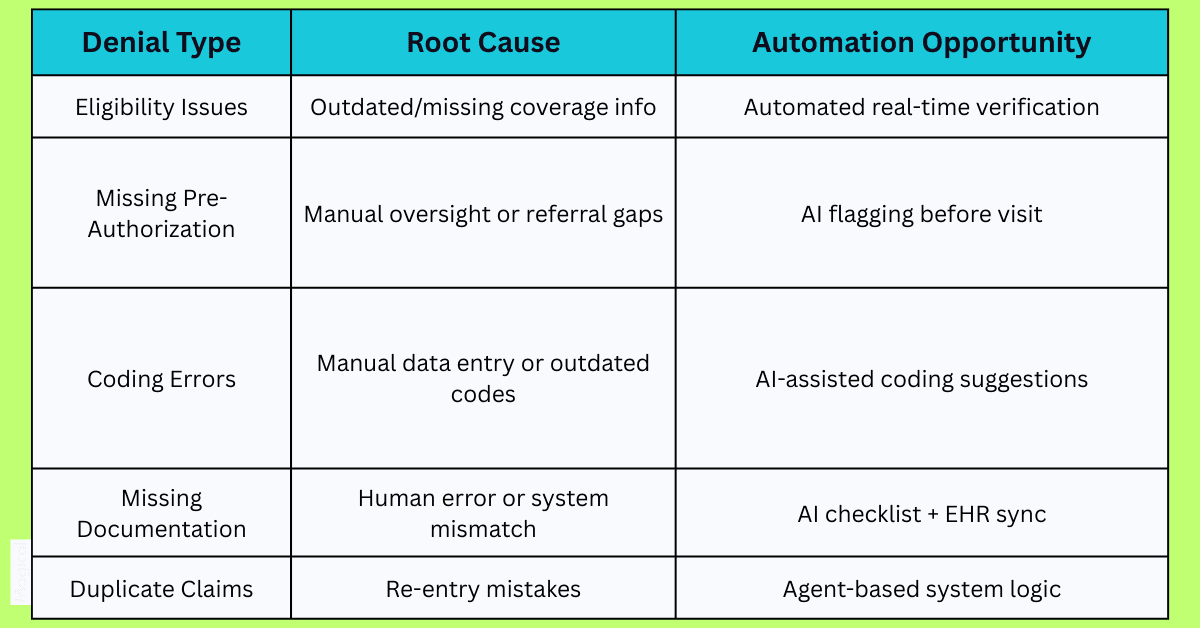
Nearly all of these can be automated or prevented upstream.
The problem isn’t lack of effort.
It’s workflows built for a pre-AI world.
Traditional Denial Management: Too Little, Too Late
For most healthcare teams, denial management starts after the damage is already done.
The claim is submitted. The payer rejects it. Then the scramble begins:
Staff investigate the rejection reason
Pull up supporting documentation
Manually correct the issue
Resubmit the claim
Wait (again)
Hope it gets approved this time
Multiply that process by dozens (or hundreds) of claims per week, and you’ve got a system designed for reaction, not prevention.
And it’s burning your team out.
The Flaws In Reactive Denial Management:
It’s slow — Each denial adds days or weeks to reimbursement cycles.
It’s expensive — Reworking a claim costs more than just time—it’s lost margin.
It’s demoralizing — High-performing teams feel like they’re stuck in cleanup mode.
It’s incomplete — Many denials aren’t resubmitted at all. The revenue just… dies.
In a system where even small claims can take 10–15 touches to resolve, this model doesn’t scale.
It never did.
What healthcare needs isn’t better denial rework. It’s fewer denials, period.
And that’s where AI flips the model.
How AI Automation Prevents Denials Before They Happen
Denials don’t come from one big mistake.
They come from a thousand small ones. Missed pre-auths, outdated coverage data, incomplete fields, incorrect codes.
And most of those mistakes happen before the claim is submitted.
That’s why AI doesn’t just help your denial team work faster.
It helps your entire organization submit cleaner claims on the first try.
Here’s how intelligent agents shut down denial risk at every stage.
Pre-Submission Data Validation
AI agents verify that all required data is present, accurate, and formatted correctly before the claim ever leaves your system.
They:
Auto-check for missing fields
Validate patient demographics against payer requirements
Flag duplicate or inconsistent entries
Cross-reference historical claim patterns
No more “clean claims” that aren’t actually clean.
AI agents learn over time which payers are pickier about certain fields—and adapt accordingly.
Real-Time Eligibility Checks
One of the most common (and preventable) denial causes?
Eligibility errors.
AI agents run real-time eligibility verification the moment a patient is scheduled or checked in, pulling data directly from:
EHRs
Intake forms
Clearinghouses or payer APIs
They confirm coverage, network status, co-pays, and deductible information and update the patient record automatically.
Already saw this in action? TCPA reduced admin time and coverage-related denials by automating eligibility upfront.
Automated Prior Authorization Detection
AI agents can:
Detect if a procedure or service requires prior auth based on payer rules
Cross-check the patient plan
Alert staff immediately before the appointment
Even trigger automated workflows to submit pre-auth requests
That means no more post-visit surprises or authorization denials weeks after care is delivered.
Intelligent Coding Support
Agents assist coders in real time by:
Suggesting accurate CPT/ICD-10 codes based on documentation
Flagging common denial triggers like mismatched modifiers or diagnosis-code conflicts
Surfacing payer-specific coding rules
This reduces both undercoding (lost revenue) and overcoding (compliance risk).
Case Study: ZoomCare
Magical helped ZoomCare automate backend billing workflows, reducing errors, accelerating reimbursement, and lowering resubmissions due to coding and documentation issues.
Post-Submission Pattern Recognition
Once claims are submitted, agents continue working in the background, analyzing payer responses to identify:
Denial trends
Payer-specific rejection language
Timing issues (e.g., late submissions)
They then adjust future submissions to avoid the same issues, just like your best rev cycle analyst would, only 24/7.
AI doesn’t just automate tasks.
It improves the system every time it runs.
And when intelligent agents are working across your entire revenue cycle, you don’t just reduce denials. You rewire the process to prevent them.
Magical’s Unique Approach to Denial Prevention
Plenty of platforms promise automation.
But most of them are built for tech teams, not healthcare ops. They’re rigid, slow to deploy, and crumble the second a payer changes a rule.
Magical was built differently.
It’s not just AI. It’san intelligent agent automation that’s designed for healthcare complexity, denial prevention, and operational speed.
Here’s what makes Magical stand out:
Outcome-Based Automation
Most automation tools stop at task completion. Magical’s agents are trained to achieve specific outcomes, like:
Lower denial rates
Faster claims processing
Cleaner first-pass submission
It’s not about pushing buttons.
It’s about getting you paid faster with fewer errors and zero rework.
Cross-Workflow Intelligence
Denials aren’t caused by one broken task. They’re caused by disconnected workflows.
Magical’s agents operate across the full claim lifecycle:
Intake
Eligibility
Authorization
Coding
Submission
Reconciliation
Because when your processes are siloed, denials slip through the cracks. Magical closes the gaps.
No-Code, Healthcare-Ready Deployment
Unlike RPA platforms like UiPath or Make, Magical requires:
No scripting
No developer support
No custom APIs
Just choose the workflow, plug into your existing tools, and deploy in days, not quarters.
Secure, Scalable, and Built for PHI
Role-based access controls
End-to-end encryption
Full audit trails
Magical gives rev cycle leaders the power of AI without compromising on security, governance, or system compatibility.
Fast Time-to-Value
You don’t need to wait 6 months to prove ROI.
Magical customers often see:
Immediate reduction in denials
Hours of admin time saved in week one
Cleaner claims within the first billing cycle
This is AI you can deploy, trust, and scale, without the bloat.
Business Impact of Reducing Denials with AI
Reducing denials isn’t just about fixing a workflow.
It’s about reclaiming revenue, protecting your margins, and giving your team the time and tools to stop cleaning up problems…and start preventing them.
Here’s what happens when intelligent agents take the lead.
Higher First-Pass Resolution Rates
Clean claims = faster payment, fewer rejections, less back-and-forth.
With AI automating eligibility, pre-auth detection, coding, and submission:
Denials drop
Reimbursement cycles shrink
Cash flow improves
According to RevCycle Intelligence, each 1% improvement in first-pass yield can drive significant ROI in organizations processing high claim volume.
Lower Cost Per Claim
Fewer denials = less staff time wasted on:
Manual investigation
Rework and resubmissions
Appeals and documentation pulls
MGMA estimates reworking a denied claim costs $25–$118 per claim. That’s pure margin lost on work you already did.
AI agents prevent those errors upfront, reducing total claim cost and boosting operating efficiency.
Increased Revenue Retention
Industry-wide, up to 65% of denied claims are never resubmitted (Becker’s Hospital Review).
That’s not just inefficiency. That’s lost revenue.
By stopping denials before they happen, AI helps you:
Capture more revenue
Eliminate revenue leakage
Maximize reimbursement for services already rendered
Team Efficiency and Morale
Your team didn’t sign up to be claim chasers. AI agents give them time back to:
Focus on complex cases
Improve process quality
Breathe
Less rework = less burnout. And in healthcare, that’s priceless.
What Denials You Can Automate Right Now
You don’t need to overhaul your entire claims operation to see results. You just need to start where the pain is sharpest and the win is fastest.
Here are the most common, high-impact denial types you can automate immediately with intelligent agents:
Eligibility-Related Denials
Outdated or missing insurance info
Incorrect plan or policy numbers
No secondary coordination
AI Fix: Agents run real-time verification and sync payer data back into your EHR or billing system before the claim is even submitted.
Missing Prior Authorizations
Services requiring pre-auth not flagged
No referral on file
AI Fix: Agents detect pre-auth requirements automatically based on procedure codes and payer rules, and flag or trigger next steps before the visit.
Incomplete Documentation
Supporting clinical notes or attachments missing
Incorrect or partial patient data
AI Fix: Agents pull required documentation, double-check fields for completion, and ensure payer requirements are met at the point of submission.
Coding Errors
Mismatched diagnosis and procedure codes
Missing modifiers
Outdated codes
AI Fix: Agents assist coders in real time, suggesting corrections and adapting to payer-specific logic to reduce bouncebacks.
Duplicate Submissions
Claims submitted twice by mistake
Billing errors due to system sync issues
AI Fix: Agents track submission status, detect duplicates, and eliminate repeat entries automatically.
Automate just one of these? You’ll see the impact immediately.
Automate all five? You’ll change the way your entire rev cycle operates.
Final Thoughts
Denials are not inevitable. They’re not just the cost of doing business.
They’re the byproduct of broken workflows and they can be prevented.
When intelligent agents step in, claims go out clean, fast, and fully prepared.
No missing data.
No missed pre-auth.
No preventable rejections.
This isn’t about working harder.
It’s about making your systems smarter, so your team can stop chasing dollars and start collecting them.
Try it for yourself:
Download the free Magical Chrome Extension — used by nearly 1,000,000 users to save an average of 7 hours per week.
Or book a live demo to see how Magical is helping over 100,000 companies prevent denials, protect revenue, and take back control of the claims process.
Because getting paid shouldn’t be a battle.
With AI, it isn’t.