
Many health plans and insurance providers assume their claims operations are “tight”—but even small inefficiencies compound. While precise public benchmarks are elusive, evidence from payer and insurance programs point to meaningful leakage:
According to a recent study, prior authorization (PA) alone is estimated to cost payers $6 billion annually in administrative burden.
In Medicaid, “improper payments” (i.e. overpayments, underpayments, errors) are a recognized issue: in FY 2024, the Medicaid improper payment rate was ~5.09%, totaling $31.1 billion—with ~79% of those errors traced to insufficient documentation.
Claims denials remain significant: in a 2024 survey, roughly 15% of claims were denied—up from ~12% in earlier years—hinting at persistent friction in adjudication.
These data points suggest that payers are bearing nontrivial cost and risk from process inefficiencies. The question is: how do you translate this into your own leakage baseline and identify where automation can plug these inefficiencies?
4 Ways Health Plans Are Quietly Bleeding Dollars
Health plans don’t always see where the money is leaking. On paper, your claims operations might look efficient. But under the surface? Billions slip away every year through preventable process inefficiencies.
Here are four of the biggest culprits—and why they matter now more than ever.
1. Prior Authorization (PA) Pain
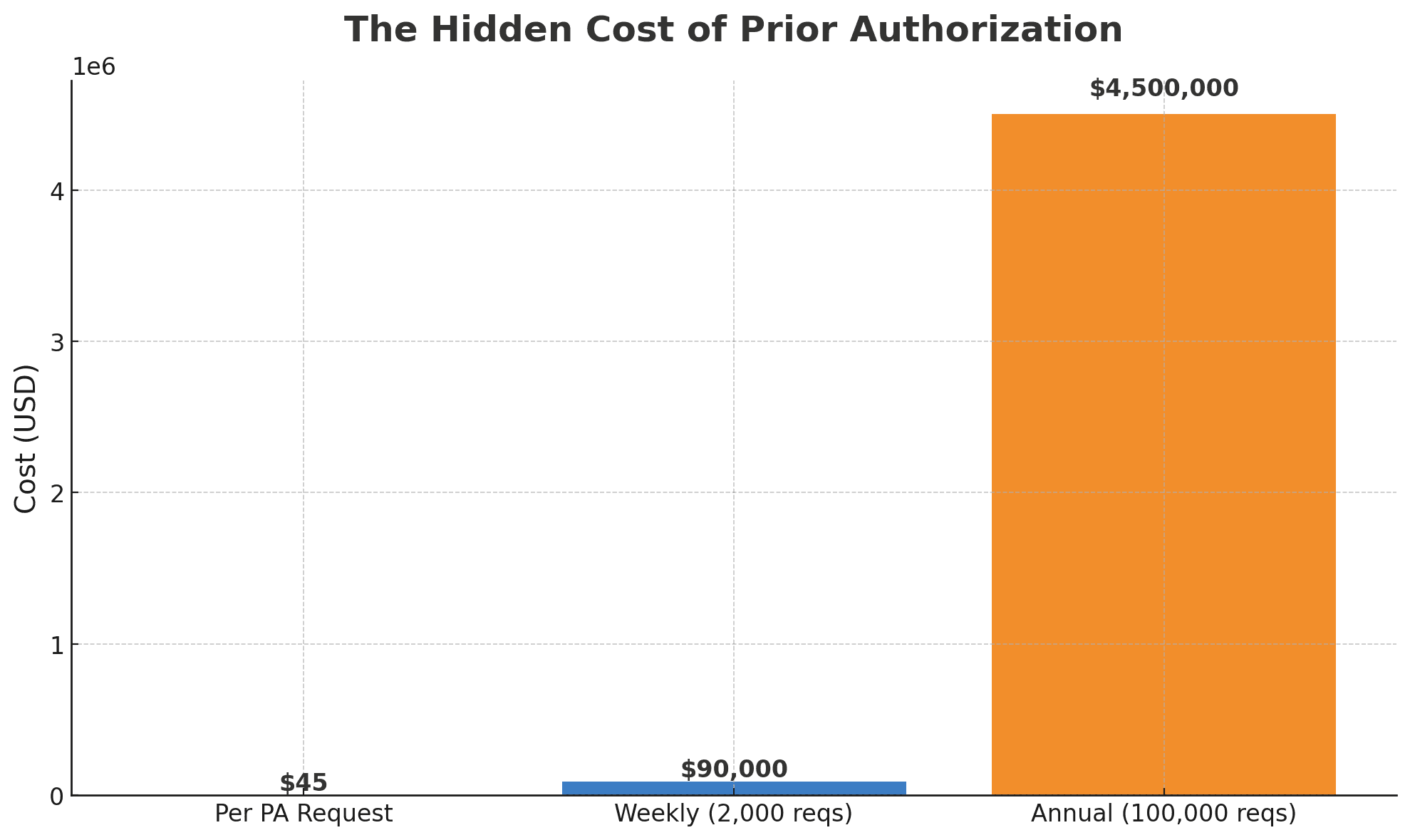
Prior auth isn’t just a provider headache—it’s a payer cost center too.
Each PA request costs health plans $40–$50 in administrative overhead. Multiply that by thousands of requests per week, and the math gets painful fast.
New federal rules (effective in 2026) will require faster turnaround times—as little as 72 hours for urgent cases.
Miss those deadlines, and the cost isn’t just labor. It’s penalties, corrective action plans, and brand damage with providers and members alike.
Bottom line: The PA process is a regulatory and cost minefield. Without automation or a prior authorization AI employee, every request drags your margins.
2. Improper Payments from Documentation Gaps
Not all leakage comes from fraud—sometimes it’s just sloppy process.
In Medicaid, improper payments totaled $31.1B in FY 2024, with nearly 80% tied to insufficient documentation.
For commercial and MA plans, similar risks lurk: overpayments made because a document was missing or miscoded, underpayments that spark costly provider disputes, or delayed audits that make recoveries impossible.
Every missed recovery opportunity is money permanently out the door.
Bottom line: Weak documentation controls are a silent drain. The dollars look legitimate until you dig deeper.
3. Denials, Appeals, and Endless Rework
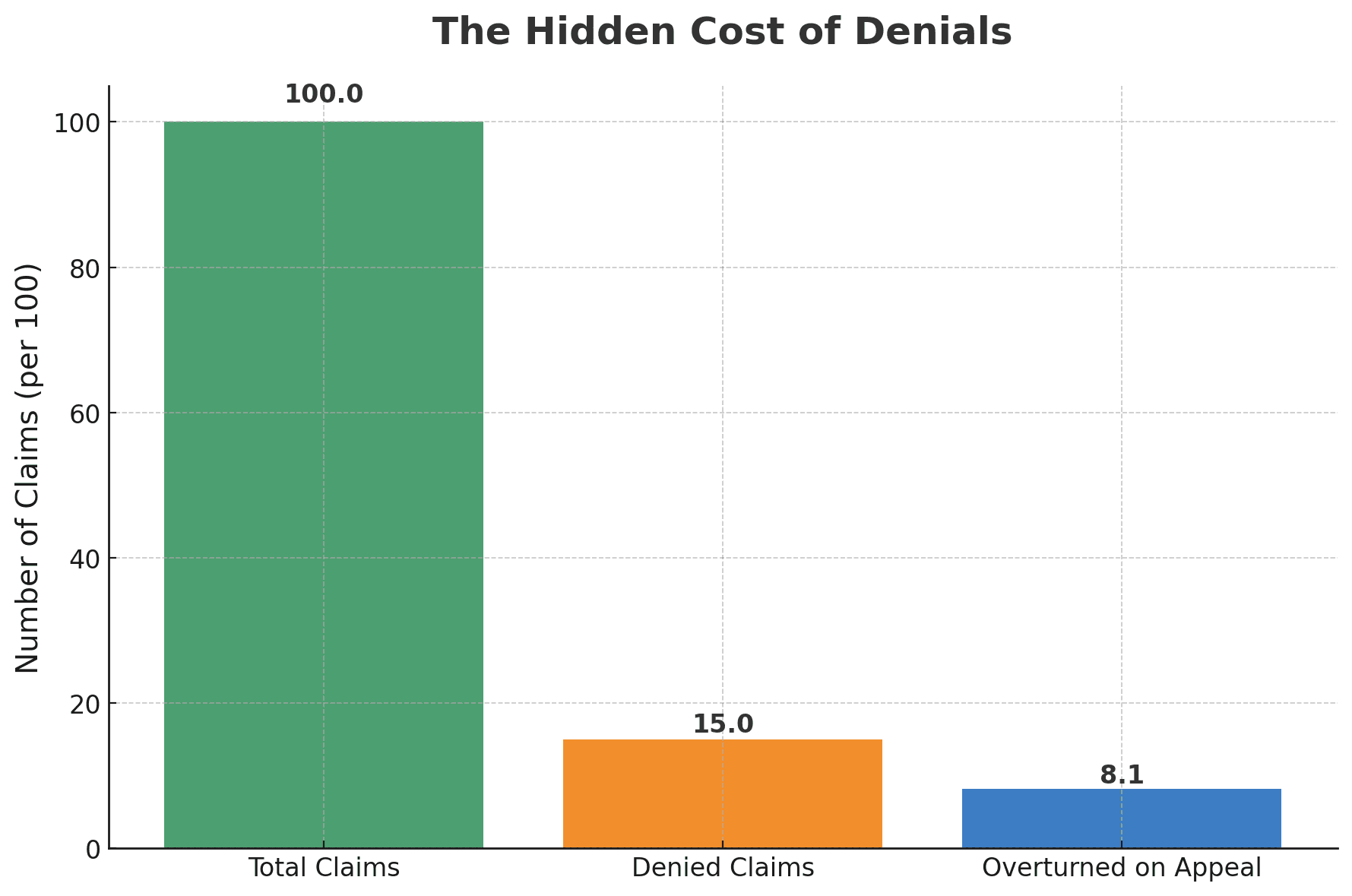
Denials aren’t just frustrating—they’re expensive.
Around 15% of claims are denied in some payer environments.
More than half of those denials (54.3%) are later overturned—after costly back-and-forth.
Each denial triggers staff time, member/provider frustration, and slowed cash flow. Worse, some valid claims are never resubmitted at all, turning inefficiency into true leakage.
Bottom line: If half your denials are overturned, you’re not just delaying payment—you’re paying double in labor.
4. Bad Provider Data, Big Consequences
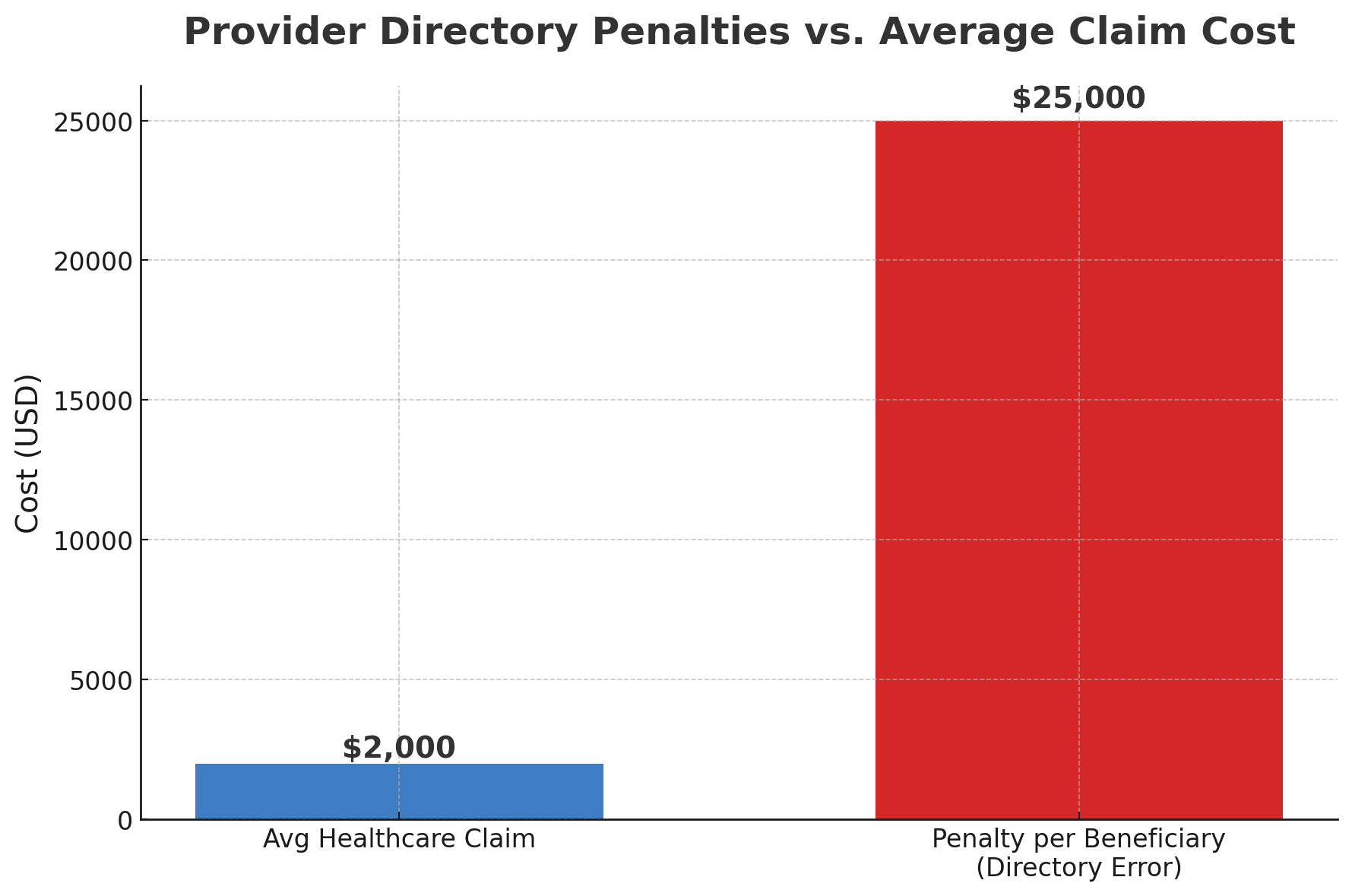
Provider data issues sound small—until they scale.
Inaccurate directories can trigger massive penalties: Medicare Advantage plans can be fined up to $25,000 per beneficiary for errors.
Stale or wrong data causes claims to be misrouted, denied, or reprocessed. Every correction = staff hours.
Members and providers also lose patience quickly. A bad directory entry can mean a patient shows up at the wrong office—or a provider spends weeks fixing an error.
Bottom line: Bad data creates both regulatory exposure and operational drag. It’s the definition of death by a thousand cuts.
Instruction Manual: Estimating Leakage & Savings for Health Plans
Here’s a more conservative, payer-aligned framework your team can use to build a leakage model specific to your health plan operations.
Step 1: Collect Baseline Inputs
Metric | Description |
Annual Paid Claims Spend (TCS) | The total dollars your plan pays out on claims in a year |
Estimated Baseline Leakage Rate (ELR) | A percentage estimate of how much spend is lost to inefficiency, errors, overpayments, denials, etc. Use industry proxies (e.g., 3–7%) if internal audit data are weak |
Number of Claims Processed (N_claims) | Total volume of claims adjudicated annually |
Denial / Rework Rate (DRR) | Proportion of claims requiring appeal, rework, denial resolution |
Cost per Rework / Appeal (CRC) | Fully loaded labor + overhead per claim reworked or appealed (based on internal costing) |
Automation-Addressable Fraction (AAF) | The fraction of your leakage that you believe can be mitigated by automation (e.g. 20–40%) |
Automation Implementation Cost (AutoCost) | One-time + recurring cost to deploy and run automation systems in the plan |
Step 2: Estimate Your Baseline Leakage
You can look at leakage in two ways:
By total spend: Take your total annual claims spend and apply a conservative leakage percentage (industry benchmarks suggest 3–8%). This gives you a quick, high-level estimate of what might be slipping through the cracks.
By rework: Add up the costs of reprocessing denied or appealed claims. Multiply the number of claims reworked each year by the average staff cost per rework.
To stay safe, use the larger of the two numbers as your baseline estimate. As a gut check, your leakage should usually fall in that 3–8% of claims spend range. If it doesn’t, you may want to revisit your assumptions.
Step 3: Estimate Potential Savings with Automation
Now that you know your leakage, the question is: how much of it can be fixed with automation?
Addressable Leakage: Estimate what percentage of your leakage can realistically be reduced through automation—typically 20–40% is a fair starting point.
Net Savings: Subtract the cost of implementing automation from the savings potential to see your “true” benefit.
ROI and Payback: Look at the return compared to your investment, and calculate how long it would take to “break even” (often measured in months, not years).
Sensitivity Testing: Run a few scenarios—conservative, likely, and optimistic—by adjusting your assumptions. This helps you set realistic expectations.
Step 4: Allocate Leakage to Key Domains
Not all leakage is equal. Break down your savings potential by the four key problem areas:
Prior authorization (PA) processing
Claims denials and appeals
Documentation and improper payments
Provider data accuracy
This helps you see which areas are the biggest drains and should be tackled first.
Step 5: Pilot, Calibrate, Expand
Don’t try to fix everything at once. Instead:
Pick one high-volume, high-friction area (like denial management or PA).
Run a pilot project and measure leakage before and after automation.
Adjust your assumptions based on the real-world results.
Expand into other areas once you’ve proven the return.
Why This Matters Now for Health Plans
The healthcare regulatory environment is tightening — upcoming federal rules around prior authorization will require faster, more transparent decisions. (E.g. 72-hour decision windows for urgent requests.)
Plan administrators are already signaling moves to reduce PA burdens; for example, Humana plans to eliminate ~1/3 of its PA requirements for outpatient services by 2026.
Rising volume, shrinking margins, and labor cost inflation make any inefficiency more painful.
Automation / AI can help not only reduce leakage but also reduce cycle times, improve audit defensibility, minimize regulatory risk, and improve provider satisfaction.
What's next?
Your first step isn’t installing a product. It’s mapping your own leakage baseline and prioritizing the domains with the highest ROI. Once you see even modest leakage numbers (e.g. 5% of spend), the upside becomes undeniable.
We encourage you to:
Use this instruction manual internally to build your baseline
Book a demo with Magical to see how you can run pilot projects in one or two domains (for example, PA, claims review)
Share your pilot results and compare to benchmark ranges
Explore how agentic AI / workflow automation can deliver the scale and cognitive oversight needed