
Every day your team spends chasing down denied claims is a day you lose money, momentum, and sleep.
You don’t need another report telling you the denial rate went up 3%. You’re already knee-deep in rework:
Pulling patient records from one system
Logging into payer portals
Copy-pasting clinical notes
Praying the appeal goes through
Hoping someone gets to the next one before the deadline hits
Meanwhile, the queue keeps growing.
The backlog gets heavier.
And your team? Burned out, outnumbered, and out of time.
Here’s the problem no one wants to admit:
Most denial rework processes are designed to fail.
They’re manual. They’re brittle. And they assume your team has infinite hours to babysit them.
You don’t.
But AI does.
Not the theoretical “AI might solve this someday” kind.
The kind that runs smoothly in the background, cutting down hours of denial and rework. All without needing code changes or pulling your engineers away from real work.
This isn’t about fixing what’s broken.
It’s about replacing it with something that works.
Let’s break down how AI agents are helping healthcare teams eliminate their denial backlogs, recover revenue faster, and finally catch their breath.
Why Denial Rework Backlogs Happen (Even at High-Performing Teams)
Time to set the record straight. A denial backlog doesn’t mean your team isn’t putting in the effort.
It means they’re working in a system that’s not built to keep up.
Denial rework is one of the most manual, chaotic, and error-prone processes in healthcare ops. And even high-performing teams get overwhelmed, fast.
Here’s why.
Denials Sit in Queues Too Long
Your EHR or billing system might log denials, but:
There’s no auto-triage
No prioritization
No routing to the right person
No alerts for deadlines
So the denials pile up.
Some get missed. Some get started but not finished.
And some just disappear into the void.
Every Appeal Is a Miniature Scavenger Hunt
Even a “simple” rework involves:
Digging into the EHR
Copying over CPT codes, encounter notes, and insurance details
Logging into a payer portal
Filling out the same form for the 50th time
Attaching PDFs and documentation
Multiply that by 20, 30, 100 denials a week, and you’ve got a backlog by design.
No Consistent Workflow
One team member might:
Work denials from a spreadsheet
Use a saved Word doc template
Rely on email reminders
Leave notes in the EHR… maybe
Another might do it differently.
So if someone’s out sick or leaves?
The process falls apart.
No standard = no scalability.
Humans Just Can’t Keep Up
The tough part is, even when your team jumps on it right away, they’re already playing catch-up.
Because denials are relentless.
They don’t care how many you’ve reworked. They keep coming.
And your staff isn’t inefficient. They’re under-supported.
Doing too much, with too little, on systems that were never built for high-volume denial cycles.
Stat Spotlight
Denials cost healthcare providers $262 billion annually in administrative waste and lost revenue
65% of denied claims are never reworked, even though most are recoverable
You don’t need more people.
You need a system that doesn’t rely on people to do it all manually.
Why Traditional Automation Doesn’t Solve the Problem
If you’ve tried to fix your denial backlog with automation and still ended up underwater, you’re not alone.
You don’t have a denial problem.
You have a broken automation model.
Rigid Bots Break on Contact
Most “automation” in healthcare is still rule-based:
“If denial code = X, do Y”
“Auto-populate field A with value B”
Sounds great, until:
Payer rules change
Forms are updated
Fields move
A claim doesn’t fit the pattern
Then the bot fails.
And guess who has to pick up the pieces?
You.
Static Workflows Don’t Flex With Reality
Traditional automations are linear:
They expect clean inputs
They assume no exceptions
They collapse when something unexpected happens
But denial rework is messy:
Different payers, different formats
Missing documentation
Secondary insurance quirks
Clinical nuance that requires real context
Legacy tools can’t reason.
They can’t decide.
They can’t adapt.
Most Tools Don’t Span Systems
You might have an automation inside your billing tool. But denials touch:
EHR
CRM
Payer portals
Fax tools
Spreadsheets
Email
No single system owns the workflow, so your team ends up being the “integration.”
And guess what that looks like?
Copy → Paste → Tab → Log in → Upload → Repeat.
Traditional Automation Is IT-Dependent
You want to change a step in your workflow?
Cool. Open a ticket.
Wait 3 weeks.
Hope it doesn’t break anything else.
That’s not agility. That’s gridlock.
And denial rework doesn’t wait for approval cycles.
Bottom Line?
Old-school automation can’t handle the complexity or volume of denial workflows.
It doesn’t understand what’s happening.
It doesn’t make decisions.
It doesn’t evolve with your team.
But AI agents can and do.
The Case for AI Agents in Denial Rework
If traditional automation is a brittle flowchart, AI agents are dynamic coworkers that think, act, and learn.
They don’t follow static rules.
They understand the denial, figure out what’s missing, and take action across systems, with zero guesswork.
That’s not wishful thinking.
That’s how Magical’s agents work right now.
What Makes AI Agents Different?
AI agents don’t just move data. They make decisions.
They:
Interpret context (e.g. payer-specific denial codes)
Identify required actions based on reason codes and workflows
Pull relevant documentation from EHRs, billing tools, and notes
Assemble packets or draft appeals in seconds
Route to the right team or submit directly via portals
All while maintaining a full HIPAA-compliant audit trail.
How Magical Deploys Agents in the Real World
Magical agents:
Run in the browser. No need for deep integration
Work across EHRs, billing software, CRMs, and payer portals
Read, write, and act securely using AI + automation
Are built without code, so ops teams can launch them directly
You tell the agent what the goal is:
“When a denial comes in, check if it’s appealable, pull the required documents, and send a draft to the payer.”
Magical builds and deploys that agent.
No code. No IT bottlenecks. No patching together five tools with copy-paste.
AI Agents vs. Traditional Bots
Capability | Traditional Automation | AI Agents (Magical) |
Adapts to payer rules | ✘ | ✅ |
Pulls data across systems | ✘ | ✅ |
Makes decisions with context | ✘ | ✅ |
Learns over time | ✘ | ✅ |
Built by ops, no IT | ✘ | ✅ |
HIPAA-compliant with audit logs | ⚠️ | ✅ |
This isn’t “set it and hope.”
This is outcome-driven execution that works the way your team works and finally scales the process that’s been scaling your stress.
Anatomy of an AI-Driven Denial Rework Workflow
So how does an AI agent eliminate denial rework?
Let’s walk through a complete denial workflow. From the moment the denial hits your queue to the moment the appeal is submitted or resolved.
This isn’t theoretical.
This is the exact kind of workflow Magical agents handle for healthcare orgs every single day.
Step 1: Denial Detected
Magical monitors your billing system or denial queue (via browser view or API) and identifies new denials as they appear—no refresh, no manual check.
Extracts payer name, denial reason, claim ID, and service codes
Cross-references against a ruleset to determine if it's appealable
No: → logs and closes the loop.
Yes: → moves to Step 2.
Step 2: Payer Rule Check
The agent references payer-specific guidelines for that denial type:
Required documentation
Format of appeal (fax, portal, mail)
Appeal deadline and expiration window
This context drives the next steps, not a static script.
Step 3: Record Retrieval
Magical accesses:
EHR documentation (visit notes, lab results, CPT/ICD codes)
Prior auth forms
Insurance verification history
Any other required supporting materials
It pulls the exact data points needed. No more, no less.
Step 4: Appeal Packet Creation
The agent assembles everything:
Drafts an appeal letter (with dynamic fields auto-filled)
Attaches all supporting docs in the required format
Names and organizes files according to payer specs
Everything is logged with timestamps, source data, and access trails for HIPAA compliance.
Step 5: Auto-Routing or Submission
Depending on your workflow, the agent:
Uploads the packet to the payer portal
Sends it via secure e-fax
Or routes it internally for review or escalation
Nothing gets stuck.
Nothing gets missed.
Nothing gets misrouted.
Step 6: Confirmation and Follow-Up Logging
Once submitted, the agent:
Logs confirmation from the payer (or fax success)
Updates internal systems or dashboards
Flags any needed follow-ups or exceptions
Triggers a recheck task before the appeal window closes
Steps in an AI-Driven Denial Rework Workflow
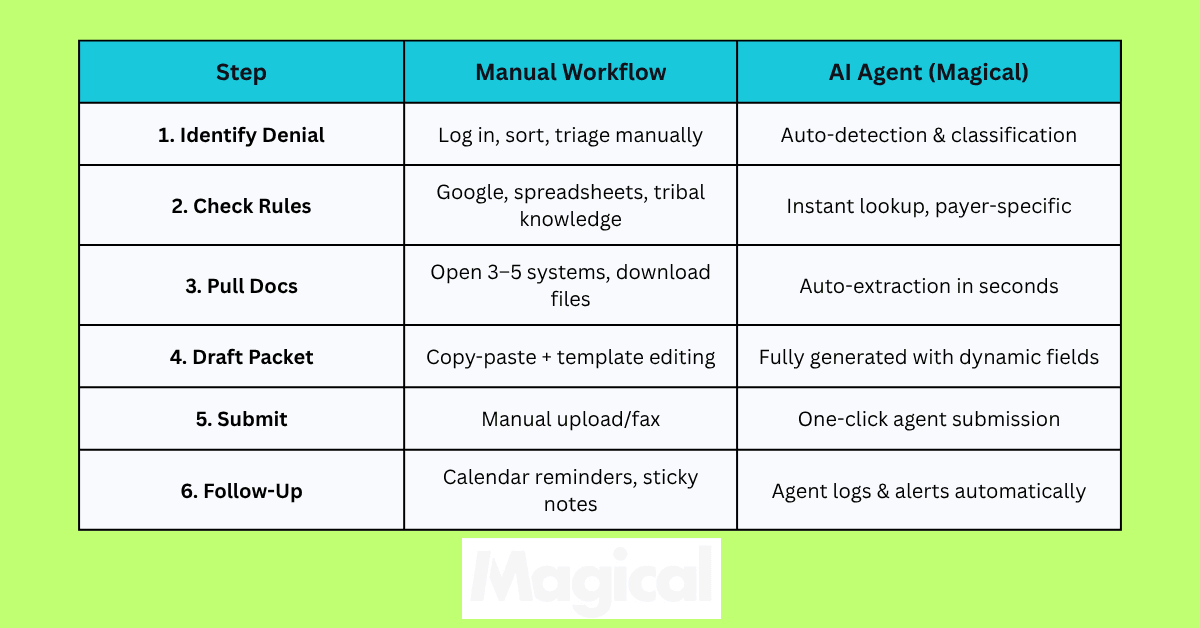
It’s not only quicker, but also more accurate, compliant, and built to scale.
3 Big Results Teams See With AI-Powered Denial Workflows
When AI agents take over the heavy lifting in denial rework, the impact is immediate and compounding.
You’re not just removing friction.
You’re unlocking capacity, revenue, and speed in ways no spreadsheet or rule-based bot ever could.
1. Rework Time Drops by 60–90%
Once agents take on:
Denial intake
Documentation gathering
Appeal drafting
Submission
...your team is no longer spending hours per denial on repetitive admin tasks.
Instead:
They review only exceptions
Handle escalations
Focus on high-value claims
Actually breathe
Result: Same team. Way more done.
Backlog? Gone.
2. Denials Actually Get Worked
Truth is, most teams don’t follow up on every denial. They just don’t have the capacity.
There’s not enough time in the day. So what happens?
Denials age out
Deadlines are missed
Recoverable revenue stays unrecovered
AI agents flip the script:
Every denial is triaged instantly
Agents escalate only what needs a human
High-volume, low-complexity claims are resolved fast
No denial gets left behind.
3. Revenue Gets Recovered
Speed + accuracy + coverage = cash.
When you work more denials, faster, with fewer errors:
More first-pass appeals succeed
Fewer claims get resubmitted late
More dollars hit your bottom line in weeks, not months
Stat Check:
A Change Healthcare study found that the average cost to rework a denied claim is $118
With automation, those costs drop dramatically, and recovery rates spike
The Result? Your Team Stops Drowning
There’s no dashboard stat for burnout. But every ops and billing lead knows what it looks like:
Missed deadlines
High turnover
Mental fatigue
That look in someone’s eye after 6 hours of portal logins
AI agents give your people time back.
Time to focus, time to improve processes, time to stop surviving and start optimizing.
Editor’s Note: See how WebPT and TCPA were able to do this by clicking here and here.
What You Need to Make This Shift
The good news is that eliminating your denial backlog doesn’t require an enterprise overhaul or six months of integration.
You already have what you need….except the right tool.
Here’s what it takes to move from reactive to resolved, fast:
The Right People (Spoiler: You Already Have Them)
You don’t need a full automation team.
You need:
One billing lead or ops manager who knows your denial process
A few examples of your most common denial types
Someone who can say, “Here’s where we always get stuck”
That’s it. If your team knows the work, the agent can do the work.
The Right Process (Keep It Simple to Start)
This isn’t about mapping every edge case. Start with:
1–2 high-volume denial categories
A simple outcome (e.g. “create appeal,” “route for review”)
The systems involved (EHR, billing tool, portal)
Focus on one clean win, not boiling the ocean.
From there, the system scales.
Agents can handle more denial types, add logic, and automate exceptions over time.
The Right Platform (Here’s the Catch…Most Don’t Work)
Most tools fail here. Why? Because they’re:
Too rigid (rule-based, no logic handling)
Too technical (need IT to build)
Too siloed (don’t work across systems)
Too risky (lack HIPAA compliance)
Magical was built specifically to solve this.
It gives you:
Agentic AI that executes denial workflows end to end
HIPAA-compliant automation with signed BAAs, encryption, and full audit logs
No-code deployment so your ops team can launch and refine workflows in plain language
Cross-system execution, from browser-based portals to backend tools—no dev needed
That’s it.
No engineers. No downtime. No “transformation initiative.”
Just better outcomes, fast.
Final Thoughts: Kill the Backlog. Reclaim the Revenue.
Denial rework backlogs don’t start big.
They build slowly. One untouched claim, one missed appeal window, one system delay at a time.
Until you’re buried.
But here’s the thing: you’re not stuck.
You don’t need more people.
You don’t need more spreadsheets.
You don’t need another round of denial training that won’t scale.
You need a system that can:
Think like your best billing specialist
Act like your fastest analyst
Scale like software
And do it 24/7, without burnout or error
That’s what Magical delivers.
Built-in, agent-powered workflows that eliminate denial backlogs
Cross-platform, browser-native execution
HIPAA-compliant by default with audit logging
No-code setup your team can run themselves
Trusted by 100,000+ companies and nearly 1 million users
Saving teams an average of 7 hours per person, per week
Try Magical Free or Book a Demo
Install the free Magical Chrome extension and start seeing time savings immediately
Book a personalized demo to see how AI agents can eliminate your denial backlog, without touching your existing systems
You’ve tried working harder.
It’s time to work smarter.
Kill the backlog. Reclaim the revenue.
And give your team room to breathe.