
You followed the rules.
The codes were correct.
The service was covered. But still—denied.
It happens every day in healthcare billing. Claims that appear “clean” on the surface come back rejected for missing modifiers, invalid code pairings, or documentation mismatches.
And each denial doesn’t just delay revenue. It triggers a cascade of manual work: appeals, resubmissions, patient calls, and mounting frustration.
That’s why claim scrubbers have become essential, not optional, in revenue cycle management. But what they do (and don’t do) is still widely misunderstood.
A claim scrubber isn’t just another software add-on. When used strategically, it becomes the first true line of defense against revenue leakage and the unsung hero in your denial prevention playbook.
Let’s cut through the buzzwords and explain what a claim scrubber is, how it works, why it matters, and what the smartest teams are doing to take it even further.
What Is a Claim Scrubber in Healthcare?
Claim scrubbers are one of the most powerful yet underutilized tools in the healthcare revenue cycle. At a glance, they look like simple error-checking software. But in practice, they’re your first (and sometimes last) chance to prevent a claim from being rejected.
In an environment where up to 20% of claims are denied on first submission—most due to preventable issues like coding mismatches or invalid data—claim scrubbers can dramatically reduce friction, manual rework, and lost revenue.
Let’s break down what they are, how they function, and where they fit inside the revenue cycle workflow.
Definition: What a Claim Scrubber Does
At its core, a claim scrubber is software that reviews medical claims before they’re submitted to a payer. It evaluates the accuracy, completeness, and compliance of the claim by checking it against a massive set of coding, billing, and payer-specific rules.
Specifically, claim scrubbers:
Validate CPT, HCPCS, and ICD-10 code pairings
Identify missing or mismatched patient demographics
Detect invalid modifiers or outdated procedure codes
Check for medical necessity alignment based on payer or Medicare guidelines
Flag errors tied to payer-specific requirements, such as formatting or frequency limitations
According to Change Healthcare’s 2022 Denials Index, 86% of claim denials are potentially avoidable, and 26% are due to registration, eligibility, and authorization issues, all of which claim scrubbers can catch before submission.
Where Claim Scrubbing Fits in the Revenue Cycle
Claim scrubbing typically happens after the claim is generated in your EHR or billing system, but before it is sent to the clearinghouse or payer.
Here’s how it fits into a standard claims workflow:
Where Claim Scrubbing Happens
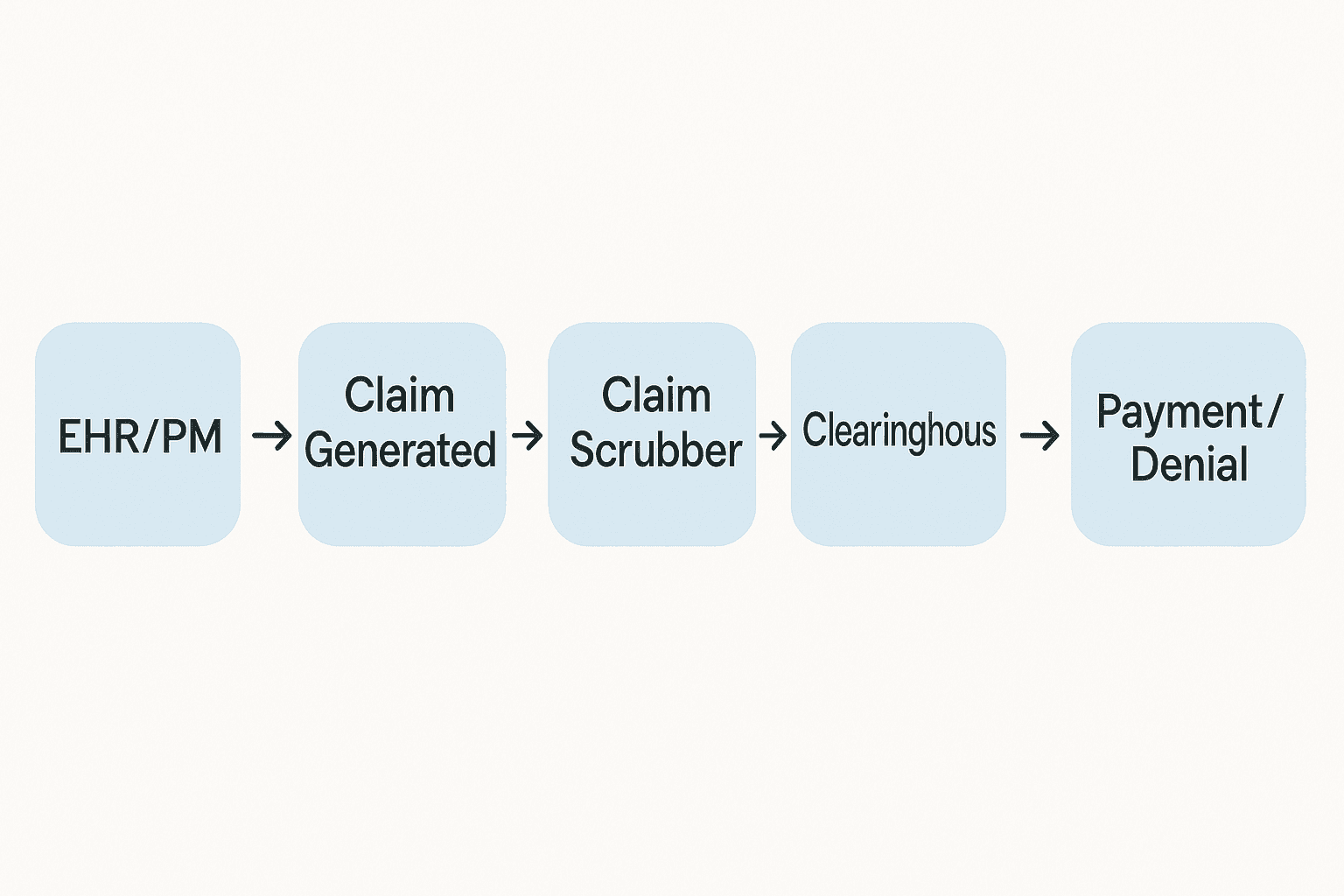
The scrubber acts as the “gatekeeper” between your system and the payer. The goal is a first-pass clean claim, meaning it’s accepted on first submission without edits or rework
What Claim Scrubbers Check For (and Catch)
Claim scrubbers check against a variety of rule libraries, including:
Validation Area | What’s Being Checked |
Code Accuracy | CPT, ICD-10, HCPCS code validation |
Modifier Use | Are modifiers appropriate and payer-approved? |
Medical Necessity | Does the diagnosis justify the procedure? |
Payer-Specific Requirements | Frequency limits, local coverage rules (LCDs) |
Data Completeness | Are patient demographics and NPI fields valid? |
If a scrubber flags an issue, the claim is typically routed back for manual correction—unless you’re using automation tools (like Magical) to handle the fix and resubmission instantly.
What Claim Scrubbers Don’t Do (And Why It Matters)
Here’s where many teams get tripped up: claim scrubbers don’t fix the errors they detect—they just flag them. That means your billing staff still has to:
Log into the EHR or billing system
Locate the issue
Manually correct the data
Re-enter or reformat the claim for submission
Update claim logs or dashboards manually
In high-volume billing environments, this creates significant overhead.
According to a 2023 HFMA survey, 74% of revenue cycle leaders say manual claim rework is a major cause of revenue leakage, particularly when flagged claims aren’t corrected and resubmitted promptly.
Think of Claim Scrubbers as Your Claims Quality Control Layer
Without scrubbing, you’re sending unverified claims into a complex, high-stakes payer environment. And given how fast payer rules evolve—and how strict Medicare and MAC LCD rules can be—no human team can realistically keep up manually.
Claim scrubbers are your safety net, but only when they’re paired with the right tools to act on what they catch.
In the next section, we’ll explore why claim scrubbers are more important than ever, especially in today’s high-volume, denial-prone billing environment.
Why Claim Scrubbers Matter More Than Ever in 2025
Healthcare billing has always been complex, but in the last few years, it’s crossed into something more chaotic: denial rates are rising, payer rules are shifting faster, and staffing gaps are stretching RCM teams to their limit.
In this environment, even small mistakes—like a missing modifier or outdated code—can cause big financial consequences. That’s why modern claim scrubbers have become indispensable. They’re no longer just an edit check. They’re the first line of revenue defense.
Here’s why.
Denials Are Increasing—and So Is the Cost to Fix Them
According to Experian Health, denials rose 23% between 2016 and 2023, with 11% of all claims denied on first submission.
Each denied claim costs:
$25–$118 to rework (based on data from HFMA)
An average of 16–20 additional days in AR
Additional downstream work: appeals, documentation gathering, patient follow-up
Multiply that by hundreds or thousands of claims a month, and the financial impact is massive.
Up to 65% of denied claims are never resubmitted, according to the American Medical Association, leading to permanent revenue loss.
Payers Are Updating Rules Faster Than Ever
Payers are constantly updating:
Covered CPT/HCPCS code lists
Diagnosis-to-procedure crosswalks
Frequency limitations
Prior authorization requirements
Medicare Administrative Contractors (MACs) update LCDs quarterly, and commercial payers often change rules with no standardized notice.
That means what was accepted last month might get denied today. Static rules-based scrubbers that aren’t constantly updated can’t keep up.
A 2024 MGMA report ranked “keeping up with payer rule changes” as the #1 challenge for billing teams, ahead of staffing and software complexity.
Manual Work Is Piling Up: Staff Burnout Is Real
Even when scrubbers flag errors, human staff still need to fix them, rekey data, and resubmit the claim. In high-volume environments, this creates:
Long claim queues
Higher error rates due to fatigue
Revenue delays
Staff burnout and turnover
The 2023 AAPC Medical Coding Salary Survey found that 73% of coders and billing professionals are performing repetitive rework tasks daily. It's unsustainable, especially in an industry already facing staffing shortages.
Claim Scrubbers Turn Data Chaos Into Revenue Control
In the middle of this storm, claim scrubbers give teams visibility, structure, and confidence. When properly configured, they help ensure that:
Claims are clean before they leave your system
Payer-specific rules are applied correctly
Denials are prevented, not just appealed
Scrubbers give your billing operation something it desperately needs: a consistent, reliable filter that catches costly errors before they become costly problems.
The Denial Domino Effect Without a Scrubber
[🔴] Outdated Modifier on CPT Code
Claim generated in EHR with a legacy modifier that’s no longer valid under current payer rules.
↓
[🔴] Claim Denied by Payer
Payer rejects the claim. Reimbursement is paused. Clock starts ticking.
↓
[🟡] Denial Reason Reviewed Manually
Billing team logs into portal, reads denial code, cross-references reason.
↓
[🟡] Claim Corrected and Resubmitted
Modifier corrected in EHR. Claim re-entered manually into payer portal.
↓
[🔴] Rejected Again Due to New LCD Update
Since initial claim, MAC has changed LCD coverage policy. Payer now rejects based on ICD mismatch.
↓
[🟡] Resubmitted Again with Added Documentation
Additional notes, justification statement, or test results uploaded manually.
↓
[🟢] Paid—34 Days After Original Submission
Revenue finally arrives—but only after weeks of rework and delay.
Without a scrubber: 3x more work, 2x longer payment window, and a frustrated team.
How Claim Scrubber Software Works (Step by Step)
Claim scrubbers may feel like black boxes from the outside—errors go in, alerts come out. But under the hood, they’re performing a series of crucial validations that can make or break your clean claim rate.
Here’s a simplified look at how a claim scrubber fits into your billing workflow—and what it does at each stage.
Step 1: Claim Is Exported from Your EHR or PM System
The process begins the moment a provider documents care. Once that data is coded and a claim is generated in your:
Electronic Health Record (EHR)
Practice Management (PM) System, or
Medical billing software (e.g., Kareo, Athenahealth, NextGen)
…it’s exported for review. This is where the scrubber takes over.
Step 2: The Claim Is Parsed and Checked Against Rule Sets
Claim scrubbers evaluate the claim line-by-line, checking it against:
General coding rules (CPT/HCPCS and ICD-10 syntax)
National Correct Coding Initiative (NCCI) edits
Payer-specific requirements
Local Coverage Determinations (LCDs) and Medically Unlikely Edits (MUEs)
Modifiers that may be missing or misused
According to CMS, modifier misuse is a top cause of billing errors, especially with -25 and -59.
The scrubber flags any discrepancies, missing fields, or compliance issues that could trigger a denial.
Step 3: Errors Are Flagged and Categorized
After analysis, the scrubber flags:
Hard edits that must be resolved before submission (e.g., invalid CPT code)
Soft edits that should be reviewed (e.g., questionable modifier use)
Each flagged issue is:
Displayed in a dashboard
Linked to its claim line item
Often categorized by denial risk or urgency
Some advanced scrubbers even provide recommendations or reasoning based on prior claims data or payer behavior.
Step 4: Staff (or an AI Agent) Applies Corrections
Here’s where the human or automation divide kicks in:
Without automation: A biller or coder manually opens the claim, switches to the EHR, fixes the issue, re-exports, and resubmits the claim.
With Magical: An AI agent pulls in the flagged field (e.g., CPT, modifier, diagnosis), cross-references it with prior clean claims, fills in the correction, and resubmits—all in seconds.
This step is where most delays and errors occur, especially when there’s toggling between systems.
According to HIMSS Analytics, healthcare staff switch between an average of 4.3 systems per workflow. Claim rework is one of the biggest culprits.
Step 5: The Claim Is Repackaged and Submitted
Once clean, the claim is:
Reformatted according to payer-specific formatting rules
Packaged with updated documentation, if required
Pushed to the clearinghouse or directly to the payer portal
From there, it enters the payer’s adjudication pipeline, and the wait begins.
But with fewer errors, claims scrubbed correctly are far more likely to be accepted on first pass.
Step 6: Status Updates and Feedback Are Tracked
Depending on your system, claim scrubbers may:
Track resubmission status
Log edits for compliance/audit trails
Feed insights into dashboards for future denial prevention
This feedback loop is critical for RCM leaders looking to monitor trends and educate billing staff on frequent issues.
Types of Claim Scrubbers
Not all claim scrubbers are created equal.
Some are built on decades-old rules engines that rely on static edit libraries and manual updates. Others are modern, AI-augmented tools that adapt to new payer behavior and help teams predict denials before they happen.
Understanding the difference between scrubber types isn’t just about features—it’s about knowing what your team needs based on your claim volume, complexity, and compliance requirements.
Let’s break it down.
Rules-Based Claim Scrubbers (The Traditional Model)
How they work: Rules-based scrubbers compare each claim against a predefined set of coding and payer rules. These rules are updated by vendors (sometimes monthly, sometimes quarterly), and cover:
Code formatting and validity
Modifier logic
NCCI and MUE edits
Payer-specific coverage policies
Strengths:
Reliable for basic error checking
Familiar to most RCM and billing teams
Cost-effective for smaller organizations
Limitations:
Edits are static—they don’t adapt to payer behavior or denial patterns
No learning capability (can’t improve based on past rejections)
Often requires manual updates to rule sets
Doesn’t support prediction, only detection
A RevCycle Intelligence survey found that 51% of RCM leaders still use static edit logic and are frustrated by its inability to keep up with fast-changing payer rules.
AI-Powered and Predictive Claim Scrubbers
How they work: AI-driven scrubbers use machine learning models trained on large volumes of past claim data to:
Predict denials based on code combinations, payer behavior, and past submissions
Recommend the correct CPT/ICD/modifier pairings
Flag high-risk claims before submission
Continuously improve from user and payer feedback loops
Some tools go further, using natural language processing (NLP) to extract documentation and validate medical necessity against LCD/NCD requirements.
Strengths:
Learns from real-world payer behavior
Flags issues that static scrubbers miss
Supports better coding accuracy and documentation alignment
Reduces rework by recommending or applying fixes proactively
Limitations:
May require IT support or integration work upfront
Often more expensive than traditional tools
Some features still in early-stage adoption across smaller vendors
Providers using predictive scrubbers have seen up to a 25% improvement in first-pass claim acceptance, according to Waystar.
Integrated vs. Standalone Scrubbers
Another key distinction: Where your scrubber lives in your workflow.
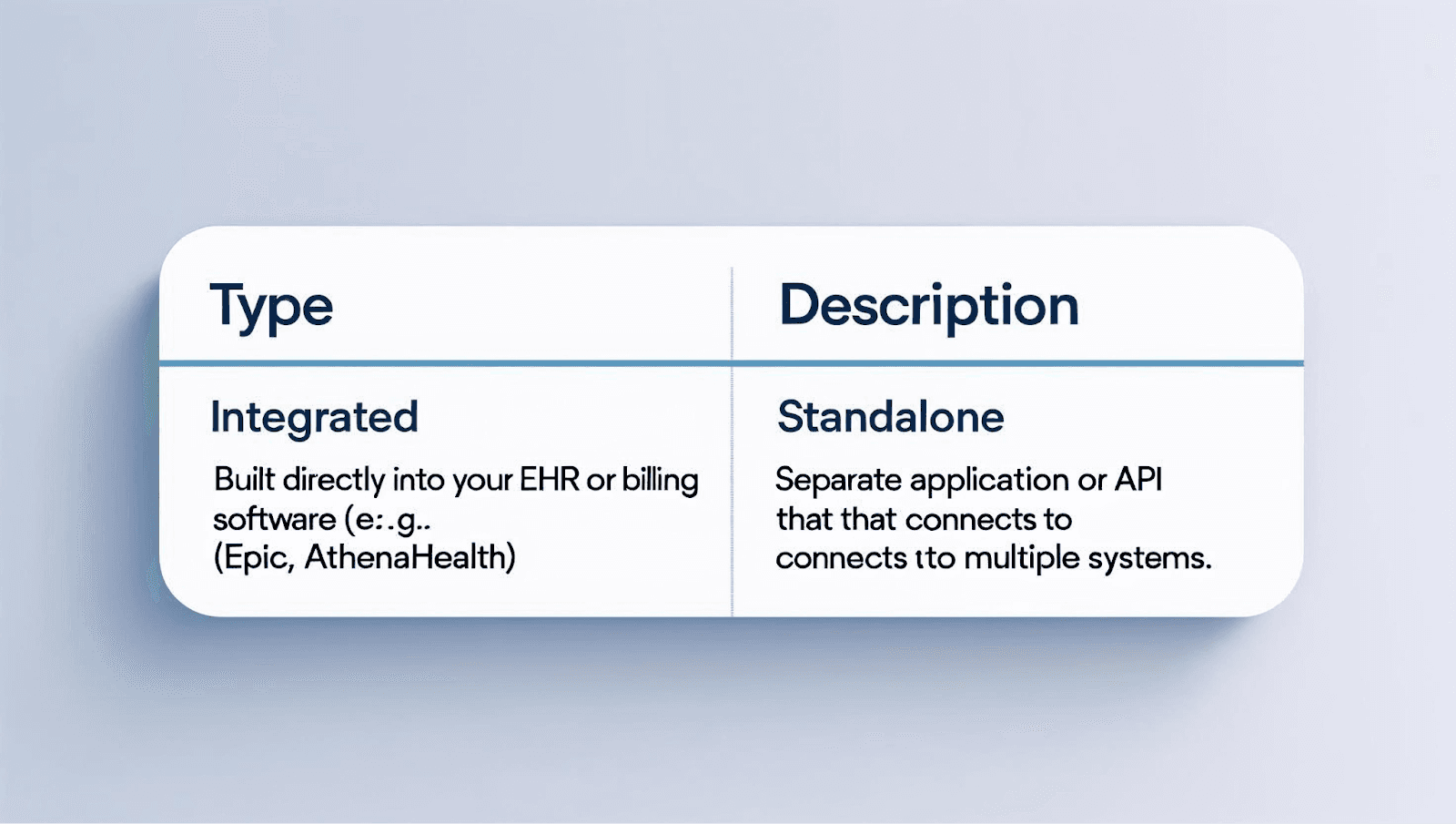
Integrated scrubbers tend to offer convenience and seamless syncing, but can be limited in customizability.
Standalone scrubbers often deliver more powerful features and analytics but may require additional setup.
Pro tip: Look for scrubbers with open API support and pre-built clearinghouse integrations, as this allows for better automation (especially if you’re layering in a tool like Magical for post-scrubbing tasks).
Comparison Table – Rules-Based vs. AI-Powered Claim Scrubbers
Feature | Rules-Based | AI-Powered / Predictive |
Rule Updates | Manual | Real-time / adaptive |
Denial Prediction | No | Yes |
Learning from Outcomes | No | Yes |
Payer Behavior Modeling | No | Yes |
Cost | Lower | Moderate to higher |
Recommended For | Smaller practices | Mid-to-large organizations |
Which Type Is Right for You?
If your team:
Has a low claim volume
Submits to a limited payer mix
Wants a simple, affordable tool
→ A rules-based scrubber may be sufficient.
But if you:
Handle high claim volume across multiple specialties
Face frequent denials for documentation or modifier errors
Need to scale your RCM operation without adding headcount
→ It’s time to explore AI-powered, predictive scrubbing—and prepare to support it with automation tools like Magical to streamline everything around it.
5 Benefits of Using a Claim Scrubber
Claim scrubbers are more than error detectors.
They’re revenue protectors.
When used strategically, scrubbers reduce denials, streamline billing, and give your RCM team the time and accuracy they need to focus on what matters: getting paid faster.
Let’s explore the biggest benefits of using a claim scrubber, especially for healthcare teams handling high-volume Medicare, Medicaid, and commercial claims.
1. Fewer Denials, Faster Payments
This is the number one reason healthcare organizations invest in claim scrubbers: cleaner claims mean fewer denials, and that means faster payments.
The average first-pass denial rate in U.S. healthcare is ~10–15%, depending on specialty and payer mix. A strong claim scrubber can cut that number dramatically by:
Catching modifier issues
Flagging invalid CPT/ICD combinations
Verifying payer-specific requirements before submission
According to Becker’s Hospital Review, improving first-pass claim rates by just 5% can translate to hundreds of thousands in annual recovered revenue for mid-sized healthcare organizations.
2. Less Manual Rework for Billing Staff
Denials aren’t just expensive—they’re exhausting.
Every denied claim adds 15–30 minutes of rework time:
Re-analyzing the denial reason
Correcting the issue
Reformatting and resubmitting
Updating internal logs and reports
Scrubbers prevent much of this by proactively flagging those issues before the claim leaves your system, so your staff spends more time submitting clean claims and less time playing clean-up.
In a 2024 Medical Group Management Association (MGMA) report, 61% of billing managers cited “manual denial rework” as their team’s top time-drain.
3. Higher Staff Productivity and Lower Burnout
Burnout in revenue cycle teams is real, and it often comes down to repetitive, high-pressure tasks like denial resolution and claims cleanup.
By eliminating unnecessary rework, scrubbers help:
Free up staff capacity for more complex claims
Reduce multitasking across disconnected systems
Improve morale (less busywork, more billing wins)
One midsize clinic reported a 32% increase in billing team productivity after implementing AI-enhanced claim scrubbing, simply by reducing rework and speeding up approvals.
4. Better Payer Relationships and Fewer Audits
Submitting clean claims consistently builds trust with payers and reduces the chance of landing in audit territory.
Many payers track:
Error rates
Resubmission frequency
Documentation gaps
Scrubbers help ensure each claim meets the payer’s expectations from day one, which improves your organization’s standing and reduces flags for:
Prepayment review
Additional documentation requests
Post-payment audits
5. Improved Revenue Forecasting and Cash Flow
A cleaner claim pipeline leads to:
Fewer payment delays
More predictable AR timelines
Higher first-pass resolution rates
For finance leaders, this improves revenue forecasting accuracy and cash flow stability—critical metrics for any healthcare organization navigating tight margins.
According to a 2023 Kaufman Hall report, organizations with cleaner claims cycles report 20–35% shorter days in AR compared to peers with high denial rates.
5 Tangible Benefits of Using a Claim Scrubber
Fewer Denials – Cleaner claims = more approvals
Less Rework – Save time with pre-submission error detection
Happier Teams – Focus on revenue, not fixing typos
Better Payer Trust – Lower error rates = fewer audits
Healthier Revenue Cycle – Predictable payments and stronger cash flow
A claim scrubber isn't just a billing tool. It’s a frontline revenue asset that protects your income, your team’s time, and your payer relationships.
Common Claim Scrubber Vendors and Tools (Optional Overview)
By now, it’s clear that a claim scrubber is no longer a “nice-to-have”—it’s a necessity. But if you're exploring options, it's helpful to understand what types of tools are available and what they’re best at.
Here’s a quick snapshot of some of the most widely used claim scrubber platforms across the healthcare industry today.
Optum Claims Manager
Used by large enterprise health systems, Optum offers one of the most advanced rule libraries on the market. Ideal for organizations with complex payer mixes and EHR integrations like Epic or Cerner.
Waystar Claim Monitoring
Known for clean UI and strong real-time edit logic, Waystar supports a wide range of specialties and connects easily with many clearinghouses and PM systems.
Change Healthcare Revenue Performance Advisor (RPA)
Part of a broader RCM suite, RPA combines smart scrubbing with denial analytics and claim submission tools.
Experian Health Claim Scrubber
A good choice for mid-size practices, Experian offers fast batch claim reviews, payer-specific edits, and a clean interface for billing teams.
Availity Essentials
Scrubbing is built into the Availity clearinghouse platform, making it easy for teams already using Availity to validate claims against payer-specific rules in real time.
nThrive / FinThrive Claim Lifecycle
Geared toward AI-powered, autonomous RCM workflows, this tool includes machine learning features and robust audit trail capabilities.
Scrubbers Flag Errors, They Don’t Fix Them
All of these tools have one thing in common: they’re great at catching issues before a claim is submitted.
But they don’t:
Correct the data
Navigate between systems
Submit the fixed claim
Log submission or update status reports
That’s where Magical fits in. It fills the “action gap” between scrubber and submission.
Let’s break down exactly how it works.
Where Magical Fits: Automating the Work Around Your Claim Scrubber
Claim scrubbers do a great job of flagging errors. But that’s just the first half of the equation. The second half—fixing those errors, resubmitting the claim, and logging the work—still falls squarely on your billing team’s shoulders.
That’s where most revenue cycle bottlenecks happen.
Magical closes that gap. It acts as your AI-powered assistant, automating the exact manual workflows that happen after scrubbing, but before the claim gets paid.
The Problem: Scrubbers Don’t Eliminate Manual Work
Here’s what typically happens after a scrubber flags an issue:
Staff logs into the EHR or billing system to find the patient file
Locates the code that needs to be updated
Fixes the code, modifier, or missing data
Re-enters the claim in a payer portal or clearinghouse interface
Submits the corrected claim
Updates an internal spreadsheet or billing log
This process can take 5–15 minutes per claim, depending on how many systems are involved. Multiply that by dozens—or hundreds—of flagged claims per day, and you’ve got a major operational drag.
According to a 2023 survey by the Healthcare Financial Management Association (HFMA), manual workflows remain the top driver of RCM inefficiency, especially in mid-sized and enterprise healthcare organizations.
The Solution: Magical Automates the Rework Between Systems
Magical uses AI agents to handle the exact tasks your team currently does manually—only faster, more consistently, and without error.
Here’s how Magical works in your claim cycle:
Step | Without Magical | With Magical |
Scrubber flags a modifier error | Staff reads the error and logs into EHR | Magical extracts the patient and code data |
Code needs to be updated | Staff searches for correct modifier | Magical inserts correct modifier automatically |
Claim needs re-entry | Staff searches for correct modifier | Magical navigates to the payer portal and autofills |
Submission must be logged | Staff updates spreadsheet manually | Magical logs action, timestamp, and user |
Magical works in-browser with your existing tools—EHRs, clearinghouses, payer portals, ticketing systems—automating actions like copy/paste, data input, form navigation, and documentation upload.
No integration required. No IT lift. Just results.
Real Claim Workflows Magical Can Automate
1. Modifier Correction and Claim Resubmission
Magical pulls corrected modifier from template
Auto-updates claim in billing portal
Submits in less than 30 seconds
2. Denial Rework Based on Payer Code
Agent reads denial code in ERA or email
Pulls appropriate documentation
Fills corrected claim and resubmits
3. Status Updates Across Systems
After submission, Magical updates internal billing log, claim tracker, or CRM
Reduces toggle time and improves audit readiness
Teams using Magical report up to 80% less manual data entry across claim workflows and an average 25–40% reduction in denial resolution time.
Before and After Magical
Metric | Manual Workflow | With Magical |
Time to fix a flagged claim | 6–12 minutes | 1–2 minutes |
Systems involved | 3–5 | 1 (browser with agent) |
Re-submission consistency | Varies by user | Standardized |
Logging and audit trail | Manual or inconsistent | Automatic and time-stamped |
Why Magical Is Different From a Scrubber or Bot
Feature | Traditional Scrubber | RPA/Bot | Magical |
Flags Errors | ✅ | ❌ | ❌ |
Fixes Errors Automatically | ❌ | ✅ (rules-based only) | ✅ (agentic + dynamic) |
Works Across Multiple Systems | ❌ | ❌ (needs integration) | ✅ (browser-based agent) |
Learns and Adapts | ❌ | ❌ | ✅ (AI-powered, no-code) |
Claim scrubbers protect revenue by flagging problems. Magical protects time, accuracy, and outcomes by fixing them across systems, portals, and workflows.
Final Thoughts: Claim Scrubbers Aren’t Enough—The Future Is Autonomous Claims Handling
Claim scrubbers are vital. But they don’t do the work. They tell your team what’s wrong, not how to fix it—or better yet, fix it themselves.
In a world where claims data is increasing, payer rules are multiplying, and staffing is stretched thin, flagging errors isn’t enough. The future is about action.
What Comes After Scrubbers? Agents That Act
Today, your billing team still carries the burden between systems. Even with a great scrubber, someone has to:
Re-key codes into another platform
Upload documentation manually
Track submissions in spreadsheets
Follow up on payer responses
Repeat the cycle for every flagged claim
That’s hours per day lost to data movement, not decision-making.
The next generation of revenue cycle tools are agentic: they don’t just detect. They decide. They act. They move data between systems, correct claims, and close the loop automatically.
Autonomous Claims Handling, Powered by AI Agents
Imagine this:
Your claim scrubber flags an invalid modifier
An AI agent (like Magical) corrects the code using past claim patterns
It resubmits the claim to the appropriate payer portal
It updates your internal claim tracker
It logs every action, user, and timestamp for audit protection
All in under a minute.
This is autonomous claims handling in practice:
No toggling between platforms
No missed steps or documentation errors
No delay from rework bottlenecks
It’s not science fiction—it’s already happening. And teams using Magical are experiencing it daily.
Magical = The Missing Link Between Error Detection and Resolution
Scrubbers protect revenue. Magical amplifies it by giving your team back their time, reducing human error, and letting AI agents take over the repetitive, high-volume tasks that block cash flow.
You don’t need to replace your current tools. You just need a way to make them work together.
And that’s what Magical does.
Try Magical Free—And Automate the Work Your Scrubber Leaves Behind
Whether you’re reworking 50 claims a week or 5,000, Magical helps your team:
Reduce manual data entry by up to 80%
Resolve denials 25–40% faster
Submit clean claims—faster, more consistently, and with less stress
Install the free Magical Chrome extension and try Magical today. Let your AI workforce handle the claim rework, so your team can get back to winning the revenue cycle.