
You’ve double-checked the codes.
The patient’s insurance is valid.
The procedure was medically necessary.
Yet somehow (again) the claim comes back denied.
If this feels familiar, you're not alone. Claim denials cost U.S. healthcare organizations an estimated $262 billion annually, with many stemming from preventable issues like missing modifiers, incorrect diagnosis pairings, or payer-specific format errors.
A claim doesn’t have to be “wrong” to get rejected. It just has to fail the increasingly complex, evolving edit rules enforced by payers, and those rules differ across carriers, regions, and patient plans.
That’s where claim scrubber software comes in. But in 2025, healthcare teams don’t just need a basic rules engine. They need intelligent, fast, and adaptable tools that can integrate with the way they actually work.
Let’s talk about:
What modern claim scrubbers do—and how they’ve evolved from old rules-based tools
Strategic criteria for choosing a scrubber (hint: it’s not just about price)
A review of today’s leading claim scrubber software options with real use-case guidance
How to go beyond scrubbing by automating the workflows around it using Magical’s AI-powered platform
If you're processing hundreds or thousands of claims each month and watching revenue slip through the cracks, this is your roadmap to cleaner claims, fewer denials, and faster payments.
What Is Claim Scrubber Software—and Why It’s Evolving
Claim scrubbers used to be seen as a simple checkpoint: catch typos, flag missing codes, and keep things moving. But that’s no longer enough.
Claim scrubbers have become essential frontline tools for protecting revenue, and the best ones go beyond static rules to help healthcare teams anticipate denials before they happen.
Let’s break down what they are, how they work, and why the smartest organizations are rethinking what “scrubbing” really means.
The Basics: How Claim Scrubbers Work
At their core, claim scrubbers are software tools that review medical claims before they’re submitted to payers. Their goal? Identify potential issues that could lead to denials or rejections.
Claim scrubbers typically:
Cross-check claims against payer-specific billing rules
Flag errors in CPT, HCPCS, or ICD-10 code combinations
Identify missing or mismatched demographic or insurance information
Validate medical necessity requirements
Ensure claims follow CMS or National Correct Coding Initiative (NCCI) edits
Scrubbing usually happens after the claim is generated in the EHR or billing system, but before it’s submitted to the clearinghouse or payer portal. This makes it the last line of defense before a denial hits your inbox.
Why Traditional Scrubbers Are No Longer Enough
Legacy scrubbers were built for a different era—one where payer rules didn’t change monthly, and coding workflows were more centralized. But today, payer edits are dynamic, local MACs introduce LCD rules that vary by region, and specialties often have highly specific billing requirements.
That means scrubbers need to do more than just apply static edits. They need to:
Learn from prior denials and payer behaviors
Adapt to real-time rule changes
Support complex claims like recurring Medicare services, DME, or bundled payments
Integrate seamlessly into multi-tool workflows (EHR → scrubber → clearinghouse → payer portal)
And yet, most scrubbers still operate on rules-based logic that hasn’t changed in years.
According to CAQH’s 2023 Index Report, manual rework from denied claims costs providers an average of $25.20 per claim, and with denial rates continuing to rise, the financial impact adds up fast.
From Static Rules to Smart, Adaptive Scrubbing
The next generation of scrubbers is being powered by AI, machine learning, and agentic automation. These tools go beyond simple error detection to:
Predict likelihood of denial based on past outcomes
Recommend the correct modifier or ICD pairing dynamically
Auto-correct format issues before submission
Trigger automation flows to fix and resubmit without manual rework
This shift from reactive to proactive is why scrubbers are becoming core parts of modern RCM tech stacks, not optional add-ons.
Then vs. Now – The Evolution of Claim Scrubbing
Feature | Legacy Scrubbers | AI-Powered Scrubbers |
Rule Updates | Manual/infrequent | Real-time / automated |
Learning Capability | None | Machine Learning |
Denial Prediction | No | Yes |
EHR/RCM Integration | Limited | API-first, seamless |
Focus | Error catching | Denial prevention + outcome optimization |
If your scrubber is just flagging errors without helping you fix or prevent them, your team is doing too much of the heavy lifting. In the next section, we’ll explore what features matter when choosing a claim scrubber and how to future-proof your revenue cycle operations.
Strategic Criteria for Choosing Claim Scrubber Software
Most blog posts about claim scrubbers hand you a list of popular vendors and call it a day. But for healthcare teams processing thousands of claims monthly, the tool itself isn’t the strategy—how it fits into your revenue operations is.
That’s why this section focuses on the real-world criteria that matter: from denial prevention capabilities to how well the tool plugs into your existing systems and workflows.
If your current scrubber only flags basic errors—or worse, makes your team retype the same data into different systems—it’s time to upgrade your expectations.
Accuracy and Denial Prevention Capabilities
Not all scrubbers are created equal. The best ones do more than catch typos or format issues—they help you reduce denials before they ever reach the payer.
What to look for:
Payer-specific rule logic that updates automatically
Integrated NCCI, LCD, and MUE edit validation
Tools that can crosswalk CPT/ICD pairs to ensure medical necessity
Scrubbers with denial prediction based on historical data
Speed and Workflow Automation
Scrubbers that require your team to download files, switch screens, or manually apply fixes? They’re costing you more than time—they’re increasing the chance of error.
Look for:
Real-time scrubbing that runs as claims are generated
One-click fixes or AI-suggested corrections
Ability to auto-submit corrected claims post-scrub
Seamless movement between tools (e.g., EHR → scrubber → payer portal)
If the scrubber flags the problem but your team still has to rework it manually, the job’s only half done.
EHR and RCM Integration
Claim scrubbers are most effective when they operate within your existing workflow. Whether you use Epic, Cerner, NextGen, or a specialty EHR, your scrubber should connect easily via API, SFTP, or embedded app.
Look for:
Out-of-the-box integrations with your EHR or practice management system
Support for custom claim formats or multi-specialty workflows
Compatibility with clearinghouses like Availity, Change Healthcare, or RelayHealth
Integration isn't a nice-to-have. A 2023 HIMSS survey found that 71% of healthcare providers cite integration challenges as a barrier to effective revenue cycle performance.
Analytics and Audit Trails
If your scrubber doesn’t give you insight into why claims are being flagged—or how your team is resolving those issues—it’s not giving you the full picture.
What matters:
Detailed error reporting with payer-specific breakdowns
Resolution timelines by claim or user
Exportable reports for compliance and audit prep
Trend analysis of denials by code, provider, or payer
These analytics help you go from reactive to proactive, spotting repeat issues before they snowball into missed revenue.
Security and Compliance
Especially for Medicare and Medicaid claims, scrubbers must be built to handle PHI securely and comply with federal regulations.
Key considerations:
HIPAA-compliant infrastructure
Role-based access and user-level audit logs
Encryption of data at rest and in transit
Compliance certifications like SOC 2 Type II
When in doubt, ask for the vendor’s security documentation before signing.
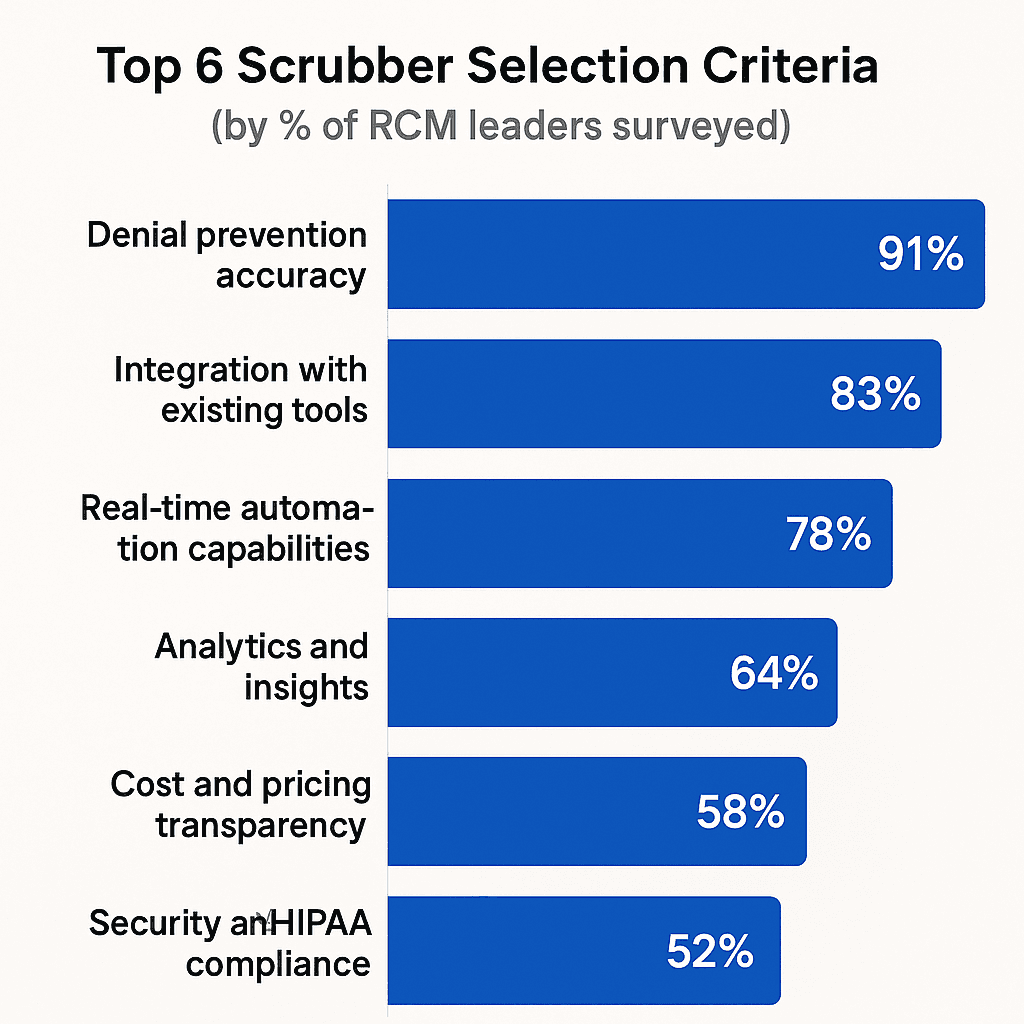
Visual: Top Priorities for Healthcare Teams When Choosing a Claim Scrubber
Here’s a look at what healthcare organizations prioritize when evaluating scrubber software:
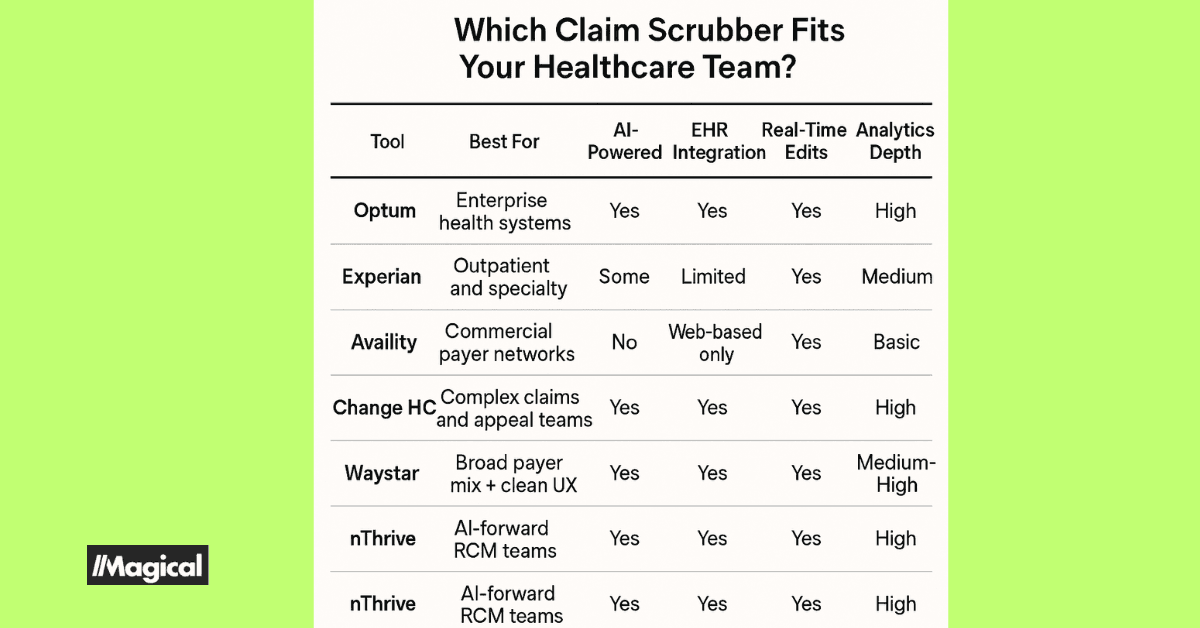
6 Top Claim Scrubber Software Solutions (Reviewed Strategically)
If you search “best claim scrubber software,” you’ll get a dozen listicles with surface-level comparisons—but few of them tell you which tool is right for your team.
The reality? Most scrubbers share core functionality. What matters is how they fit into your specific workflows, whether they support your payer mix, and how well they reduce your actual denial volume.
So here’s a breakdown of six of the top claim scrubbers. Not just by features, but by ideal use case, integration strengths, and potential limitations.
1. Optum™ Claims Manager
Overview: A powerhouse used by large health systems and integrated delivery networks, Optum Claims Manager offers deep edit logic and robust analytics tied to real-time denial trends.
Key Features:
30M+ payer-specific edits
Predictive edit logic tied to revenue performance
Integration with Epic, Cerner, and other enterprise EHRs
Real-time eligibility and authorization checks
Best For: Enterprise health systems or large multi-specialty groups processing high-volume, multi-payer claims.
Watch Out For: May be cost-prohibitive for smaller practices; steep learning curve for non-technical teams.
2. Experian Health Claim Scrubber
Overview: Experian’s claim scrubber stands out for its clean user interface and real-time payer logic, especially for outpatient services and specialty practices.
Key Features:
Payer-specific edits and real-time eligibility
Batch processing and batch correction
ICD/CPT/Modifier cross-validation
Denial analytics dashboards
Best For: Mid-size practices and billing teams that want a user-friendly interface and fast turnaround.
Watch Out For: Integration options can be limited depending on your EHR; some edits require manual updates.
3. Availity Essentials Claim Scrubber
Overview: Integrated with one of the largest clearinghouses in the U.S., Availity offers a seamless scrub-to-submit experience, especially for payer-aligned systems.
Key Features:
Scrubbing tied directly to Availity clearinghouse
Payer rule updates in real time
Tools for eligibility, benefits verification, and attachments
Web-based interface, no installation required
Best For: Providers working heavily with commercial payers or those already using the Availity portal.
Watch Out For: More basic analytics and limited customization vs. standalone RCM tools.
4. Change Healthcare Revenue Performance Advisor (RPA)
Overview: Combining claim scrubbing with robust denial analytics, RPA is designed to improve first-pass resolution rates across complex claims.
Key Features:
Denial prediction and resolution guidance
AI-assisted scrubbing engine
Integrated clearinghouse + scrubbing workflow
Provider benchmarking tools
Best For: Medical groups and ASC networks with diverse payer contracts and internal billing staff.
Watch Out For: May require Change’s broader ecosystem (e.g., clearinghouse, practice management software) for full functionality.
5. Waystar Claim Monitoring + Editing
Overview: Known for its clean interface and real-time claim intelligence, Waystar’s platform supports both traditional and value-based care models.
Key Features:
600,000+ rules, including Medicare, Medicaid, and commercial edits
Real-time alerts and correction suggestions
Built-in eligibility verification and denial analytics
Supports APIs and file-based workflows
Best For: Billing teams that need high-quality claim intelligence with broad payer support.
Watch Out For: Some features require additional modules or product tiers.
6. nThrive Claim Lifecycle AI (now FinThrive)
Overview: An advanced solution that pairs scrubbing with denial root-cause analysis and AI-powered decision-making, ideal for teams ready to move toward agentic claims handling.
Key Features:
Machine learning to flag denial risk
Predictive modifiers and ICD/CPT suggestions
Integrated appeals and resubmission workflows
Built-in audit readiness and compliance logging
Best For: Health systems or larger provider groups looking to move toward autonomous claims management.
Watch Out For: More advanced than many teams may need—best suited for orgs with in-house RCM analysts or IT support.
Where Magical Fits: Automating the Work Around Your Claim Scrubber
Choosing the right claim scrubber is a powerful move. But even the best scrubber in the world has a blind spot: it flags the errors, but someone still has to fix them, reformat the claim, re-enter it into the payer portal, and track the status.
That’s where Magical steps in.
Magical isn’t a scrubber. It’s the AI workforce that connects your EHR, scrubber, clearinghouse, and payer systems—automating the tedious, manual work that happens between “error flagged” and “claim paid.”
Claim Scrubbers Flag. Magical Fixes.
Let’s break it down:
Workflow Stage | Traditional Process | With Magical |
Claim error flagged | Scrubber flags issue | Same |
Data pulled from EHR | Staff opens EHR, copies patient info | Magical extracts data instantly |
Rework in payer portal | Staff pastes data, re-enters codes manually | Magical autofills correct fields |
Submission + notes | Staff submits, logs claim manually | Magical submits + logs automatically |
You can think of Magical as the agentic layer that executes tasks between your systems, using AI agents to handle routine claim rework, resubmission, and status updates across platforms.
Key Claim Workflows Magical Can Automate
1. Correcting and Re-Submitting Claims Post-Scrub
Extract patient name, date of service, CPT/ICD codes from EHR
Auto-fill corrected claim fields in payer portal
Submit without logging into multiple systems
2. Copying Denial Reasons into Internal Logs
Pulls denial codes from email or ERA
Pastes them into ticketing systems or claim trackers
Tags by claim ID and date for audit visibility
3. Matching Claims to Attachments and Documentation
Auto-matches required documents (e.g., medical necessity, progress notes)
Attaches them to claims based on scrubber output
Sends updated claim to clearinghouse or portal
4. Updating Claim Status Across Systems
Marks claim as “resubmitted” in tracker or CRM
Sends internal notifications or Slack messages to billing teams
Magical customers report up to 80% less manual data entry across claim workflows, especially when reworking high-volume Medicare or Medicaid claims.
How Magical Bridges the Gap Between Scrubbers and Payers
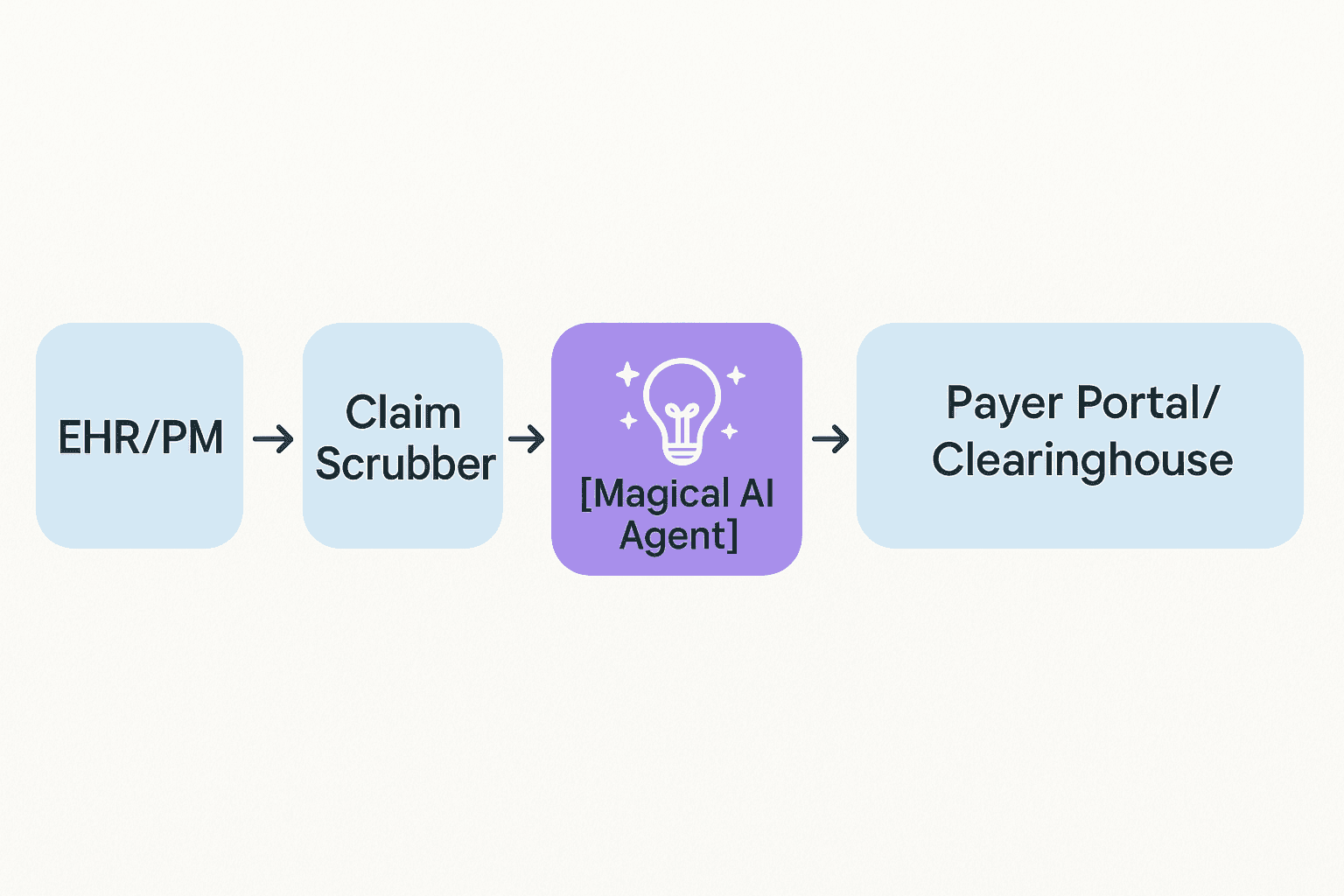
Magical:
Pulls data directly from EHR/scrubber
Automates rework in payer interface
Tracks status + logs submission
Compliance and Security, Built In
Magical is built for healthcare-grade automation:
HIPAA-compliant automation—no data stored in transit or at rest
In-browser AI agents work where your team already does
User-based logs for full visibility: who triggered what, when, and how
So your workflows get faster, cleaner, and safer.
Real-World Result: Faster Resubmissions, Fewer Denials
A claims team at a mid-size health system used Magical to automate rework for outpatient claims flagged with modifier errors and LCD mismatches. Within 60 days, they saw:
38% reduction in average denial resolution time
47% increase in daily clean claim submission volume
Significant reduction in toggling between systems
Final Thoughts: Claim Scrubbers Aren’t Enough—The Future Is Autonomous Claims Handling
Scrubbers are critical. They’ve helped healthcare teams reduce preventable denials, improve billing accuracy, and enforce compliance at scale.
But they only do one thing well: flag what’s wrong.
In a modern revenue cycle, that’s not enough.
Every flagged error still requires:
Manual navigation across systems
Copying and pasting claim details
Re-submitting through payer portals
Updating internal logs or trackers
This is the invisible tax your team pays daily—and it’s burning time, money, and morale.
The future? An AI-powered workforce that doesn’t just catch errors, but fixes them, files them, and logs them, automatically.
Agentic Automation: From Claim Scrubbing to Claim Success
Agentic AI doesn’t replace your coders, billers, or compliance experts. Instead, it amplifies them, taking over the repetitive, rule-driven workflows so they can focus on the edge cases, denials, and audits that truly require human insight.
Imagine this:
A claim gets flagged for a modifier mismatch
An AI agent pulls the correct modifier based on past claim success
It resubmits the claim through the correct portal
Logs every action for audit readiness
Updates your internal tracker and notifies the billing lead
No more toggling. No more retyping. No more delay.
That’s what Magical makes possible today.
Your Claims. Clean, Compliant, and On Time.
Whether you’re running a specialty clinic or overseeing revenue ops at a health system, the message is clear:
Scrubbers are step one.
Automation is step two.
Agentic claims handling is step three—and it’s already here.
With Magical, your team can:
Reduce manual claim rework by up to 80%
Submit claims faster, with fewer errors
Keep your billing team focused on outcomes, not data entry
Try the free Magical browser extension and start automating the tedious work your claim scrubber leaves behind. Join almost 1 million users and 100,000+ companies using Magical to accelerate clean claims, reduce denials, and reclaim valuable hours every week.