Charge reconciliation shouldn’t be detective work.
But for most healthcare teams, that’s exactly what it feels like.
You’re digging through notes, cross-checking spreadsheets, correcting claims that never should’ve gone out broken.
And the software that’s supposed to help? Half of it’s clunky. The other half doesn’t actually talk to your systems.
So the errors keep happening. The revenue keeps leaking. And your team keeps burning out, one missed charge at a time.
Here’s the truth no one tells you: you don’t need more features.
You need fewer places for mistakes to hide.
This guide cuts through the noise to spotlight the charge reconciliation tools that actually help you do that.
From enterprise platforms to browser-native automations, we’ll show you what works, why it works, and which solution fits your workflow (not just your budget).
Let’s dig in.
What to Look for in Charge Reconciliation Software
Not all charge reconciliation tools are created equal.
Some help you track errors.
Others help you avoid them entirely.
When choosing the right software for your team, you’re not just shopping for features. You’re investing in a system that directly impacts revenue, compliance, and operational sanity.
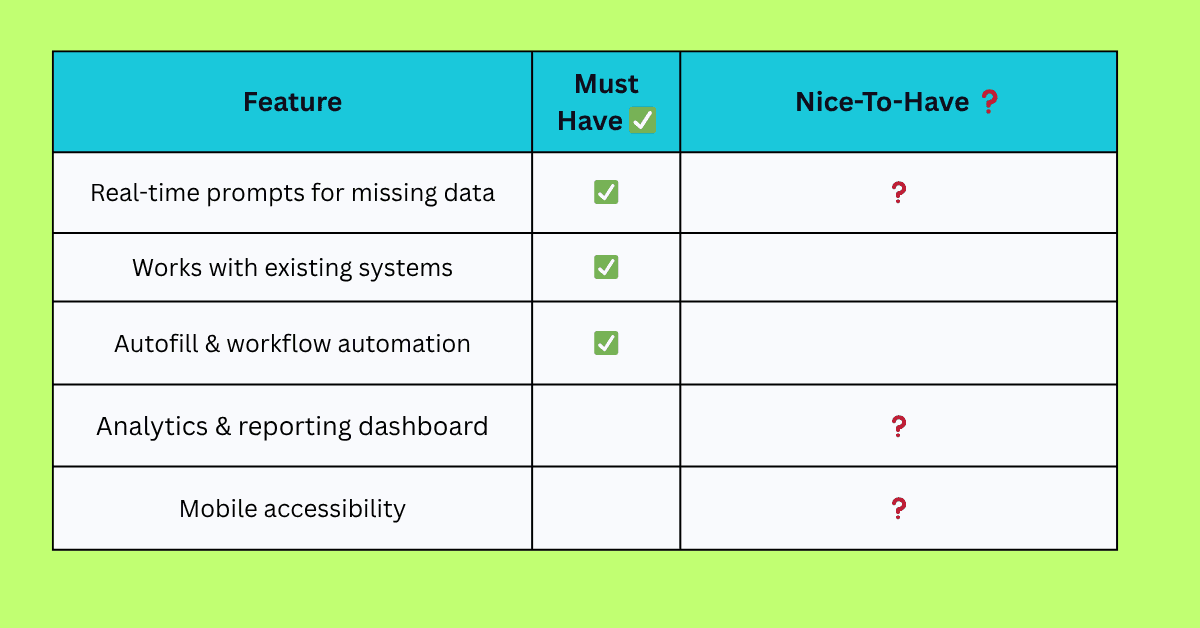
Here’s what actually matters in a charge reconciliation tool (and why):
Real-Time Error Prevention (Not Just Detection)
Too many platforms are built to catch errors after the claim is generated. But by then, it’s too late. The team is stuck fixing mistakes instead of preventing them.
Look for tools that:
Validate charges at the point of entry
Flag missing codes or documentation before submission
Suggest corrective actions in real time
Why it matters: The average cost to rework a denied claim is $25–$118 per claim, according to the American Medical Association. That adds up fast, especially when many denials stem from issues that could’ve been flagged earlier.
Integration (or Workaround) with Your Existing Systems
Your charge reconciliation software shouldn’t force you to rip and replace. The best tools:
Integrate directly with your EHR or billing system
Or work on top of your current tools via browser-based automation
Require little or no involvement from IT to deploy
Why it matters: A recent HIMSS study shows that IT bottlenecks delay implementation of revenue cycle tools by an average of 3–6 months in mid-sized orgs. Time your team doesn’t have to wait.
Automation That Actually Reduces Manual Work
You’re not looking for another dashboard. You’re looking to get hours back.
The right solution should:
Autofill common charge fields
Prompt staff to include frequently missed services
Standardize workflows across users and locations
Why it matters: Organizations using smart automation save up to 35–40% of time spent on revenue cycle tasks.
Support for Compliance and Audit-Readiness
Charge reconciliation is about more than just money. If the charges don’t match the documentation, you risk:
Claim denials
Payer audits
Compliance violations
Choose software that includes:
Audit trails
Timestamped logs of every change
Template enforcement to ensure billing consistency
Scalability for Multi-Clinic or Multi-User Teams
Whether you’re growing or already managing multiple sites, your tool should:
Allow shared templates and workflows
Offer role-based permissions
Maintain data integrity across teams
Without this? You’ll fix one department while another keeps bleeding revenue.
Top Charge Reconciliation Tools (2025 Edition)
From lightweight browser-based automation to full-scale RCM platforms, these are the tools actually helping healthcare teams stop revenue leakage from missed or mismatched charges.
Each one solves the charge reconciliation problem differently—what matters is choosing the one that fits your workflow.
1. Magical
Best for: Fast, browser-based automation with zero IT lift
Why it stands out: Magical works right inside Chrome to automate the data entry and charge validation workflows that cause most reconciliation issues. It’s ideal for teams that don’t want to wait for IT or switch EHRs.
Key features:
Autofill for CPT, ICD, and patient data fields
Smart prompts for missing or mismatched charges
Conditional logic to suggest modifiers or additional codes
Templates to standardize reconciliation across teams
Best use case: Organizations that use multiple systems (EHR + billing + spreadsheets) and want to prevent missed charges without backend integrations.
Pricing: Free plan available; paid tiers for teams
Setup time: Under 1 hour
2. Waystar
Best for: Enterprise RCM teams seeking end-to-end reconciliation with payer integration
Why it stands out: Waystar offers a full RCM suite with advanced charge integrity tools, including AI-based reconciliation workflows. It’s built to catch billing anomalies, mismatched documentation, and under-coding across complex systems.
Key features:
Claim integrity scoring
Automated charge audits
Deep EHR integration (Epic, Cerner, etc.)
Predictive analytics for denials
Best use case: Large health systems that need charge reconciliation baked into their full RCM process.
Pricing: Custom enterprise pricing
Setup time: 2–6 months with IT involvement
3. RCM Intelligence by Experian Health
Best for: Organizations that want analytics-driven reconciliation oversight
Why it stands out: RCM Intelligence provides real-time visibility into your revenue cycle—and specifically targets missed charges, documentation gaps, and payer rules.
Key features:
Dashboards to monitor undercoded visits
Real-time alerts for charge anomalies
Reporting for executive and compliance teams
Best use case: Groups that already have reconciliation workflows but want better visibility and QA over them.
Pricing: Mid-to-enterprise tier
Setup time: Weeks to months, depending on EHR
4. CollectRx
Best for: Teams focused on underpayments and missed revenue
Why it stands out: CollectRx combines reconciliation with payment review, helping teams recover missed or underpaid charges, not just prevent future ones.
Key features:
Missed revenue recovery
Charge comparison analysis
Rebilling support and appeals assistance
Best use case: Teams who want both front-end charge integrity and back-end payment maximization.
Pricing: Performance-based pricing (typically % of recovered revenue)
Setup time: Minimal
5. Medusind
Best for: Practices that want reconciliation as a managed service
Why it stands out: Medusind offers reconciliation as part of its broader outsourced RCM services. This is ideal for small to mid-size practices that want to offload the process entirely.
Key features:
Dedicated billing and coding teams
Reconciliation audits
Charge correction and claim resubmission
Best use case: Clinics that lack internal billing resources but want clean, reconciled claims every time.
Pricing: Based on claim volume
Setup time: Variable
Tool | Best For | Setup Time | Requires IT? | Real-Time Prompts | Works With Existing Systems |
Magical | Teams that want fast browser-based automation | <1 hour | No | ✅ | ✅ |
Waystar | Enterprise RCM with deep integration | Months | Yes | ✅ | With integration |
RCM Intelligence | Analytics-driven QA | Weeks+ | Yes | ⚠️ (Alert-based) | With integration |
CollectRx | Revenue recovery + reconciliation | Days | No | ❌ | ✅ |
Medusind | Fully outsourced reconciliation | Varies | No | ✅ (via human team) | ✅ |
Why Most Charge Reconciliation Tools Still Fall Short
Charge reconciliation software isn’t new. But most of it still doesn’t solve the core issue: making sure every charge that should be billed actually is.
Why? Because too many tools focus on reporting errors, not preventing them.
Here’s where most platforms fail:
1. They Only Catch Mistakes After Submission
Once a claim goes out the door, fixing it takes time, rework, and follow-up. By the time an error is flagged:
The provider has moved on
The chart has changed
The payer window may be closing
That’s not reconciliation. That’s recovery.
2. They Require Heavy IT Support or Costly Integrations
Enterprise systems promise powerful insights, but only after:
Weeks (or months) of implementation
Custom integrations with your EHR
Training your team to use a whole new platform
If your team doesn’t have the bandwidth or budget? You're stuck with the status quo.
3. They Don’t Fit How Real Admin Teams Work
Most billing teams aren’t sitting inside enterprise dashboards all day. They’re:
Toggling between EHRs, billing software, and spreadsheets
Entering codes manually
Fixing issues on the fly with limited time
Reconciliation needs to happen in the workflow. Not outside of it.
4. They Can’t Keep Up with the Speed of Daily Claims
Reconciliation shouldn’t delay submissions. But with tools that rely on post-entry audits or external reviews, the timeline slows down, creating backlogs, late filings, and missed revenue windows.
If your reconciliation tool doesn’t catch mistakes at the moment they happen, or better yet, stop them from happening at all, it’s not helping your team. It’s just giving them more reports to read.
That’s why automation tools like Magical are stepping in to fill the gap.
Why Magical Stands Out for Modern Healthcare Teams
Most charge reconciliation tools try to solve the problem from the outside in with reports, audits, and post-submission clean-up.
Magical solves it from the inside out.
It embeds directly into the everyday tools your admin and billing teams already use. EHRs, billing software, spreadsheets, portals. And prevents charge errors before they ever leave the screen.
No integrations. No friction. No waiting for IT.
1. Designed for Admins, Not Analysts
Magical lives in Chrome, so it works inside the tools your team uses right now. There’s no need to learn a new platform, log into a separate dashboard, or rely on complex integrations.
One-click autofill of patient, charge, and payer data
Reuse of accurate data across multiple systems
Smart prompts that guide correct charge entry in real time
Your team stays in flow. The system works in the background.
2. Fixes the Root of Reconciliation Errors
Magical catches the exact mistakes that lead to failed charges:
Missing modifiers
Underbilling or unbilled services
Duplicate entries
Incorrect CPT/ICD pairings
Missed ancillary items (like injection supplies or follow-up codes)
And it doesn’t just highlight them. It suggests the correct fix.
3. Fast Setup, No IT Involvement
Whether you’re a team of 3 or 30, you can install Magical and start using it in under an hour:
No software to integrate
No custom code or dev work
No changes to your EHR or billing platform
This isn’t a “digital transformation.” It’s a browser extension that transforms your workflow.
4. Scalable, Shareable Templates for Charge Consistency
Once one staff member creates a charge workflow or modifier template, they can share it with the entire team.
That means:
Standardized reconciliation across locations
Cleaner claims from new or rotating staff
Less training time and fewer handoffs
Magical isn’t just automation—it’s a foundation for scalable, repeatable billing excellence.
5. Built for the Work You Actually Do
Magical doesn’t require a strategy session. It just works.
And that’s what makes it a standout for reconciliation.
Final Thoughts
Charge reconciliation is too important to leave to chance or to clunky systems that only catch mistakes after the damage is done.
Your team doesn’t need another analytics tool.
You need a system that helps you bill accurately the first time, without the back-and-forth, the rework, or the risk.
Magical turns the reconciliation process into something nearly invisible.
No complex rollout.
No disruption.
Just automation that fills the gaps, flags what’s missing, and helps your team work cleaner, faster, and more confidently every day.
Start automating today.
Try the free Magical Chrome extension
Or book a demo for your team and see how much smoother charge reconciliation becomes when automation works the way you do