
You coded the procedure correctly.
The diagnosis is valid.
The patient’s insurance checks out.
So why did the claim get denied?
Modifiers.
They’re just two-digit add-ons to CPT or HCPCS codes—but when used incorrectly, they can single-handedly sink your claim.
Used too often? You’ll trigger audits.
Used too little? You’ll leave money on the table.
Used incorrectly? Prepare for denials, clawbacks, and compliance headaches.
In the world of revenue cycle management (RCM), modifiers are a big deal, and mastering them is one of the fastest ways to improve first-pass claim rates, reduce rework, and stay aligned with payer policy (especially Medicare).
In this guide, we’re cutting through the jargon to explain:
What modifiers are and how they work
Why they matter more than ever in 2025
The difference between necessary, risky, and overused modifiers
How top RCM teams are automating modifier accuracy with AI and agentic workflows
Let’s get into it, because the difference between a clean claim and a denied one could be just two digits.
What Is a Modifier in Medical Billing?
In revenue cycle management, a modifier is a two-character code—either numeric or alphanumeric—that’s appended to a CPT or HCPCS code to provide additional information about the service provided.
In plain terms? Modifiers explain the "what else."
What else happened during the procedure?
What was different about how the service was delivered?
What should the payer know before deciding whether to reimburse it?
These tiny codes carry big weight. Without the right modifier, a claim that should be payable might get rejected, or worse, flagged for fraud.
Modifiers Tell the Full Story of the Encounter
Let’s look at an example.
Say a physician performs two distinct procedures during the same visit, both coded with valid CPTs. Without a modifier, the payer system might assume the second procedure is “bundled” or part of the first and deny it.
But with Modifier 59 (“Distinct procedural service”), you signal that the second procedure is medically necessary and separately identifiable.
Boom: second procedure gets paid.
According to a 2023 CMS Modifier Usage Audit, modifier misuse contributed to over $2.1 billion in improper payments, largely due to incorrect or unsupported use of Modifiers 25, 59, and 91.
Types of Modifiers: CPT vs. HCPCS
There are two main modifier systems used in medical billing:
Modifier Type | Code Format | Used With | Maintained By |
CPT Modifiers | 2 digits (e.g., 25, 59) | CPT/HCPCS codes | AMA |
HCPCS Modifiers | 2 letters (e.g., RT, LT) or letter-digit (e.g., GZ) | HCPCS Level II codes | CMS |
CPT modifiers are more common for procedural context, while HCPCS modifiers are often used in Medicare claims, DME billing, or site-specific care.
Where Modifiers Fit in the Claim Lifecycle
Modifiers come into play after the service is coded but before the claim is submitted.
Flow:
→ Provider delivers service
→ CPT/HCPCS code assigned
→ Modifier appended based on documentation
→ Claim scrubber reviews modifier usage
→ Claim sent to payer
If the modifier is missing, incorrect, or overused:
Denial
Downcoding
Pre-payment review
Post-payment audit
This is why modifier logic is built into most claim scrubbers and is a top denial trigger category.
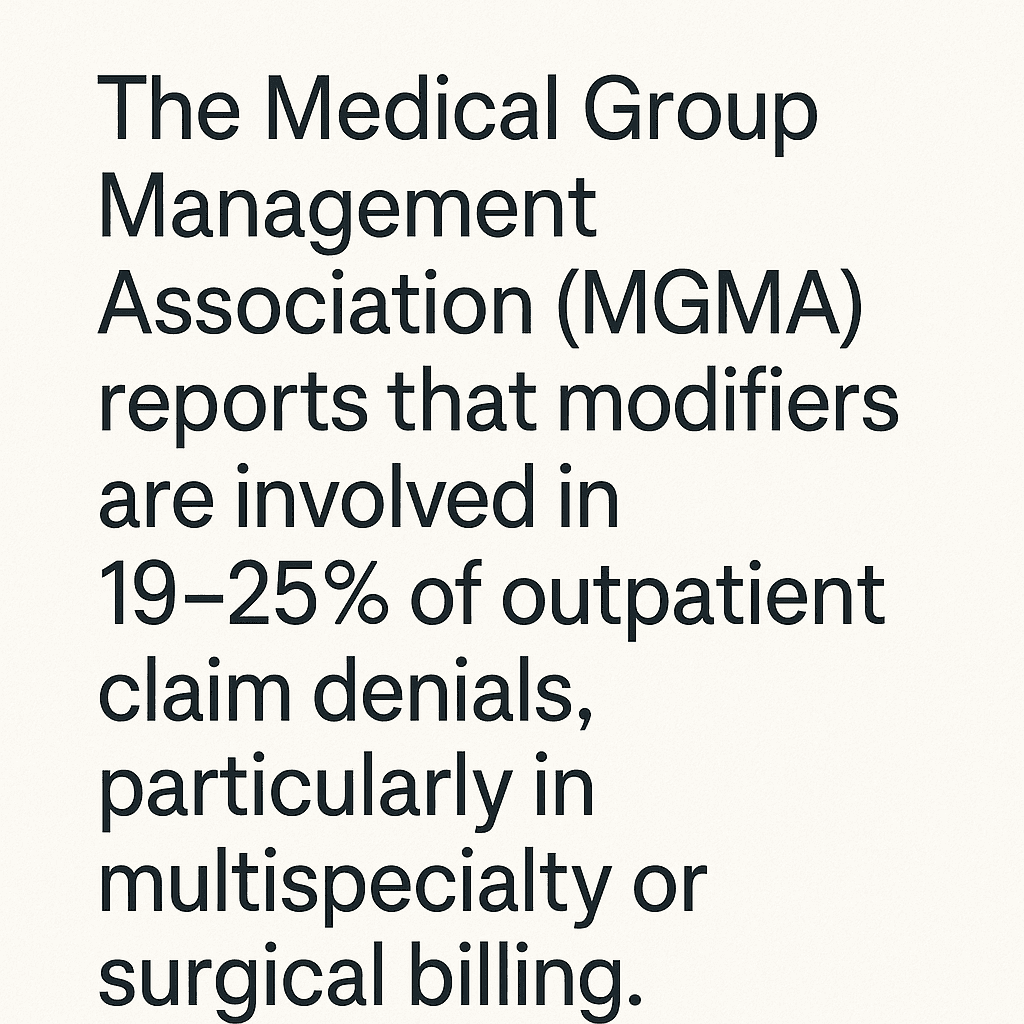
Why Modifiers Matter So Much
Modifiers are small, but their impact is big:
They influence reimbursement amounts
They determine medical necessity validation
They often dictate whether a claim is payable or rejected
And with CMS and commercial payers becoming more aggressive in modifier audits, the margin for error is shrinking.
That’s why modern RCM teams don’t just rely on coders. They’re turning to claim scrubbers and AI agents to ensure modifiers are accurate, justified, and compliant across every claim.
Why Modifier Accuracy Matters in 2025 (And What’s at Risk)
In 2025, healthcare billing teams are operating in one of the most regulated, denial-prone environments ever. And modifier errors are now a top reason claims get denied—or worse, flagged for audit.
This isn’t just about coding precision. It’s about revenue protection, audit avoidance, and long-term compliance.
Improper Modifier Use = High-Dollar Denials
When used incorrectly, modifiers can:
Trigger bundling edits that result in partial or zero reimbursement
Violate payer-specific coding policies (e.g., overuse of Modifier 25)
Flag claims for medical necessity audits
Lead to repayment demands or pre-payment review status
The Office of Inspector General (OIG) has prioritized Modifier 25 and Modifier 59 usage in recent audits, citing tens of millions in potential overpayments.
And it’s not just Medicare. Commercial payers are auditing modifier-heavy claims with increasing frequency, especially in specialties like:
Dermatology
Pain management
Orthopedics
Behavioral health
Common Modifier Mistakes That Lead to Denials
Modifier | Common Misuse Scenario | Denial Risk |
25 | Used without proper documentation for E/M visit | High (overuse flag) |
59 | Added to unbundled procedures that aren't truly distinct | High (bundling denial) |
91 | Repeating lab tests without medical necessity | Moderate |
LT/RT | Missing laterality modifier for site-specific services | High (Medicare-specific) |
A 2024 Cigna policy update announced stricter requirements for Modifier 25, including documentation submission at the time of claim, a trend other payers are now following.
Staff Burnout from Reworking Modifier-Related Denials
Billing teams aren’t just dealing with denials—they’re reworking the same modifier errors over and over again. And each one adds up:
10–15 minutes per reworked claim
Manual documentation reviews
Claim corrections in multiple systems
Resubmissions through payer portals
Multiply that across dozens of flagged claims a week, and the result is:
Slower cash flow
Increased AR days
Burned-out billing staff
In a 2024 AHIMA survey, 68% of coders and billers reported increased workload related to modifier audits and denial rework.
Modifiers Are a Hidden Denial Risk
They're just two characters. But they carry massive downstream impact. In today’s fast-shifting compliance landscape, accuracy isn’t optional; it’s mandatory.
And that’s why leading RCM teams are investing in smarter tools and automation to validate, apply, and document modifier use accurately, every time.
The Most Common Medical Billing Modifiers (And How They’re Used)
If you’re handling claims, you already know the big modifiers. But knowing when and how to use them—especially in payer-specific or Medicare contexts—is what separates clean claims from rework.
Here’s a quick-reference breakdown of the most common (and most misused) medical billing modifiers in RCM today, plus what you need to watch out for.
Modifier 25: Significant, Separately Identifiable E/M Service
What it means: Used when a separate evaluation and management (E/M) service was provided on the same day as a procedure or service.
Common use case:
Patient comes in for an office visit (E/M), and also has a minor in-office procedure.
Why it’s risky:
Often overused without proper documentation
Payors now require clinical notes to support “significant and separate”
In 2023, UnitedHealthcare and Cigna implemented stricter documentation rules for Modifier 25, denying claims where supporting notes weren’t submitted with the claim.
Modifier 59: Distinct Procedural Service
What it means: Used to indicate that two procedures billed together were medically necessary and distinct, not bundled.
Common use case:
Two surgeries in different anatomic sites
Procedures performed in separate sessions
Why it’s risky:
Highly audited modifier
Often misapplied to unbundle services that are not truly separate
CMS encourages use of more specific -X{EPSU} modifiers (e.g., XE, XS) instead
According to the OIG, inappropriate use of Modifier 59 resulted in $450 million in improper Medicare payments in 2022.
Modifier 91: Repeat Clinical Diagnostic Lab Test
What it means: Used when the same lab test is repeated on the same day for medical necessity, not due to specimen or equipment error.
Common use case:
Repeat glucose or troponin testing during the same encounter.
Why it’s risky:
Payers expect documentation showing why repeat testing was required.
Not to be used for reruns due to lab failure or QA issues.
Modifiers LT / RT – Left Side / Right Side
What they mean: Used to indicate which side of the body a procedure was performed on. Required for certain radiology, surgery, and DME claims.
Why it’s risky:
Claims missing LT/RT for procedures like joint injections or imaging can be automatically denied.
Medicare and MACs treat laterality as critical data.
Palmetto GBA (a Medicare MAC) reports a 17% denial rate for joint and orthopedic claims missing required laterality modifiers.
Modifier 24: Unrelated E/M Service During Post-Op Period
What it means: Used when an unrelated E/M service is performed during the post-operative global period of another procedure.
Common use case:
Patient has surgery, then returns a week later for a completely unrelated issue (e.g., asthma flare).
Why it’s risky:
Must be clearly unrelated to the surgical procedure
Needs separate documentation and diagnosis linkage
How Modifier Management Is Evolving
With rules changing frequently and documentation expectations rising, smart billing teams are turning to:
Claim scrubbers to catch missing/inappropriate modifier use
AI tools to recommend or validate modifier assignment
Agentic automation (like Magical) to apply modifiers in real time across systems
RCM teams using modifier-aware automation tools have seen a 22–30% drop in modifier-related denials.
How to Improve Modifier Accuracy with Automation and AI
For years, modifier management was a manual process.
Coders reviewed documentation.
Billers cross-referenced payer rules.
Someone flagged missing modifiers.
Someone else fixed the claim.
Then it all had to be tracked across multiple systems before the claim went out the door.
It worked. Sort of.
But in 2025? It’s not scalable. And it’s not sustainable.
That’s why forward-thinking RCM teams are using automation and AI agents to clean up modifier workflows, prevent errors, and eliminate the endless toggling between systems.
Here’s how.
Step 1: Let a Claim Scrubber Flag Modifier Errors Early
Claim scrubbers remain a key line of defense.
When configured properly, they can:
Identify missing modifiers
Catch incompatible code/modifier combinations
Flag overused or high-risk modifiers (like 25 or 59)
Validate laterality (RT/LT) where required
But here’s the problem: scrubbers flag issues, they don’t fix them.
Once a modifier issue is detected, the heavy lifting still falls on your billing staff—unless you’ve got automation in place to pick up the slack.
Step 2: Use AI to Recommend or Auto-Fill Modifiers
Modern AI tools trained on past claims and payer behavior can:
Suggest the correct modifier based on procedure type, location, and diagnosis
Auto-validate that documentation exists to support use of Modifier 25 or 59
Flag high-risk claims that might trigger prepayment review
Adapt to payer-specific modifier logic
Some advanced RCM platforms now include modifier-specific edit engines powered by machine learning. These systems improve accuracy with every claim processed.
According to Waystar, AI-assisted coding tools have helped reduce modifier-related denials by as much as 28% in high-volume multispecialty practices.
Step 3: Automate the Modifier Workflow Between Systems
This is where most billing teams still struggle.
Even if a claim scrubber flags the issue, someone has to:
Open the claim in the billing system or EHR
Locate the field needing the modifier
Enter or correct the code
Resubmit the claim via portal or clearinghouse
Update logs or denial tracking tools
That’s a 5–10 minute task for a single modifier error. Multiply that by dozens per week, and you’ve got serious resource drain.
This is the exact work Magical automates.
Real Modifier Workflows That Can Be Automated with Magical
Use Case 1: Modifier 25 Correction
Scrubber flags missing Modifier 25
Magical identifies correct E/M and procedure pairing
Inserts modifier into claim
Submits claim through payer portal
Logs action with timestamp for audit trail
Use Case 2: LT/RT Modifier Validation
Procedure requires laterality
Magical verifies procedure documentation supports left/right side
Adds correct HCPCS modifier
Navigates back to internal billing tracker and updates status
Use Case 3: Modifier 59 Flag + Rework
Claim flagged for 59 misuse (based on NCCI edits)
AI suggests more specific XE/XS modifier
Magical updates the field, logs change, and resubmits claim
Don’t Just Scrub Modifiers—Automate Them
Your modifier accuracy shouldn’t depend on human memory or multi-tab toggling. It should be systematized, consistent, and audit-proof.
By combining scrubber logic with AI-driven recommendations and agentic automation, you can:
Prevent more denials
Submit claims faster
Reduce burnout
Stay compliant—even as rules evolve
Final Thoughts: The Modifier Is Small—But the Stakes Are Huge
It’s just two characters.
But when it’s wrong—or missing—it can cost you a payment, trigger an audit, or create days of downstream chaos.
Modifiers are one of the most misunderstood (and most denied) elements in medical billing. They require precision. They demand documentation. And in 2025, they’re under more payer scrutiny than ever before.
Here’s the reality:
You can’t afford to overuse them
You can’t risk underusing them
And you definitely can’t leave them to manual workflows and memory
That’s why more RCM leaders are turning to automated modifier workflows that pair detection with action and reduce the time, risk, and rework tied to every flagged claim.
Magical: Your Modifier Automation Layer
Magical doesn’t replace your scrubber—it completes it.
When your scrubber flags a modifier issue, Magical steps in to fix it, submit the claim, and log the work automatically.
That means:
No toggling between systems
No time lost on repetitive edits
No gaps in documentation or audit trails
Just clean claims—faster, smarter, and with less manual effort.
Teams using Magical report up to 40% faster resolution time for modifier-related denials, and significantly reduced resubmission delays across payer workflows.
Try Magical for Free—and Automate Modifier Rework at Scale
Want to reduce denials, cut rework, and get paid faster? Start by automating one of the highest-risk claim elements: your modifiers.
Install the free Magical Chrome extension and start building your AI workforce—no IT lift required.
Let your AI agents handle the modifier edits, submissions, and system updates so your billing team can focus on what really matters: revenue, not rework.