There's a gold rush happening in healthcare AI, and like most gold rushes, a lot of people are going to get burned.
Every RPA vendor has rebranded. Every workflow tool has an "AI layer." Every legacy platform has a chatbot bolted onto the front end and a press release about transformation. The pitch decks all look the same: impressive demos, confident claims, logos from health systems you recognize. And underneath? In too many cases, the same brittle rule-based automation that's been failing healthcare operations teams for a decade — just with a new coat of paint and a language model answering emails.
The problem isn't that healthcare executives are falling for bad technology. It's that the signals for good technology are genuinely hard to read right now. "AI-powered" means nothing. "End-to-end automation" means nothing. Even accuracy numbers can be gamed — cherry-picked from controlled pilots that bear no resemblance to production environments where payer portals change without warning, edge cases multiply, and your team doesn't have time to babysit agents that need constant intervention.
So how do you tell the difference between a platform that was built for this — from the ground up, with healthcare's specific complexity in mind — and one that layered AI onto infrastructure that was never designed to handle it?
Here are five ways that Magical stands apart from other AI vendors. These are the ways our team is able to guarantee your automation pilot moves into production.
1. It thinks like a healthcare professional, not a generic AI
The dirty secret of most AI automation platforms is that they're horizontal tools with a healthcare skin on top. They can move data between systems. They can follow a script. But ask them to navigate a complex prior auth with unusual payer rules, or handle an exception mid-workflow, and they fall apart.
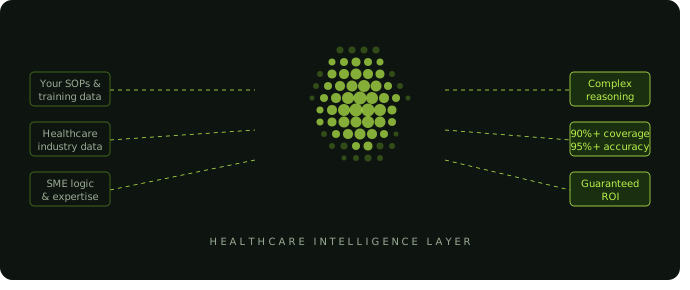
Magical's intelligence layer is different in kind, not just degree. It's built on a foundation of healthcare process knowledge — not just industry data, but the accumulated logic of how healthcare operations actually work: the SOPs, the payer ecosystems, the edge cases, the subject matter expertise that lives in the heads of your best people. That knowledge is baked into every agent, shared across workflows, and continuously refined as the system learns from each implementation.
The result is agents that don't just execute steps — they reason. They understand context. They can handle the multi-step, decision-heavy workflows that separate real automation from fancy button-clicking. Think intake through follow-up, fully automated, with the kind of judgment that used to require a trained human in the loop.
That's not incremental improvement. That's a different category of tool.
2. It deploys in 8 weeks — and your team can even run it themselves
One of the most reliable ways to kill an automation initiative is a 12-month implementation timeline. By the time the platform is live, the business has changed, the champions have moved on, and the ROI case is a distant memory.
Magical was engineered for speed — not just in execution, but in deployment. The platform's conversational automation agent lets your operations team build, test, and launch workflows using plain language. No code. No engineering sprints. No waiting on IT to open a ticket. You describe what you need, and the system builds it. You need to change it? You ask. It updates.
This isn't just about convenience. It's about organizational agility. When your teams can create and modify automations themselves, they do it. Constantly. They find new workflows to automate. They iterate on the ones that are running. The platform becomes a living system that grows with your operations — not a static deployment that ossifies six months after go-live.
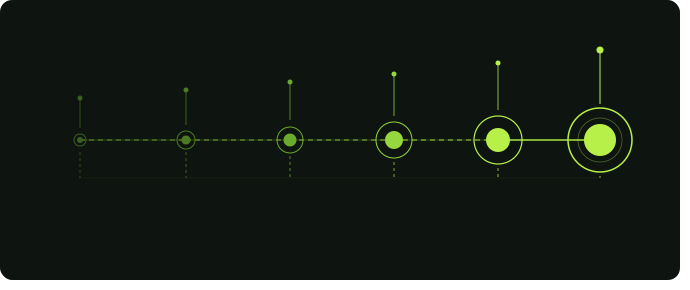
Eight weeks to first deployment. Faster ROI tipping point. And a self-serve model that scales without scaling your implementation costs.

3. It's reliable enough to trust with production operations
Accuracy claims are easy. Reliability in production is hard. The gap between "it works in demos" and "it works at 2am on a Tuesday when volume spikes" is where most automation platforms quietly fail.
Magical's reliability architecture is built for the latter. Every agent action is continuously monitored with sub-second feedback loops. Outputs are verified against ground truth before they ship. When the system detects drift — before it becomes an error — it corrects. When it encounters something it can't self-resolve, it routes to your team immediately. No silent failures. No mystery backlogs discovered days later.
The numbers back this up: 99.9% of actions verified, reaction times under 200 milliseconds, 24/7 coverage. Fully transparent audit logs. Enterprise-grade uptime and security controls.
For healthcare operations — where errors aren't just inefficiencies, they're compliance risks and patient care issues — this isn't a nice-to-have. It's the whole ballgame. Automation you can't trust with production workloads isn't automation. It's a pilot that never scales.
4. A model purpose-built for healthcare speed and scale
Here's a technical reality that rarely makes it into vendor pitch decks: running AI at production scale is expensive and slow. Generic large language models are powerful, but they're built for breadth, not for the specific action decisions that healthcare workflows require. Using them for every task is like using a freight train to run a courier route — technically possible, economically insane.
Magical's proprietary model was built to solve this. A 4-billion parameter model fine-tuned specifically on healthcare workflow data, it routes tasks intelligently — matching the right model to the right job based on speed, cost, and accuracy requirements. The result is 90%+ faster inference and 2–3x lower latency compared to relying on general-purpose frontier models for everything.
This matters enormously at scale. The cost and latency barriers that make healthcare AI impractical in high-volume, production environments are the exact barriers this model was designed to remove. It's what makes the economics of true end-to-end automation work — not just for one workflow in a pilot, but across your entire operation.
5. It works inside your existing systems — no rip-and-replace required
The integration question kills more automation deals than any other objection. Healthcare organizations run on legacy EHRs, a patchwork of payer portals, and internal systems that were never designed to talk to each other. Most automation vendors solve this by building a custom integration layer — which means API dependencies, IT involvement, long timelines, and a fragile architecture that breaks every time a system updates.
Magical takes a different approach. Its agents operate directly within your existing systems — EHRs, payer portals, internal tools — without requiring APIs or custom integrations. They work the way a human would: navigating the interfaces that already exist, pulling and pushing information through the same screens your team uses today.
The practical implication is significant. Deployment is faster because there's no integration layer to build. New workflows can be automated without going back to IT. And when a payer portal changes its UI, you don't have a broken API to fix — you have an agent that adapts.
This is what "total interoperability" actually means in practice. Not a long list of pre-built connectors. A platform that works wherever your work happens.
The future is agentic
The promise of AI in healthcare isn't smarter chatbots or fancier dashboards. It's the ability to run complex, high-stakes operations at scale — with the accuracy, reliability, and speed that healthcare demands — while freeing your people to focus on the work that actually requires them.
That's a hard problem. Most platforms aren't built to solve it. Magical is.
For healthcare executives who've been burned by automation initiatives that promised transformation and delivered incremental efficiency gains, the bar is simple: show me guaranteed ROI, show me reliable production performance, and show me a deployment timeline that doesn't outlast my patience.
Magical clears that bar. That's why it's the automation partner that healthcare operations teams are actually choosing in 2026.