
Behind every prescription filled for an inmate in the Indiana county jail system sits a question that has to be answered correctly, every single time: does this patient have insurance coverage the state or county can bill instead of the taxpayer footing the bill directly?
Quality Correctional Care (QCC) provides medical, dental, mental health, and pharmacy services to county jails across Indiana through its pharmacy division, QualityRx. Because jail populations often retain active Medicaid or other insurance coverage even while incarcerated, checking eligibility on every single patient before a prescription goes out is not optional. It is the difference between a manageable pharmacy budget and one that balloons unnecessarily.
For a pharmacy operation processing thousands of prescriptions a month, that eligibility check has to happen reliably and at volume, or the savings disappear.
A manual process that couldn’t keep pace with growth
Before automation, QCC staff checked eligibility by hand: logging into a state insurance portal, entering each patient's name and date of birth one at a time, and manually recording results back into a spreadsheet. When a name did not return a clean match, staff had to pull the patient's Social Security number from QCC's electronic medical record system and search again.
"It honestly just feels like the most never-ending task, when you're working your way down a spreadsheet, one line, by one line, by one," said Whitney Bruner, Financial Operations Specialist at QCC.
As QRX's prescription volume grew toward roughly 10,000 medications a month, QCC brought in a robotic process automation (RPA) vendor to handle the name-and-date-of-birth lookups. That tool worked, but it had a gap: whenever a search did not return a clear result, the fallback SSN lookup still had to be done by hand, one patient at a time.
"Every time a batch ran, there were always going to be a few it couldn't find,” said Bruner. “I'd copy and paste every patient's Social Security number so I could manually go back to the portal and search all of those myself, just to make sure we were covering our bases."
Then: an email popped up in Whitney’s inbox. QCC's automation vendor announced it was shutting down, giving the team at QCC only a few weeks to find a replacement. With no in-house staff freed up to absorb the workload manually, and volume that had only grown since the process was first automated, the clock was ticking. QCC needed a replacement that could be live before the shutoff date, without dropping any of the reliability the pharmacy depended on.
A more complete automation, live in just four weeks
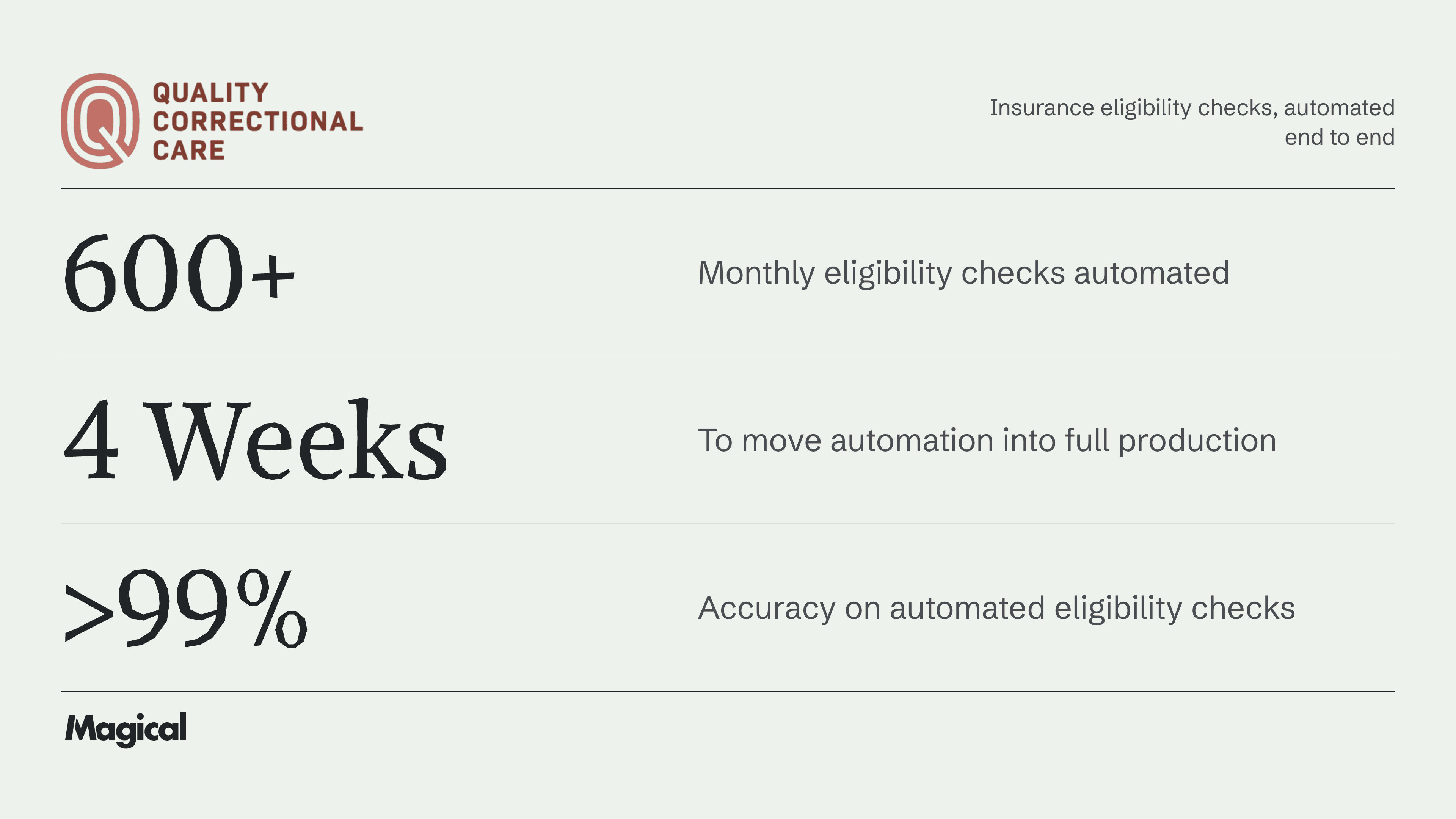
QCC brought in Magical to build a drop-in replacement, with one key upgrade: an agent that could complete the full workflow end to end, including the SSN fallback that had previously required manual work.
The build itself stayed simple by design. QCC's team populates a spreadsheet with four fields per patient: facility, last name, first name, and date of birth. Magical's agent logs into the state Medicaid eligibility portal, checks each patient by name and date of birth, and for any patient without a clear match, retrieves the Social Security number from QCC's EMR and re-checks automatically (no manual handoff required). Results, including the insurer name, member ID, and a status note for every patient, are written back to an output sheet, with an email notification when a run completes.
From first meeting to a fully independent, self-service workflow took about a month, in line with the deadline QCC was working against.
"It was the fastest transition," Bruner said. "I showed them what I do, this is where the information goes, this is where I want it, here's A, B, and C... and then it was ready. Everything I was doing manually myself before, that whole second step of the process, is totally done by Magical's process now."
Reliability that doesn’t need any double-checking
Since going live, QCC has run the automation against its full patient volume without a single incomplete run or error. Spot checks during the initial rollout confirmed the outputs matched what manual verification found, and QCC has not needed to double-check results since.
"I trust the results five thousand percent. I don't need to do any double-checking at all," Bruner said. "The biggest selling point of having a program like this is reliability, consistency, and accuracy. I trust a program like this way more than someone that we've just hired."
That confidence extends to the added SSN fallback step, which saves the team meaningful time every week compared to the manual follow-up the previous automation still required, on top of removing a source of errors from incomplete checks slipping through.
Built to grow with QCC
For a pharmacy operation serving close to 70 county jails and growing, having an automation partner that can pick up new steps as the business scales, without hiring a person for every new task, has become part of how QCC plans to grow.
"It's just this unicorn that came out of nowhere," Bruner said. "I'm thoroughly impressed, and I would sing your praises... the team was so professional and thorough. Those are really important, awesome qualities that I've found in Magical."
To learn more about how Magical's agentic AI automates revenue cycle workflows like insurance eligibility checks and prior authorizations, book a demo today.