
If you've been using Thoughtful AI for revenue cycle management (or evaluating it) you already know the pitch: intelligent agents that automate eligibility, prior auth, claims, payment posting, and denials. It's a compelling vision. And in many ways, Thoughtful delivered real operational value.
But as the healthcare automation landscape has matured, the differences between legacy automation platforms and truly agentic AI have become harder to ignore. Here's an honest breakdown of where Thoughtful and Magical overlap, and the seven areas where Magical is meaningfully ahead.
Where They're the Same
Before the differentiators, credit where it's due. Both platforms share a common foundation:
Both target the same RCM workflows. Eligibility verification, prior authorization, claims scrubbing, payment posting, and denials management… these are the core use cases both platforms were built to address. If you're automating a prior auth workflow today with Thoughtful, Magical covers the same ground with its dedicated Prior Authorization, Benefits Verification, Denials Actioning, and Payment Posting agents.
Both connect to payer portals and EHR/PMS systems. Whether through RPA, APIs, or clearinghouses, both platforms operate across the complex web of payer portals and practice management systems that define modern RCM.
Both preserve human-in-the-loop checkpoints. Neither platform advocates for fully lights-out automation. Both build in human review and escalation paths for edge cases, exceptions, and high-stakes decisions.
Both serve provider organizations across specialties. Multi-specialty practices, DME providers, behavioral health, physical therapy, ambulatory care… both platforms have worked across the breadth of the provider landscape.
But beyond these similarities, there are a number of key differences between the two platforms.
Deployment time
First agent live from scoping
True agentic architecture
Multi-agent orchestration, not RPA scripts
AI judges for output verification
99.9%+ actions verified in <200ms
Self-healing workflows
Auto-recovers from errors without re-engineering
Native real-time reporting
Built-in vs. custom per customer
Proprietary healthcare model
4B param model trained on real workflows
Standardized deployments
Repeatable process across customers
Revenue cycle automation
Eligibility, prior auth, claims, denials, payment posting
Coverage beyond RCM
Clinical ops, pharmacy, supply chain, call center
Human-in-the-loop escalation
Routes uncertainty to humans - no silent failures
Connected app graph
100,000+ apps across desktop, web, APIs, voice
7 Ways Magical Is Built Differently
If you've been considering a rapid transition from Thoughtful to Magical, or are just interested in seeing a breakdown of how the two platforms compare, you've come to the right place. Here are the biggest differences you should be aware of if you're considering the switch.
1. True Agentic Architecture vs. Dressed-Up RPA
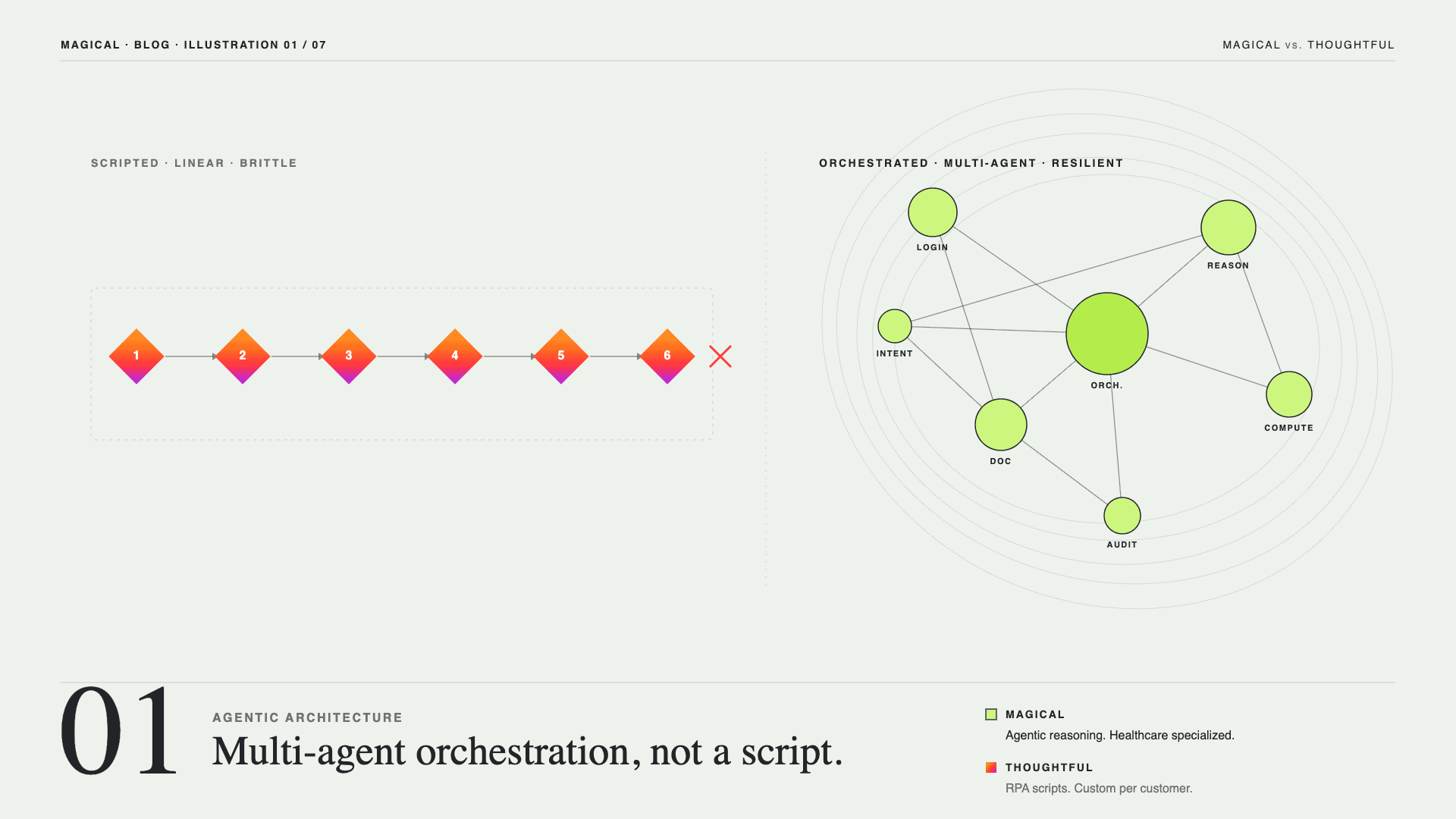
This is the most important distinction. Thoughtful's own team has acknowledged openly that "very little of this was done in a fully agentic fashion" — most workflows were RPA scripts executed in ephemeral instances, with business rules built custom per customer. The agent names (EVA, PAULA, CAM, PHIL, DAN) represented problem spaces, not standardized software.
Magical was architected from the ground up as a multi-agent framework. Specialized agents, such as a Login Agent, Doc Processing Agent, Computing Agent, Reasoning Agent, and others, collaborate within a single orchestration layer. No single agent tries to do everything and fails. This is the architectural difference between a workflow that looks like AI and one that is AI.
2. AI Judges That Guarantee Reliability vs. Hope
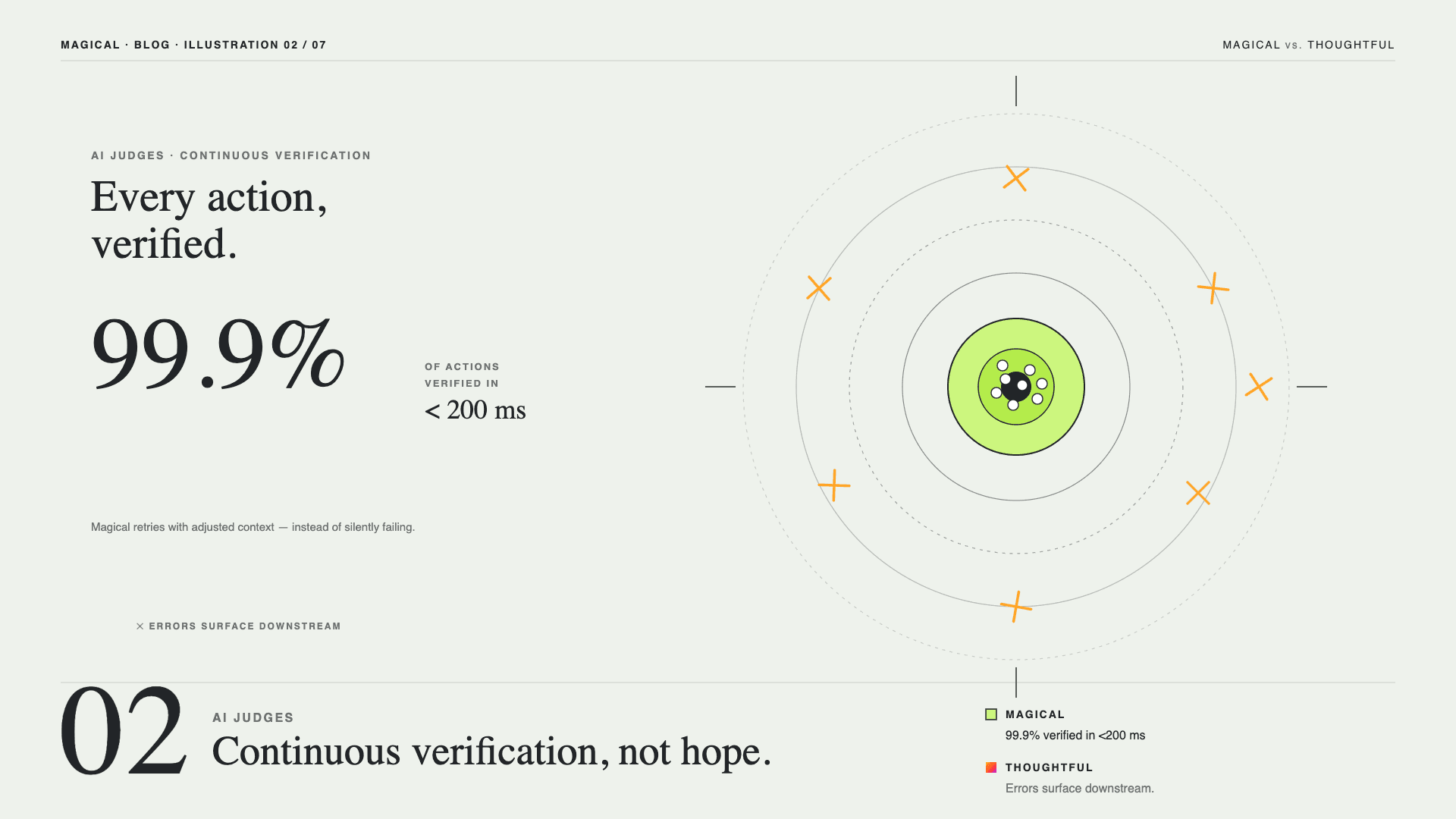
Thoughtful had no native mechanism for verifying agent output quality in real time. If an agent made an error, it surfaced as a downstream as a misposted payment, a denied claim, or a frustrated customer.
Magical's AI Judges layer provides continuous monitoring with sub-200ms reaction time, verifying 99.9%+ of actions as they happen. When something goes wrong, the system self-heals (retrying with adjusted context) rather than silently failing. This is what enables Magical to publish a 90%+ accuracy commitment rather than negotiating what "correct" means after the fact.
3. Self-Healing Workflows vs. Constant Maintenance
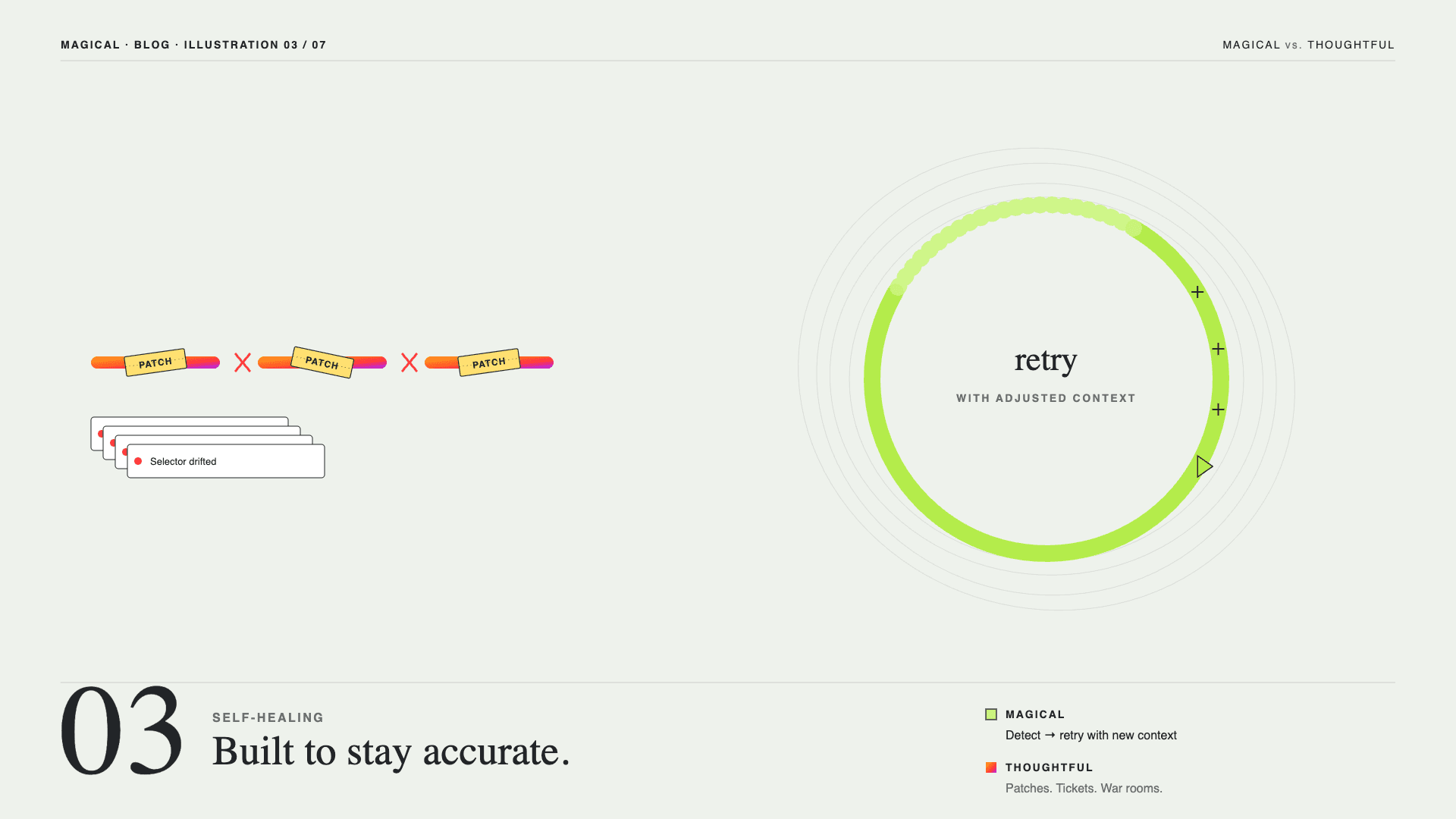
One of Thoughtful's most persistent challenges was the ongoing maintenance burden. Payer portals change. EHR screens update. Edge cases proliferate. Each change required engineering involvement to patch scripts.
Magical's self-healing architecture is designed to adapt automatically. Agents detect transient errors, retry with updated context, and escalate to human review only when necessary. Combined with daily automated testing and an LLM evaluation platform that continuously monitors for drift, Magical is built to stay accurate without requiring constant re-engineering.
4. Weeks to Deploy, Not Months
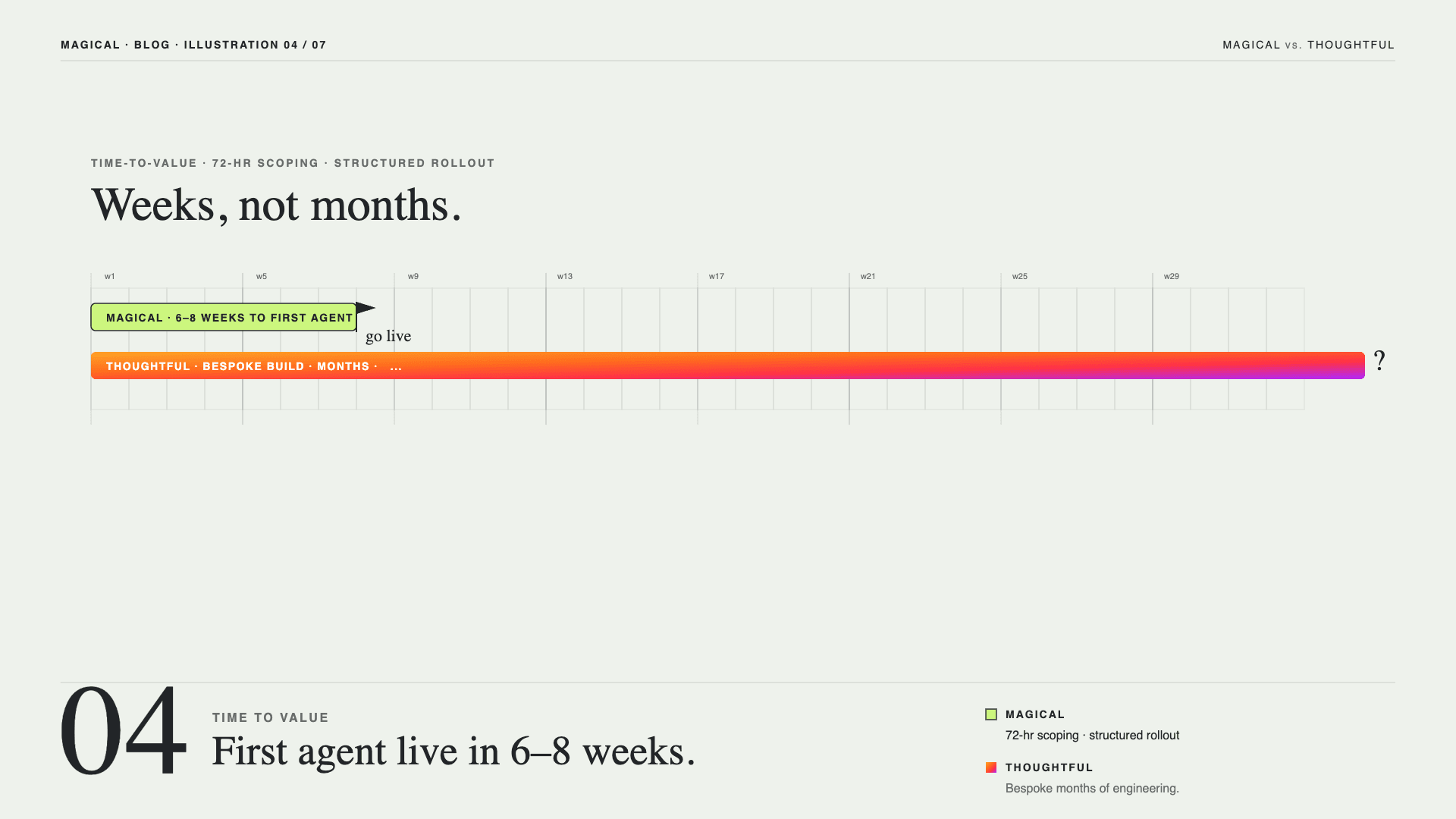
Thoughtful's bespoke deployment model was its biggest scaling constraint. Implementations stretched across months, required deep engineering involvement, and generated what their own team called "war stories." Every new customer was, in many ways, a ground-up build.
Magical deploys a first agent in 6-8 weeks from access. The platform ingests SOPs in natural language, disseminates tasks to specialized agents automatically, and has a structured 72-hour scoping process that gets to a deployment plan without open-ended discovery.
5. A Proprietary Model Built for Healthcare vs. General-Purpose LLMs
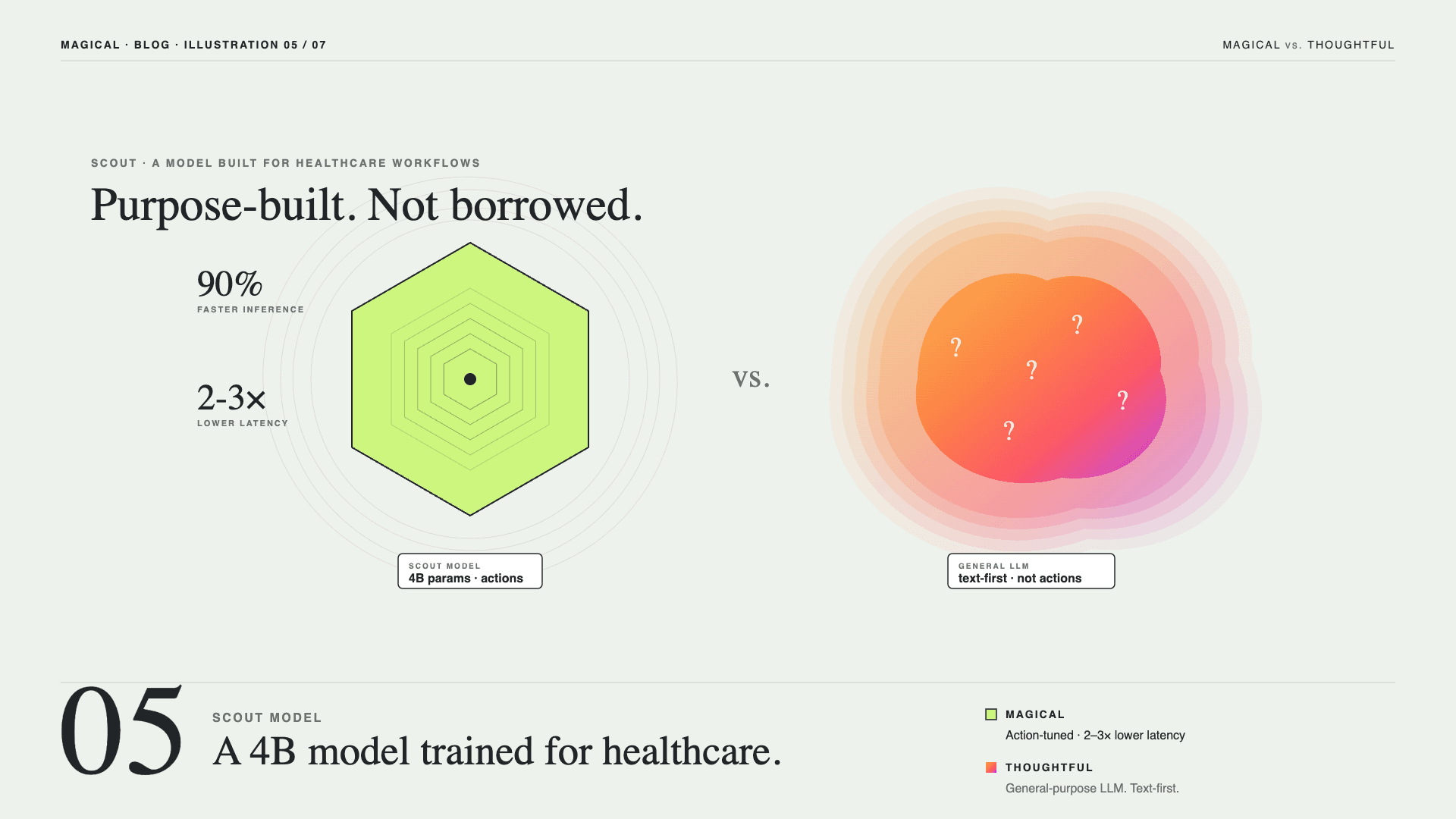
Thoughtful used LLMs selectively (primarily for answering payer clinical questions in prior auth workflows and for some coding logic) but the underlying models were general-purpose.
Magical's Scout model is a proprietary 4B parameter model trained specifically on healthcare workflows and real platform data. It's fine-tuned for action decisions, not text generation, which is why it achieves 90%+ faster inference and 2–3x lower latency than general-purpose alternatives. The model also handles opinionated routing — automatically picking the right model for each subtask based on speed, cost, and accuracy requirements.
The end result is a platform that is faster, more reliable, and more cost effective to scale.
6. Breadth Beyond RCM vs. RCM-Only
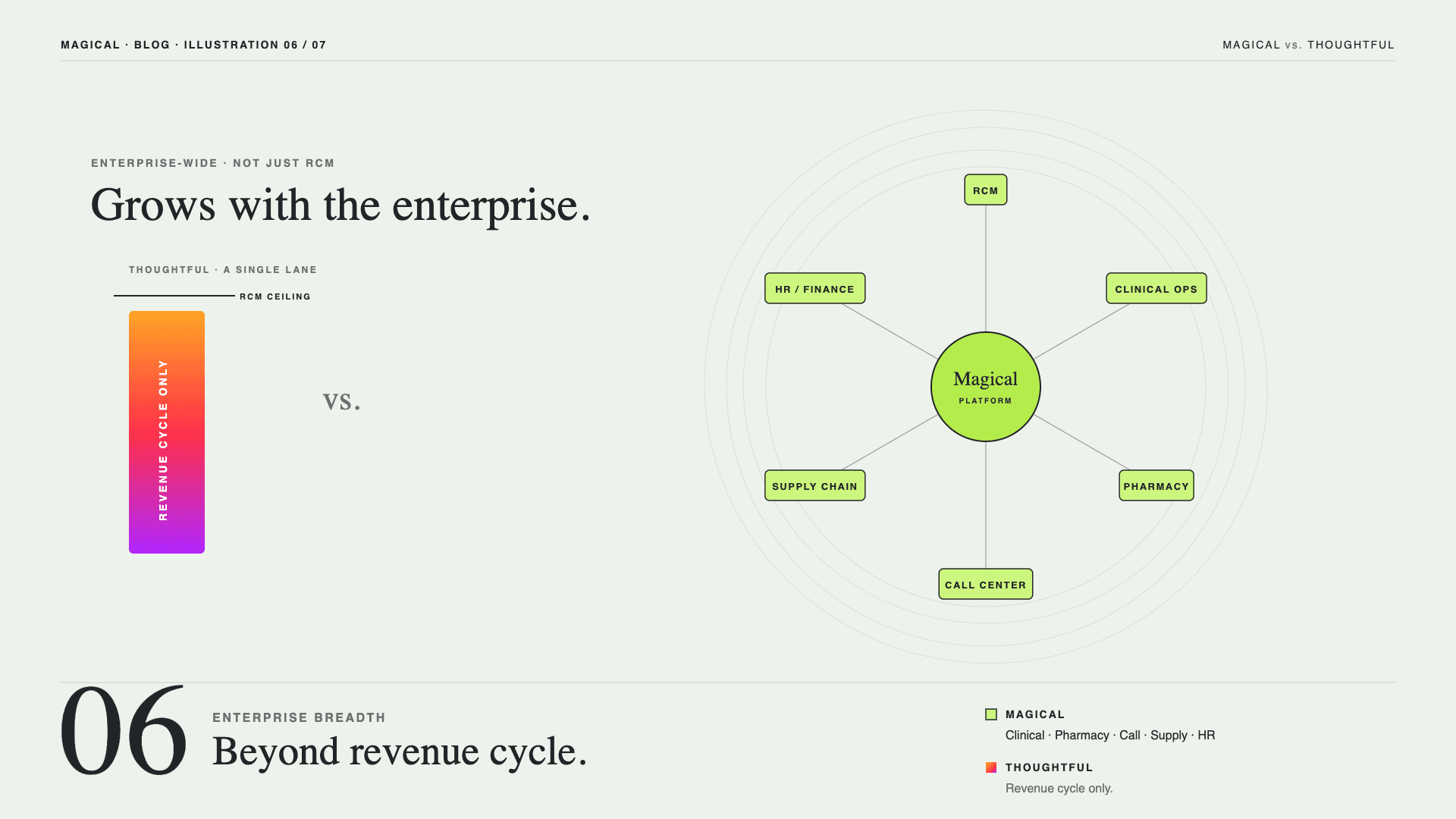
Thoughtful was purpose-built for revenue cycle. That focus was a strength… but also a ceiling.
Magical covers the full healthcare enterprise: clinical ops, pharmacy, call center , supply chain, and even HR/finance — in addition to the full RCM stack. For organizations looking to consolidate automation vendors, or for private equity groups managing multi-entity health systems, Magical is the platform that grows with the enterprise rather than hitting a wall at the RCM boundary.
7. Real-Time Reporting Built In vs. Custom QuickSight Dashboards
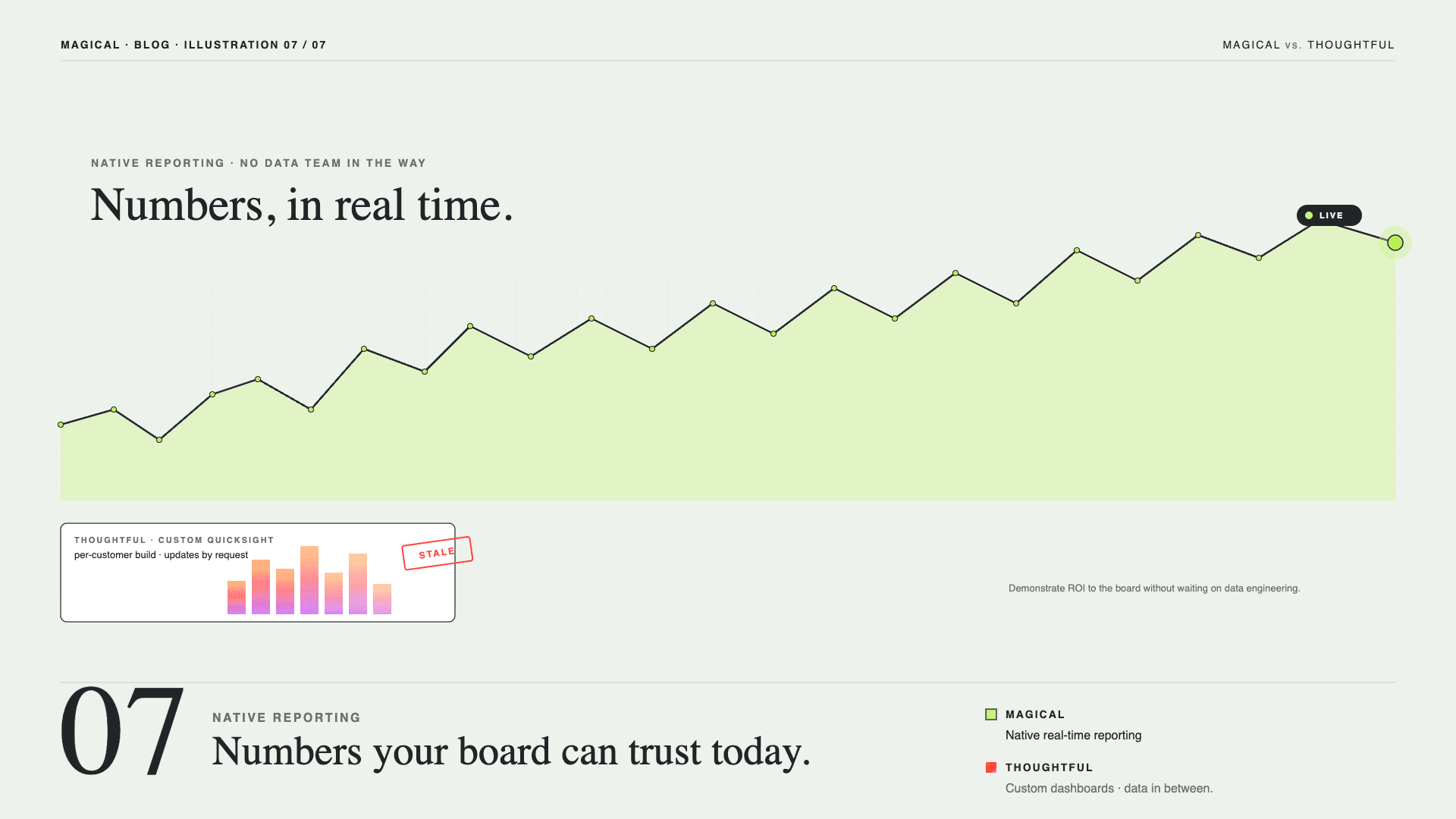
Thoughtful built custom dashboards per customer… a meaningful capability, but one that required data pipeline engineering for each deployment, generated definition conflicts with customers over what "processed correctly" meant, and was never standardized across the portfolio.
Magical's real-time reporting is a native platform capability, not a post-hoc data engineering project. This matters enormously when healthcare operators need to demonstrate ROI to boards, justify headcount reductions, or track automation rates against contract commitments, without a data team standing between them and the numbers.
Maigcal is Not a Replacement, But a Step-Change
Thoughtful AI built something real. For the customers who used it well, it delivered genuine automation value in eligibility verification, prior auth, and payment posting. The team understood RCM deeply, and the operational grounding showed.
But the architecture had ceilings: customization that couldn't scale, RPA that couldn't self-heal, deployments that took months, and AI that augmented workflows without truly orchestrating them.
Magical is what the next generation looks like. It's not more of the same wrapped in a better pitch; it's a different architectural bet on what reliable, scalable, truly agentic healthcare automation should be.
For any organization evaluating a migration or a new deployment, the question isn't whether Magical covers your workflows. It's how fast you want to get there.